

Protecting wealth in Miranda involves more than choosing cautious investments. You may want to safeguard what you’ve built while still supporting future income and long-term goals. The most useful wealth preservation strategies Miranda residents consider are shaped around their circumstances, not a single defensive move.
There are several pressures to weigh. The Australian Bureau of Statistics reported annual inflation of 4.0% in the 12 months to August 2026. Investment risk and the possibility of a longer retirement can also affect how far your resources need to stretch. Superannuation, tax, investments and estate intentions may each play a part, but they work best when considered together.
This guide offers a practical framework for identifying financial priorities and weighing options. It explains how scenario modelling can bring trade-offs into focus, and how superannuation, portfolio construction, tax strategy, Centrelink structuring and estate planning can fit within a coordinated plan. You’ll finish with clearer next steps towards a strategy aligned with your goals.
Key Takeaways
- See wealth preservation as a coordinated process that protects financial resilience while keeping future choices open.
- Use long-term projections to understand how decisions across your finances may interact and where trade-offs could arise.
- Compare growth, income and access needs before deciding how to balance cash and investments.
- Review your goals, time horizons, income needs and responsibilities to clarify your priorities.
- Explore how tailored wealth preservation strategies Miranda advice can turn your priorities into a plan, supported by scenario modelling and clear explanations.
Why wealth preservation strategies matter for Miranda residents
Protect what you’ve built while keeping future options open. That balance is central to wealth preservation for households in Miranda, Sydney. The aim isn’t simply to avoid loss, but to coordinate financial decisions so they support resilience and personal goals over time. A broad overview of Wealth Management can help place preservation within the wider picture of managing financial resources.
Preservation doesn’t mean avoiding every investment risk. Holding everything in cash may feel reassuring, but growth, access and changes in purchasing power also matter. The right balance depends on your circumstances, the role each asset plays and when you expect to use it. A strategy for someone approaching retirement may differ from one for a household with a longer investment horizon.
Life stage is only part of the picture. Household responsibilities, income needs, retirement plans and the timing of major expenses can all shift priorities. A tailored approach considers how these factors interact instead of treating investments, superannuation and estate intentions as separate decisions. This is the central idea behind this wealth preservation strategies guide, which explores planning principles without assuming every household needs the same mix.
What does wealth preservation mean in practice?
Three considerations make the idea practical: preserving purchasing power over time, managing potential investment downside, and keeping suitable access to funds for planned or unexpected needs. These aims can pull in different directions, so there’s no universal allocation or shortcut. The appropriate balance depends on your goals, circumstances and time horizon.
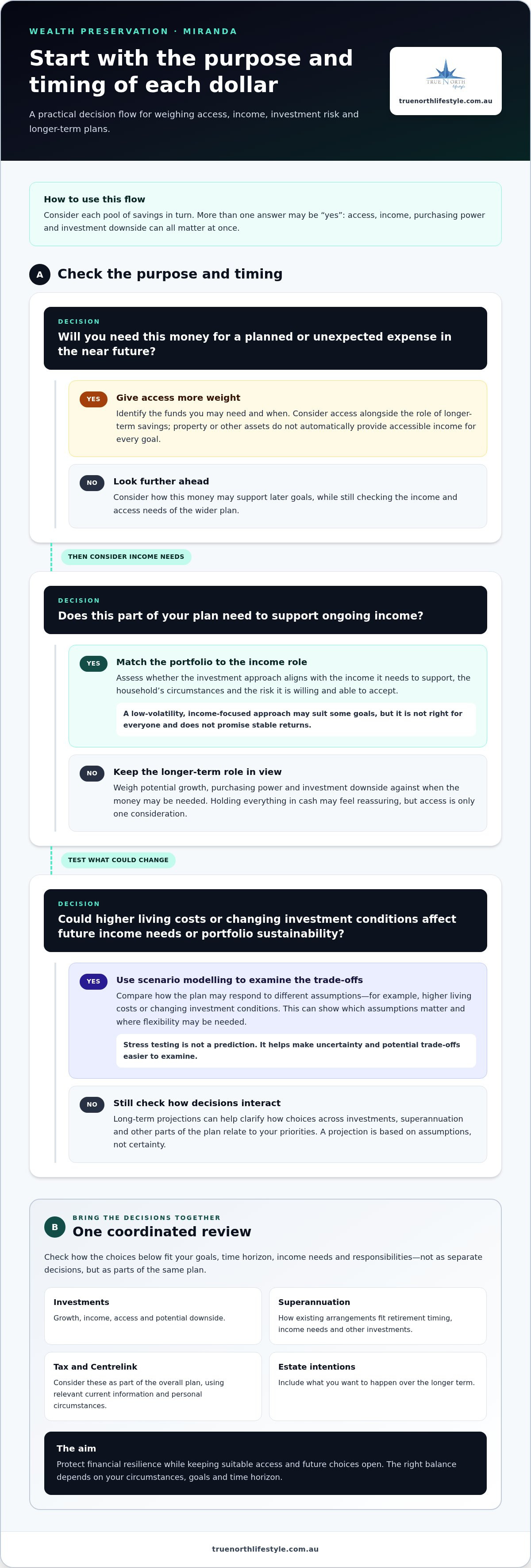
For example, someone saving for a planned expense in the near future may put greater emphasis on access, while considering how longer-term savings could support later goals. This isn’t a recommendation about where to invest. It shows why the purpose and timing of each part of a financial plan matter.
Why local context matters for Miranda households
Miranda and the Sutherland Shire are home to households with varied responsibilities, plans and financial arrangements. One household’s position might include a home, superannuation and investment assets; another may have a different combination. Property can be a substantial part of a household’s wealth, but it doesn’t automatically provide accessible income for every goal.
Looking at assets together can reveal questions that aren’t obvious when each is considered alone: how much is readily accessible, what income may be needed, and how superannuation and investments relate to future plans. For Miranda households, wealth preservation strategies should reflect individual circumstances, not unsupported assumptions about local property values or a typical household.
A useful starting point is to identify what you want your financial resources to support, when you may need them and which responsibilities could affect your choices. A coordinated review can then help clarify where resilience, access and future flexibility deserve attention.
How a Miranda wealth preservation strategy brings financial decisions together
A preservation plan works as a system. Investment choices affect the income available to support your plans. Superannuation, tax strategy and Centrelink considerations may influence how resources are organised, while estate intentions shape what you want to happen over the longer term. Treating each area separately can hide important trade-offs. A coordinated review connects these decisions to your priorities and makes the assumptions easier to examine.
Long-term projections can bring that picture into focus. They model how a plan may respond under different assumptions, rather than presenting one forecast as certain. For example, a comparison might test how higher living costs could affect future income needs, or how changing investment conditions could affect portfolio sustainability. Stress testing isn’t a prediction. It helps show which assumptions matter and where a plan may need flexibility.
For wealth preservation strategies Miranda households consider, scenario modelling can make competing priorities more visible: access to funds, income over time, investment risk and longer-term intentions. The aim isn’t to remove uncertainty, but to understand how choices may interact before deciding what fits.
Portfolio, income and risk management
Risk management and portfolio sustainability modelling help assess whether an investment approach aligns with the income it needs to support and the risks a household is willing and able to accept. A low-volatility, income-focused approach may suit some goals, but it isn’t automatically right for every investor or a promise of stable returns. The balance depends on personal circumstances and the role of each asset.
For a closer look at investment construction, explore this bespoke investment advice guide. Portfolio decisions are one part of building a plan around individual needs.
Superannuation, tax strategy and longer-term intentions
A superannuation review can consider how existing arrangements fit with retirement timing, income needs and other investments. Tax-minimisation strategies can also form part of the overall plan, with recommendations shaped by personal circumstances and the Australian rules that apply at the time. Tax and superannuation settings can change, so planning assumptions need to reflect current information.
Centrelink structuring is another consideration, as eligibility and entitlements depend on individual circumstances and applicable rules. Estate planning strategy considers how financial intentions fit with plans for the future. Financial advice is distinct from legal document drafting.
A preservation plan should be reviewed as life changes, because yesterday’s assumptions may no longer fit tomorrow’s priorities. A tailored review can test whether the pieces still work together. Explore tailored financial advice and planning to see how this process can apply to your circumstances.
Comparing wealth preservation choices: growth, income and access
Protecting wealth doesn’t automatically mean holding everything in cash. Cash can support near-term access, but a plan focused only on immediate stability may not address longer-term goals or changes in purchasing power. Growth-oriented investments and income-focused approaches may also play a role, each with different risks and purposes. The useful question isn’t which choice is universally safest, but how each fits your needs.
The best balance depends on your goals, timeframe and capacity for risk. Use the comparison below to clarify what each approach might contribute and what to consider when weighing options.
| Choice | Purpose | Potential trade-offs and access | Planning question |
|---|---|---|---|
| Income-focused approach | Support a need for income from investments. | Income needs and investment risks must be considered together; income isn’t guaranteed. | How does this fit with other sources of income and future needs? |
| Growth-oriented investments | Form part of a strategy for longer-term objectives. | Values can fluctuate, and the timeframe may affect whether those movements are manageable. | Could you stay with the approach through periods of market change? |
| Liquid funds | Keep resources accessible for planned or unexpected needs. | Ease of access matters, but keeping more aside may affect how the rest of the portfolio is positioned. | What funds might you need, and when? |
These categories can overlap within a bespoke portfolio. They aren’t competing products to select in isolation, but different roles to consider alongside your income needs, time horizon and wider financial position. Use the table as a starting point for discussion, not as a recommendation or forecast of performance.
Income-focused strategies versus growth-oriented investments
An income-focused approach may be designed around cash flow needs, while growth-oriented investments may support objectives with a longer timeframe. Neither role is inherently safer or right for everyone. Focusing more on current income can involve trade-offs for longer-term aims, while growth exposure brings investment risk that needs to be understood in context. A tailored portfolio considers how these roles might work together.
Liquidity, superannuation and property exposure
Access depends partly on where assets are held and the purpose they serve. Superannuation and direct property are part of some households’ financial picture, but they aren’t interchangeable with readily accessible funds. Property may take time to sell or otherwise access, while superannuation is subject to applicable access rules. Their place in a plan depends on personal circumstances, not assumptions. For households managing cross-border assets or requiring specialist UK property financing and debt structuring, Lee Tonks: Mortgage Guru provides independent mortgage and protection advice to help align property commitments with overall financial goals.
For households considering wealth preservation strategies in Miranda, a practical comparison starts by listing each asset’s purpose, when funds may be needed and what risks could affect the plan. This helps frame an informed discussion about balancing income, growth and access without assuming one allocation suits every household.
A practical wealth preservation review for Miranda and the Sutherland Shire
A useful review begins with your priorities, not a preset investment mix. This sequence can help households in Miranda and the Sutherland Shire organise questions before getting tailored advice. Keep private financial records secure, and use this as a preparation guide rather than sharing sensitive details publicly.
- Set out your goals and time horizons. Note what you want your finances to support, when you may need funds and which goals matter most. Different objectives can have different timeframes.
- Describe income needs and responsibilities. Consider current and expected income needs, people who rely on you, and commitments that could influence your financial choices.
- Map your financial position. Make a private overview of assets and liabilities, including superannuation, investments and property where relevant. Note how each asset is held and whether access may be limited.
- Record future intentions and transitions. Include retirement plans, a possible change in work or household circumstances, significant planned expenses and estate intentions you want considered.
- Write down the questions that remain. Identify concerns about investment risk, access to funds, tax considerations, superannuation and family intentions. These questions can help shape a focused review.
Gather the information that shapes the review
Bring together a current overview of income, assets, liabilities and superannuation, using information you can access and understand. You don’t need to resolve every detail before starting. Noting what’s uncertain can be useful too. Record changes that may affect your plans, such as a retirement transition, a new responsibility or a shift in priorities. Keep account details and other sensitive information private.
Use scenarios to test the plan’s resilience
Comparing scenarios can show how different assumptions affect the choices available. For example, consider whether higher living costs could change the income you need, or how a change in circumstances might affect your access to funds. These are questions to test, not predictions. Revisiting assumptions when your goals or circumstances change can help keep the plan relevant.
For retirement-specific questions, the Sydney retirement planning guide offers a related perspective on planning for financial longevity. Preparing this overview can also make it easier to discuss how wealth preservation strategies Miranda residents consider might relate to individual goals, responsibilities and timeframes.
To turn your review into a tailored plan, explore tailored wealth preservation advice and long-term projections designed around your circumstances.
Tailored wealth preservation advice for Miranda: what working with True North Lifestyle involves
Once you’ve clarified your goals and the trade-offs you’re weighing, tailored advice can help turn that thinking into a coordinated plan. For people considering wealth preservation strategies in Miranda, the process starts with their circumstances, priorities and financial position, not a standard formula. The aim is to make the choices, assumptions and possible implications easier to understand.
True North Lifestyle brings relevant parts of your finances into one review. Its pre-retirement and retirement strategies include retirement modelling and long-term projections, superannuation review and optimisation, bespoke portfolio construction, tax-minimisation strategies, Centrelink structuring, wealth preservation, estate planning strategy and risk management. Each area has a different role, but decisions in one can affect the wider plan. Recommendations are explained clearly so you can understand how they relate to your objectives and the trade-offs involved.
What a tailored planning process can bring into focus
Retirement modelling and long-term projections connect future income needs with today’s planning decisions. Scenario modelling lets you compare how different assumptions or circumstances could affect your plan, helping identify pressure points and questions to explore. It doesn’t predict outcomes or remove uncertainty; it provides a structured way to consider possibilities and make informed choices.
Depending on your needs, the review can consider superannuation optimisation, tax-minimisation strategies and estate planning strategy alongside portfolio construction and risk management. This helps clarify how each recommendation supports your wider intentions, rather than leaving you to interpret separate decisions in isolation.
Plans can evolve as goals and circumstances change. Ongoing support and plan reviews provide an opportunity to revisit assumptions and assess whether recommendations remain aligned with your priorities. If you’ve started mapping your goals and questions, a structured review can help bring the next decisions into focus. Explore tailored wealth preservation advice as your next step.
A local conversation focused on clarity and confidence
True North Lifestyle supports Australians, including professionals, families, business owners and retirees, with advice shaped around their individual circumstances. For a Miranda household, that means focusing on the goals, responsibilities and financial arrangements that matter to them, not assumptions about what a local client should need.
The team includes 13+ team members, including 4 Certified Financial Planners. Portfolio construction uses an in-house Investment Committee and Resonant Asset Management. These are parts of the investment process, not promises of a particular return or outcome. True North Lifestyle has $220 M+ funds under management, excluding direct property assets. This measure of scale should be considered separately from whether a particular strategy is right for you.
Clear explanations matter as much as the modelling. You should be able to see what a recommendation is intended to do, which assumptions inform it and how it fits with the rest of your plan. That understanding can help you take a more confident role in decisions about protecting your financial position and supporting future income.
Take the next step towards a plan that fits
Your next step doesn’t need to be a major financial decision. Start by choosing one priority you’d like greater clarity on, such as future income, access to funds or how your plans may change over time. This gives a tailored discussion a practical focus and connects the questions that matter to your circumstances.
For wealth preservation strategies Miranda residents can consider, the value lies in building a plan around personal goals, then reviewing it as those goals evolve. True North Lifestyle has supported 1,000+ Australians, including 400+ long-term clients. That experience informs a thoughtful planning process, while recommendations remain specific to each person’s situation.
Ready to explore your options? Book your consultation with True North Lifestyle. Begin with the questions you’ve already identified and work towards a clearer view of the choices ahead. A considered next step can make the path feel more manageable and help you move forward with confidence.
Frequently Asked Questions
Is wealth preservation only for people who are already retired?
No. Wealth preservation can be relevant while you’re building assets, approaching retirement or managing an inheritance. Someone receiving an inheritance, for example, may need to consider how it fits with existing commitments and future plans, while a person still working may prioritise flexibility. The questions change at each life stage. A tailored plan focuses on your circumstances and what you want your finances to support, not your age alone.
Can a wealth preservation strategy still include growth investments?
Yes. A wealth preservation strategy can include growth-oriented investments, depending on your goals, timeframe, income needs and capacity for investment risk. Someone with a longer-term objective may weigh growth exposure differently from someone who expects to draw on investments soon. Rather than assume a standard allocation, compare how different choices could affect your plans under varying conditions. Scenario modelling can help make those trade-offs easier to discuss.
How can inflation affect wealth over the long term?
Inflation can reduce the purchasing power of money, so the same amount may cover less in future than it does now. If household expenses rise, for instance, a retirement income plan may need to account for higher spending over time. The impact varies with income, expenses, assets and timeframe. Comparing more than one inflation assumption can help test a plan; use current data from authoritative sources for any specific rate.
What should I prepare before speaking with a financial adviser in Miranda?
Prepare a short outline of your goals, expected income needs, assets, liabilities and superannuation, along with questions you want to discuss. You might note an upcoming retirement decision, a change in work or a family responsibility that could affect your plans. You don’t need to resolve everything beforehand. For a conversation about wealth preservation strategies in Miranda, keep account numbers and identifying financial documents private unless you’re using an appropriate secure channel.
How often should a wealth preservation plan be reviewed?
There’s no single review timetable that suits everyone. A change in income, family circumstances, work, health or financial goals may mean earlier assumptions need another look. A change to a planned retirement date, for example, could affect the timing of income needs and other decisions. Ongoing plan reviews can help assess whether recommendations still fit. After a material change, consider its effect on your circumstances before relying on an old projection.
Does wealth preservation include estate planning?
It can. Estate planning strategy may form part of broader financial planning by considering how your intentions relate to your financial arrangements and family circumstances. A change in family relationships or the arrival of a new beneficiary, for example, could prompt you to revisit those intentions. Financial advice is distinct from preparing legal documents. Specific legal or tax implications depend on your situation and should be assessed against current Australian requirements.
Can Centrelink entitlements be considered in a wealth preservation plan?
Yes. Centrelink structuring and potential entitlements may be relevant to some people’s financial plans, particularly when considering retirement and income arrangements. Eligibility depends on individual circumstances and current rules, so another person’s experience or a general example won’t establish what you may receive. A planning discussion can identify questions to examine alongside your other priorities. For current requirements, refer to Services Australia’s authoritative information.


