

A trainer’s financial plan should reflect their working life, not assume every month looks the same. For personal trainers in Sydney, client numbers, work arrangements and business costs can all affect income. That can make it harder to connect day-to-day cash flow with longer-term goals. Financial planning for personal trainers Sydney should start with how you earn and what you want your finances to support.
If you’re unsure how to bring everyday decisions, superannuation and retirement goals into one clear picture, you’re not alone. A useful plan should reflect your current position, income arrangements and future priorities, rather than rely on a one-size-fits-all approach.
This 2026 guide explains what to consider when assessing financial advice for a trainer’s working life, and how to judge whether a strategy fits your circumstances. It covers variable income, cash flow priorities, tax considerations, superannuation, investments and retirement planning. Retirement modelling and tailored advice can help bring these moving parts together, giving you a clearer view of your priorities and a practical framework for informed decisions over time.
Key Takeaways
- Explore what financial planning for personal trainers Sydney should address, from your work arrangements and priorities to longer-term goals.
- Understand the different roles of day-to-day cash-flow planning, investment advice and retirement modelling.
- Compare advice by its scope, modelling, implementation, review process and fee explanation, not simply by the services listed.
- Prepare for an initial discussion by outlining your goals, income arrangements and relevant financial records.
- See how retirement modelling, superannuation review and bespoke portfolio construction can help bring longer-term decisions into a coordinated strategy.
Financial planning for personal trainers in Sydney: what should a plan address?
Personal trainers don’t all earn their living the same way. You might be employed by a gym, work as a contractor across several studios, coach private clients or run a training business. Your income may be steady, variable or a mix of both. A plan should reflect your actual working arrangements instead of assuming every trainer has irregular earnings or the same priorities.
Financial planning connects your goals with your resources and circumstances. People searching for “financial planning for personal trainers Sydney” often have a practical question: how should advice account for the way I work? Start by understanding how your income, commitments and future plans relate to one another.
Which parts of a trainer’s financial life may need coordinating?
Financial decisions are connected. Cash flow affects what you can put towards current commitments and longer-term goals. Superannuation and investments may support future plans, while risk management considers how your finances could be affected if circumstances change. The right mix depends on your work and business arrangements, as well as what matters to you.
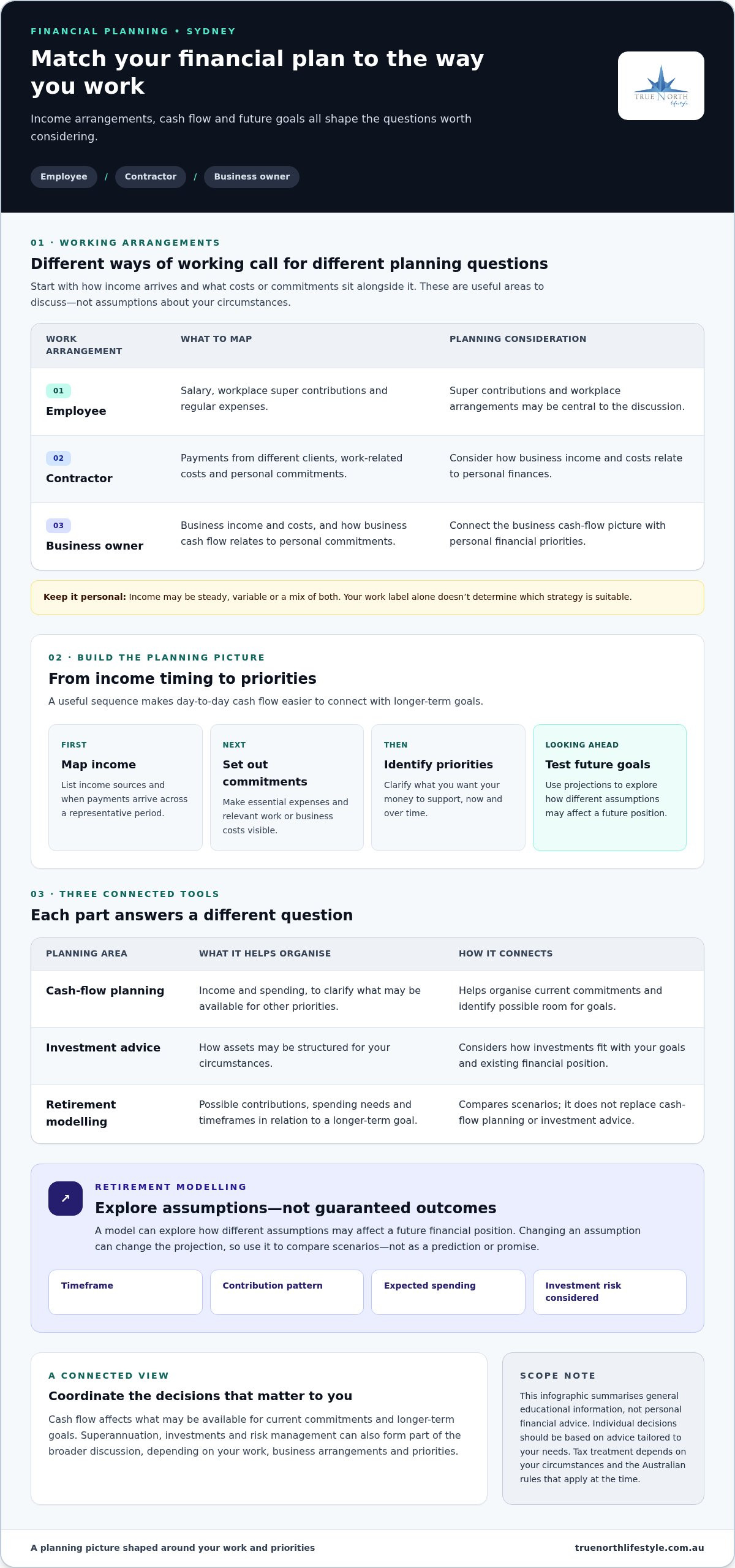
For an employee, super contributions and workplace arrangements may be central. A contractor or business owner may also need to consider how business income and costs relate to personal finances. These are useful areas to discuss, not assumptions about your circumstances.
- Cash flow: Map your income and essential commitments to understand what may be available for other priorities.
- Superannuation and investments: Consider how these fit with your goals and existing financial position.
- Risk and long-term goals: Explore how your plans may need to adapt as your work, responsibilities or future intentions change.
A financial planner can help bring investment, retirement and estate planning into a broader discussion. For a personal trainer, the value is in understanding how relevant decisions fit together, rather than treating each as a separate task.
Why Sydney context matters without assuming one career path
Trainers in Sydney may work across gyms, studios, private-client settings or their own businesses. Those settings can shape how they organise their work and finances, but location alone doesn’t determine what advice is suitable. Your priorities, resources and employment arrangements matter more than a typical career template.
Local advice can make ongoing conversations more accessible as your circumstances and goals evolve. True North Lifestyle has advisers in New South Wales, including at its office in Miranda, serving clients in the Sydney area. The focus is on understanding your position and shaping a strategy around it, rather than assuming one career path fits every trainer.
A note on scope: This article provides general educational information, not personal financial advice. The examples are starting points for considering your own circumstances. Individual decisions should be based on advice tailored to your needs.
How a financial plan can connect changing income with long-term goals
A useful plan turns separate financial details into a working picture. An adviser can help map where your income comes from and when it arrives, set out essential commitments, then identify what you want your money to support. This sequence can show which priorities need attention now and which belong in longer-term planning.
Turning different income patterns into a useful planning picture
Rather than relying on one month as a snapshot, record your income sources and payment timing across a representative period. An employee might consider salary, workplace super contributions and regular expenses. A contractor could map payments from different clients alongside work-related costs. A business owner may also need to understand how business cash flow relates to personal commitments. These are planning questions, not tax conclusions.
Once income and commitments are visible, cash-flow planning can help clarify what may be available for priorities such as a reserve, contributions or other goals. Tax treatment depends on your individual circumstances and the Australian rules that apply at the time. Don’t assume a strategy suits you based on your work label alone. For general guidance on what to expect from advice, Moneysmart.gov.au is a useful reference.
Using projections to test whether goals remain realistic
Cash-flow planning and investment selection serve different purposes. Cash flow helps organise income and spending. Investment advice considers how assets may be structured for your circumstances. Retirement modelling looks further ahead, connecting possible contributions, spending needs and timeframes with a longer-term goal. Each informs the next, but none replaces the others.
Retirement modelling explores how different assumptions may affect a future financial position. It is a planning tool, not a prediction or guarantee. Useful assumptions can include your timeframe, contribution pattern, expected spending and the level of investment risk considered. Changing an assumption can change the projection, so use the result to compare scenarios, not as a promise of a particular outcome.
Illustrative scenario: Imagine a trainer whose income comes from both employed work and private clients. Rather than treating one strong month as typical, they and an adviser could record when each income source arrives, note regular personal and work commitments, then consider how a quieter period might affect their priorities. This cash-flow view could inform what to explore in retirement modelling, without assuming a particular income level or investment return.
This practical sequence is central to financial planning for personal trainers Sydney: establish the income picture, organise priorities, then test longer-term goals using clear assumptions. True North Lifestyle offers retirement modelling and long-term projections to help connect present decisions with future goals through a tailored strategy.
How to compare financial planning options for personal trainers in Sydney
A long list of services doesn’t tell you whether advice will suit your working life. Compare how the adviser understands your circumstances, explains recommendations and supports implementation. For financial planning for personal trainers Sydney, consider whether the process accounts for employment, contracting or business ownership, rather than assuming every trainer has the same financial setup.
| What to compare | What to understand |
|---|---|
| Advice scope | Which goals and financial areas will the advice address, and how will it reflect your work and personal circumstances? |
| Modelling | Will the plan test relevant timeframes and assumptions, and explain the limits of projections? |
| Implementation | What support is available to put agreed recommendations into effect, and what remains your responsibility? |
| Ongoing reviews | How can the strategy be revisited if your work arrangements, goals or circumstances change? |
| Fee explanation | How are advice, implementation and ongoing support charged, and what does each arrangement cover? |
Questions that reveal whether advice fits your circumstances
Focus on the quality of the conversation. Do the questions make room for how you earn and organise your work? Are your goals, assumptions, risks and trade-offs explained in language you can follow? A suitable process should help you understand why a recommendation is being made, rather than leave you with a list of products or tasks without context.
It’s also reasonable to understand what happens after recommendations are presented. Ask how implementation is handled and how the plan may be reviewed if, for example, you move from employed work to contracting or take on a business role. You don’t need to predict every change, but it helps to know how advice can respond when your circumstances shift.
What to understand about scope, fees and ongoing support
One-off strategic advice focuses on developing and implementing an agreed strategy for a defined need. Ongoing advisory support provides a continuing relationship in which advice can be revisited over time. The right arrangement depends on your circumstances and preferences. Before committing, make sure you understand the scope, fees, payment arrangements and what ongoing support includes.
True North Lifestyle offers one-off strategic implementation and ongoing advisory services. Its planning can bring retirement modelling, superannuation review, tax-minimisation strategies and investment advice into a broader strategy. Tax-minimisation advice is different from tax return preparation, and financial planning is not the same as legal document drafting.
You can use ASIC’s Financial Advisers Register to look up adviser details and relevant information. Reviewing the advice process and how well it fits your needs can help you assess the substance of the service, not just its list of offerings.
What to prepare before seeking financial planning in Sydney
You don’t need perfectly organised accounts to have a useful first conversation. A clear outline of how you work, what you have and what you hope to achieve gives an adviser a better starting point. For financial planning for personal trainers Sydney, a little preparation can make the discussion more focused without turning it into a paperwork exercise.
Bring a clear snapshot of work and finances
Start with the information you already have. Records can help clarify the picture, but not every item will apply to every trainer or need to be ready before an initial discussion.
- Describe your work arrangements. Note whether you’re employed, contracting, running a business or combining arrangements. Include the income sources you rely on and, if useful, when payments usually arrive.
- Outline regular commitments. List recurring personal and work-related expenses, along with any significant financial commitments you’re managing. Estimates are fine for an initial overview.
- Gather relevant records. If readily available, bring or make a note of income records, bank or investment statements, details of any debts, and recent superannuation statements. These can provide context, but you don’t need to collect every possible document in advance.
- Keep personal information protected. Don’t send sensitive financial or identity information through unsecured channels. Ask about an appropriate way to share documents when needed.
This snapshot helps distinguish what’s known from what needs further investigation. It also gives the conversation a practical starting point, whether your income is consistent or changes with your work pattern.
Set priorities and questions for your first advice conversation
Before you meet, write down the decisions on your mind now and the outcomes you’re working towards over time. A near-term priority might be understanding how a change in work arrangements affects your finances. A longer-term aim might involve retirement planning. For broader context on how retirement goals fit into a financial strategy, explore this guide to retirement planning in Sydney.
Bring a few questions that matter to you, such as:
- How will the advice reflect my employment, contracting or business arrangements?
- What assumptions and risks will be used in any modelling, and how will the results be explained?
- What are the advice fees and engagement arrangements, and what does implementation involve?
- How can the strategy be reviewed if my work or goals change?
Clear priorities make it easier to judge whether the advice addresses what you came to discuss. To understand how True North Lifestyle’s advice process can connect your current position with longer-term goals, explore the financial planning process.
A tailored financial planning pathway for personal trainers with True North Lifestyle
Advice should fit the way you earn, the resources you have and the future you want to build. Before deciding on a strategy, consider whether the process takes your work arrangements into account, explains its assumptions and trade-offs clearly, and shows how recommendations may relate to your goals. The right approach should help you understand your options, not promise a particular result.
For personal trainers seeking financial planning for personal trainers Sydney, this means looking beyond an isolated superannuation or investment decision. Retirement goals, current financial commitments and the way your money is structured can influence one another. A coordinated plan can bring those considerations into view while keeping recommendations grounded in your individual circumstances.
How advice can bring retirement, super and investments into one strategy
Retirement projections can help explore possible paths by considering factors such as your timeframe, spending needs and available resources. They can also illustrate trade-offs between different choices. Projections rely on assumptions, so use them to examine scenarios, not as a guarantee of what your future finances will look like.
Superannuation review and optimisation is one part of the picture. Investment strategy is another, considering how investments may be structured in line with your circumstances and goals. These areas can be considered together without treating them as interchangeable. True North Lifestyle provides retirement modelling and long-term projections, reviews and optimises superannuation, and constructs bespoke portfolios overseen through an in-house Investment Committee.
If you’d like more context on how super fits into a broader wealth strategy, this guide to superannuation advice in the Sutherland Shire explores the topic further.
Take the next step with a measured, tailored conversation
A first discussion can start with your priorities, work and financial circumstances, and the questions you want advice to address. You can clarify how the advice process works, what recommendations are intended to cover, and how implementation or ongoing support may fit your needs. You don’t need to have every future decision settled before starting the conversation.
True North Lifestyle works with individuals and businesses in the Sydney area, with an office in Miranda. Its advice can be tailored to your goals and circumstances, whether you want to understand your current position, review superannuation or explore longer-term retirement possibilities. The focus is on a clear strategy and informed decisions, not a preset pathway for every trainer.
If you’re ready to explore how a tailored strategy could address your priorities, discuss your financial planning goals with True North Lifestyle.
Make your next financial decision with greater clarity
Your financial strategy doesn’t need to be perfect before you begin. It should give you a useful basis for decisions and room to adapt as your work and priorities change. That’s a valuable way to approach financial planning for personal trainers Sydney: focus on the next meaningful choice while keeping your longer-term direction in view.
A conversation can help turn a broad concern into a clearer question, whether you’re weighing a change in your work arrangements or thinking about the future you want your finances to support. True North Lifestyle’s advice is shaped around individual circumstances and goals, so the discussion can start with what matters most to you rather than a preset pathway.
Discuss your financial planning goals with True North Lifestyle and take a considered next step towards a strategy that reflects your working life.
Frequently Asked Questions
Do personal trainers in Sydney need a financial planner?
No, a personal trainer doesn’t automatically need a financial planner. It depends on your goals, the complexity of your finances and whether you want help coordinating decisions. Advice may be useful during a shift from employment to contracting, when establishing a business or as retirement draws closer. If you’re unsure, identify one financial decision you’d like to understand better, then consider whether tailored advice would help.
Can a financial planner help if my personal training income changes?
Yes. An adviser can help you consider how changes in client numbers, work arrangements or business costs may affect your financial priorities. For example, you might compare what happens to available cash if client bookings rise or fall, without treating either scenario as a forecast. The aim is to make decisions with a clearer view of possible pressures and options, not to promise a particular income or result.
What should financial planning for a personal trainer include?
It should reflect your circumstances and goals, rather than follow a fixed checklist. Depending on your needs, discussions may cover cash flow, superannuation, investments, risk management, tax-minimisation strategies and retirement goals. A trainer building a business may have different priorities from someone focused on reviewing their super. A coordinated approach can help you see how relevant decisions relate to one another.
How do I compare financial advisers in Sydney?
Compare how each adviser explains the advice process, the scope of recommendations, fees, implementation and future reviews. Consider whether they listen to the details of your work arrangements and explain risks and assumptions in plain language. You can also use ASIC’s Financial Advisers Register to look up adviser information. If you’re meeting locally in Miranda or Sydney, convenience may matter, but suitability should remain central.
Can a financial planner help me plan for retirement as a personal trainer?
Yes. Retirement planning can help you explore how your current position relates to the lifestyle and timeframe you have in mind. A discussion may consider your superannuation and other relevant resources, alongside how your goals could change over time. Modelling can help compare possible pathways, but it relies on assumptions and can’t guarantee future results. A tailored review can help identify which questions deserve attention first.
Does financial planning include tax returns or legal documents?
Not necessarily. Financial planning may include tax-minimisation strategies, but that’s different from preparing or lodging a tax return. Estate planning strategy can consider how your broader financial arrangements relate to your wishes, but it isn’t the same as drafting legal documents. Understanding the scope of advice helps you know what the recommendations cover and where financial strategy ends.
What should I bring to my first financial planning meeting?
Bring a short outline of what you want to discuss, such as a planned change in work, a major purchase or a retirement question. If useful, note which income sources matter most to your current budget and any decisions with a deadline. Existing statements or records can add context, but you don’t need a complete financial file to begin. Keep sensitive documents secure when sharing them.


