

What if feeling more confident about money came not from earning a steady income, but from having a plan that can adapt when income changes? Between contracts, releases and quieter stretches, it can be difficult to connect creative work with personal goals, superannuation and long-term security. When studio decisions overlap with personal finances, it helps to keep the two clear. If you’re looking for financial planning for game developers Sydney, advice should reflect your circumstances and priorities.
This guide explains how tailored financial advice can bring your income, priorities and future plans into focus. You’ll learn what to consider when reviewing superannuation, building an investment approach and exploring tax-minimisation strategies, as well as how retirement modelling can compare different scenarios. The aim is to give you a clearer view of your choices, so you can balance what matters now with longer-term financial confidence.
Key Takeaways
- Shape a personal financial plan around changing project income, regular commitments and your own priorities.
- Use scenario modelling to compare possible income and investment paths, and see how they may affect longer-term goals.
- Understand the distinction between studio finance, production funding and financial planning for game developers Sydney.
- Prepare for a planning conversation by outlining your goals, income patterns, commitments, superannuation and investments.
- Explore how tailored advice on superannuation, portfolios, tax minimisation and wealth preservation can support your personal financial future.
Financial planning for game developers in Sydney: why personal finances need their own plan
Game development can move in cycles. A contract may end, a release may shift, or a new project may change your workload and income. These changes can make it harder to decide how much to set aside for living costs, investing or future goals. A personal plan brings those decisions into one clear view.
Personal financial planning turns your goals and circumstances into a tailored strategy. For a Sydney developer, that means considering how current priorities connect with superannuation, investments and longer-term plans, without assuming income will follow a predictable pattern. A financial planner can help structure advice around your circumstances and objectives.
That’s the distinction at the heart of financial planning for game developers Sydney: the focus is your personal financial position, not the studio’s accounts or production pipeline. Understanding the difference helps you direct your financial decisions to the right place.
What makes a game developer’s financial picture different?
Your income may come from a salary, contract work, royalties or business income, depending on your role and work arrangements. Project schedules can also affect when work is available or payments arrive. These possibilities won’t describe every developer, so a useful plan starts with your actual income sources and commitments.
Separate income you can rely on from uncertain future earnings. For example, you might use confirmed salary or contract payments to map regular expenses, while treating a possible royalty payment from a future release as a separate scenario, not money already available. This grounds cash-flow decisions in what you know and helps show what may need adjusting if a project is delayed.
Personal financial advice versus studio finance
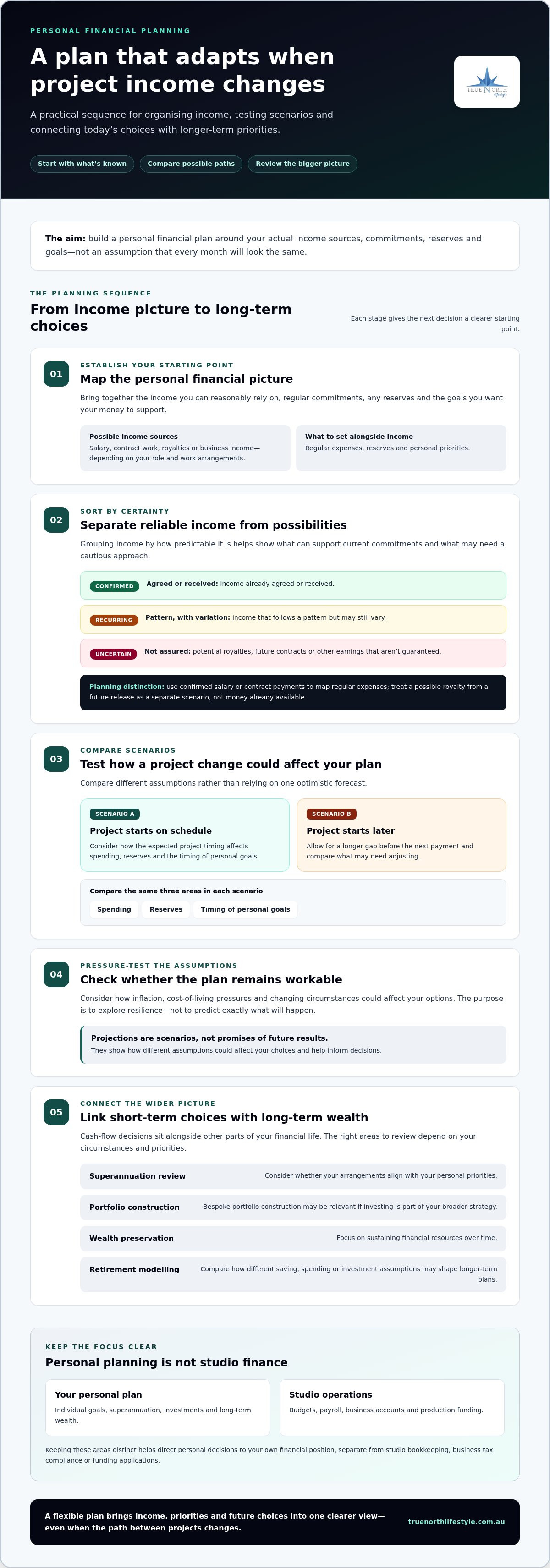
Personal financial advice is about your goals, superannuation, investments and wealth over time. Studio finance has a different focus: running the business, including budgets, payroll, business accounts and production funding. Keeping those areas distinct helps you see which decisions affect you personally and which relate to studio operations.
A personal plan can consider whether your superannuation arrangements fit your longer-term priorities, how investments may support your goals, and how different income patterns could affect your financial position. It gives your personal choices their own structure, separate from studio bookkeeping, business tax compliance or funding applications.
- Studio operations: budgets, payroll, business accounts and production funding.
- Personal planning: individual goals, superannuation, investments and long-term wealth.
A tailored strategy can help you consider today’s financial choices alongside the future you’re working towards, even when the path between projects changes.
Build a financial plan around changing game-development income
A useful plan starts with a clear picture of your personal finances, not an assumption that every month will look the same. Map the income you can reasonably rely on, your regular commitments, any reserves and the goals you want your money to support. This gives you a grounded starting point, whether you’re employed, contracting, receiving royalties or earning through a business.
Then test how the plan responds to change. A project may be delayed, work may pause between contracts, or income may arrive differently than expected. Financial projections are scenarios to inform decisions, not promises of future results. They show how different assumptions could affect your options, helping you make choices with greater clarity.
Turn irregular income into usable planning scenarios
For a planning discussion, group income by how certain and predictable it is. This helps distinguish what can support current commitments from what may be better treated cautiously.
- Confirmed: income already agreed or received.
- Recurring: income that follows a pattern, while still allowing for variation.
- Uncertain: potential royalties, future contracts or other earnings that aren’t assured.
These categories can help you compare different versions of your financial plan. For example, one scenario could assume a project starts on schedule, while another accounts for a later start and a longer gap before the next payment. Compare how each version may affect spending, reserves and the timing of personal goals. ASIC’s MoneySmart website also offers general information and tools to help Australians think about budgeting and financial decisions.
Good modelling doesn’t depend on a single optimistic forecast. True North Lifestyle’s research-driven approach can test assumptions against inflation and cost-of-living pressures, helping you consider whether a plan remains workable if everyday expenses rise or circumstances shift. This helps you explore resilience, rather than predict exactly what will happen.
Connect short-term choices with long-term wealth
Cash-flow decisions matter, but they sit alongside other parts of your financial life. A superannuation review can help you consider whether your arrangements align with your personal priorities. Bespoke portfolio construction may be relevant if investing is part of your broader strategy, while wealth preservation focuses on sustaining resources over time.
Retirement modelling can provide useful context without making retirement the only measure of progress. A projection can compare how different saving, spending or investment assumptions may shape a longer-term path. Relate those possibilities back to what matters to you now, including the flexibility you may want as work changes.
That’s the practical value of financial planning for game developers Sydney: connecting changing work patterns with personal priorities through a tailored plan. To explore how tailored financial advice could help bring those moving parts into focus, speak with True North Lifestyle.
Compare financial planning options without confusing them with studio services
Similar financial language can describe very different kinds of help. Studio finance focuses on running a game business, while production-funding information explains support for a project. Personal financial planning looks at your own goals and financial position. Keeping these purposes distinct makes it easier to identify which decisions need attention and what kind of guidance is relevant.
The Interactive Games & Entertainment Association (IGEA) provides context on the Australian games industry. That perspective can help you understand the sector, but it differs from advice tailored to your personal circumstances, superannuation and wealth goals.
| Approach | Main focus | Typical questions it addresses |
|---|---|---|
| Studio finance | Business operations | How should budgets, payroll and business accounts be managed? |
| Personal financial planning | An individual’s goals and wealth | How might superannuation, investments and future priorities fit together? |
| Production-funding information | Funding a game project | What support may be relevant to a project and its funding requirements? |
What should a personal financial planning approach cover?
Look for recommendations shaped around your circumstances and stated goals. Useful projections make their assumptions clear and compare different possible scenarios, so you can understand how changes might affect your plans. Depending on your needs, advice may consider superannuation, investment strategy, tax-minimisation strategies and wealth preservation.
Ongoing review also matters: your priorities, work and financial position can change, so a plan may need to be revisited. Tax-minimisation strategies are one part of personal financial advice. They are distinct from preparing a tax return, which is a separate task.
Which decisions belong to the studio, and which are personal?
Studio budgets, payroll and funding applications concern business operations or a project. Personal decisions include your superannuation, investments, retirement goals and estate planning strategy. A decision can affect both areas without making them the same. For example, a change in business income may influence your personal plans, while the advice discussion remains focused on your personal circumstances.
For financial planning for game developers Sydney, consider whether the approach is tailored, explains long-term projections, tests different scenarios and includes plan reviews. These features relate to your personal financial strategy, rather than the day-to-day running or funding of a studio. True North Lifestyle’s tailored financial advice can connect personal priorities with considered planning for superannuation, investments and wealth over time.
Prepare for a financial planning conversation: a practical Sydney checklist
A little preparation can make a financial planning discussion more focused. You don’t need to arrive with every detail resolved. A broad, honest picture of your priorities, finances and uncertainties gives the conversation a useful starting point and keeps the advice centred on your personal life, rather than studio operations.
Use this sequence to organise your thoughts:
- Clarify your goals. Note what matters in the near term and further ahead, such as flexibility between projects, building investments or feeling more prepared for later life.
- Outline your personal finances. Bring a general view of income patterns, regular commitments, savings or reserves, existing investments and superannuation. You don’t need to share sensitive account details in advance of a discussion.
- Identify changes and questions. Think about possible shifts in workload, income or lifestyle, then write down the decisions you’d like help understanding.
- Compare scenarios. Consider what you’d like to explore, such as a project delay, a change in spending or a different approach to investing, and how each might affect your priorities.
Information to organise before an advice discussion
Keep the preparation practical. List your current goals, major financial commitments and any expected changes in work or lifestyle. Gather a broad picture of your superannuation and investments so you can discuss how they fit with your aims. You don’t need to create a perfect financial dossier; focus on making your circumstances and questions easier to explain.
It can also help to describe what financial confidence would look like in everyday terms. Perhaps it means having more clarity about managing a gap between contracts, or understanding how today’s choices relate to longer-term plans. These priorities give the discussion a human measure of progress alongside the figures.
Questions that help assess clarity and fit
Ask how recommendations will reflect your circumstances and goals, and how assumptions behind projections will be explained. You might also ask how different scenarios are compared, what could prompt a plan review, and how superannuation, investment strategy or wealth preservation may relate to your priorities. Clear answers should explain the reasoning behind recommendations.
For further context, Bespoke Investment Advice Sydney: Crafting Stability for Your Lifestyle in 2026 explores tailored investment considerations, while Superannuation Advice Sutherland Shire: A Guide to Strategic Wealth in 2026 focuses on superannuation planning. These topics can help you frame questions about financial planning for game developers Sydney, while keeping the discussion focused on your own circumstances.
When you’re ready, book a consultation with True North Lifestyle to discuss a tailored personal financial plan.
How True North Lifestyle can support your personal financial plan
Your financial plan should reflect the life you’re building, not just the income you receive today. True North Lifestyle provides tailored advice that brings your personal circumstances, goals and financial priorities together. For a game developer, this can mean considering how changing work patterns relate to superannuation, investments and longer-term wealth, while keeping personal decisions distinct from studio operations.
The aim is clarity. Recommendations are explained in the context of your goals, so you can understand the reasoning and how different parts of a strategy may work together. Relevant considerations could include superannuation review and optimisation, bespoke portfolio construction, tax-minimisation strategies and wealth preservation. The areas that matter depend on your individual position and priorities.
From personal circumstances to a tailored strategy
Planning can begin with a detailed view of your current position and the outcomes you want to work towards. Long-term projections and scenario modelling can compare possible paths using stated assumptions, such as different patterns of income, spending or investment returns. These models help explore choices; they aren’t predictions or guarantees of future results.
That distinction matters. A projection can help you see how a change in circumstances might affect your plan, while a recommendation can outline options to consider. True North Lifestyle also provides ongoing support and plan reviews, so you can revisit your strategy as your goals or financial circumstances change. This keeps the focus on a plan that can remain relevant, rather than treating advice as a one-off set of instructions.
For financial planning for game developers Sydney, this tailored approach can connect day-to-day priorities with longer-term considerations. Retirement modelling may provide useful context, while superannuation, investments and wealth preservation can be considered as part of your broader financial picture.
Research-led support, with a local NSW presence
Portfolio construction uses an in-house Investment Committee and Resonant Asset Management. This provides a research-led foundation for bespoke portfolios, with recommendations shaped around each client’s circumstances. True North Lifestyle has $220 M+ in funds under management, excluding direct property assets, has supported 1,000+ Australians and works with 400+ long-term clients.
The team includes 13+ team members, including 4 Certified Financial Planners, and True North Lifestyle has 3 NSW office locations. With a local presence in Miranda and Sydney, the team can discuss how recommendations relate to your personal goals. These details offer context for the organisation behind the advice; the important measure for your planning conversation is whether recommendations are clearly explained and connected to your priorities.
If you’re ready to discuss how your circumstances and priorities could shape a personal financial plan, Book Your Consultation with True North Lifestyle.
Give your next financial decision a clearer direction
Your next step doesn’t need to be a complete financial overhaul. Start with one question that matters to you: what would you like your money to make possible, even as your projects and work patterns change? A clear answer can help shape a plan around your priorities, rather than letting the next contract or release dictate every decision.
With financial planning for game developers Sydney, the aim is to create a considered path from today’s circumstances towards the future you want, while leaving room to reassess as life changes. You don’t need every detail worked out before beginning. A conversation can help identify which decisions deserve attention first and what information will make them clearer.
When you’re ready to explore a personal strategy shaped around your goals, Book Your Consultation with True North Lifestyle. Your creative work may move through different seasons; your financial direction can still feel thoughtful, steady and your own.
Frequently Asked Questions
Can a financial planner help game developers with irregular income?
Yes. A financial planner can help you consider uneven payment timing in your personal plan, rather than assuming each month brings the same income. For example, if a milestone payment is due after several months of ongoing expenses, you can discuss how those commitments align with available funds and what a delay might mean. This helps distinguish decisions supported by income you can rely on from those that depend on a future project payment.
What should game developers look for in a financial adviser in Sydney?
For financial planning for game developers Sydney, look for tailored recommendations, clear explanations and projections with understandable assumptions. Consider how superannuation, investing and longer-term goals can be considered together, and whether plans are reviewed as circumstances change. Credentials and a clear explanation of advice and portfolio-management fees can help you understand the service. True North Lifestyle supports Australians in Miranda and Sydney, with a local NSW presence.
Does financial planning for game developers include studio accounting?
Studio accounting and personal financial planning address different needs. Studio accounting concerns business records, budgets, payroll and business tax compliance; personal financial advice focuses on an individual’s financial position and goals. True North Lifestyle’s planning can address personal wealth questions for professionals and business owners, such as how their priorities relate to investments or retirement. Keep business accounts and tax returns distinct from personal decisions about superannuation, portfolio strategy or estate planning.
How can financial planning account for uncertain game project income?
A plan can distinguish between income you can reasonably rely on and potential earnings that depend on a future project, contract or royalty. It can also examine timing, such as how your personal budget may be affected if a payment arrives later than expected. Comparing different assumptions about income and spending can clarify which choices depend on uncertain receipts, without treating a projection as a guaranteed outcome.
Can a financial adviser help with superannuation and investments?
Yes. True North Lifestyle provides superannuation review and optimisation, along with bespoke portfolio construction. Advice can consider whether your current arrangements and investments align with your objectives, time horizon and approach to investment risk. It can also look at how these elements fit alongside your other financial priorities, rather than treating superannuation or a portfolio as a standalone decision. Investment outcomes aren’t guaranteed.
Does True North Lifestyle help game studios apply for Screen Australia funding?
Screen Australia funding relates to game projects and studio needs. For personal financial planning, a potential funding outcome can be considered as one factor in your broader financial position, including its possible effect on your personal income expectations. This keeps the focus on your personal goals, investments and longer-term planning.
What happens during a financial planning consultation?
A consultation is an opportunity to discuss your goals and personal circumstances, then explore what financial advice may be relevant. You can raise questions about changing income, superannuation, investments or future priorities. True North Lifestyle develops tailored advice with long-term projections and explains its recommendations, so you can understand the thinking behind them. You don’t need to have every answer ready; begin with the decisions you’d most like to bring into focus.


