

Your super is only one part of the retirement picture. For retirement planning for systems administrators in Miranda, the key is to coordinate super with other assets and potential Centrelink benefits, then adjust the plan as work, health and family circumstances change. Super becomes accessible at 60, and super income stream payments and lump-sum withdrawals are not taxed from age 60.
It’s understandable to focus on whether your super balance will be enough. A more useful question is how your savings can support the life you want through early, middle and later retirement, while accounting for income needs and possible government support.
This guide explains how super shapes retirement savings, how income streams and lump-sum withdrawals fit into the picture, and how Centrelink’s Income and Assets Tests affect Age Pension eligibility. It also shows how to adapt your plan at each stage, so you can weigh the trade-offs and make decisions with greater confidence.
Key Takeaways
- Consider how regular income and one-off withdrawals can work together to support your spending plans.
- Revisit investment settings when work, family, finances or health change, so your strategy stays aligned with your timeframe and comfort with risk.
- Understand how income and assets are assessed when considering Age Pension eligibility, including how financial decisions may affect support.
- Shape your retirement strategy around the different needs of early, middle and later retirement, rather than relying on a single fixed plan.
Retirement income streams and lump-sum withdrawals
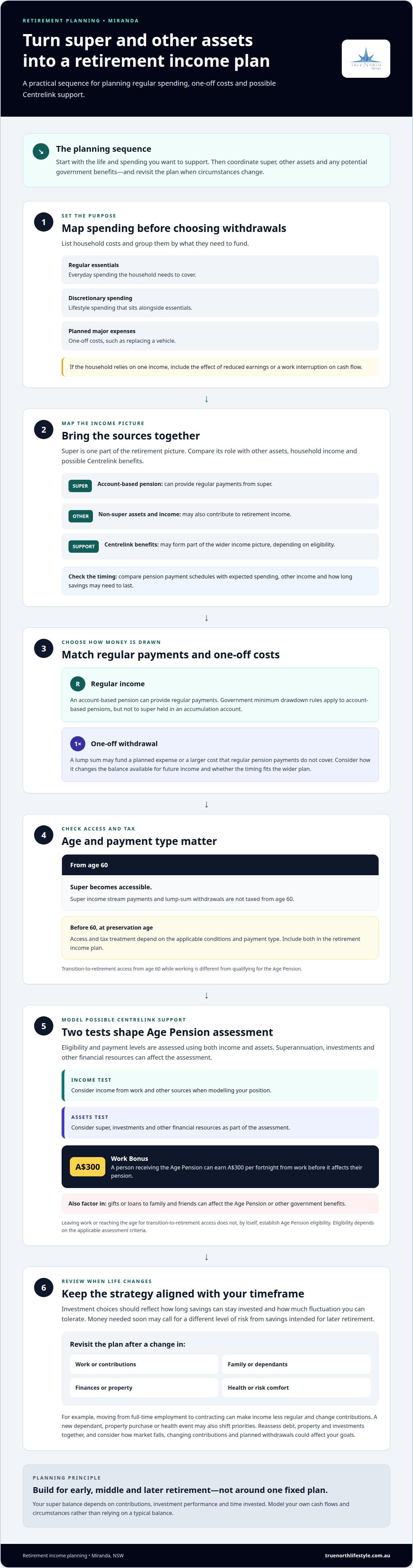
A retirement plan turns super and other assets into income for everyday spending and one-off costs. Systems administrators should align withdrawals with retirement goals, household expenses and the timing of any change in work.
Retirement income streams and pensions
An account-based pension can provide regular payments from super, while non-super assets and Centrelink benefits may also contribute to retirement income. Compare the payment schedule with expected spending, other income and how long your savings may need to last. Government minimum drawdown rules apply to account-based pensions, but not to super held in an accumulation account.
Lump-sum super withdrawals
A lump-sum withdrawal can fund a planned expense, such as replacing a vehicle, or meet a larger cost that regular pension payments don’t cover. Super becomes accessible at 60, and payments and lump-sum withdrawals aren’t taxed from age 60. Before choosing a withdrawal, consider how it changes the balance available for future income and whether the timing fits your wider plan.
Employees, contractors and self-employed systems administrators may have different patterns of employer contributions, personal contributions and income continuity. A financial adviser can model those cash flows against your intended retirement date instead of assuming a steady salary throughout your career. Your super balance depends on contributions, investment performance and time invested, so there is no reliable typical balance for a given age and salary without those details.
Set your objectives before choosing payment amounts. List regular essentials, discretionary spending and planned major expenses. If your household relies on one income, include the effect of reduced earnings or a work interruption on cash flow. Review life insurance, income protection and total and permanent disability (TPD) cover in light of debts, dependants and the income your household relies on.
For tax, the stated rule is clear from age 60: super income stream payments and lump-sum withdrawals aren’t taxed. At preservation age before 60, access and tax treatment depend on the applicable conditions and payment type, so include both in the retirement income plan.
Ask an adviser: When would I need to get advice again?
Investment advice should reflect how long your savings can remain invested and how much fluctuation you can tolerate. A systems administrator nearing retirement may need a different investment mix from someone building wealth over a longer timeframe.
In Miranda, NSW, retirement advice can bring together long-term projections, superannuation, tax-minimisation strategies, portfolio construction and investment risk management. The right approach depends on your goals, income and financial position.
Revisit your plan after a major change in work, family, finances or health. Moving from full-time employment to contracting, for example, can make income less regular and change your contributions. A new dependant, property purchase or health event may also shift your priorities.
Investment choices should match the timeframe for each goal. Money you need soon may call for a different level of risk from savings intended for later retirement. A financial adviser can model how market falls, changing contributions and planned withdrawals could affect your portfolio’s ability to meet those goals.
Wealth strategies should account for debt, property and investments together. Paying down a home loan, for example, may compete with investing surplus income. A financial adviser can assess cash flow, liquidity and concentration risk, then build a bespoke portfolio around your goals and capacity to absorb losses.
Before setting up or changing an investment option, consider its investment mix, fees, access to money and role in your wider plan. The Australian Securities and Investments Commission’s Financial Advisers Register lets you check an adviser’s registration and qualifications. This can help you understand who is providing personal advice before you act on recommendations.
If a change has altered your timeframe or comfort with risk, consider reviewing your retirement advice before making investment decisions.
Centrelink age pension eligibility
Retirement has no single age for every worker. In Australia, transition to retirement may provide access to some super from age 60 while working; this does not establish Age Pension eligibility.
Age Pension eligibility criteria
Centrelink assesses retirement benefits using both an Income Test and an Assets Test. These tests consider income and assets when determining eligibility and payment levels. Superannuation, investments and other financial resources can affect the assessment, so model how each may influence your position. Gifts or loans to family and friends can also affect the Age Pension or other government benefits.
Retirement age and pension eligibility age
Retirement is a personal decision shaped by work, health, savings and preferred lifestyle. Accessing some super through a transition-to-retirement arrangement from age 60 while continuing to work is different from qualifying for the Age Pension. The eligibility decision depends on the applicable assessment criteria, not simply on leaving employment or reaching the age for transition-to-retirement access.
That distinction matters for systems administrators planning a gradual move away from full-time work. A person still earning employment income may consider how reduced hours interact with super withdrawals and future Centrelink support. The Work Bonus allows a person receiving the Age Pension to earn A$300 per fortnight from work before it affects their pension. Include this rule when modelling part-time work alongside other income.
Property decisions can change the picture too. Before downsizing, consider the tax impact and whether the move could affect government benefits. A financial gift or family loan may also change the assets considered in an assessment. Think carefully about timing, particularly if a household member relies on one income or the proceeds will fund retirement spending.
A practical assessment brings together income, assets, super balances, work plans and significant planned transactions. For example, compare a scenario where you continue part-time work with one where you stop working, then review how each affects income and potential pension support. This structured view can clarify trade-offs and support financial security without treating Age Pension eligibility as your only source of retirement income.
Planning for early, middle and later retirement
Retirement planning for systems administrators in Miranda works best as a sequence of decisions, not a one-off calculation. An adviser can review your goals as your work, health and family circumstances change.
Early-retirement planning
Start by mapping your expected retirement date against super contributions, savings and the lifestyle you want. Starting early gives your strategy more time to adjust as circumstances and markets change. If you expect an inheritance, leave it out of your plan until you receive it. This keeps projected retirement income grounded in assets you already have, rather than money that may arrive later.
In middle retirement, compare actual spending and investment income with the assumptions in your plan. Reducing work hours, supporting family or moving home can shift the balance between income and savings. For systems administrators in Miranda, retirement planning should adapt as these changes arise. Ask your adviser to update projections after a major change, then assess whether contributions, spending or investment settings need adjustment. A gradual transition through part-time work may have income and superannuation advantages, depending on your circumstances.
Later-retirement planning
Later retirement calls for attention to longevity, sustainable spending and the practical management of assets. Some people may spend 40 years in retirement, so the plan should account for income needs over an extended period. Review whether investments remain suitable for your timeframe, and consider how health or care needs could affect future spending. Estate planning also matters: superannuation sits outside a will, so beneficiary nominations need separate consideration.
A broader estate plan may include powers of attorney and medical directives, alongside a will and superannuation death benefit nominations. These arrangements set out who can make decisions if you’re unable to do so. Review them after a change in family circumstances, such as a relationship change or the arrival of a grandchild, so your intentions remain clear.
Build a retirement strategy that reflects your stage and changing circumstances through a tailored retirement plan.
True North Lifestyle: Retirement modelling & long-term projections
True North Lifestyle helps systems administrators turn retirement goals into a structured plan through retirement modelling and long-term projections. This can be useful when weighing a change in work, estimating future income or reviewing whether your super strategy still fits your circumstances.
The modelling brings your superannuation, expected income and planned spending into a long-term view. Superannuation review and optimisation can help assess whether your arrangements align with your goals, while tax-minimisation strategies and bespoke portfolio construction address other parts of your plan. Together, these considerations help you understand your options and the trade-offs involved.
If you’re ready to discuss your retirement plans, contact True North Lifestyle.
Make your next retirement decision with clarity
Your retirement plan should keep pace with your life as work, priorities and family circumstances evolve. Start by identifying the decision on your mind now, whether it’s when to move out of full-time work, how to structure investments or how to include super in a wider plan.
For systems administrators, retirement planning in Miranda can provide a clearer framework for these decisions. True North Lifestyle supports the process with retirement modelling and long-term projections, tax-minimisation strategies, and superannuation review and optimisation. The aim is to connect your financial position with the retirement goals you want to pursue, making the path ahead more considered and manageable.
You don’t need every future decision settled before taking a first step. Contact True North Lifestyle to discuss your plans and explore an approach that reflects your circumstances.
Frequently Asked Questions
How does superannuation affect my retirement savings?
Super builds retirement savings through contributions and investment returns over time. Your eventual balance depends on contribution amounts, investment performance, fees and how long the money remains invested. A period of reduced work, for example, can change your contributions and future projections. Review your super fund’s investment option and costs to understand how it fits with savings held outside super.
Am I eligible for the Age Pension?
Eligibility depends on Centrelink’s Income Test and Assets Test, so reaching retirement age alone doesn’t settle the question. Your assessable income and assets are considered together. A change in paid work or a financial gift, for example, can affect the figures relevant to an assessment. Include such changes in your retirement cash-flow planning rather than relying on a pension payment as a fixed amount.
Does my will cover my superannuation?
No. A will may not set out how superannuation is distributed, so consider reviewing your beneficiary arrangements separately. If your family circumstances change, review whether your super nomination still reflects your wishes and aligns with your wider estate plan. This is especially relevant when planning how retirement assets should pass to family members after your death.
Have I left it too late to retire comfortably?
Judging your position by age alone isn’t useful. A retirement projection can bring together your current super, savings, expected contributions, intended retirement date and spending goals. Changing your planned retirement date or working part-time during a transition, for example, can alter your income and savings. A clear projection gives you practical options to consider instead of relying on a general rule.
What is the current super guarantee rate and contribution cap in Australia?
The super guarantee is the compulsory minimum contribution employers pay into an employee’s super fund, and employers pay contributions quarterly. Contribution caps limit how much can receive concessional tax treatment. The applicable cap depends on the contribution type and financial year. Superannuation contributions are typically taxed at 15%. Build contribution decisions around the relevant year’s rules and your existing contributions.
How can systems administrators in Australia get professional help with salary-sacrifice or personal super contributions?
A financial adviser can assess salary-sacrifice or personal contributions alongside your income, existing super and retirement goals. For a systems administrator in Miranda, a superannuation review can show how proposed contributions fit into your wider plan, while tax-minimisation strategies can take their tax implications into account. Bring details of your current contributions and intended changes to the discussion so recommendations can reflect your circumstances.


