

A business succession plan is only as strong as the decisions it connects. Estate planning for business owners in the Sutherland Shire brings ownership transition, management continuity and the interests of the people involved into one considered plan. A Will alone may not address every part of that transition.
It’s understandable to want the business you’ve built to keep operating while protecting the people who matter to you. Planning early can give successors clearer direction and help reduce uncertainty if you retire, step back or die. This article explains how professional advice can help you plan for succession and coordinate your Will, testamentary trusts and powers of attorney within a broader estate strategy.
You’ll see how these elements work together, which decisions shape a practical succession plan, and why it should be reviewed as your business changes. The aim is a clear framework for continuity that considers your personal and business interests together.
Key Takeaways
- Start succession planning early so ownership and management can transition with greater clarity when you step back or leave the business.
- Qualifying assets in testamentary trusts may access the 50% Capital Gains Tax discount, according to the Australian Taxation Office.
- Coordinate your will with your business arrangements so your personal and business interests are considered together.
- Plan for who can manage financial matters if you lose capacity by considering an enduring power of attorney as part of your estate plan.
Business succession planning
Succession planning connects ownership transfer, management continuity and the financial interests of everyone involved. A coordinated estate plan can set out how the business should proceed if you retire, step down or die.
Coordinating Succession Advice
Succession advice works best when your accountant and financial planner consider the same proposed transition. An accountant can assess tax implications, while a financial planner can model effects on your long-term finances and beneficiaries. Costs for wills, estate planning and succession advice in Sutherland Shire depend on scope, ownership structure and documents involved; the price depends on the case and is given after a quote request. Coordinated advice can help limit disputes by clarifying responsibilities and recording decisions in agreements.
Company Shares and Estate Claims
A company constitution sets basic governance rules, while a shareholders agreement can address decisions, disputes, exits and share transfers. Reviewing both can reveal whether existing arrangements support succession or conflict with your estate plan. Jointly held company shares may pass automatically to surviving owners when someone dies without a Will. In NSW, an eligible person may claim under the Succession Act 2006 (NSW) if they haven’t received adequate provision, or the person died without a Will. Clear documents help reduce uncertainty for each member and business partner.
Choosing and Training a Successor
A successor could be a family member, key employee or business partner. Assess their ability to manage operations, lead staff and maintain important business relationships, rather than relying only on family expectations. If no successor is ready, consider whether a sale or a trusted manager taking over would better support continuity. Hands-on training and mentoring can transfer practical knowledge, client responsibilities and decision-making experience before the owner steps back.
Succession Planning Beyond a Will
A Will sets out how personal and business assets are distributed, but may not explain how the business will operate during a transition. Review the business structure, constitution, shareholders’ agreement and any buy-sell agreement together. A buy-sell agreement can clarify what happens if an owner dies or leaves. Alongside legal arrangements, reviewing business risk protection with specialists like AllCover Insurance Brokers helps ensure commercial assets and operations remain safeguarded throughout any transition. Identify potential successors early, coordinate transfer planning with your accountant and financial planner, and revisit arrangements as the business or ownership changes. This joined-up approach gives beneficiaries and business partners clearer guidance.
Testamentary trusts
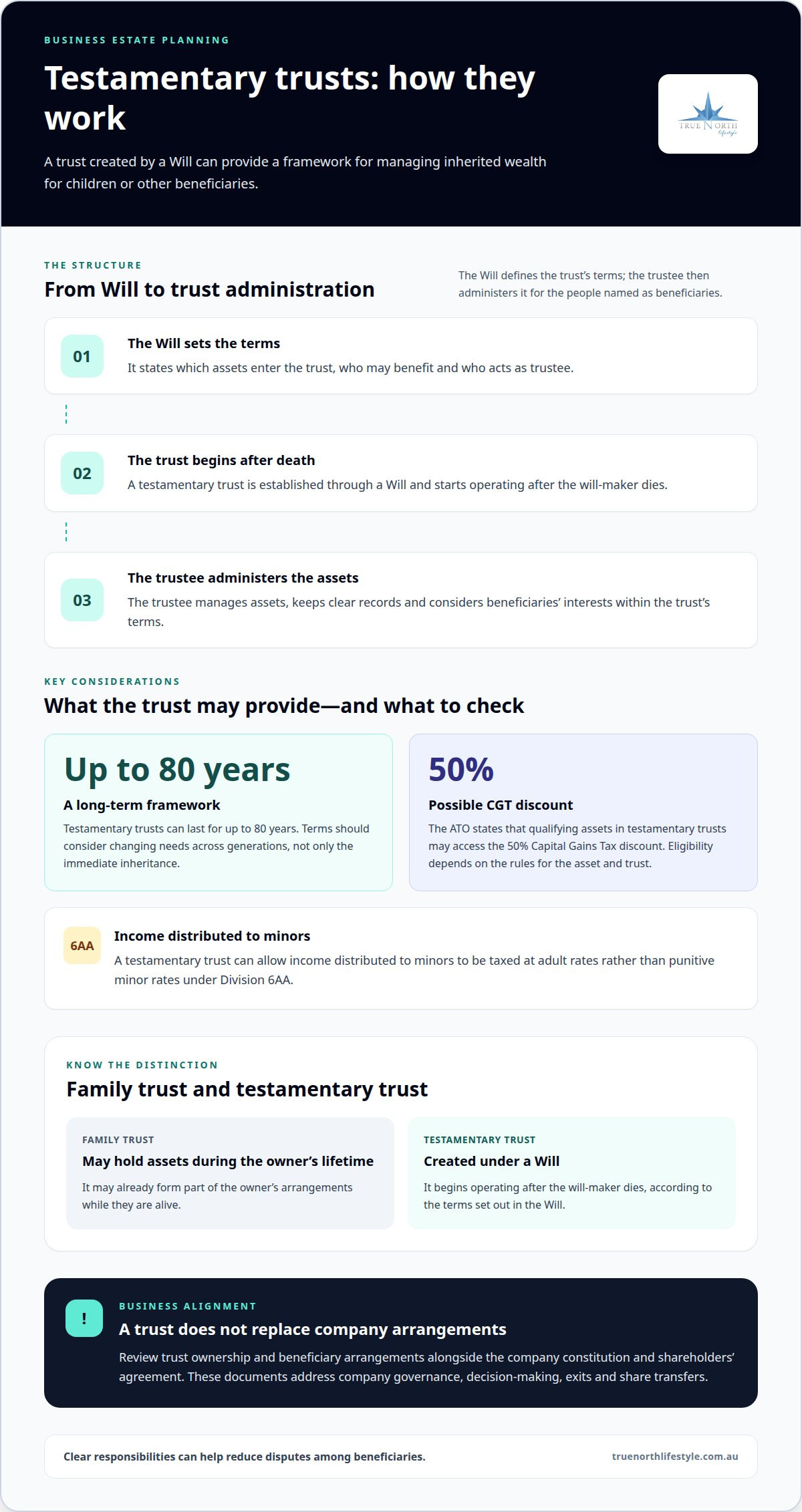
A testamentary trust is established through a Will and begins operating after the will-maker dies. The Will sets out which assets enter the trust, who may benefit, and who acts as trustee. This can provide a framework for managing inherited wealth for children or other beneficiaries. Testamentary trusts can last for up to 80 years, so the terms should reflect changing needs across generations, not only the immediate inheritance.
Tax treatment is one consideration, not the only reason to use a trust. Testamentary trusts can allow income distributed to minors to be taxed at adult rates rather than punitive minor rates under Division 6AA. The Australian Taxation Office states that qualifying assets in testamentary trusts may access the 50% Capital Gains Tax discount. Whether a particular asset qualifies depends on the rules applying to that asset and trust. Structuring should therefore consider the assets involved, intended beneficiaries and how distributions may be managed.
A family trust and a testamentary trust serve different roles in an estate plan. A family trust may already hold assets during the owner’s lifetime, while a testamentary trust is created under a Will. Each trust needs a trustee to administer its terms and make decisions within its framework. Choosing a suitable trustee matters: the role involves managing assets, keeping clear records and considering beneficiaries’ interests. Clear responsibilities can help reduce disputes among children or other beneficiaries.
Trust ownership also needs to align with the business structure. If a company is involved, its constitution sets basic governance rules, while a shareholders’ agreement can address decision-making, exits and share transfers. A trust does not replace these company arrangements. Review how the trust’s ownership or beneficiary arrangements interact with company documents and succession plans. This helps keep estate structuring, business governance and wealth planning aligned as ownership or family circumstances change.
Wills and estate planning
For a business owner in the Sutherland Shire, core documents can include a Will, testamentary trust, enduring power of attorney and advance health directive. Together, they address asset distribution and decision-making if you die or lose capacity.
Wills for Business Estate Plans
A Will should address how personal and business assets are distributed, including the interests of a partner or family beneficiaries. In NSW, a Will-maker generally must be over 18, have proper mental capacity and sign the Will in the presence of two independent witnesses. Lawyers can help align its terms with company arrangements, so the document reflects how business interests are held and transferred.
Estate Planning Documents for Business Owners
A business estate plan links the Will with documents that address incapacity and health decisions. An enduring power of attorney records who may manage financial matters, while an advance health directive sets out health-related instructions. These documents serve different purposes, so consider their roles and nominated decision-makers together, particularly if a business partner or family member may need to act during your absence.
Superannuation also needs attention. In Australia, a beneficiary nomination often lapses after three years, so consider its status alongside your Will and broader estate plan. Superannuation may not be dealt with in the same way as assets distributed under a Will. Coordinating the nomination with your intended beneficiaries can help reduce inconsistencies between separate parts of the plan.
If someone dies without a Will in NSW, the Succession Act 2006 (NSW) governs who inherits; a spouse and children usually inherit first under intestacy rules. Probate and letters of administration are different processes for administering an estate, and which applies depends on the circumstances. These processes affect how an estate is administered. Reviewing documents after changes to a relationship, business ownership or family circumstances helps keep appointed decision-makers and instructions aligned.
Powers of attorney
A power of attorney can appoint someone to manage financial matters if you can’t act yourself. For a business owner, professional estate planning connects that authority with business arrangements and instructions for what happens if you die unexpectedly.
Enduring Powers of Attorney
An enduring power of attorney records who may manage financial matters on your behalf. Consider whether the person understands your assets, business obligations and approach to financial decisions. They may need to handle financial matters while you’re unable to manage them, so the document should make the intended authority clear. Discuss its role alongside your Will and business succession arrangements.
An enduring guardian serves a different purpose, relating to health and lifestyle decisions rather than managing business finances. In NSW, an enduring guardian must be at least 18 years old. Naming someone for this role requires considering their understanding of your preferences and their relationship with you. Keeping the appointment distinct from financial authority helps clarify who can make each type of decision.
Protecting the Business if You Lose Capacity
If illness or injury leaves you unable to act, an enduring power of attorney can give an appointed person authority over financial matters. That person may be able to assist with financial responsibilities affecting the business, according to the document’s terms. Consider how this authority fits with the company’s decision-making arrangements and the people responsible for day-to-day operations.
A clear plan also distinguishes incapacity from death. A power of attorney addresses financial decision-making while you’re alive; your Will and succession arrangements address what follows your death. This distinction matters for beneficiaries, business partners and anyone responsible for continuity. Coordinating these documents can reduce uncertainty about who may act, what decisions they can make and how personal assets relate to business interests.
For an integrated review of how decision-making authority fits your wider plans, discuss an estate planning strategy.
True North Lifestyle: Estate planning strategy
True North Lifestyle helps business owners include estate planning strategy in a broader financial plan. Consider this work when ownership, family circumstances or retirement plans change, or when your Will and business succession arrangements need to be considered alongside your financial position.
Retirement modelling and long-term projections can help assess how stepping back or transferring business interests may affect your future plans. Tax-minimisation strategies and superannuation review and optimisation can also inform decisions about preserving wealth and coordinating assets. This financial planning complements legal advice and document preparation, rather than replacing them.
A considered plan connects business continuity with your personal priorities and the people you intend to benefit. Contact True North Lifestyle to discuss your estate planning strategy.
Give your next decision a clear direction
Your next step can be a focused conversation about what you want your business and personal wealth to support over time. Estate planning for business owners in the Sutherland Shire is most useful when it reflects your priorities today and can be revisited as circumstances change.
True North Lifestyle can connect estate planning strategy with retirement modelling and long-term projections, tax-minimisation strategies, and superannuation review and optimisation. These financial perspectives can help you consider how your plans fit together, while legal advice and document preparation remain separate parts of the process.
You don’t need every future decision settled before you begin. Start by clarifying the transition or concern that matters most, then consider how it fits your wider financial direction. Contact True North Lifestyle to discuss a considered next step for your circumstances.
Frequently Asked Questions
How can a professional help me plan for succession in my business?
A financial planner can map the ownership transition and financial consequences around your business structure and goals. For estate planning for business owners in the Sutherland Shire, this may include identifying a successor, reviewing how a transfer could affect tax, and coordinating decisions with your accountant and financial planner. For example, a retiring owner can model how stepping back may affect personal finances while preparing the successor for greater responsibility.
Can I challenge a will if I feel left out?
Potentially, if you’re an eligible person and the estate hasn’t made adequate provision for you. In NSW, section 57 of the Succession Act 2006 defines who may be eligible to seek a family provision order. A claim generally must be made within 12 months of the deceased person’s death, although a court may allow a late claim in limited circumstances. Feeling overlooked alone doesn’t establish eligibility or determine the outcome.
What happens without a plan?
Without clear arrangements, a business can face uncertainty about who makes decisions, manages operations or handles ownership interests. If an owner becomes unavailable and no successor or authority is clearly established, for example, staff and business partners may be unsure how to proceed. Confusion can contribute to financial losses, disputes or slower operations, and the business may struggle to continue. Clear planning gives everyone involved direction during a difficult transition.
What happens if someone dies without a will?
In NSW, the Succession Act 2006 governs how an estate is distributed when someone dies without a Will. A spouse and children usually inherit first under intestacy rules, so the result may differ from the deceased person’s wishes. The estate is generally handled through letters of administration rather than probate. Business interests may also be affected by ownership arrangements, so surviving owners and family members can face uncertainty about the next steps.
What if I don’t have a Will?
Without a Will, your estate won’t have your written instructions for distributing assets or appointing an executor. NSW intestacy rules then determine who inherits, and someone may need to apply for letters of administration to deal with the estate. For a business owner, this can leave family members and business partners without a clear personal plan for the owner’s interests. A Will can set out those intentions and complement the business’s separate governance arrangements.
How do NSW succession laws affect business owners’ estates?
NSW succession laws affect who may inherit when an owner dies without a Will and who may seek provision from an estate. The Succession Act 2006 applies to intestacy, while eligible people may bring a family provision claim if they haven’t received adequate provision. Business owners should consider how estate claims could interact with business interests and succession arrangements. The Act doesn’t itself replace company governance documents or determine how a business operates day to day.


