

Your super doesn’t have to become a lump sum when you retire. In Australia, you can keep it in super, start an income stream, withdraw a lump sum or combine these options. Retirement planning for machine learning engineers in Miranda means weighing them against the income and lifestyle you want, rather than relying on a one-size-fits-all target.
It’s understandable to want a clear picture of what your super could support, especially when retirement may still be years away and your priorities could change. A useful plan links your super, contributions, fees and investment choices with expected spending, including housing and healthcare.
This article explains how these factors shape retirement savings, what budget benchmarks can and can’t tell you, and how longevity affects the income you may need. You’ll also see how retirement modelling brings the moving parts together, making future decisions more structured and less uncertain.
Key Takeaways
- Understand how contribution levels, super fees and investment choices can influence the retirement income your savings may support.
- Use budget benchmarks as a starting point, then consider how housing, household size and spending priorities shape your own plan.
- Build a retirement estimate around your expected income needs and the possibility that savings may need to support you for many years.
- Include healthcare and longevity in your projections, and consider professional modelling to bring your super and retirement goals into one clear strategy.
How contributions, fees and investment options affect retirement income
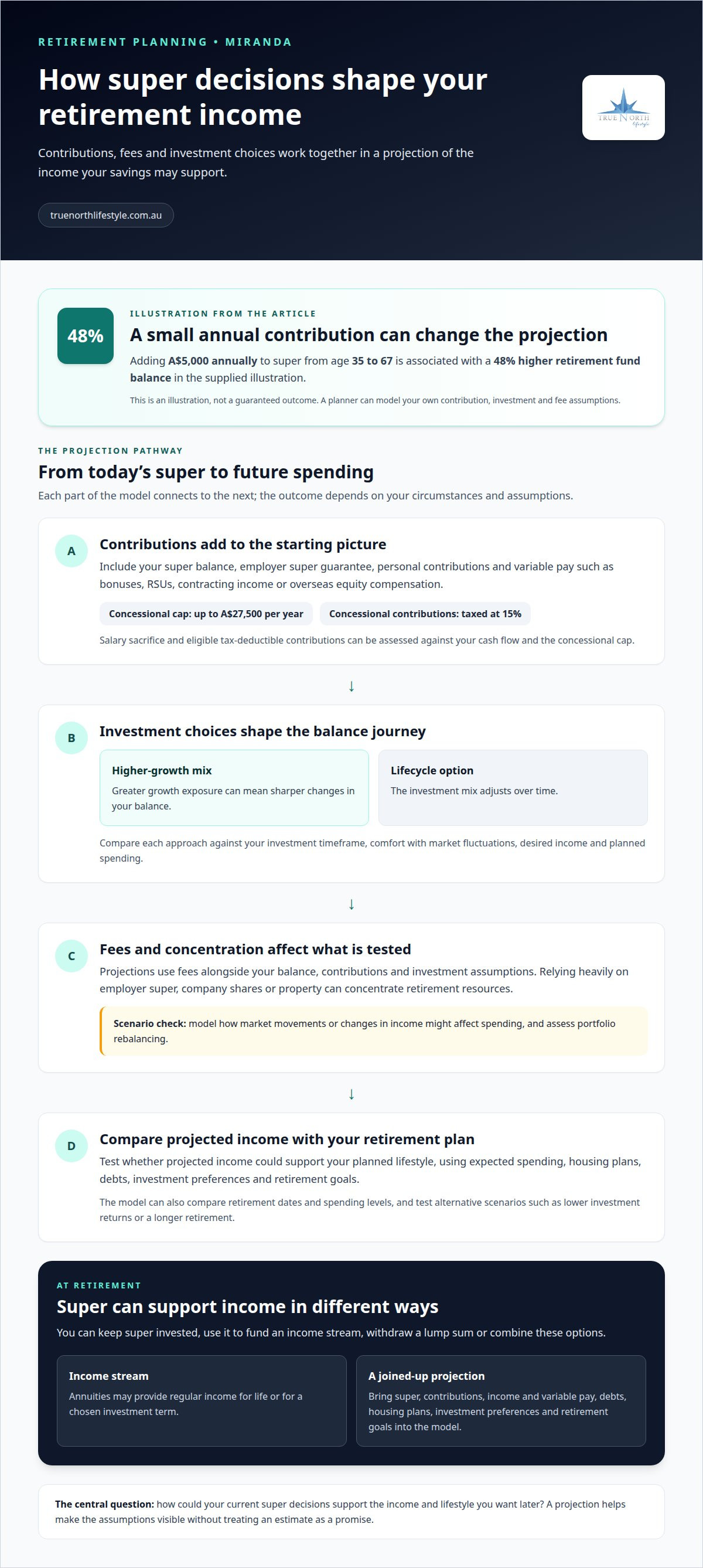
Retirement planning for machine learning engineers in Miranda starts by connecting current finances with the lifestyle and income wanted later. A planner can model spending, housing, debts and retirement goals, then test how contribution levels, investment choices and fees shape projected income. For example, adding A$5,000 annually to super from age 35 to 67 is associated with a 48% higher retirement fund balance in the supplied illustration.
A planner can compare a higher-growth investment mix with a lifecycle option by modelling your investment timeframe and comfort with market fluctuations. Greater growth exposure can mean sharper changes in your balance, while a lifecycle option adjusts its investment mix over time. The comparison should consider how each approach could support your desired income and spending.
Eligible Australians can make concessional super contributions of up to A$27,500 per year. Concessional contributions deposited before tax are taxed at 15%. The super guarantee is an employer contribution that also affects projections; the model should account for it alongside personal contributions.
A planner can assess salary sacrifice and eligible tax-deductible contributions against your cash flow and the concessional cap. Retirement planning for machine learning engineers in Miranda can also factor in RSUs, bonuses, contracting income and overseas equity compensation by mapping variable pay and vesting into future contribution scenarios.
Relying heavily on employer super, company shares or property can concentrate your retirement resources. A planner can model how market movements or changes in income might affect spending and assess portfolio rebalancing. Annuities may provide regular income for life or for a chosen investment term. At retirement, you can keep super invested, use it to fund an income stream, withdraw a lump sum or combine these options.
To build projections, a planner uses your super balance, contribution details, income and variable-pay information, debts, housing plans, investment preferences and retirement goals. This helps test whether projected income could support your planned lifestyle.
Retirement budgets for single people and couples
A retirement budget in Australia starts with the lifestyle you want to fund. These are reference points, not personal spending plans. Housing, health, travel and household costs can change the income you need, as can whether you own your home, downsize or rent.
A retirement planner can group projected spending into essentials and discretionary choices, then compare it with super income and other available support. A single person may need to cover household costs alone, while a couple may share some expenses but still needs to plan for each person’s needs. A useful budget also allows for spending to change over time, rather than assuming today’s costs will stay constant throughout retirement.
For the Age Pension in 2026-27, assessment considers qualifying age, income and assets; the tests affect eligibility and payment rates. Services Australia lists the total as A$1,866 per fortnight. These figures help frame a projection, while the income and assets assessment determines how support relates to an individual’s circumstances.
The Australian Government’s 2026-27 Budget included proposed measures affecting people approaching retirement, retired people or planning for aged care. Those measures were proposals, not law. A retirement budget can show how different income and spending assumptions affect the plan, without treating proposed changes as settled rules.
Investment choices should support the budget’s timing and income needs. A planner can model how a portfolio may fund regular spending while considering market fluctuations and the need to preserve savings over time. For example, essential costs and discretionary travel can be modelled separately, making it easier to see which goals depend on investment returns. Retirement budget modelling can help connect projected income with the lifestyle you want to plan for.
Estimating how much money is needed for retirement
There’s no single super balance that guarantees a comfortable retirement for every machine learning engineer in Australia. The amount you need depends on your desired spending, housing, debts, income sources and how long your savings must last.
A useful estimate connects those personal inputs with projected super and potential Age Pension support. Retirement spending may need to be planned across a period of up to 35 years.
Estimating retirement costs
A retirement planner can translate lifestyle goals into spending categories, including housing, daily expenses, travel and healthcare. The estimate should separate regular essentials from flexible choices, then account for whether you plan to stay in your home, downsize or rent. A change in housing plans, for example, can affect both ongoing costs and the savings available for other goals.
Technical workers may also have variable income, bonuses or equity compensation before retirement. A planner can map these cash flows separately from dependable retirement income, so one-off proceeds aren’t mistaken for annual spending money.
Calculating savings needs
To estimate the savings you may need, a planner projects your starting super balance, future contributions, fees and investment returns against expected withdrawals. The model can compare retirement dates and spending levels, showing which assumptions have the greatest effect on your projected balance. It should also consider potential Age Pension support alongside super, rather than treating either source in isolation.
The calculation can then be tested under alternative scenarios, such as lower investment returns or a longer retirement. This helps show how much income your portfolio may need to provide and whether planned withdrawals fit your resources. Projections are most useful when their assumptions are clear and can be updated as your employment, housing or goals change.
Planning for healthcare costs and longevity
Healthcare needs can change as retirement progresses, and savings may need to last longer than expected. A useful plan separates routine health spending from larger, less predictable costs, then tests how each could affect your income. In Australia, inflation had been increasing again over the past year, making it important to review healthcare assumptions rather than hold them constant throughout retirement.
The Association of Superannuation Funds Australia estimates healthcare costs at around 15% of weekly expenses for people aged 65. By age 85, its estimate is around 20% of weekly expenses. These figures show why a retirement projection should model health costs at different ages, alongside everyday spending, rather than using one flat allowance.
An emergency fund can help cover an unexpected expense without forcing an untimely withdrawal from investments. A planner can distinguish accessible cash from long-term retirement assets and model how an unexpected health bill might affect both. For example, a projection can test a one-off cost against planned income and show whether other spending goals may need adjustment.
Health insurance is another part of the picture. A retirement plan can include premiums and out-of-pocket costs relevant to your chosen cover, then assess how they interact with super income and other savings. Policies and health needs can change, so projections should use updated costs as circumstances shift, without assuming insurance covers every treatment or expense.
Longevity planning also considers how income may remain sustainable if retirement lasts longer than initially expected. A planner can test different time horizons, healthcare assumptions and investment outcomes, then assess whether withdrawals remain aligned with essential spending. Discuss wealth preservation and longevity planning to develop projections that account for healthcare costs and the income you may need over time.
True North Lifestyle: Retirement modelling & long-term projections
True North Lifestyle can turn your retirement goals into clear projections, bringing super, expected spending and investment assumptions into one view. This can help you compare retirement dates, income needs or the impact of changing contributions.
For machine learning engineers, variable pay and equity compensation can make future income less predictable. Retirement modelling can show how different assumptions affect projected savings, while a superannuation review can assess whether your arrangements align with your plans. Tax-minimisation strategies and bespoke portfolio construction can also form part of a broader retirement approach.
The aim is a practical framework you can revisit as your circumstances and priorities change. Contact True North Lifestyle to discuss retirement modelling for your goals.
Give your next step a clear direction
Your next step is to turn broad retirement intentions into decisions you can revisit as work and life evolve. For machine learning engineers, that can mean bringing changing compensation, career plans and personal priorities into one considered financial picture. A clear framework helps you see which assumptions shape your future choices and where adjustments may matter most.
True North Lifestyle supports this process with retirement modelling and long-term projections, tax-minimisation strategies, and superannuation review and optimisation. For retirement planning for machine learning engineers in Miranda, the value lies in connecting these considerations to your goals, rather than treating each decision in isolation.
Start a conversation when you’re ready to explore a plan shaped around your circumstances. Contact True North Lifestyle to discuss your next step and move forward with greater clarity.
Frequently Asked Questions
What happens to your super when you retire?
You can generally keep your super invested, use it to start an income stream, withdraw a lump sum or combine these approaches. The right structure depends on how you want to receive income and manage your remaining savings. For example, if you want regular payments, you might use an income stream while keeping other savings invested. Your retirement plan can compare these choices with your expected cash flow.
What retirement age and lifestyle does Miranda, NSW typically plan for?
There isn’t one retirement age or lifestyle that applies to everyone in Miranda. Your timing may depend on when you want to stop or reduce work, while your preferred housing, spending and activities shape the lifestyle you’re planning for. Someone who plans to keep consulting part-time may need a different transition plan from someone leaving work entirely. Set projections around your goals, not an assumed local norm.
How does Australian superannuation work for machine learning engineers?
Australian superannuation works under the same system for machine learning engineers as for other employees: employer contributions and eligible personal contributions build retirement savings, which are invested through your chosen super arrangement. Your occupation doesn’t create a separate super scheme. If you have bonuses, contracting income or equity compensation, include those cash flows in your planning so projected contributions reflect changing remuneration, not just salary.
What are the current super guarantee rate and concessional contribution caps in Australia?
Eligible Australians can make concessional super contributions of up to A$27,500 per year.
How much super might a machine learning engineer need to retire comfortably in Australia?
There’s no single super balance that guarantees a comfortable retirement. The amount you need depends on your lifestyle, housing, spending, debts and how long your savings must last.


