

Reducing your professional hours doesn't have to mean shrinking your bank balance. For many Australians, the approach to age 60 is often clouded by high personal income tax and a nagging anxiety about whether their nest egg will truly last the distance. It's a period defined by a desire for more time but a fear of losing financial momentum. You've worked hard to build your life; the thought of compromising your current lifestyle to fund your future is a difficult trade-off to accept.
Clarity brings confidence. By implementing bespoke transition to retirement strategies, you can effectively bridge the gap between full-time work and your final retirement date. This guide will show you how to manage the 2026 landscape, leveraging the updated $32,500 concessional contribution caps to minimise tax while potentially boosting your superannuation balance. We will examine the technical modelling required to balance immediate cash flow needs with long-term longevity, ensuring you remain the steady navigator of your own financial journey.
Key Takeaways
- Learn why age 60 is the pivotal preservation age for Australians in 2026 and how it enables you to access your superannuation benefits while remaining in the workforce.
- Compare two powerful transition to retirement strategies that allow you to either supplement your income while working part-time or accelerate your wealth through salary sacrifice.
- Gain clarity on the 2026 tax environment, specifically how to leverage the $32,500 concessional contribution cap to minimise your personal income tax.
- Identify why bespoke retirement modelling is superior to generic calculators for protecting your lifestyle against inflation and market volatility.
- Follow a professional checklist to consolidate your superannuation and ensure your portfolio is optimised for the unique challenges of the 2026 financial year.
Understanding Transition to Retirement (TTR) Strategies in 2026
Clarity replaces chaos. Transition to retirement strategies offer a structured path through the final chapters of a professional career, providing a sense of order during a time of significant change. For many, the traditional view of What is Retirement? is shifting from a sudden stop to a gradual, controlled evolution. A TTR strategy acts as a financial bridge between full-time work and total leisure, allowing you to access a portion of your superannuation while you remain in the workforce.
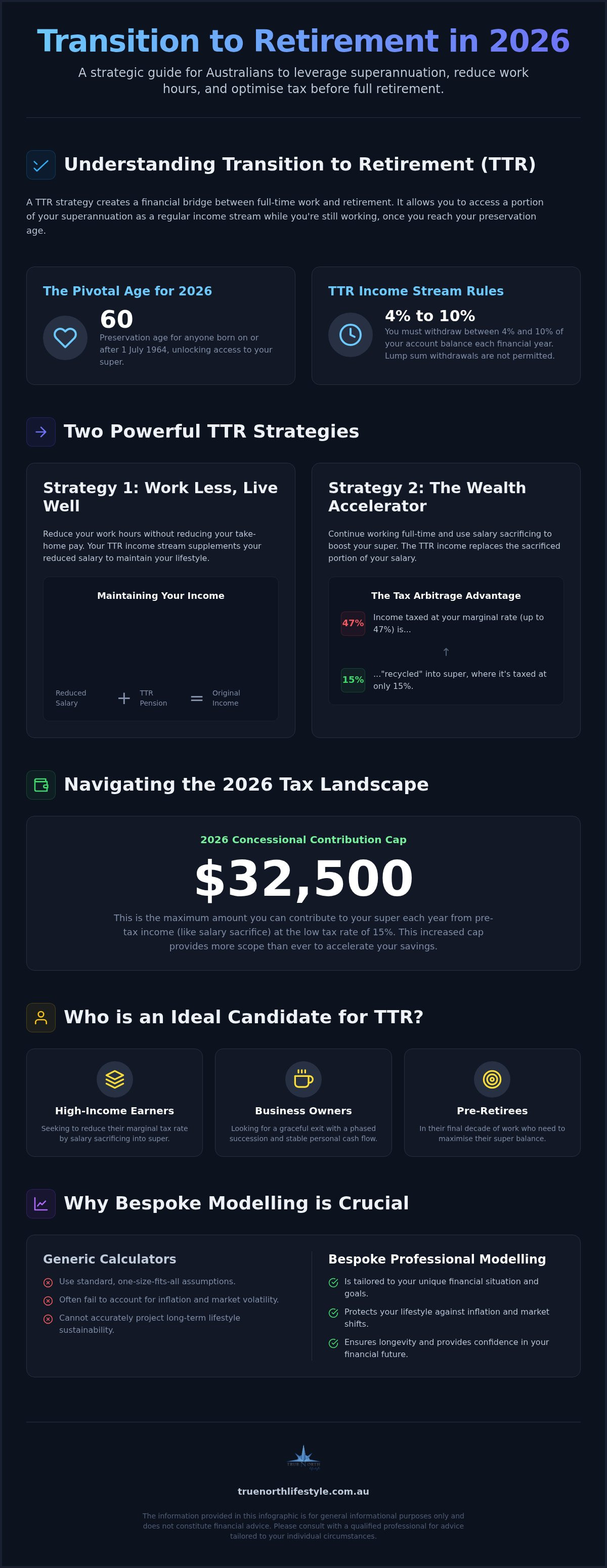
In 2026, the regulatory landscape is clearer than in previous years. For anyone born on or after 1 July 1964, the preservation age is now firmly set at 60. Reaching this milestone is the magic number that unlocks the ability to start a TTR income stream. This regulatory certainty helps quiet the anxiety of longevity risk, providing a predictable framework for those looking to adjust their work-life balance without sacrificing their standard of living. It's about maintaining control while the environment around you shifts.
The Core Mechanism of a TTR Income Stream
Establishing a TTR strategy involves a deliberate structural shift. You move a portion of your superannuation from the accumulation phase into a dedicated transition to retirement income stream. This allows you to receive regular payments while your employer continues to contribute to your separate accumulation account. However, strict guardrails apply. You must withdraw a minimum of 4% and a maximum of 10% of the account balance annually. Unlike a full retirement pension, lump sum withdrawals are generally prohibited, keeping the focus on sustainable income replacement and long-term stability.
Who is the Ideal Candidate for a TTR Strategy?
Success with transition to retirement strategies depends on your specific financial architecture. High-income earners often utilise this path to reduce their marginal tax rate by salary sacrificing into super while replacing that income with tax-free pension payments. For Sutherland Shire business owners, it provides a graceful exit, allowing for a phased succession without a sudden drop in personal cash flow. It's also the preferred choice for individuals in their final decade of work who need to maximise their super balance. By recycling tax savings back into their fund, you can significantly strengthen your wealth preservation without compromising your day-to-day lifestyle.
The Dual Benefits: Reducing Work Hours vs Boosting Superannuation
Choice is empowering. Transition to retirement strategies aren't monolithic; they adapt to your specific objectives. Whether you wish to reclaim your time or fortify your capital, this structure remains a robust vehicle for financial stability. It allows for a deliberate, phased exit from the workforce that preserves your capital while providing the flexibility to live life on your terms. This period serves as a vital rehearsal for your final retirement, ensuring the lifestyle you've envisioned is both achievable and sustainable.
Path A: Maintaining Lifestyle on Reduced Hours
Transitioning to a three or four day work week often creates a daunting income gap. For a Sydney executive, this reduction in billable hours or salary can mean a significant drop in monthly cash flow. However, a TTR pension fills this void by drawing income directly from your superannuation. Consider a senior professional in the Sydney CBD who chooses to reduce their workload by 20%. By activating a TTR income stream, they can supplement their reduced salary and maintain their exact take-home pay. This strategy allows you to enjoy more leisure time now without compromising your current standard of living. For a structured approach to these preparations, reviewing resources like the U.S. Department of Labor's Retirement Checklist can provide a useful global perspective on readiness, though local technical modelling remains essential.
Path B: The Tax-Optimised Super Boost
For those not yet ready to leave the office, the Wealth Accelerator path offers a sophisticated tax arbitrage. You continue working full-time but salary sacrifice a significant portion of your income into super. To maintain your lifestyle, you draw an equivalent amount from your TTR pension. This recycle strategy replaces income taxed at your marginal rate, which can be as high as 47%, with super contributions taxed at just 15%. In 2026, the concessional contribution cap has risen to $32,500, providing more scope than ever to accelerate your savings. This effectively uses tax incentives to fast-track your super balance in its final growth phase.
Preserving your capital while transitioning requires precise navigation. It's not just about the numbers; it's about the certainty that your strategy won't run dry. Engaging in professional retirement modelling and long-term projections ensures your chosen path is grounded in reality and built to last.
Navigating Tax Optimisation and Contribution Caps
Precision leads to peace. Once you turn 60, the tax landscape for your retirement income shifts into a more favourable gear. TTR pension payments are generally tax-free, allowing you to supplement your lifestyle without pushing your personal taxable income into a higher bracket. However, the internal mechanics of the fund remain distinct; while your personal payments are tax-free, the investment earnings within the TTR account are still taxed at up to 15%, which differs significantly from a full account-based pension where earnings are typically tax-exempt. Managing this transition requires a keen eye on the General Transfer Balance Cap, which as of 1 July 2026, sits at $2.1 million.
A frequently overlooked factor in transition to retirement strategies is the "sequence of returns" risk. Drawing down from your superannuation during a period of market volatility can have a compounding negative effect on your long-term financial health. If you liquidate assets during a downturn to fund your TTR payments, you lose the opportunity for those assets to recover when the market eventually turns. This makes bespoke portfolio construction essential, as it ensures your cash flow needs are met through dividends or cash reserves rather than forced asset sales at an inopportune time.
Salary Sacrifice and Concessional Caps
Strategic timing is paramount. For the 2026 financial year, the concessional contribution cap has reached $32,500, offering a significant opportunity to lower your taxable income. For Sydney business owners, the goal is to align these contributions with high-profit periods to maximise the immediate tax benefit. Professional modelling is the only way to navigate these limits safely, as exceeding the cap can lead to unnecessary penalties and administrative hurdles. It's about finding the "sweet spot" where your tax savings are maximised without triggering unwanted ATO scrutiny.
The Re-contribution Strategy Integration
A TTR income stream also serves as a catalyst for a superannuation re-contribution strategy. This involves withdrawing funds from the taxable component of your super and re-contributing them as non-concessional contributions. This process effectively reduces the future tax liability for your non-dependant beneficiaries, such as adult children, who might otherwise face a 15% tax plus Medicare levy on the taxable portion of an inherited lump sum. While you focus on the technicalities, AARP's Guide to a Smooth Retirement Transition reminds us that the psychological shift is just as important as the fiscal one, helping you move from a mindset of accumulation to one of strategic preservation.
Implementing a TTR Strategy: A Checklist for Sydney Professionals
Precision demands a plan. Transitioning to a new financial phase in a high-cost environment like Sydney requires more than just a signature on a form; it requires a methodical approach to ensure your lifestyle remains protected. The goal is to replace uncertainty with a structured, step-by-step progression toward your retirement objectives. Following a disciplined checklist helps you avoid common pitfalls that can derail even the most well-intentioned transition to retirement strategies.
- Step 1: Conduct a thorough superannuation review. You must confirm your current fund technically supports a TTR income stream and that your account balance is sufficient to meet the 4% minimum withdrawal requirement.
- Step 2: Perform retirement modelling. Stress-test your strategy against various market scenarios and inflation rates to ensure your capital can sustain your desired lifestyle for the long term.
- Step 3: Consult a specialist. Whether you are based in Miranda or the Sydney CBD, meeting with a professional ensures your structure is compliant with the latest 2026 regulations and tailored to your personal tax position.
- Step 4: Notify your employer. Once the structure is ready, you'll need to adjust your payroll arrangements and update any salary sacrifice agreements to align with the $32,500 concessional cap.
- Step 5: Review and re-optimise. Your goals will evolve. Commit to an annual review to adjust your drawdowns and contributions as your personal circumstances or market conditions change.
The Importance of Superannuation Review
Evaluating your fund's technical capability is your first line of defence. It's a common oversight, but many pre-retirees inadvertently cancel their life or TPD insurance when they alter their superannuation structure or move funds. Seeking professional superannuation advice Sutherland Shire ensures that your fees remain competitive and your underlying insurance remains intact. We focus on simplifying these complexities so you can move forward with the certainty that your foundations are secure.
Bespoke Portfolio Construction for TTR
A TTR account requires a distinct asset allocation that differs from a pure accumulation fund. Your portfolio must be engineered to provide reliable cash flow for your annual drawdowns while maintaining exposure to growth assets that combat the rising cost of living in Sydney. Our Investment Committee focuses on constructing low-volatility portfolios that aim to mitigate the "sequence of returns" risk discussed earlier. By shielding your capital from sharp market swings during this delicate phase, we help you maintain a steady course toward full retirement.
Ready to build your roadmap? Book a session for retirement modelling and long-term projections to see how these steps apply to your unique situation.
Bespoke Retirement Modelling: Beyond Generic Government Advice
Confidence requires evidence. Generic government calculators often provide a basic starting point, but they are frequently inadequate for high-net-worth individuals with complex tax structures and specific lifestyle goals. These tools typically overlook the nuances of inflation and the reality of market volatility, which can lead to a false sense of security. Transition to retirement strategies must be built on more than just averages; they require a bespoke architecture that reflects your actual spending patterns and longevity expectations. True North’s approach integrates these plans with comprehensive wealth preservation strategies to ensure your legacy remains intact while you fund your current lifestyle. This documented, research-driven methodology moves the focus from mere numbers to the human outcome of financial security.
Stress-Testing Your TTR Strategy
Data-driven certainty is the hallmark of a professional plan. We don't just plan for the best; we model for the difficult years. By running worst-case market scenarios through our proprietary systems, we can ensure your superannuation isn't depleted prematurely during a downturn. When we stress-test transition to retirement strategies, we look beyond the current year to account for long-term sustainability. This involves adjusting your projections based on sustainable retirement withdrawal rates, ensuring that your 4% to 10% drawdowns don't compromise the fund's future growth. It's the Steady Navigator approach: using logic and structure to remain calm while the market fluctuates. This rigorous testing provides a protective layer against the inherent anxiety of complex financial decision-making.
Your Next Steps with True North Lifestyle
The path forward is defined by order. Moving from a state of confusion to one of structured oversight is a significant emotional relief. A face-to-face consultation at our Miranda or Sydney CBD offices allows us to deep-dive into your specific numbers and long-term projections. We've done the heavy lifting of research and testing, allowing you to step into a role of confident oversight. You deserve a partner who values trust and proven outcomes over flashy innovation. Organise a consultation with our Sydney financial advisers to begin constructing your documented, research-driven path to retirement.
Securing Your Financial Horizon in 2026
The path to age 60 is no longer a descent toward an uncertain finish line but a deliberate transition toward a new way of living. By integrating sophisticated transition to retirement strategies, you've seen how it's possible to reclaim your time without compromising your financial stability. Whether you choose to reduce your professional hours or accelerate your wealth through the updated 2026 contribution caps, the key remains a structure built on evidence rather than averages.
Clarity replaces anxiety when your plan is backed by a research-driven Investment Committee and a focus on low-volatility portfolio construction. At True North Lifestyle, we specialise in the complex retirement planning needs of Sydney professionals, ensuring your strategy is resilient against market fluctuations and inflation. You don't have to navigate these regulatory shifts alone. Step into a role of confident oversight and ensure your lifestyle is protected for the decades ahead.
Book a bespoke retirement modelling session with True North Lifestyle to begin your journey toward a structured and certain future. Your next chapter deserves the stability of a well-defined path.
Frequently Asked Questions
What is the preservation age for a TTR strategy in 2026?
The preservation age for anyone born on or after 1 July 1964 is 60. Reaching this milestone is the essential trigger that allows you to access your superannuation through a transition to retirement income stream while remaining employed. It's a critical date in your financial calendar. Understanding this requirement helps you time the commencement of your strategy with precision, ensuring you don't inadvertently trigger compliance issues before you are legally eligible to draw down your benefits.
Can I still make contributions to my super while on a TTR pension?
You can absolutely continue to make contributions to your superannuation while receiving a TTR pension. In fact, many transition to retirement strategies rely on this dual flow to maximise tax efficiency. For the 2026 financial year, you can utilise the $32,500 concessional contribution cap to salary sacrifice into your accumulation account while simultaneously drawing a pension. This cycle effectively replaces high-taxed income with tax-effective superannuation growth, provided you stay within the regulated contribution limits.
How much tax will I pay on my transition to retirement income?
If you are aged 60 or over, your TTR pension payments are generally tax-free. This provides a significant boost to your net cash flow without increasing your personal taxable income. However, it is vital to remember that the investment earnings within the TTR account itself are still taxed at up to 15%. This is a distinct difference from a full retirement phase pension, where earnings are typically tax-exempt, making professional modelling essential to track your long-term balance.
Can I take a lump sum from my TTR account if I have an emergency?
Lump sum withdrawals are generally prohibited from a TTR account until you meet a full condition of release. Your access is restricted to a maximum of 10% of your account balance each financial year. This restriction is designed to ensure the strategy remains a sustainable income stream rather than a vehicle for capital depletion. If you face a genuine financial emergency, you must typically rely on other liquid assets or wait until you reach age 65 or retire fully.
Will a TTR strategy affect my eligibility for the Age Pension later?
A TTR strategy can influence your future Age Pension eligibility through the standard Centrelink income and assets tests. While the Age Pension age is 67 for most Australians in 2026, the way you structure your superannuation now can impact your assessments later. TTR accounts are counted as assets, and the deemed income can affect your payment rates. We prioritise early modelling to ensure your current strategy doesn't create unforeseen obstacles when you eventually apply for government support.
What happens to my TTR strategy when I reach age 65?
When you turn 65, your TTR pension automatically converts into a standard account-based pension in the retirement phase. This is a significant milestone because the 10% maximum annual withdrawal limit is removed, giving you total flexibility over your capital. The investment earnings within the account also become tax-free, subject to the $2.1 million transfer balance cap. This shift simplifies your financial structure and typically improves the overall tax efficiency of your retirement portfolio.
Is a TTR strategy worth it if I am already in a low tax bracket?
Even if you are in a lower tax bracket, a TTR strategy can be highly valuable for lifestyle reasons. The primary benefit shifts from tax arbitrage to income replacement, allowing you to reduce your working hours without a corresponding drop in your take-home pay. It provides the financial floor needed to move to part-time work or consult on your own terms. The focus moves from aggressive tax saving to maintaining your current standard of living while working less.
How often should I review my transition to retirement strategy?
You should review your transition to retirement strategy at least once every twelve months. Annual reviews are necessary to adjust your drawdown rates based on your current account balance and to ensure you are maximising the 2026 contribution caps. Market volatility and changes in your personal lifestyle goals can also necessitate structural tweaks. Regular oversight ensures your plan remains a reliable anchor, providing the stability and order required to navigate the final years of your professional career.


