

What if the investment that looks strongest on paper is the wrong fit for your life? For Sydney households balancing living costs, family priorities and long-term goals, wealth creation strategies Sydney investors consider can involve very different trade-offs. Property, superannuation and diversified investments may each have a role, but they differ in risk, access to your money and tax treatment. Comparing them can feel complicated, especially when general information doesn’t reflect your circumstances.
A more useful starting point is to define the outcome you want, when you may need the money and how much uncertainty you can manage. This guide compares practical ways to build wealth, including their trade-offs around growth, liquidity, tax and risk. It also explains what to gather before speaking with a financial adviser in Miranda 2228 or elsewhere in Sydney, so you can focus on your goals, superannuation, investments and the assumptions that matter to your household. The aim isn’t to find one perfect investment. It’s to understand how the pieces could work together in a considered plan.
Key Takeaways
- Wealth creation works best as a coordinated plan shaped around your goals, rather than a bet on one asset or product.
- Compare cash flow, superannuation, property and diversified investments by their accessibility, time horizon and risks.
- Use wealth creation strategies Sydney households can adapt to their priorities, from retirement needs to family and lifestyle plans.
- Make your approach practical: clarify what you’re working towards, assess your tolerance for risk and schedule regular reviews.
- Before speaking with an adviser, organise details about your goals, finances, superannuation and existing investments.
What wealth creation strategies in Sydney are designed to achieve
Build with purpose. Wealth creation means growing financial resources over time to support the life you want, whether that includes a home, greater flexibility, family needs or a comfortable retirement. The broader concept of wealth can include more than money, but a practical financial strategy focuses on how your resources may help meet your goals.
Effective wealth creation strategies Sydney households use aren’t defined by one investment or product. They bring together decisions about income and spending, investments, superannuation, tax considerations and risk management. Wealth creation focuses on building resources; wealth preservation focuses on protecting what you’ve accumulated and supporting its longevity. The two overlap: managing risk and reviewing a plan can help safeguard progress while still allowing for growth. Neither approach guarantees an outcome. Results depend on your circumstances, market conditions, time frame and the level of risk taken.
What belongs in a wealth creation strategy?
Start by building a clear picture of your:
- Goals and time frame: what you’re working towards and when you may need the funds.
- Income, spending and liabilities: what comes in, what goes out and what you owe.
- Assets and superannuation: what you already hold and how it relates to your plans.
- Risk tolerance and protection needs: how much fluctuation you can accept and what risks could disrupt your plans.
These factors interact. For example, a couple in the Sutherland Shire with young children might be saving for future education costs while paying down a home loan and building retirement savings through super. Their available cash, competing priorities and comfort with investment risk all affect how they might balance those goals. This is an illustration, not a recommended portfolio. A household with different income, debt or time frames could make different choices.
Who can benefit from a structured approach?
Structure can help professionals managing competing goals, families planning for future costs, business owners with changing income, and people approaching retirement who are considering how to use their accumulated resources. You don’t need substantial assets to start. Organising cash flow, clarifying priorities and understanding your super can help establish a direction before you’ve built significant wealth.
If you’re considering how investment choices could reflect your circumstances, a related guide to bespoke investment advice in Sydney can offer another perspective. A structured plan provides a framework for decisions, not a promise of returns. Revisit it as your goals, finances and circumstances change.
The main wealth creation strategies and how they work together
Think in connected parts. Managing cash flow can create capacity to save and invest. Superannuation may support longer-term retirement goals, while investments outside super can serve goals where access to funds matters. The right mix depends on your circumstances, not a universal ranking. The Australian Bureau of Statistics’ latest household wealth data provides broader context on household assets and liabilities, but your own starting point matters most for planning.
Each asset type behaves differently. Shares and diversified portfolios can provide exposure to different investments, but their values can fluctuate. Property may suit some long-term plans, yet it can be harder to sell quickly and involves property-specific costs and risks. Cash is generally more accessible, but its role and growth potential differ from assets intended for longer time frames. Diversification can spread exposure across investments, but it doesn’t eliminate risk.
How do investing and superannuation differ as wealth-building tools?
Superannuation is designed for retirement savings, with investment options and access governed by Australian rules. Investments held outside super may offer different choices and access, depending on the asset and arrangements. Tax treatment also varies, so consider how contributions, earnings and withdrawals may affect your overall position. Super rules can change. Check current details with official sources or a qualified professional. A dedicated superannuation advice guide can help you understand what to consider when reviewing a fund.
How should growth, access and risk be balanced?
A longer time frame may give you more opportunity to ride out short-term market movements. If you may need the money sooner, give closer consideration to access and stability. That doesn’t mean there’s one suitable allocation for every investor. Consider when you may need funds, how much fluctuation you could tolerate and whether your investments are concentrated in one asset or area. A wealth preservation guide can add perspective on resilience and managing risk as circumstances change.
Tax-aware planning is another connecting thread. Investment and superannuation decisions can have different tax implications, and the relevant rules depend on individual circumstances and current law. Seek professional advice before acting on tax-sensitive choices. An adviser can help coordinate a strategy, while tax matters requiring specialist interpretation may need a registered tax professional.
For Sydney investors, wealth creation strategies Sydney residents consider should be assessed against their own goals, cash needs and time horizon, rather than ranked as universally best or worst. To explore how portfolio construction, superannuation and tax-minimisation strategies may fit together, learn more about True North Lifestyle’s financial advice.
Which wealth creation approach fits your goals, time frame and risk tolerance?
There’s no single winning asset. A suitable approach depends on what you’re saving for, when you may need the money, how much fluctuation you can tolerate and how much effort you’re comfortable taking on. You don’t need to be a high-net-worth investor to benefit from thoughtful planning. The scope might be as focused as reviewing superannuation or as broad as coordinating investments, tax considerations and retirement goals.
How do you compare common wealth-building options?
Use the same questions to assess each option. The table is a starting point, not a ranking or personal recommendation.
| Approach | Purpose and time frame | Access | Complexity, costs and key risks |
|---|---|---|---|
| Diversified investment portfolio | Can support medium- or long-term goals, depending on the investments selected. | Varies by investment. Some assets may be easier to sell than others. | Requires decisions about investment mix and ongoing review. Fees, market falls and the risk of selling at an unfavourable time need consideration. Diversification doesn’t remove losses. |
| Superannuation strategy | Primarily designed to support retirement savings over the longer term. | Access is generally subject to conditions of release under Australian superannuation rules. | Investment options, fees and tax treatment vary. Rules can change, so check current details with the ATO or another official source. |
| Property | Often considered for longer-term goals, including potential rental income or capital growth. | Less readily accessed than cash or many listed investments. Selling takes time. | Can involve substantial purchase, holding and selling costs, plus management effort. Values, income and expenses can change. |
Tax and regulatory details depend on your circumstances and current Australian rules. Verify them with official sources and seek qualified advice before acting. Past performance isn’t a reliable forecast of future results. Moneysmart’s guide can help you develop an investing plan around your goals, time frame and risk.
What if you are cautious about investment risk?
Concern about market falls, volatility or having savings tied up is reasonable. Start by identifying when you may need access to funds, then consider how diversification and your time frame could shape the discussion. Scenario testing can help you examine how a plan might respond to different market conditions or changing needs. It can inform decisions, but it can’t predict markets or prevent losses.
Risk management is ongoing. Review your exposures, understand what could affect your goals and adjust the plan as circumstances change. Wealth creation strategies Sydney investors consider should reflect their own needs, not a universal league table. If you’d like to discuss portfolio construction or risk management with True North Lifestyle, explore financial advice options.
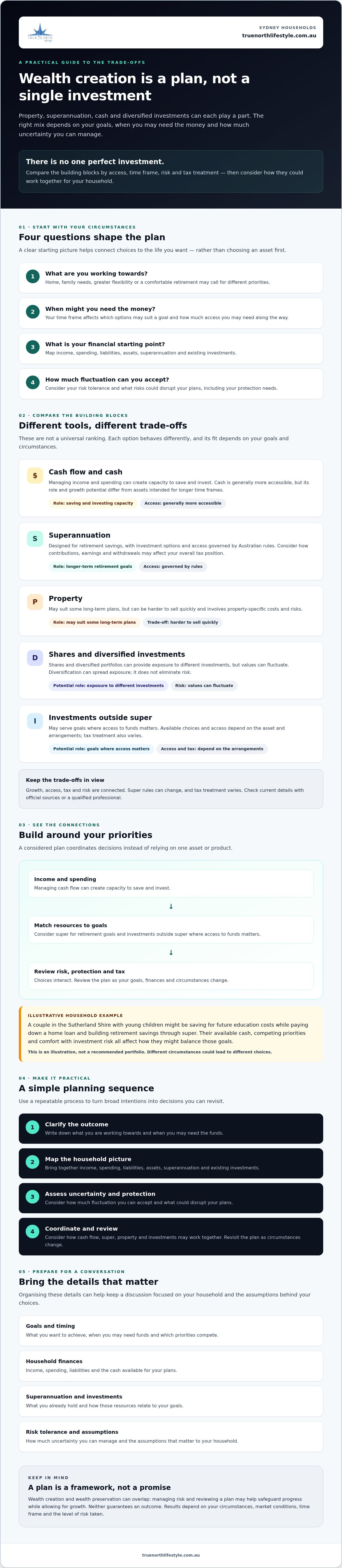
How to turn a wealth creation strategy into a practical Sydney plan
A workable plan begins with your actual finances and priorities, not a product. These steps can help you organise information and decisions before speaking with an adviser. For a Sydney household, that might mean weighing future education costs against a career break or retirement goals. This is an example of competing priorities, not a claim about local markets.
What information should you gather before building a plan?
Bring together a clear snapshot of your finances, then turn it into questions and decisions:
- 1. Define your goals. Note what you want to achieve, when you may need the money and which goals matter most.
- 2. Record your position. Gather details of income, spending, debts, assets, superannuation and any dependants.
- 3. Note upcoming commitments. Include major planned expenses, existing financial commitments and any likely changes to household income.
- 4. Clarify access and risk. Consider how much money needs to remain accessible and how comfortable you are with investment values fluctuating.
- 5. List your questions. Write down what you want to understand about investments, superannuation, tax considerations and risks that could affect your plans.
You don’t need every figure to be perfect. An honest overview is a useful starting point. Recent super statements and a household budget can help clarify the picture.
How can you monitor and adjust the strategy?
Agree on a review schedule and measure progress against your goals and the assumptions behind the plan. Check whether your time frames, cash needs and capacity to invest still make sense. A change in employment, family circumstances, health or retirement plans may call for a fresh look. Major market movements can also prompt a review, though reacting to every shift may not support a considered long-term approach.
Scenario modelling can help compare possible outcomes if assumptions change, such as income, investment returns or the timing of a goal. It’s a way to test resilience and identify decisions to revisit, not a prediction or guarantee. If future income is becoming a priority, a guide to retirement planning in Sydney may help you consider the next set of questions.
These steps can make a conversation more focused. If you’d like help testing assumptions and coordinating investments, superannuation and long-term projections, discuss your financial planning needs with True North Lifestyle.
How Sydney financial advice can bring your wealth strategy together
A financial adviser can help connect decisions that are often considered separately: your goals, investment approach, superannuation, tax considerations and tolerance for risk. This can make wealth creation strategies Sydney households explore easier to assess as a whole, rather than as a series of disconnected choices. Advice should be based on your objectives and circumstances, and it can’t guarantee investment outcomes.
What can a financial adviser help you assess?
Retirement modelling and long-term projections can help compare scenarios, test assumptions and show how changes in income, timing or spending might affect future plans. They’re planning tools, not forecasts. A superannuation review may examine how your fund and investment options align with your objectives, while bespoke portfolio construction can consider the role of investments outside super.
True North Lifestyle provides financial advice in New South Wales, including retirement modelling, superannuation review and optimisation, tax-minimisation strategies, bespoke portfolio construction and risk management. Its services also include wealth preservation and longevity planning, Centrelink structuring and estate planning strategy. People in Miranda 2228 and Sydney 2000 can discuss which services may suit their needs. Ask how recommendations relate to your goals, time frame and risk profile, and what they can and can’t address.
What should you ask before proceeding with advice?
A clear discussion helps you understand what you’re agreeing to and how the advice may work in practice. Consider asking:
- Scope: Which parts of my financial situation will the advice cover, and what falls outside it?
- Reasoning: How do the recommendations relate to my goals, time frame and comfort with risk?
- Costs: What fees apply, how are they calculated, and what services do they include?
- Conflicts: How are potential conflicts of interest identified and managed?
- Implementation: What decisions or actions would be mine, and what support is included?
- Review: How often will we revisit the plan, and what circumstances should prompt an earlier review?
Take time to understand the proposed strategy, its risks and the service arrangements before deciding whether to proceed. A useful conversation should leave you clearer about your options, not pressured to choose an investment immediately.
If you’re ready to explore how advice may help bring your goals, superannuation and investments into one considered plan, discuss your wealth creation goals with True North Lifestyle.
Take the next step towards a considered wealth plan
A sound plan isn’t about choosing one asset and hoping for the best. It’s about connecting your goals, time frame, access needs and comfort with risk, then reviewing those decisions as life changes. The right wealth creation strategies Sydney households use depend on their circumstances, and no approach can guarantee investment outcomes.
Professional guidance can help bring the moving parts into focus. True North Lifestyle offers retirement modelling and long-term projections to compare financial scenarios, alongside superannuation reviews, tax-minimisation strategies and wealth preservation planning. Its bespoke portfolio management is supported by an in-house Investment Committee. These services can help inform a strategy, but suitability depends on your individual needs and objectives.
Before acting, make sure you understand the advice scope, fees, risks and review arrangements. If you’d like to explore how your goals and financial circumstances could shape a coordinated plan, discuss your wealth creation goals with True North Lifestyle.
Frequently Asked Questions
What are the most common wealth creation strategies in Australia?
Common Australian wealth-building approaches include regular saving, diversified investing, superannuation planning and managing risk. A considered plan may use these together, with each serving a different purpose: cash reserves support access needs, investments may suit longer-term goals, and superannuation is generally focused on retirement. Property and shares can play a role, but neither is automatically suitable. Compare liquidity, costs, volatility and tax treatment, and check current Australian rules before acting.
How do I start building wealth in Sydney?
Start by defining what you want your money to support and when you may need it. Review your income, spending, debts, savings and superannuation, then consider your time frame and comfort with investment risk. Choosing wealth creation strategies Sydney investors can use starts with personal circumstances, not broad assumptions about the city. For example, a household in Miranda might be balancing family expenses with a longer-term savings goal. Modelling can help test scenarios against your own information.
Is property or shares better for wealth creation?
Neither property nor shares is universally better for building wealth. Shares can provide access to a range of investments, while property is a tangible asset that may require more management and can be harder to sell quickly. Both can fall in value and involve costs. Consider your goals, financial position, time frame, liquidity needs and capacity for risk. Don’t choose solely on recent performance; seek current, personal advice before making a significant decision.
Can superannuation help with wealth creation before retirement?
Yes, superannuation can form part of a long-term wealth strategy before retirement, but it has specific investment choices, rules and access conditions. Whether extra contributions or a fund review may suit you depends on your objectives and circumstances. Super isn’t a substitute for accessible savings you may need sooner. Check current tax and superannuation requirements through reliable Australian sources or with an adviser before acting, as rules can change.
How much money do I need to start investing?
There isn’t one starting amount that suits everyone. First understand your cash flow, existing commitments and when you may need access to your money. Investment options can have different minimums, fees and risks, so check their terms before deciding. You don’t need to have accumulated substantial wealth to begin planning. An adviser can help you assess a realistic approach for your circumstances, without assuming that a particular investment or contribution level is right for you.
Are wealth creation strategies guaranteed to make money?
No, investment strategies can’t guarantee gains or remove risk. Markets can fall, and results depend on factors such as asset performance, costs, time frame and decisions made along the way. A plan can help you understand risks, consider diversification and test different scenarios, but projections aren’t promises. Be cautious of claims of assured returns. Before acting, ask how recommendations work, what assumptions they rely on and what potential downsides you should understand.
When should I speak with a financial adviser about building wealth?
Consider speaking with an adviser when you have decisions to coordinate, such as reviewing superannuation, investing, planning for retirement or responding to a major life change. You don’t need to wait until you’ve built substantial assets. If you’re in Miranda or elsewhere in Sydney, prepare an overview of your goals, finances and questions. Before proceeding, ask about adviser authorisation, scope, fees, risks and review arrangements, then decide whether the service fits your needs.


