
Your business may be valuable, but that doesn’t automatically mean you’re ready to retire. For sole traders, retirement planning for self-employed Miranda starts with separating the value of the business from the income and assets you can realistically rely on later. Variable cash flow, super contributions and the timing or possibility of a business sale all affect the picture.
These decisions are connected, but they don’t have to be tackled all at once. A contribution that suits a stronger trading period may not be comfortable in a quieter one, and a hoped-for sale shouldn’t be treated as guaranteed retirement income. This guide explains how to build a projection around changing business income, consider super alongside investments and tax, and include possible business-exit scenarios. It also sets out practical questions to take to an adviser, so you can compare advice options and decide on a next step based on your circumstances.
Key Takeaways
- Retirement planning for self-employed Miranda can bring personal assets, superannuation and potential business-sale proceeds into one clearer view.
- Use a range of business-income scenarios when estimating future retirement income, rather than relying on one unusually strong year.
- Compare advice options by checking what’s included: modelling, super review, investment advice and ongoing review may differ.
- Prepare for an advice meeting by gathering key financial, super and business records, then noting your preferred retirement timing and priorities.
- Explore how retirement projections, superannuation review, tax-minimisation strategies and portfolio advice could fit together for your circumstances.
Retirement Planning for Self-Employed People in Miranda: What Needs to Be Planned?
Running a business means making decisions for today while building security for a time when you may work less or stop altogether. For sole traders, contractors and business owners in Miranda and the Sutherland Shire, retirement planning for self-employed Miranda means looking beyond a super balance. It involves considering personal assets, superannuation and any proceeds that might become available if you sell or wind down your business.
These parts of your finances need to be considered together, but they aren’t interchangeable. A business can have an estimated value on paper without generating cash you can use in retirement. A sale depends on factors such as finding a buyer, timing, the business’s ability to operate without you, and any costs or obligations that affect the proceeds. If you treat a possible sale as certain, you could leave a gap in your plan if the timing or amount differs from your expectations.
Why retirement planning can look different when you are self-employed
Employee income often arrives on a regular schedule. Business income can rise and fall with workload, invoices, expenses and trading conditions. As profits or drawings vary, it can be harder to choose a contribution amount that remains manageable in a quieter period. You may also be weighing super contributions against operating costs, personal drawings or reinvestment in the business.
You don’t need to solve every decision at once. A plan can account for uneven income and be reviewed as circumstances change. The right structure depends on your situation: being self-employed doesn’t automatically mean you have, or need, a self-managed super fund (SMSF). For a high-level introduction to Australia’s superannuation system, it helps to see super as one part of your retirement position, not the entire strategy.
What should count towards your retirement position?
Start by listing what you own, what you owe and what depends on a future event. Keeping the categories separate makes it easier to see what may be available to support you:
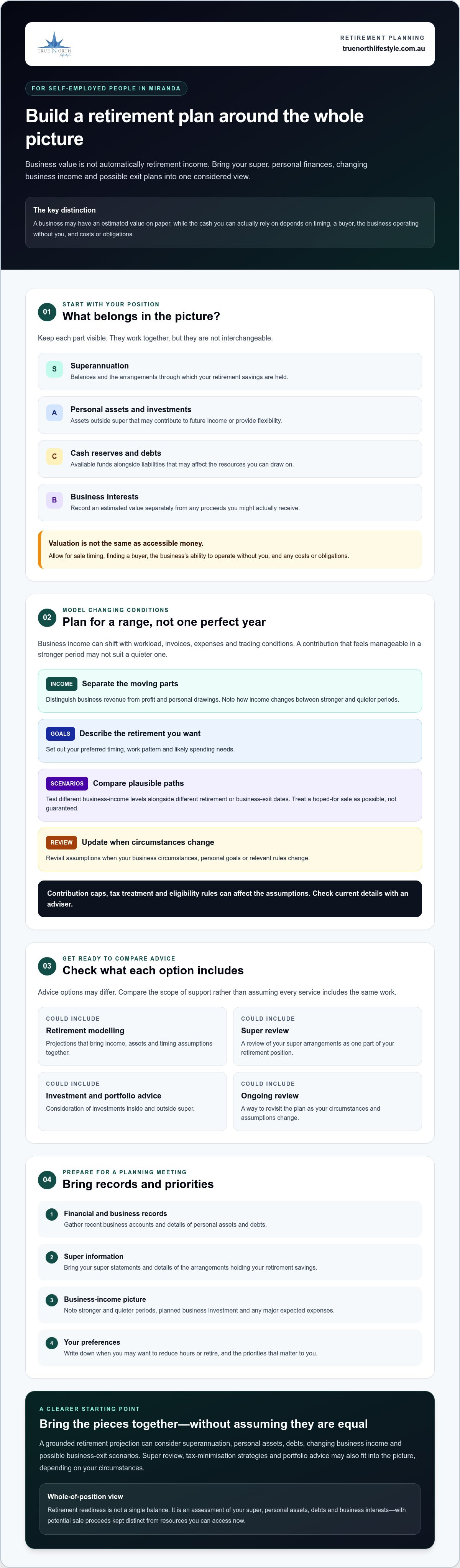
- Superannuation: balances and the arrangements through which your retirement savings are held.
- Personal assets and investments: assets outside super that may contribute to future income or provide flexibility.
- Cash reserves and debts: available funds alongside liabilities that may affect the resources you can draw on.
- Business interests: an estimated value, considered separately from the proceeds you might actually receive.
A valuation is not the same as money in your account. Assess potential sale proceeds with timing, costs and obligations in mind, rather than assuming they will be immediately available. Keeping this estimate separate from accessible assets makes your projection more grounded.
Retirement readiness is a whole-of-position assessment of your super, personal assets, debts and business interests, not a single balance. That broader view gives you a more useful starting point for the decisions ahead.
How Miranda Business Owners Can Model Retirement Alongside Business Income
A useful projection starts with a clear picture of what you have, what you earn and what you want retirement to look like. For retirement planning for self-employed Miranda, the aim isn’t to predict exactly how your business will perform. It’s to test how different, plausible paths could affect your choices.
Build a projection from reliable information
Gather records that show both your personal and business position. These may include recent business accounts, super statements, details of personal assets and debts, and expected major expenses. Note how income changes between stronger and quieter periods, whether you’re planning business investment, and when you might want to reduce your hours or retire.
Use that information to work through the modelling sequence:
- Map income: distinguish business revenue from profit and personal drawings, and identify how much varies from year to year.
- Set goals: describe your preferred retirement timing, work pattern and likely spending needs.
- Model scenarios: compare different income levels and retirement or business-exit dates.
- Review assumptions: update the projection when business circumstances, personal goals or relevant rules change.
Contribution caps, tax treatment and eligibility rules can affect the assumptions in a projection. Check current details with official sources, including the official ATO rules for sole traders, and seek appropriate advice where your circumstances call for it.
Compare different business and retirement paths
One strong year shouldn’t define the whole projection. Compare conservative, middle and stronger income assumptions without treating any of them as guaranteed. You might test continuing to run the business, gradually reducing your hours, or planning for a potential sale or succession. For each path, consider what could happen if retirement starts earlier or later, or if a sale takes longer than hoped.
Changing one assumption at a time can show which factors matter most. For example, a later retirement date may give you more time to build savings, while reducing your hours could lower business income before retirement. These are scenarios to assess, not predictions. A projection is an estimate based on available information and assumptions. It can clarify trade-offs, but it can’t promise future results.
For broader context on retirement modelling, read this retirement planning guide for Sydney. To explore your own assumptions across super, investments and business plans, True North Lifestyle’s retirement modelling and long-term projections may help bring the scenarios into a more coordinated view.
Compare Retirement Advice Options for Self-Employed People in Miranda
You don’t need to be close to selling or closing your business before seeking guidance. Retirement planning for self-employed Miranda can help you understand how super, personal assets and business interests fit together while you consider different paths. Focus on whether the advice addresses the decisions you need to make, not just whether it provides a document.
Ask for the proposed scope in writing. Find out what information the adviser needs, how uneven income and business assets will be reflected in projections, and how assumptions, risks and recommendations will be explained. Confirm what happens after the advice is presented: implementation and ongoing advice may be separate or not included.
| Area to compare | Questions to ask |
|---|---|
| Scope | Which decisions are covered, and what falls outside the agreed advice? |
| Retirement modelling | Will projections account for fluctuating income, business interests and different retirement timings? |
| Super review | Will your super arrangements be reviewed, and what information or action is needed from you? |
| Investment advice | Does the advice include investment recommendations, or is it limited to other parts of your retirement position? |
| Ongoing review | Are future reviews included? If so, what do they cover, and how are they arranged? |
Check scope, fees and professional boundaries
Ask how fees are disclosed, what they cover and whether implementation or ongoing advice involves separate fees. Compare written scope and fee information rather than relying on broad descriptions such as “complete financial advice”. If super is a central concern, the ATO’s information on superannuation for sole traders can help you identify questions to raise with an adviser.
Clarify professional boundaries as well. Ask whether you’ll need to work with other professionals on matters outside the advice scope, such as tax return preparation or legal document drafting. These are separate from retirement modelling, super review or tax-minimisation strategies. For more on evaluating superannuation considerations, see this superannuation advice guide for the Sutherland Shire.
A considered advice process should explain its assumptions and limits, so you can decide whether the proposed approach suits your circumstances. You can also review True North Lifestyle’s retirement planning support to explore retirement modelling and related advice options.
Prepare for a Retirement Planning Meeting in Miranda
A little preparation can make an initial conversation more useful. For retirement planning for self-employed Miranda, you don’t need every figure perfectly reconciled before speaking with an adviser. Bring the clearest information you have, note what’s uncertain and identify the decisions you’d most like help thinking through.
Documents and decisions to bring
Gather what’s available across your personal finances and business. This checklist can help you organise the essentials:
- Superannuation and investments: recent super statements and summaries of investments held outside super.
- Household position: an estimate of regular spending, major upcoming expenses, personal assets and debts.
- Business information: recent accounts or reliable estimates, ownership details, and any succession or sale planning already considered.
- Income and contributions: notes on how business income changes, how much you currently draw, and questions about future super contributions.
Bring your priorities, too. Note when you might like to retire or reduce your hours, what you hope retirement will make possible, and what concerns you about income stability. If a sale or succession is part of your thinking, write down your assumptions about timing and value, as well as what would need to happen for that plan to be realistic.
Make the first conversation count
Use the meeting to understand the advice process as well as discuss your circumstances. Ask what the advice will cover, what information is needed, how your personal and business details will be handled, and how assumptions and risks will be explained. Before proceeding, clarify the scope, how fees are disclosed, and whether implementation or ongoing review is included or arranged separately.
It may also help to ask how the adviser will work alongside other professionals if your decisions involve matters outside the advice scope. For related context on retirement and tax considerations, see this retirement tax planning guide.
You don’t need every answer ready. A clear list of questions gives you a practical starting point and helps you assess whether the advice fits your needs. If you’re ready to discuss retirement modelling and your circumstances, explore retirement planning support from True North Lifestyle.
How True North Lifestyle Can Support Self-Employed Retirement Planning
For sole traders and business owners, retirement decisions often involve more than choosing a super contribution. True North Lifestyle provides retirement modelling and long-term projections to help bring personal finances, superannuation and possible business-exit plans into a clearer picture. For retirement planning for self-employed Miranda, this offers a structured way to explore scenarios and identify assumptions that may need closer attention.
What a tailored retirement strategy may bring together
A projection can consider how super, personal investments and business interests may contribute to future income, alongside your preferred retirement timing and longer-term needs. Depending on your goals and circumstances, a broader plan may also include a superannuation review, tax-minimisation strategies and bespoke portfolio advice. The purpose is to clarify options and trade-offs, not to promise a particular result.
Recommendations depend on the information available and assumptions that should be checked and explained. True North Lifestyle describes its investment approach as research-driven and risk-managed; investment outcomes can’t be guaranteed. Advice may also identify when you need to coordinate with other professionals. The firm doesn’t provide tax return preparation or legal document drafting.
A measured next step for Miranda business owners
Bring a realistic picture of your business and personal finances to an initial conversation. Be ready to discuss how income varies, what you’re considering for the business, when you might want to reduce your workload, and what you want retirement to look like. This can help establish whether modelling, super review, portfolio advice or another area of advice is relevant to your needs.
Before proceeding, ask what the advice will cover, how fees are disclosed, what ongoing support may involve and whether you may need to coordinate with your accountant or solicitor. A clear explanation of scope and next steps helps you decide whether the approach suits your circumstances.
If you’d like to explore whether the advice is a good fit, discuss your retirement strategy with True North Lifestyle.
Take the Next Step Towards a Clearer Retirement Plan
For sole traders, retirement readiness depends on more than a business valuation or super balance. A realistic plan considers how variable income, personal investments and possible business-exit proceeds could work together. It also tests different retirement dates and business scenarios rather than relying on one expected outcome.
Retirement planning for self-employed Miranda can help turn those moving parts into questions and decisions you can work through with greater clarity. True North Lifestyle’s retirement modelling and long-term projections can be considered alongside superannuation review, tax-minimisation strategy and bespoke portfolio construction, depending on your goals and circumstances. The firm serves clients across New South Wales, with Miranda listed as a local service area. Confirm office arrangements and advice scope directly.
Bring your current financial picture, retirement priorities and questions about income stability to a conversation. Discuss your retirement plans with True North Lifestyle to explore a suitable next step.
Frequently Asked Questions
Can I plan for retirement if my self-employed income changes from year to year?
Yes. Retirement planning for self-employed Miranda can use conservative, middle and stronger income scenarios rather than treating one year’s earnings as typical. Review business cash flow, planned super contributions, personal assets and retirement goals together. For example, test whether a contribution remains manageable during a quieter trading period. Projections rely on assumptions, not guarantees, and should be updated as your income, business plans or personal circumstances change.
How much super should a self-employed person have before seeking retirement advice?
No single super balance determines when advice is useful. The relevant picture includes your age, desired lifestyle, super, other assets, debts, business plans and expected income. Someone with substantial business assets but uncertain exit timing may have different questions from someone relying mainly on super. Consider seeking clarity when these decisions start affecting one another. A universal balance or target can’t account for everyone’s circumstances.
What happens if most of my wealth is tied up in my business?
Business value and retirement income aren’t the same thing. A plan can examine potential sale or succession timing, uncertainty around valuation, liquidity and what might happen if an exit is delayed. Compare several possibilities, including continuing to work longer or reducing your role gradually. Where needed, coordinate with appropriate accounting or legal professionals on business and transaction matters beyond financial advice, so your plans reflect relevant practical considerations.
Is superannuation still important if I am self-employed?
Yes. Superannuation may form part of a self-employed person’s retirement strategy alongside business interests and personal assets. The role and level of contributions depend on your circumstances and current rules, so avoid relying on a general recommendation. Check current information from the Australian Taxation Office or seek personal advice before acting, particularly if you’re weighing contributions against business cash flow or other financial priorities.
Can a financial adviser help with retirement planning for a small-business owner in Miranda?
Yes. An adviser may help model retirement scenarios and review super, investments and wealth-preservation considerations. True North Lifestyle serves clients in New South Wales, including Miranda, but confirm local availability, advice scope, fees and relevant expertise directly. Ask what’s included before proceeding. Tax return preparation and legal document drafting may require separate professionals, and shouldn’t be assumed to form part of financial advice.
How often should a self-employed person review their retirement plan?
Review your plan when income, business plans, family circumstances, investments or retirement timing change. A regular review can also help check whether the assumptions behind your projections remain reasonable. There’s no single review schedule suited to everyone, so agree on arrangements with your adviser. If tax or super rules change, check current official information and consider whether those changes affect your strategy.
What should I bring to a retirement planning meeting as a business owner?
Bring recent super and investment statements, a snapshot of debts and household spending, and available business financial information. Write down your retirement goals, preferred timing, income fluctuations and any likely sale or succession options. A short list of questions about contributions, business assets and income stability can keep the discussion focused. Ask the adviser beforehand which documents are needed and how the information will be used.


