
Your legacy is personal. It represents decades of disciplined saving and the quiet satisfaction of providing for those you love. However, many Australians unknowingly trigger significant financial penalties by misinterpreting the gifting rules for age pension, leading to what Centrelink classifies as deprived assets and a subsequent reduction in their own fortnightly payments. It is a distressing situation that usually arises from the confusing overlap between standard tax thresholds and strict social security limits.
You likely believe that you should be able to distribute your own hard-earned capital as you see fit. We recognise that the tension between supporting your family and maintaining your own financial preservation is a heavy emotional burden to carry. This guide provides the precise clarity you need to manage these regulations with total confidence, ensuring your generosity never compromises your personal lifestyle. You will learn the exact $10,000 and $30,000 limits for 2026, understand how the five-year rolling period functions in practice, and discover a structured methodology for safe, strategic wealth transfer.
Key Takeaways
- Clarify the limits. Understand the $10,000 annual and $30,000 rolling five-year thresholds to protect your entitlements from accidental deprivation penalties.
- Identify hidden traps. Discover how Centrelink assesses non-cash transfers and undervalued sales to ensure you don't inadvertently trigger asset test complications.
- Strategic wealth transfer. Learn to align your family support goals with the specific gifting rules for age pension to build a proactive and secure financial future.
- Protect your longevity. Explore how rigorous retirement modelling ensures your generosity today does not compromise your lifestyle or capital in the years ahead.
Understanding Gifting: Why Centrelink Monitors Your Generosity
Generosity is a fundamental virtue. Helping children secure a home deposit or supporting a grandchild's education brings immense personal satisfaction. However, Australia's social security system is built upon a principle of targeted support. To maintain the integrity of this framework, Centrelink closely monitors the disposal of assets. They define a gift as any instance where you transfer money, property, or possessions and receive less than the fair market value in return. This oversight exists to prevent the artificial reduction of wealth to qualify for a higher payment rate, ensuring that taxpayer-funded support reaches those who truly lack the private means to support themselves.
The distinction between a gift and "adequate consideration" is pivotal. If you sell your home or car for its documented market price, you have simply changed the form of your asset from physical to liquid. No gift has occurred. However, if you sell that same asset for a "family discount," the difference between the sale price and the actual value is classified as a gift. Balancing the natural desire to provide for your legacy with the strict gifting rules for age pension requires a disciplined approach to longevity planning. It is about ensuring your kindness today doesn't compromise your financial stability tomorrow.
What Counts as a Gift in 2026?
It's not just cash. In 2026, the definition remains broad to capture various forms of wealth transfer. Common examples include:
- Direct cash transfers: Providing lump sums to family members or friends.
- Debt forgiveness: Legally waiving a loan you previously made to a child or business partner.
- Third-party payments: Paying a mortgage repayment or private school fees on someone else's behalf.
- Asset transfers: Putting money or property into a family trust or someone else's name.
The Concept of Deprivation
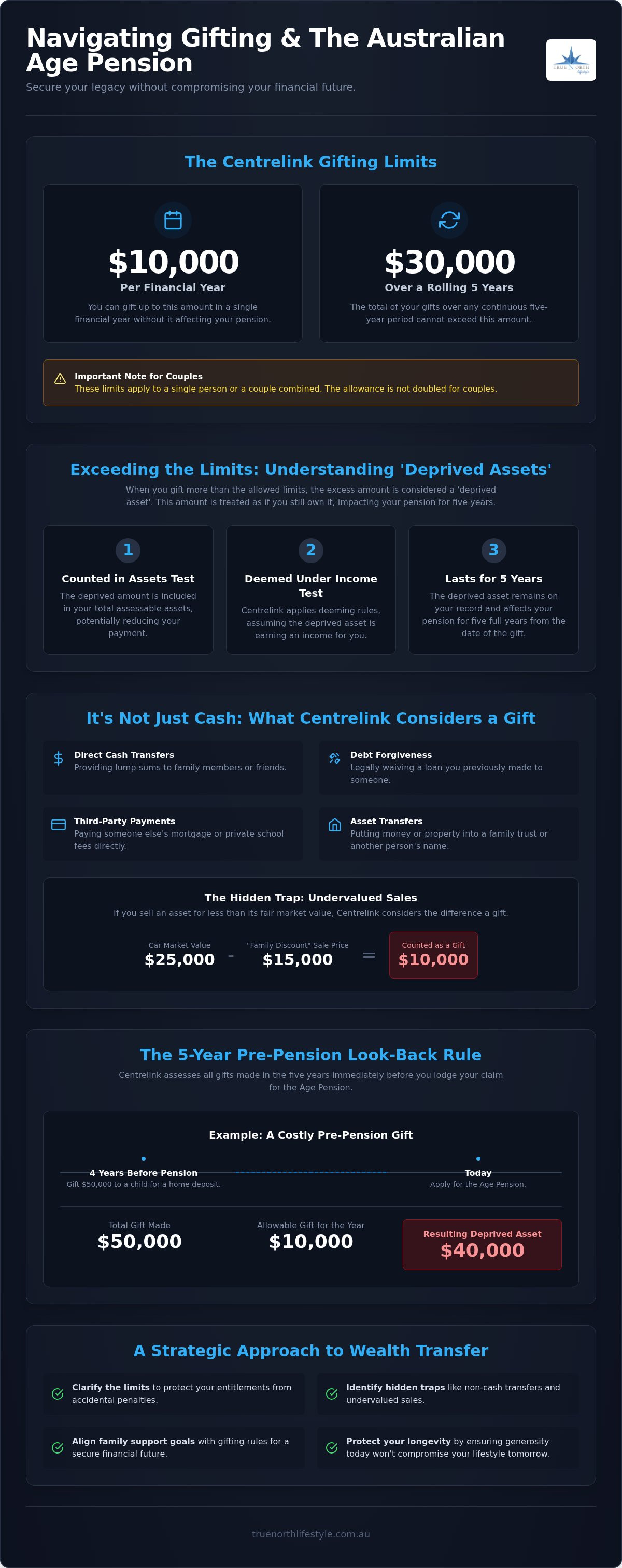
When you exceed the allowable limits, you enter the territory of "deprived assets." This is a technical term for money that Centrelink continues to treat as if it were still in your bank account, even though it has been spent or given away. These amounts remain on your record for five years from the date of the gift. This has a dual impact on your entitlements. It is counted under the Assets Test, and it is also subject to deeming under the Income Test. The psychological shift is often the hardest part. You must accept that while the capital is gone, the impact on your pension remains. Understanding the gifting rules for age pension is the first step in replacing this potential anxiety with a structured, research-driven strategy.
The $10,000 and $30,000 Limits: Navigating the Deprivation Rules
The framework governing your generosity is built upon two specific thresholds. You can gift up to $10,000 in a single financial year without incurring a penalty. However, a secondary cap exists: you cannot exceed a total of $30,000 over a rolling five-year period. A rolling five-year period is a continuous look-back from the current date to calculate the cumulative value of your gifts. It is vital to understand that these Centrelink gifting rules apply to the "pensioner couple" as a single unit or to a single individual. Couples do not receive a doubled allowance. A combined gift from both partners is still measured against these same singular limits.
Miscalculating these figures often leads to accidental deprivation, where funds you no longer possess still affect your payment rate. Strategic retirement modelling allows you to visualise the impact of these limits before you make a commitment, ensuring your legacy remains a source of pride rather than a financial burden. By mapping out your wealth transfer strategy, you can maintain the delicate balance between family support and your own longevity planning.
The 5-Year Look-Back Rule
Centrelink's scrutiny doesn't begin the day you lodge your application. They assess all gifts made in the five years immediately preceding your claim. This makes "pre-pension" gifting particularly risky for those who haven't planned their exit from the workforce with precision. Consider a scenario where a retiree gifts $50,000 to a child for a home deposit four years before they intend to apply for the Age Pension. Under the gifting rules for age pension, only $10,000 of that gift is exempt. The remaining $40,000 is classified as a deprived asset. Because the gift occurred within that critical five-year window, it will be included in the Assets Test when they finally apply, potentially reducing their pension for the first year of their retirement.
Stacking and Excess Calculations
Calculating the excess requires a methodical approach. If you gift $10,000 every year for three years, you have reached your $30,000 five-year limit. Any further gift in the fourth or fifth year, even if it's only $1,000, will be considered an excess. This excess remains on your record as a deprived asset for exactly five years from the date the gift was made. During this time, Centrelink applies deeming rates to these "phantom" assets. You are essentially assessed as earning income on money you have already given away. This can create a frustrating gap in your cash flow, as your pension is reduced based on wealth that is no longer accessible to you.
Non-Cash Gifts and Undervalued Sales: Traps in Asset Transfers
Value is fluid. While cash transfers are easily tracked, the transfer of physical assets or income streams often creates invisible traps for the unwary. Centrelink assesses the disposal of any asset based on its current market value, not your sentimental attachment or family loyalty. If you sell the family car to a grandchild for a "mate's rate," the difference between the sale price and the independently verified market value is immediately classified as a gift. For example, selling a vehicle worth $25,000 for $5,000 creates a $20,000 gift, instantly exceeding the annual threshold and triggering deprivation penalties.
Property transfers carry even greater risk. A $1 title transfer to a child might feel like a noble gesture, but in the eyes of the gifting rules for age pension, it is a massive disposal of capital. Without receiving "adequate consideration," the entire market value of the property, minus that nominal dollar, remains on your assessable asset register for five years. Professional valuations are not merely a suggestion. They are a critical safeguard to prove you have received fair value and to protect your ongoing pension eligibility. Even redirecting income, such as dividends or rental returns, to a family member's account can be caught under these regulations.
Sydney Property and Gifting
Downsizing in Miranda or the Sydney CBD often releases significant capital. While the temptation to "give away" this surplus to help children enter the property market is strong, it requires meticulous timing. A "granny flat interest" can provide a legitimate alternative. This allows you to pay for a lifetime right to live in a family member's home without the payment being classified as a traditional gift. This complex intersection is why your estate planning strategy Australia must be integrated with your gifting plans to ensure your legacy doesn't inadvertently ruin your lifestyle.
Family Loans vs. Gifts
Formal agreements change everything. A loan is not a gift. When you document a transfer as a formal loan with repayment terms, the principal remains an asset on your balance sheet rather than a deprived amount. This distinction is vital for maintaining pension levels while still providing family support. Strategic use of forgivable loans allows for a controlled intergenerational wealth transfer. The debt is reduced by the allowable $10,000 limit each year, ensuring you remain within the gifting rules for age pension while still achieving your family goals.
Strategic Timing and Modelling: How to Support Family While Preserving Entitlements
Strategy demands foresight. While the limits discussed previously may seem restrictive, adopting an "Early and Steady" approach allows you to utilise the $10,000 annual threshold to reduce your assessable assets gradually over time. This proactive stance ensures you remain compliant with the gifting rules for age pension while slowly shifting capital to the next generation. Paradoxically, this reduction in assets can actually increase your fortnightly pension payment if you're currently assessed under the Assets Test. By lowering your assessable wealth, you may move closer to the full pension threshold, creating a more sustainable long-term cash flow.
However, generosity must never come at the cost of your own security. Engaging in comprehensive retirement planning Sydney is essential to ensure you don't inadvertently gift away your "longevity buffer." Gifting should only occur after a rigorous portfolio sustainability model is performed. This technical exercise replaces guesswork with mathematical certainty, allowing you to see the exact impact of your generosity on your future lifestyle and capital requirements.
Modelling the Impact of a Large Gift
Large-scale generosity requires deep projections. If you intend to gift $100,000 to a child today, you must understand how that decision affects your liquid capital at age 85 or 90. Our modelling compares the immediate loss of pension income against the long-term benefit provided to your family. We identify the specific "tipping point" where a gift transitions from a managed strategy to a genuine threat to your financial independence. This level of detail provides the peace of mind necessary to act with confidence, knowing your own needs are fully protected.
Wealth Preservation and Gifting
Generosity and wealth preservation strategies are not mutually exclusive. We often utilise income-focused portfolios to compensate for any temporary reduction in pension payments caused by excess gifting. This approach ensures your daily needs are met while your capital transfer goals are achieved. Most importantly, we model for the unexpected, ensuring that your gifting plan doesn't compromise your ability to afford high-quality Aged Care in the future. To secure your financial future through evidence-based projections, consider our bespoke retirement modelling services.
Securing Your Legacy: How Professional Retirement Modelling Simplifies Gifting
Clarity brings peace. While understanding the gifting rules for age pension is essential for compliance, the true value lies in how these regulations are integrated into your broader financial architecture. A one-size-fits-all approach often fails to account for the unique nuances of your family's needs or the specific performance of your assets. This is why we focus on bespoke investment advice Sydney, ensuring that every gift you make is supported by a robust, evidence-based plan that prioritises your financial longevity and personal comfort.
Our role is to act as your steady navigator. We move beyond simple definitions to provide a comprehensive view of your wealth transfer strategy, replacing the inherent anxiety of government complexity with a sense of structured order. By aligning your generosity with a tailored retirement model, we ensure that your desire to support your loved ones never creates a "phantom" asset trap that could erode your own lifestyle. It is about empowering you to make informed choices with quiet certainty.
The True North Methodology
Our approach is fundamentally stabilizing. We utilise research-driven investment portfolios designed to provide a reliable income stream, ensuring your cash flow remains resilient even after significant wealth transfers. Our in-house Investment Committee conducts rigorous testing on every bespoke portfolio, focusing on real-world probability rather than market hype. This discipline extends to our Centrelink structuring services. We meticulously organise your asset register to ensure you receive every dollar of pension entitlement you are legally owed, maintaining a no-nonsense focus on proven outcomes and long-term capital sustainability.
Your Path to Clarity
The journey toward a secure legacy begins with deep discovery. We take the time to understand your family's specific needs and your personal lifestyle goals for the decades ahead. Once we have established this foundation, we move into the modelling phase. This is where the complex becomes simple. You will see the projected 20-year impact of your generosity, allowing you to understand how a gift today affects your bank balance at age 85. Finally, we provide ongoing oversight. As the gifting rules for age pension inevitably change, we proactively adjust your strategy to ensure your plan remains an anchor in a fluctuating environment.
Take the first step toward a structured and confident future. Organising a consultation allows us to stress-test your gifting intentions against our proprietary sustainability models. Let us do the heavy lifting, allowing you to step into a role of confident oversight as you support the next generation.
Mastering Your Wealth Transfer Strategy
Confidence comes from order. By understanding the strict $10,000 annual and $30,000 five-year limits, you have already taken the first step toward protecting your financial future. However, true security requires moving beyond simple compliance to a state of proactive optimisation. Mastering the gifting rules for age pension is not just about avoiding penalties; it's about ensuring your generosity today doesn't compromise your lifestyle at age 90.
Our research-driven retirement modelling replaces the anxiety of guesswork with mathematical certainty. From our offices in Miranda and Sydney, we provide specialist Centrelink and estate planning strategy alongside bespoke portfolio construction designed for income and stability. You don't have to navigate these complexities alone. We have already done the heavy lifting, allowing you to focus on what matters most: your family. Secure your legacy with a bespoke retirement strategy from True North Lifestyle. Your journey toward clarity starts with a single, informed choice.
Frequently Asked Questions
Can I give my children more than $10,000 if it's for a house deposit?
Yes, you can, but anything over $10,000 will be treated as a deprived asset for five years. Centrelink doesn't offer exemptions based on the purpose of the gift, even for significant life events like a home purchase. This means the excess amount continues to be counted under both the assets and income tests, potentially reducing your pension rate despite the money no longer being in your possession.
How far back does Centrelink look at my bank statements for gifts?
Centrelink typically reviews your financial history for the five years immediately preceding your Age Pension application. Any transfers or disposals made during this period are assessed against the gifting rules for age pension. It's a rolling look-back, so gifts made more than five years before your claim date are generally excluded from the deprivation rules. Maintaining clear records of all major transactions during this window is essential for a smooth assessment.
What happens if I sell my house to my son for half its value?
Selling an asset for significantly less than its market value is classified as a gift of the difference. If your home is worth $1 million and you sell it for $500,000, Centrelink views this as a $500,000 gift. After applying the $10,000 annual threshold, the remaining $490,000 is treated as a deprived asset for five years. This could severely impact your pension eligibility and future cash flow.
Is gifting money to a charity subject to the same $10,000 limit?
Yes, donations to charities are treated as gifts and are subject to the same $10,000 and $30,000 limits. While these contributions may be tax-deductible under Australian tax law, Centrelink applies its own social security criteria. If your total charitable giving and family gifts exceed the thresholds in a single financial year, the excess will be assessed as a deprived asset, regardless of the recipient's status or the noble cause.
Does the $30,000 five-year limit apply to each person in a couple?
No, the limits are not doubled for couples. A pensioner couple shares a single combined threshold of $10,000 per financial year and $30,000 over a rolling five-year period. Whether one partner gives the full amount or both contribute smaller portions, the total combined value must remain within these boundaries to avoid deprivation penalties. It's a common point of confusion that requires careful, joint financial planning.
Can I gift assets other than cash, such as shares or a car?
You can gift non-cash assets, but they are assessed at their current market value on the date of the transfer. This includes shares, vehicles, or jewellery. For instance, if you transfer $15,000 worth of shares to a family member, Centrelink treats this exactly like a $15,000 cash gift. Accurate valuations are necessary to ensure you don't inadvertently exceed the gifting rules for age pension through asset appreciation.
If I gift money while I'm still working, will it affect my pension later?
Yes, gifts made while you are still in the workforce can affect your future pension if they occur within five years of your application. Because Centrelink employs a five-year look-back period, any large disposals made during your final years of employment are still assessable. Strategic timing is vital; gifting significant sums well before your retirement transition ensures these assets are no longer "on the books" when you eventually apply.
How do I notify Centrelink that I have made a gift?
You must notify Centrelink of any gift that exceeds the allowable limits within 14 days of the transfer. This can be done via your MyGov account or by submitting the appropriate "Financial Details" form at a service centre. Failing to report these changes can lead to overpayments and subsequent debt recovery actions. Keeping a dedicated log of all financial transfers helps maintain transparency and reduces administrative stress during your retirement.


