

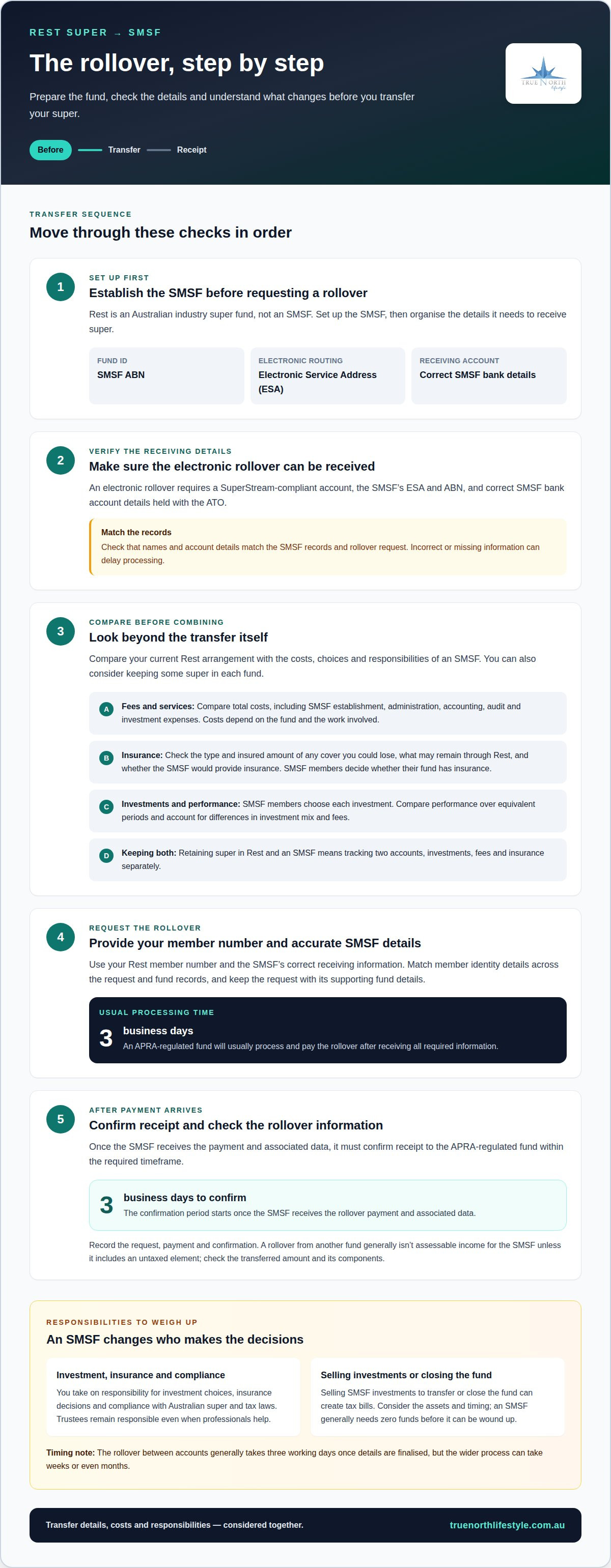
The rollover is only one part of moving from Rest Super to an SMSF. Rest is an Australian industry super fund, and transferring your super means providing your member number and the SMSF’s correct details, including its bank account information. Once it has everything required, the fund will usually process and pay the rollover within 3 business days; the SMSF must then confirm receipt within 3 business days.
It’s understandable to focus on how to make the transfer. But the fees and insurance you leave behind matter too. With an SMSF, you are responsible for investment decisions and for deciding whether the fund has insurance.
This guide explains the transfer steps, electronic rollover requirements and what to compare before combining your super. It also covers how selling SMSF investments or closing a fund can affect timing and tax considerations, so you can assess the responsibilities involved.
Key Takeaways
- Have your SMSF’s receiving details and your Rest member number ready; the rollover can usually be processed once the required information is complete.
- Compare the fees and insurance you may leave behind with the costs and responsibilities of managing investments and insurance through an SMSF.
- Check that the SMSF has the details needed for an electronic rollover, including its Electronic Service Address and accurate bank account information.
- Use retirement modelling to assess how the move could fit your wider plans, alongside potential tax and investment considerations.
Moving super from an APRA-regulated fund to an SMSF
Rest is an Australian industry super fund, not an SMSF. Use these steps to plan a transfer in either direction and verify the details.
-
Establish the SMSF before rollover
Set up the SMSF before requesting a rollover from Rest, then organise its receiving details: the SMSF’s ABN, Electronic Service Address and bank account details. Check that the fund can receive an electronic rollover and that the account details are correct. Having everything ready before you start can help avoid delays caused by missing information.
-
Move super from Rest to the SMSF
Request the rollover using your Rest member number and the SMSF’s accurate details. Match the member identity information across the request and fund records to help prevent processing problems. An APRA-regulated fund will usually process and pay the rollover within 3 business days after receiving all required information. After receiving the payment and associated data, the SMSF must confirm receipt within 3 business days.
-
Consider keeping both funds
Compare transferring your entire balance with keeping some super in Rest and some in the SMSF. Retaining both means tracking two accounts, their investments, fees and insurance separately. You’ll also be responsible for the SMSF’s investment choices and insurance decision, while Rest remains an industry fund. If you later transfer SMSF super to an APRA-regulated fund, the rollover between accounts generally takes three working days once the details are finalised. The wider process can take weeks or even months.
-
Assess the risks and disadvantages
Before moving from Rest Super to an SMSF, weigh the added responsibility for investments, insurance and compliance with Australian super and tax laws. These are the main disadvantages: you take on decisions and duties that an industry fund manages for members. Selling SMSF investments to transfer or close the fund can also create tax bills, so consider the assets and timing before acting. An SMSF generally needs zero funds before it can be wound up.
Checking fees and insurance before combining super
Compare Rest and an SMSF on fees, investment choice, insurance and services. When assessing performance, use equivalent periods and account for differences in investment mix. SMSF setup and ongoing costs depend on establishment, administration, accounting, audit and investment complexity.
-
Compare fees, insurance and services
Gather Rest’s current fee information and your latest statements, then list each charge and what it covers. For an SMSF, account for the work involved in establishing and administering the fund, as well as its investments. Compare total costs, not a single fee against all SMSF expenses.
- Record administration and investment fees for each arrangement.
- Check which insurance cover you’d lose by transferring, including its type and insured amount.
- Note any cover retained through Rest and whether the SMSF would provide insurance.
- Compare available services and investment options, not just headline charges.
SMSF members choose each investment and decide whether the fund has insurance. Performance comparisons are meaningful only when you consider investment mix, fees and the same measurement period. Review insurance carefully before transferring, because losing existing cover can change your protection.
-
Review SMSF setup and ongoing costs
Build a cost schedule before deciding whether to establish an SMSF. Separate initial establishment work from recurring administration, accounting, audit and investment-related expenses. Total costs depend on what the fund holds and the work required to manage and report on it. Assess the fund’s expected activity rather than relying on a single fee figure.
Then test how those costs affect your retirement plan. Include the time and responsibility involved in managing investments and insurance, not just paid services. List the tasks you’ll handle and those requiring professional support. Compare the SMSF’s full costs with Rest’s charges and services, then weigh both against your investment objectives.
A superannuation review can help organise these comparisons alongside your wider strategy.
Electronic rollover requirements for SMSFs
Use electronic fund details that match the SMSF’s records and the rollover request. SMSF trustees remain responsible for complying with Australian super and tax laws, even when professionals help.
-
Gather the required rollover documents
Prepare your Rest member number and the SMSF’s receiving information before submitting the request. An electronic rollover requires a SuperStream-compliant account, the fund’s Electronic Service Address (ESA) and ABN, plus correct SMSF bank account details held with the ATO. Check that names and account details match the SMSF records, as incorrect information can delay processing.
Keep the rollover request and supporting fund details together. When the payment arrives, use them to check it against the SMSF’s records. A rollover from another fund generally isn’t assessable income for the SMSF unless it includes an untaxed element. The transferred amount and its components matter, so identify any untaxed element in the rollover information rather than treating every payment as identical.
-
Track the electronic rollover timeframe
Allow for the processing time after Rest has received all required information. An APRA-regulated fund will usually process and pay a rollover to an SMSF bank account within 3 business days. Once the SMSF receives the rollover payment and associated data, it must confirm receipt to the APRA-regulated fund within 3 business days.
Keep a record of the request date, payment and confirmation. These milestones help distinguish fund processing from any earlier work needed to prepare details or resolve mismatches. The 3-business-day requirement also applies to an SMSF rollover to another fund through a SuperStream-compliant payment channel. For an SMSF-to-SMSF request made through ATO online services, trustees must action it within 3 days of receiving all required information. These are separate steps and timeframes, so record the relevant request type.
In the example, Tom's rollover super balance is $1,890,000; the amount exceeded the untaxed plan cap by $185,000, and its tax-free component is $98,050. An SMSF must report a member's new income stream after a rollover as a commutation through a transfer balance account report. For a dependent beneficiary death benefit rollover, specified statements must be provided within 30 days of the rollover payment.
How do I establish an SMSF before rolling over my Rest Super balance?
- Decide whether an SMSF suits your circumstances. List the investment decisions, administration and compliance tasks you’ll take responsibility for. Compare those duties with the services you currently receive through Rest. SMSF members choose the fund’s investments and decide whether it has insurance, so consider who will manage those decisions and keep the fund’s records organised.
- Identify the people and governance arrangements. Set out who will join the SMSF and how decisions will be made. Discuss each person’s responsibilities before moving money, including who will oversee the fund’s investments and keep its information accurate. Clear roles help members understand their ongoing obligations, rather than treating the transfer as a one-off administrative task.
- Establish the fund and organise its core details. Arrange the fund’s governing documents and trustee structure, then prepare the information needed for administration. Set up the SMSF bank account and organise its ABN and Electronic Service Address. Make sure the account details held with the ATO match the SMSF’s records, as the rollover process relies on accurate information.
- Set the fund’s direction before transferring super. Document the SMSF’s approach to investment choices and consider whether members want insurance through the fund. Think about the assets it may hold and how decisions will be recorded. Trustees and members remain responsible for complying with Australian super and tax laws, even when professionals assist.
- Check readiness before requesting the rollover. Confirm the SMSF can receive an electronic payment and that member identity details align with the transfer request. Keep the fund’s records, account information and responsibilities clear before asking Rest to move your balance. If your planning also involves beneficiaries and future distributions, consider how an estate planning strategy fits alongside the SMSF.
SMSF members choose the fund’s investments and decide whether it has insurance. The fund should document its investment approach and how decisions are recorded. Trustees and members are responsible for keeping records organised and complying with Australian super and tax laws, even when professionals assist.
True North Lifestyle: Retirement modelling & long-term projections
True North Lifestyle can help you assess an SMSF decision in the context of your broader retirement plans. Retirement modelling and long-term projections can show how different super arrangements, investment approaches and retirement timing may affect your future income needs. This gives you a structured basis for weighing fund responsibilities against your goals.
A superannuation review can examine your existing arrangements, while tax-minimisation strategies and bespoke portfolio construction can inform your wider approach. Consider this support before rolling over if you’re still weighing the trade-offs, or after establishing an SMSF if you want its investments considered alongside your retirement outlook. The aim is a coherent plan, not a transfer viewed in isolation.
Contact True North Lifestyle to discuss your super and retirement planning needs.
Make your next super decision part of a wider plan
An SMSF is a long-term structure, so consider how its responsibilities fit your priorities, time and future plans. Before acting, write down what you want greater control over your super to achieve. Then consider whether that purpose still fits your retirement goals and the way you want to manage your finances.
If you’re considering moving from Rest Super to an SMSF, treat the decision as part of your wider financial direction, not simply an account change. The right structure depends on how its demands and choices fit your circumstances. Understanding that fit can help you move forward deliberately, rather than feeling pushed by the mechanics of a rollover.
Contact True North Lifestyle to discuss your next step and continue planning with greater clarity.
Frequently Asked Questions
What are the eligibility requirements and steps to transfer from Rest Super to an SMSF in Australia?
To transfer, you need an SMSF established to receive the super and must be ready to take responsibility for its decisions and compliance. Before moving from Rest Super to an SMSF, consider whether you can manage those ongoing obligations, even if professionals assist. Then prepare the rollover request using your Rest member number and matching identity details, and check the SMSF records against the payment received.
What investment, tax and compliance rules apply to SMSFs in Australia?
SMSF members choose each investment and decide whether the fund has insurance. Trustees remain responsible for complying with Australian super and tax laws, even when professionals help. A rollover is generally not assessable income unless it contains an untaxed element, and selling SMSF investments can create tax bills.


