

The biggest financial decision may not be choosing an investment. For NSW officers, financial planning for police officers in Sydney starts with understanding the super scheme: SASS members can make additional personal super contributions of up to 9% of annual salary to access employer contribution matching, while the Police Superannuation Scheme (PSS) is an entirely defined benefit scheme. These arrangements make your fund and employment circumstances central to planning.
It’s understandable to focus on building savings and choosing investments, but those decisions work best when they support a clear financial direction. A change of role, reduced hours or time away from work can affect income and super contributions, so consider how today’s choices connect with your longer-term goals.
This article explains how retirement contributions, investments and asset choices can fit into a broader strategy for NSW police officers. You’ll learn what to consider when reviewing super, managing risk and planning for goals such as retirement, with an approach grounded in your circumstances.
Key Takeaways
- Review how your super and any work-linked cover fit your current circumstances before making changes.
- Assess investments by their role, risks and potential trade-offs, not simply by asset type.
- Map income, essential costs and debt payments to understand how a work or life change could affect household finances.
- Use clear goals to guide retirement projections, super decisions and a portfolio strategy built around your priorities.
Retirement savings and tax-effective contributions
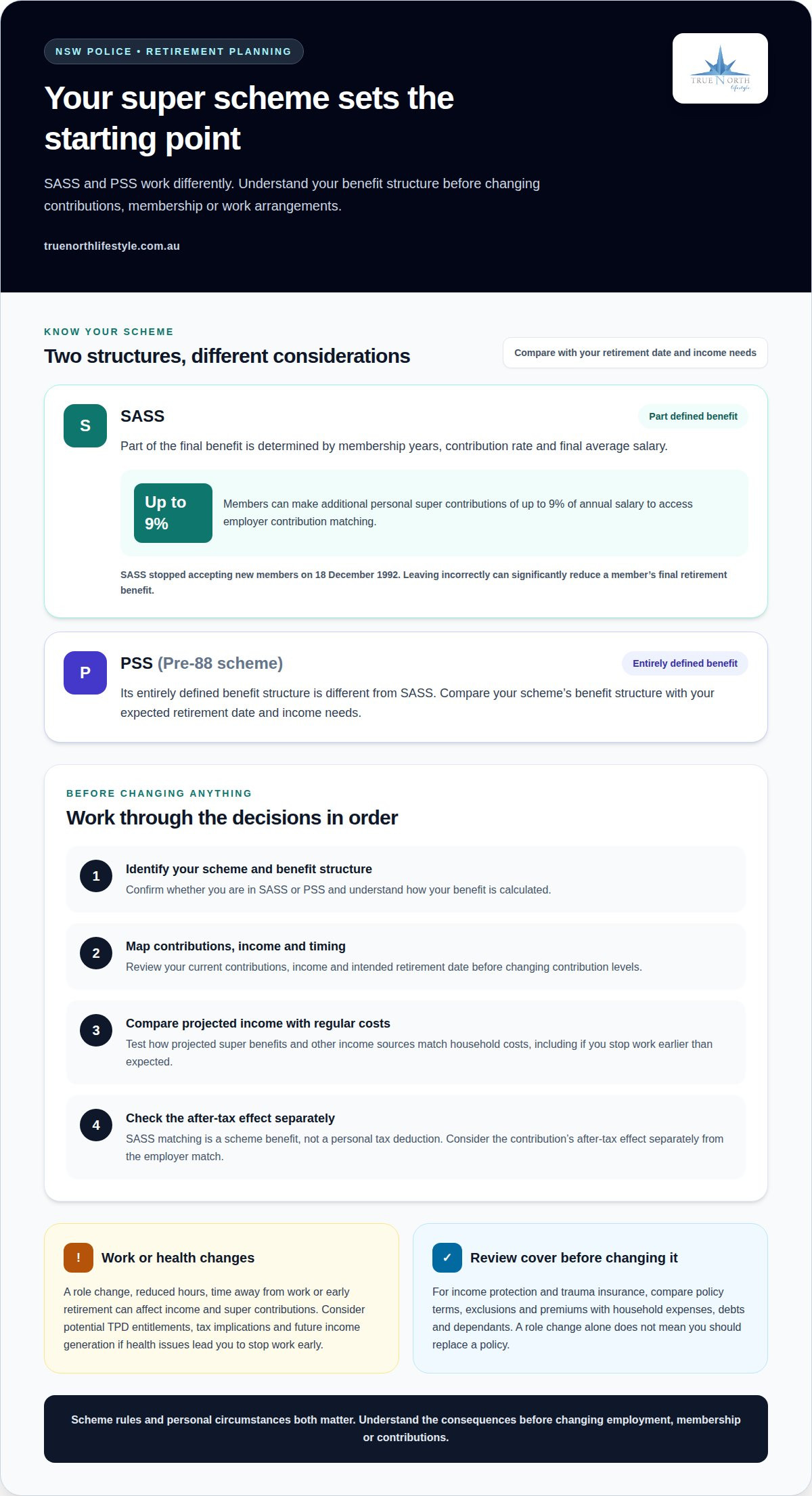
Retirement planning for NSW police starts with identifying your super scheme and how its benefit is calculated. SASS and PSS have different structures, so contribution decisions can affect retirement income in different ways.
NSW Police pension and super scheme
SASS is a part defined benefit scheme: membership years, contribution rate and final average salary help determine part of the final benefit. Members can make additional personal super contributions of up to 9% of annual salary to access employer contribution matching. PSS, also called the Pre-88 scheme, is entirely defined benefit. Compare your scheme’s benefit structure with your expected retirement date and income needs.
SASS stopped accepting new members on 18 December 1992. Leaving SASS incorrectly can significantly reduce a member’s final retirement benefit, so understand the consequences before making employment or membership changes. These scheme differences are central to how a NSW Police pension or super scheme affects retirement planning.
Tax deductions and contribution rules
For NSW police officers, tax treatment depends on the contribution type and applicable super rules. The scheme-specific figure to factor into planning is SASS’s matching arrangement: additional personal contributions of up to 9% of annual salary can access employer matching. Matching is a scheme benefit, not a personal tax deduction. Consider the contribution’s after-tax effect separately from the employer match.
Map your current contributions, income and intended retirement date before changing contribution levels. A tax-effective strategy needs to account for both scheme rules and your circumstances, rather than assuming every personal contribution receives the same treatment.
Retirement income planning should also test what happens if you stop work earlier than expected. Compare projected super benefits and other income sources with regular household costs, then consider how different retirement dates affect the plan.
Physical or mental health issues can sometimes lead police and other emergency services employees to stop working early. In that situation, consider potential TPD entitlements, tax implications and future income generation alongside legal options. These factors can affect the timing and structure of retirement income.
Review insurance cover before cancelling or changing it. For income protection and trauma insurance, compare policy terms, exclusions and premiums, then assess how the cover fits household expenses, debts and dependants. A role change alone doesn’t mean you should replace a policy.
Investment and asset planning
Investment decisions work best when each asset has a clear role in your wider plan. For NSW police officers, compare access, risk and tax effects before changing investments or superannuation.
Investment access and risk
Start by listing your investments, where they’re held and when you can access them. Cash, shares, property and superannuation can serve different purposes, but each has distinct risks and access conditions. Money needed for near-term costs, for example, has a different role from assets intended for retirement.
Before changing an investment, weigh its costs, risks and any existing features you could lose. Consider how a fall in value might affect your plans, especially if you expect to draw on the asset soon. Assess your time horizon, income needs and ability to tolerate fluctuations instead of chasing recent performance.
Write down the purpose of each holding, such as providing accessible savings or supporting longer-term growth. This makes gaps and overlaps easier to spot.
Tax-effective investing
Tax-effective investing means considering how an investment’s structure and timing may affect your after-tax position. Compare investments by their likely role and overall tax treatment, not headline returns alone. Your income, ownership structure and plans for selling or drawing on assets all influence the assessment.
Before acting, record the investment, its purpose, expected holding period and potential tax consequences. Compare these details with your superannuation strategy and retirement timeline. This can show whether an asset supports your objectives or adds unnecessary complexity.
For example, a planned investment sale may affect available funds and tax outcomes differently from holding the asset. A superannuation review and optimisation can help bring fund choices and investment decisions into one considered view. Keep the focus on costs, risks and any valuable features that a change could remove.
Financial advice for NSW emergency services employees
Financial advice can help NSW emergency services employees connect work changes with household decisions. A useful review starts with income, expenses, debts and savings, then considers how each affects the plan.
For example, compare expected household cash flow with debt payments and essential costs before changing roles or hours. This can show whether reduced income will cover regular commitments and which decisions need attention first.
Financial recommendations can involve costs, risks or features you may lose when switching investments or superannuation. Ask how a recommendation fits your objectives and compare its likely trade-offs with your current arrangements. An adviser’s credentials also matter. CFP® certification is described as an internationally recognised standard requiring advanced education, relevant experience, ethical practice and ongoing professional development.
To assess an adviser’s credentials, compare their stated qualifications and experience with the needs behind your decision. Police Super members can seek independent financial advice. A personal referral or the Financial Advice Association Australia platform can help identify an adviser. Services Australia’s Financial Information Service officers explain financial issues, but they aren’t financial planners and don’t sell investment products.
Scheme documents matter, too. Before a planner or another third party receives a Police Super member’s personal or superannuation details, Police Super requires an Authority to Release signed and dated by the member. That authority is valid for no more than 12 months from its signing date. This gives members a defined way to authorise access to relevant information.
If you stop work early, structure the discussion around issues that could shape future income. Consider potential TPD entitlements, tax implications, legal options and how income might be generated. A role change alone doesn’t mean replacing a super fund or insurance policy; employment, fund and cover details shape the decision.
Financial counsellors serve a different purpose: they can help organise finances, create a budget and negotiate with creditors. That support can complement financial advice when debt pressure or day-to-day cash flow is the immediate concern.
Financial goals and strategic planning
A financial plan becomes useful when it connects everyday decisions with specific goals. NSW police officers can set priorities such as retirement, saving for a house or funding a child’s education, then build a strategy around each one. Whether budgeting locally or preparing for overseas family relocations with centres such as Children of Tomorrow Pre-school Singapore, accounting for early developmental milestones ensures your savings timeline aligns with real costs.
Start by writing down what matters, the timeframe and the resources already available. A house deposit, for example, may require accessible savings, while retirement planning calls for projections of future income and assets. Rank goals if they compete for the same money. This helps clarify which decisions need attention now and which can wait.
Shift work, overtime, allowances and irregular income can make monthly budgeting less predictable. Separate dependable base income from variable pay, then build essential spending around the dependable amount. Use extra income to strengthen savings, reduce debt or progress a chosen goal, rather than relying on it for regular bills.
- Track base pay and variable income separately.
- Compare household cash flow with debt payments and essential costs.
- Decide in advance how additional pay will support a priority.
Review the plan when work arrangements or life circumstances change. A role change can affect income, superannuation contributions and cover connected to work or a super fund. Revisit projections and spending priorities together instead of adjusting one part in isolation. If your household relies on overtime, test whether essential costs fit without that variable income.
Keep the strategy practical. Record each goal, the next action and the condition that would prompt a review, such as a role change or a new family commitment. This turns broad intentions into decisions you can revisit as circumstances evolve. Build a strategy around your financial goals and the income patterns that shape them.
True North Lifestyle: Retirement modelling & long-term projections
True North Lifestyle can help turn your retirement priorities into a structured financial plan. Its retirement modelling and long-term projections let you compare possible retirement dates, income needs and the impact of changing work arrangements.
A superannuation review can clarify how your fund fits alongside other assets, while tax-minimisation strategies bring tax considerations into broader decisions. Bespoke portfolio construction can align investment choices with your goals, timeframe and risk tolerance. Together, these strategies connect individual decisions with a coherent long-term direction.
For NSW police officers facing a career transition, approaching retirement or reassessing investments, this planning can help map next steps and identify trade-offs. Contact True North Lifestyle to discuss your financial goals and planning priorities.
Set your next financial step
Your next move doesn’t need to solve every financial question at once. Choose one decision that would give you greater clarity, such as defining the retirement you want or deciding how a future work change fits your household plans. Then note the information and priorities that should guide it.
For NSW officers, financial planning for police officers in Sydney is most useful when it reflects both your career and the life you want beyond it. Priorities can shift over time, so a clear direction can help you respond deliberately instead of making disconnected choices under pressure.
Bring your key questions and current priorities into a conversation with True North Lifestyle. Contact True North Lifestyle to discuss a considered next step for your financial future. A well-defined plan can make the path ahead feel more manageable, one decision at a time.
Frequently Asked Questions
What financial planning services are available for police officers in Sydney?
Financial planning for police officers in Sydney can include retirement projections, superannuation and investment strategy, tax planning, wealth preservation and estate planning. The right mix depends on your priorities: an officer considering a career transition may need income projections, while someone building investments may focus on portfolio construction and risk. True North Lifestyle provides tailored planning from Miranda, supporting decisions based on your circumstances and goals.
Which Sydney financial advisers specialise in NSW Police officers?
For financial planning for police officers in Sydney, look for an adviser who can explain how NSW Police super schemes affect your decisions and assess your employment circumstances alongside your wider finances. Ask how they would approach your specific question, such as comparing retirement scenarios or reviewing a proposed investment change. True North Lifestyle provides financial planning and retirement strategy services in Miranda, including superannuation and retirement planning.
What are the NSW Police superannuation schemes and contribution options?
Relevant schemes include SASS, a part defined benefit scheme, and PSS, an entirely defined benefit scheme also known as the Pre-88 scheme. SASS members can make additional personal contributions of up to 9% of annual salary to access employer contribution matching. Before deciding, identify your scheme and review its rules and contribution history, as these shape how changes may affect your retirement benefit.
What financial planning steps should NSW police officers take before retirement?
Begin by setting a target retirement timeframe and listing the income sources you expect to rely on. Gather current super information, household spending, debts and details of planned work changes. Then test whether projected income supports your intended lifestyle, including regular costs and larger goals. Review your plan when circumstances change so decisions about retirement timing and spending stay connected to your priorities.


