

For retirement income planning in Miranda, a comfortable retirement benchmark is $55,923 per year for a single person and $78,566 per year for a couple, using the March quarter 2026 figures. These are reference points, not personal targets: the income you need depends on your lifestyle, housing, health and how long your savings must last. Your super balance and any Age Pension entitlement also affect how much income you’ll need to provide yourself.
It’s natural to want a clear figure before deciding when to finish work. But a useful plan brings the numbers together: how much income you want, what your super may provide and how Age Pension eligibility could fit in. This article explains how super contributions, retirement benchmarks and Age Pension rules can shape your timing and income needs. You’ll also learn what to consider when turning a broad benchmark into a plan for your retirement.
Key Takeaways
- Use retirement benchmarks as a starting point, then shape your target around your household’s lifestyle, housing and health needs.
- Review how super contributions may build your balance and influence the timing of your retirement.
- Factor in Age Pension eligibility and means testing when estimating how much income you’ll need from your own savings.
- Model different retirement dates and income needs to see how long your resources may last and where a tailored strategy could help.
ASFA retirement income and lump sum benchmarks
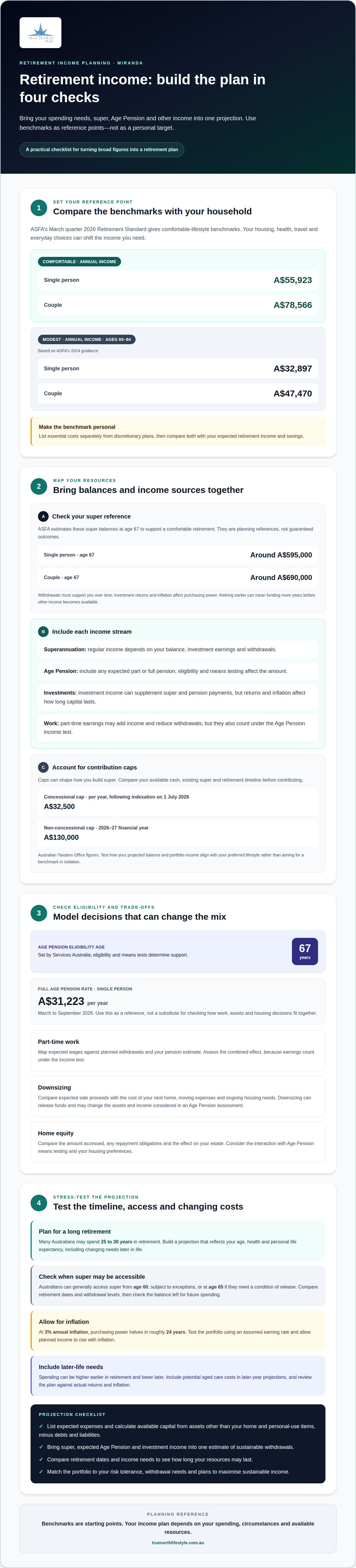
ASFA’s March quarter 2026 Retirement Standard sets a comfortable annual retirement income benchmark of A$55,923 for a single person and A$78,566 for a couple. These figures offer a useful starting point, not a personal spending target. Your housing costs, health needs, travel plans and everyday choices can shift the amount you need. A household in Sydney or Miranda should compare the benchmark with its own expected expenses.
For a modest lifestyle, ASFA estimates A$32,897 per year for a single person aged 65-84, and A$47,470 per year for a couple aged 65-84, using 2024 guidance. The difference between modest and comfortable benchmarks can help you identify which spending choices matter most. List essential costs separately from discretionary plans, then compare both groups with your expected retirement income and savings.
ASFA estimates a super balance of around A$595,000 for a single person at age 67, or A$690,000 for a couple at age 67, to support a comfortable retirement. Treat these lump sum benchmarks as planning references rather than guaranteed outcomes. A balance must support withdrawals over time, while investment returns and inflation affect its purchasing power. An earlier retirement can also mean funding more years before other income becomes available.
Contribution caps can shape how you build super towards a benchmark. According to the Australian Taxation Office, Australia’s concessional superannuation contribution cap is A$32,500 per year following indexation on 1 July 2026. According to the Australian Taxation Office, Australia’s non-concessional super contribution cap is A$130,000 per year for the 2026-27 financial year. Before contributing, compare your available cash, existing super and retirement timeline. Then test how the projected balance and portfolio income align with your preferred lifestyle, rather than aiming for a benchmark in isolation.
Age Pension eligibility and means tests
Services Australia sets the Australian Government Age Pension eligibility age at 67 years. How much support you receive depends on eligibility and means tests, so part-time work, downsizing or using home equity can change the mix of pension and other retirement income.
Part-time work impacts
Part-time work can add to your retirement income while reducing how much you draw from savings. However, earnings also count under the Age Pension income test, so assess the combined effect rather than treating wages as extra income alone. Map expected work income against planned withdrawals and your pension estimate. This helps you judge whether fewer work hours could still support your objectives.
Downsizing and pension effects
Downsizing can release funds from your home, potentially adding to the savings available for retirement income. It may also change the assets and income considered in an Age Pension assessment. Before deciding, compare the expected sale proceeds with the cost of your next home, moving expenses and ongoing housing needs. An adviser can model cash flow and pension implications together, rather than viewing the proceeds in isolation.
Home equity and retirement income
Using home equity may provide funds without selling your home, but it can affect future cash flow and the assets you retain. Compare the amount accessed, any repayment obligations and the effect on your estate. Then consider how these choices interact with Age Pension means testing. A financial adviser can explain the trade-offs as part of broader financial advice, keeping your housing preferences and objectives at the centre.
The full Age Pension rate for a single person is A$31,223 per year for March to September 2026. Treat that figure as a reference when comparing income sources, not a substitute for checking how work, assets and housing decisions fit together. Retirement income modelling can help bring those moving parts into one projection.
Retirement income planning
Australian retirement income can combine superannuation, a part or full Age Pension, and investment income. A plan brings these sources together to estimate sustainable withdrawals and match them to your spending needs.
Planning retirement income in Miranda
Start by listing your expected retirement expenses, then calculate available capital from assets other than your home and personal-use items, minus debts and liabilities. Build a projection that reflects your age, health and personal life expectancy. Many Australians may spend 25 to 30 years in retirement, so test whether income can continue across a long timeframe, including changing needs later in life.
Superannuation income
Super can provide regular retirement income, but the amount available depends on your balance, investment earnings and withdrawals. Australians can generally access super from age 60, subject to exceptions, or at age 65 if they meet a condition of release. Compare different retirement dates and withdrawal levels, then consider how each scenario affects the balance left to support future spending.
Age Pension income
Include any expected Age Pension alongside super and investment income, rather than treating each source separately. Eligibility and means testing can affect the pension income in your projection. Model how a change in assessable income or assets could alter the overall mix, then review whether the remaining income meets your essential costs and personal objectives.
Investment income
Investment income can supplement super and pension payments, but returns and inflation influence how long capital lasts. Test the portfolio using an assumed earning rate and allow planned income to rise with inflation. At 3% annual inflation, purchasing power halves in roughly 24 years. Match the portfolio to your risk tolerance, withdrawal needs and plans to maximise sustainable income.
Spending can be higher earlier in retirement and lower later, but include potential aged care costs in later-year projections. Review the plan against actual returns and inflation, and adjust withdrawals as conditions change. Estate planning also matters: consider how your income strategy affects the assets you may want to preserve for your estate.
What is retirement income planning in Miranda, NSW?
Retirement income planning in Miranda means turning your desired lifestyle into a practical plan to fund it. Begin with a household budget, separating essential costs from choices such as travel, hobbies and helping family. Then map likely income sources against those expenses and identify any gap that savings need to fill. The aim is a workable strategy for your circumstances, not a target borrowed from another household.
Local figures provide context, not a personal retirement forecast. Miranda’s median age was 39 in 2021, while median household income was A$1,920 per week. Those community measures cannot tell you what your retirement will cost. Instead, use your own spending, housing arrangements, health needs and planned retirement date to build the estimate. A homeowner and a renter in the same suburb may need different income plans.
Make the plan practical by gathering current super statements, investment details, debts and regular spending. List the income you expect from super, investments and any eligible Age Pension, then compare it with essential and discretionary expenses. Test different retirement dates and spending patterns. For example, if you plan to travel more early in retirement, model higher initial withdrawals and see how lower spending later changes the projection.
Next, stress-test the projection rather than relying on a single return assumption. Consider how inflation, uneven investment performance and changing health needs could affect income over time. Record the assumptions clearly, including planned withdrawals and your tolerance for investment risk. This makes it easier to identify which decisions have the greatest effect and where adjustments may be needed as circumstances change.
A clear plan also connects retirement income with longer-term priorities, including preserving assets and deciding what you want your estate to provide. Map out your retirement income strategy with a tailored projection that brings those choices together.
True North Lifestyle: Retirement modelling & long-term projections
True North Lifestyle can turn retirement income questions into a structured financial plan. Its retirement modelling & long-term projections can compare potential retirement dates, income needs and investment outcomes, helping you understand how different choices may affect your resources over time.
This approach can help when you’re weighing up whether to retire, reviewing your super or adjusting plans after a change in circumstances. Superannuation review & optimisation, tax-minimisation strategies and bespoke portfolio construction can inform the broader picture, alongside your income goals and comfort with investment risk.
Bring your current super and investment details, expected spending and preferred retirement timing to your discussion. Contact True North Lifestyle to explore a retirement projection tailored to your circumstances.
Shape your next retirement decision
Your next step is to turn broad intentions into choices you can review. Write down what you want retirement to make possible, the commitments you need to protect and the trade-offs you’re comfortable making. This gives each planning decision a purpose, rather than leaving it as a figure on a page.
For retirement income planning in Miranda, a structured projection can connect your priorities with your financial position. True North Lifestyle offers retirement modelling and long-term projections, alongside tax-minimisation strategies and superannuation review and optimisation. These services can help you examine how your choices fit together as your circumstances change.
You don’t need every answer before beginning. A clear starting point can make the next decisions easier to discuss and refine. Start a conversation with True North Lifestyle about your retirement plans, and take the next step with greater clarity.
Frequently Asked Questions
When should I retire and how much do I need?
Choose a retirement date by comparing your planned spending with income available at different ages. Build scenarios for stopping work, reducing hours or continuing longer, and include super access, investments and potential Age Pension income. Australians can generally access super from age 60, subject to exceptions, while Age Pension eligibility starts at 67. The workable date is the one where your projected income supports your priorities over retirement.
When should I start seeing a financial planner?
Speak with a financial planner when retirement decisions start affecting your super contributions, work plans or investment choices. Starting before you leave work gives you time to compare options, identify income gaps and adjust your approach. For example, if you’re considering reducing your work hours, bring your expected income and household spending to the discussion. A planner can map these details into a retirement projection and clarify your next decisions.
Why Start Retirement Planning Early?
Starting earlier gives savings and investment earnings more time to accumulate, and leaves more opportunity to adjust contributions or retirement timing. A five-year delay in retirement planning can cost well over A$250,000 in lost compound returns on a typical balance. Treat this as a reason to begin modelling sooner, not as a forecast for every household. Regularly revisiting your assumptions helps keep the plan aligned with changing circumstances.
What are the current Age Pension eligibility rules and payment rates in Australia?
Services Australia sets the Age Pension eligibility age at 67 years. Payment depends on eligibility and income and assets tests, which determine whether someone receives a full or part pension. The full rate for a single person is A$31,223 per year for March to September 2026. Include likely pension income in your cash-flow plan, while accounting for how other income and assets affect the amount payable.
What are the superannuation preservation age and tax rules for retirement income in Australia?
Australians can generally access super from age 60, subject to exceptions; access at 65 applies when a condition of release is met. Concessional contributions are taxed at 15% within the super fund, subject to the annual cap. Investment earnings inside an account-based pension are tax-free up to the transfer balance cap. These rules affect contribution choices and how you structure income, so consider them alongside your retirement timing.
How much retirement income do Australians need for a comfortable or modest lifestyle?
ASFA’s March quarter 2026 comfortable retirement benchmark is A$55,923 per year for a single person and A$78,566 for a couple. Its 2024 modest lifestyle guidance estimates A$32,897 per year for a single person aged 65-84, or A$47,470 for a couple aged 65-84. Use the relevant benchmark as a comparison point, then adapt your target to your housing, spending and health needs.


