

The retirement advantage comes from choosing income that suits your need for certainty and control, rather than assuming one approach will work for everyone. In Australia, people aged 60 or older who are still working can use some super to start a transition-to-retirement income stream. It must pay out at least 4% and no more than 10% of the account balance each year.
It’s understandable to want reliable income while retaining flexibility to meet changing needs. An annuity and drawdown can provide different balances of predictable payments, access to savings and exposure to investment outcomes.
This guide explains how retirement transitions and government benefits fit into the decision. It compares annuity income with drawdown and outlines withdrawal limits for transition-to-retirement income streams, helping you weigh how your super can support retirement.
Key Takeaways
- Understand how a transition to retirement can help manage income while you’re still working, and how super contributions may fit into the plan.
- Compare the steadier income of an annuity with the flexibility of drawdown to see which trade-offs suit your retirement priorities.
- Explore how your income choices can affect the longevity of your savings, including the role of withdrawals and investment performance.
- Use retirement modelling and long-term projections to bring super, tax considerations and income needs into a clearer plan.
Transition to retirement and government benefits
A transition-to-retirement income stream can bridge work and retirement. In Australia, people aged 60 or older who are still working can start one using some of their super. Payments must be at least 4% and no more than 10% of the account balance each year. At age 65, the stream moves into the retirement phase. These limits help shape how much income can be drawn while you remain employed.
Contributions also affect the calculation. According to the Australian Taxation Office, Australia’s concessional super contributions cap is $30,000 for the 2024-25 financial year. Concessional contributions are taxed at 15% up to the cap. A person considering salary sacrifice should weigh contributions against the income they need now, and their available cap. Contribution timing and existing concessional contributions also matter.
For people aged 60 or older, transition-to-retirement pension payments are tax-free. This can allow someone to reduce work hours while using pension income to help cover the resulting pay gap. Extra contributions may also boost super while payments are received. The balance depends on work income, contributions and withdrawals, so consider the combined cash flow rather than each transaction alone.
Government benefits require a separate assessment. A transition-to-retirement income stream does not, by itself, establish eligibility for a government payment. When considering possible support, assess how work income, super and pension payments fit your circumstances. Age, household finances and employment changes can all affect the broader picture. Don’t treat a projected benefit as guaranteed income in your retirement budget.
To apply, contact your super fund and follow its pension application process. Gather your latest super statement, work and income details, contribution records and an estimate of planned withdrawals. These details help you understand the proposed payment level and its cash-flow effect. Read the fund’s product disclosure information and payment terms before submitting forms. Financial advice can help you consider tax, super and government-benefit effects together.
Plan the transition as a change to your cash flow, not just a super transaction. For example, map the shift from salary to wages plus pension payments, then align bill dates and savings transfers. Using transaction and savings accounts together may make day-to-day cash flow easier to track, but it doesn’t change super withdrawal limits. If overseas spending is part of your plan, include transaction fees in your budget and compare the relevant account fee schedules. Banking charges are separate from super tax and government-benefit assessments.
Alisha transfers $155,000 of her super into a transition to retirement pension and withdraws $9,000 each year tax-free from her transition to retirement pension. Consider the planned payment alongside work income and the cash flow needed to meet regular expenses.
Kyle transfers $200,000 from his super to an account-based pension to start a transition to retirement strategy. These examples show different transfer amounts, but neither establishes what another person should transfer or withdraw. Review expected income and planned payments together when considering a strategy.
Annuity income and drawdown
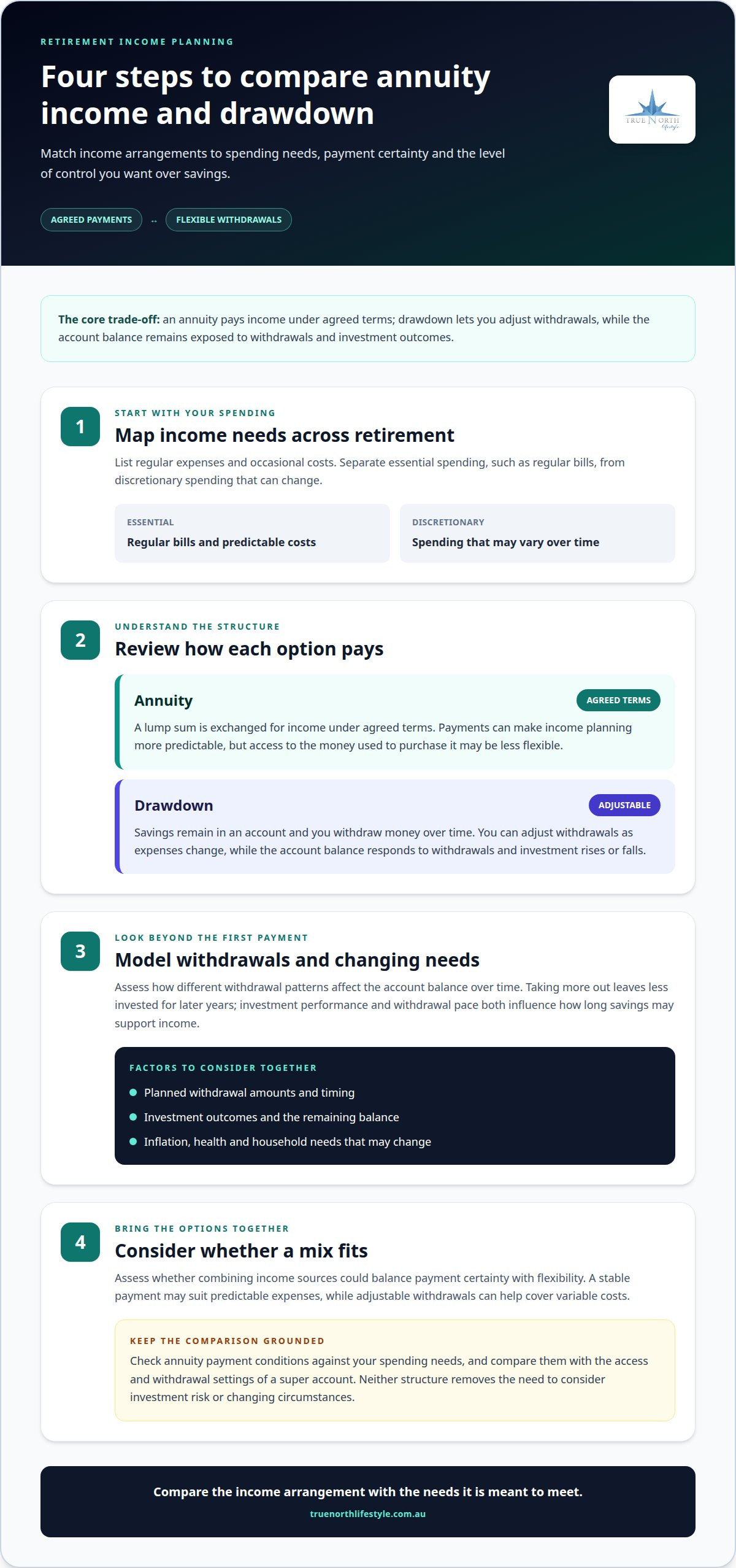
Annuities and drawdown structure retirement income differently. An annuity exchanges a lump sum for income under agreed terms. Drawdown involves withdrawing money from a super account over time. The choice affects how income is arranged, how much control you retain and how your remaining savings respond to investment outcomes.
With an annuity, payments follow agreed terms. This can make income planning more predictable than relying only on withdrawals from an invested account. In return, you may have less flexibility over how much you access or when you access the money used to purchase it. Review the payment conditions and how they fit your spending needs before committing funds.
Drawdown keeps savings in an account from which you make withdrawals. The account balance changes as money is withdrawn and investments rise or fall. You can adjust withdrawals to meet changing expenses, but taking more out leaves less invested for later years. Both investment performance and withdrawal pace influence how long the remaining savings may support your income.
How does this compare with other Australian retirement income options? An annuity can provide income under agreed terms, while drawdown gives you more direct control over withdrawals and leaves the account balance exposed to investment outcomes. Either can sit alongside other income, such as employment income or government benefits, subject to the relevant rules and your circumstances.
Compare options against your spending patterns, not just their initial payments. Separate essential costs, such as regular bills, from discretionary spending that can change. Then consider which income source could meet each need. A stable payment may suit predictable expenses, while adjustable withdrawals can help cover variable costs. Neither structure removes the need to consider inflation, investment risk or changing health and household needs.
A practical comparison can follow these steps:
- Map income needs: list regular expenses and occasional costs across retirement.
- Review payment terms: identify what an annuity pays and when, and what conditions apply.
- Model withdrawals: assess how different withdrawal patterns affect the account balance over time.
- Consider a mix: assess whether combining income sources could balance payment certainty with flexibility.
For a transition-to-retirement income stream, the annual withdrawal limits described earlier also shape the drawdown approach. An annuity’s terms and a super account’s withdrawal settings are different. Comparing them side by side helps clarify the trade-off between agreed payments and ongoing access to invested savings. The decision is about matching an income structure to your priorities, not choosing a universally superior option.
Effects on retirement savings
Income choices affect how much remains invested for later retirement. With drawdown, each withdrawal reduces the account balance unless investment returns offset it. For example, taking extra money for a major home repair leaves less invested afterwards. Over time, the effect can compound because future returns apply to the remaining balance, not the amount already withdrawn.
An annuity changes the role of the money used to purchase it. Those savings are exchanged for income under the annuity’s terms, rather than remaining available in the same super account for flexible withdrawals. This can make planned income easier to map against regular expenses. The trade-off is reduced access to the amount committed, depending on the terms selected.
What are the benefits and risks of using the retirement advantage? Balancing annuity income with drawdown can combine structured payments with access to invested savings. Risks include committing funds that later become difficult to access, withdrawing too quickly or relying on investment outcomes to support future income.
Consider the sequence of withdrawals, too. If investments fall while withdrawals continue, selling assets to fund payments can leave fewer assets to participate in a later recovery. Drawing from different income sources may affect which assets need to be sold and when. That makes withdrawal order, spending priorities and investment mix important parts of retirement cash-flow planning.
Inflation also affects what savings can buy. A payment that covers household costs today may cover less in future as prices change. Review expected spending by category, including housing, healthcare and discretionary costs, then consider how income sources may respond over time. The aim is to understand how planned payments relate to the purchasing power of your remaining savings.
A useful review can test several scenarios without assuming a single outcome:
- Planned spending: map regular costs and larger expenses against expected income.
- Higher withdrawals: assess how additional spending changes the account balance and future flexibility.
- Investment changes: examine how different market conditions affect invested savings and withdrawal needs.
- Changing priorities: consider how care needs, housing decisions or family support could alter cash flow.
Review the plan when work, spending or household circumstances change. A retirement income model can compare withdrawal patterns, income sources and projected balances over time, helping show where adjustments may be needed. Explore retirement modelling and long-term projections to assess how your income choices may shape your savings.
True North Lifestyle: Retirement modelling & long-term projections
True North Lifestyle can model how annuity income, drawdown and other income sources may affect your retirement savings over time. This can help when you’re preparing to retire, changing your work patterns or reviewing whether your withdrawal approach still fits your needs.
Retirement modelling & long-term projections bring expected income, spending and superannuation decisions into one view. A superannuation review and tax-minimisation strategies can clarify how your current arrangements fit your plan, while bespoke portfolio construction can align investments with your income needs and risk preferences.
Consider seeking advice when you need to compare income scenarios or understand how a change could affect your longer-term strategy. Contact True North Lifestyle in Miranda to discuss your retirement planning needs.
Shape your next retirement decision
Your next step is to bring your income choices into a plan that reflects how you want to live, not just how your savings are invested. Consider which decisions need attention first, such as balancing predictable income with flexibility or reviewing how your super supports future spending.
True North Lifestyle offers retirement modelling and long-term projections, tax-minimisation strategies, and superannuation review and optimisation. These services can connect income planning with your super settings and tax considerations, giving you a clearer view of the choices ahead. That’s where the retirement advantage can take shape: through decisions that work together around your priorities.
To explore a plan for your circumstances, start a conversation with True North Lifestyle. A considered next step can make retirement decisions feel more manageable and purposeful.
Frequently Asked Questions
What does “The Retirement Advantage” refer to in Australia?
Here, the retirement advantage means making informed choices about structuring retirement income, not a specific Australian government scheme or financial product. For example, someone nearing retirement might compare income certainty, access to savings and flexibility before considering how annuity income and withdrawals could fit their plans.
How does it affect the Age Pension and other Centrelink entitlements?
Choosing an income strategy doesn’t automatically grant or remove Age Pension eligibility. However, changes to your income arrangements and financial position may be relevant when Centrelink assesses entitlements. Before changing super withdrawals or committing savings to an annuity, consider how the decision fits your circumstances and seek guidance on Centrelink structuring. This can help you understand potential implications without assuming a particular outcome.


