

The lowest premium isn’t automatically the best value. There’s no single SMSF insurance premium for trustees in Sutherland Shire: costs depend on the cover and each member’s circumstances. SMSF insurance requirements in Sutherland Shire involve more than price, as trustees must consider each member’s insurance needs as part of the fund’s investment strategy.
It’s understandable to want a clear comparison before deciding whether cover belongs inside your fund. Assess premiums alongside cover limits, how benefits are paid and the effect on fund cash flow. Trustees remain responsible for the decision.
This guide explains how SMSF premiums compare, the benefits and drawbacks of holding cover through a fund, what to consider before transferring a personal policy, and the responsibilities trustees retain. It gives you a clearer basis for assessing how insurance fits members’ needs and the fund’s broader strategy.
Key Takeaways
- Compare income protection premiums alongside the benefit and payment period, not on price alone; cover generally provides benefits of up to 75% of previous work or business income.
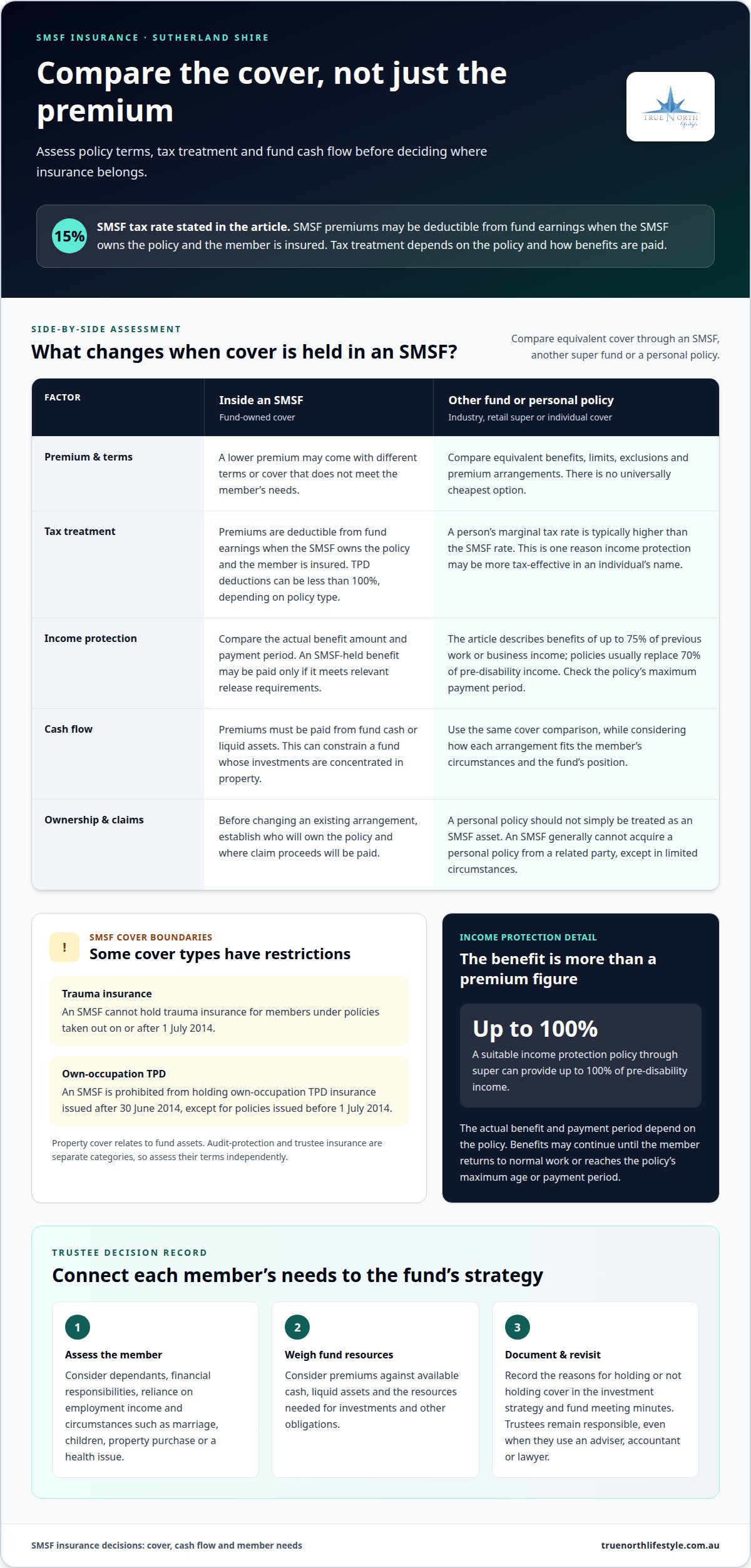
- Tax treatment can affect where cover makes sense: according to the Australian Taxation Office, SMSFs pay 15% tax, compared with a person’s typically higher marginal tax rate, which may make income protection more tax-effective in an individual’s name.
- Before moving personal life insurance into an SMSF, understand who will own the policy and where any claim proceeds will be paid.
- Trustees remain legally responsible for insurance decisions, even when they use an adviser, accountant or lawyer, so document how cover fits the fund’s strategy.
Are SMSF insurance premiums competitive?
There’s no universally cheapest option: compare equivalent cover, benefits and policy terms, not premiums alone. When weighing SMSF insurance requirements in Sutherland Shire, also consider fund cash flow and each member’s circumstances.
Comparing SMSF and Other Fund Cover
When comparing SMSF cover with insurance through an industry or retail super fund, assess similar benefits, limits, exclusions and premium arrangements. A lower premium may come with different terms or cover that doesn’t meet a member’s needs. For SMSF insurance requirements in Sutherland Shire, also consider the fund’s assets and members.
Income protection generally provides benefits of up to 75% of a member’s previous work or business income. Policies usually replace 70% of pre-disability income, with benefits payable until the member returns to normal work or the policy’s maximum age or payment period is reached. Compare the benefit amount and payment period, not just the premium.
Cover types differ. SMSFs cannot hold trauma insurance for members under policies taken out on or after 1 July 2014. SMSFs are prohibited from holding own-occupation TPD insurance issued after 30 June 2014, except for policies issued before 1 July 2014. Property cover relates to fund assets; audit-protection and trustee insurance are separate categories, so assess their terms independently.
Premiums, Benefits and Tax Treatment
Tax treatment and deductibility affect the fund and member through premiums and benefits. The outcome can depend on the policy owner, type of cover and how benefits are paid.
SMSF insurance premiums are deductible from fund earnings when the SMSF owns the policy and the member is insured. According to the Australian Taxation Office, SMSFs pay 15% tax, compared with a person’s typically higher marginal tax rate; this is one reason income protection may be more tax-effective in an individual’s name. TPD deductions can be less than 100%, depending on policy type.
Income protection through super can provide up to 100% of pre-disability income under a suitable policy. An SMSF-held benefit may be paid only if it meets the relevant release requirements. Premiums also need available fund cash or liquid assets, which can constrain a fund concentrated in property.
What are the pros and cons of insurance in an SMSF?
Insurance may help meet members’ needs, but premiums also use fund resources. Trustees must consider cover as part of the fund’s investment strategy and record their reasoning.
Considering Members’ Insurance Needs
Assess each member’s circumstances against the cover the fund could hold. Members may have different financial responsibilities and needs if they die or become permanently disabled.
Trustees should consider whether life, total and permanent disability, or income protection cover is relevant for each member. Someone with dependants may need different life cover from someone without them. A member who relies on employment income may also consider cover for temporary incapacity. Trauma cover has separate SMSF restrictions and should not be treated as interchangeable with other insurance.
Record the reasons for holding or not holding cover. Revisit the decision when circumstances change, such as marriage, having children, buying property or a health issue. This creates a considered record instead of an automatic decision to insure every member.
Insurance and the Investment Strategy
The SMSF investment strategy sets out the fund’s approach to investments and must consider each member’s insurance needs. Premiums affect the resources available for investments and other obligations.
The Superannuation Industry (Supervision) Act 1993 requires Australian SMSF trustees to consider each member’s insurance needs as part of the fund’s investment strategy. Trustees should document decisions in the strategy and fund meeting minutes, including the reasons for cover or no cover.
Consider fund liquidity alongside members’ needs. Premiums must be paid from fund cash or liquid assets, which can be challenging when investments are concentrated in property. Reviewing the strategy when a member’s circumstances change helps connect insurance decisions to the fund’s overall position.
When Life Insurance Must Be Provided
Trustees must consider members’ insurance needs, but they aren’t required to provide life insurance to every member. The decision should reflect each member’s circumstances and be documented in the SMSF’s investment strategy.
Life cover may be relevant if a member’s death could affect dependants or the fund’s financial position. Weigh that need against premiums, available fund cash and the effect on other investments. Record the decision and revisit it when circumstances change.
Tax is another consideration, not a substitute for assessing need. According to the Australian Taxation Office, SMSFs pay 15% tax, compared with a person’s typically higher marginal tax rate; this is one reason income protection cover may be more tax-effective in an individual’s name. Trustees need to consider the member’s needs alongside that potential difference.
Can I transfer my personal life insurance policy to my SMSF?
A personal life insurance policy shouldn’t simply be treated as an SMSF asset. The fund’s ownership, premium payments and claim proceeds must align with superannuation rules. Before changing an existing arrangement, consider whether the fund can acquire the policy and how ownership could affect a future claim.
An SMSF generally cannot acquire a personal insurance policy from a related party, except in limited circumstances. Since a member is connected to their fund, transferring an existing policy requires careful attention to this restriction. A change of ownership may differ from arranging new cover, so assess the proposed transfer structure before proceeding.
For insurance held through an SMSF, the fund should be named as the policy owner in the insurance documentation. Check that premiums are affordable from fund resources and that claim proceeds are handled in line with the fund’s arrangements. This differs from a personal policy arranged outside the fund. Premiums also need to be affordable from fund resources.
There’s another important difference at claim time. When insurance is held through an SMSF, a payout goes to the fund, not directly to the member or their beneficiaries. The benefit can be released only when superannuation conditions are met, so the timing and destination of proceeds may differ from personal cover.
Plan any change carefully. Arrange new cover before cancelling other policies, including insurance held in a previous super fund, to help avoid a gap while ownership or cover changes. Compare the existing policy’s terms with the proposed SMSF arrangement, including what happens after death, illness or disability.
Life insurance, total and permanent disability cover and income protection insurance may be held through an SMSF when structured within superannuation rules. Trauma insurance cannot be held for members under policies taken out on or after 1 July 2014. Check how each policy fits the fund’s permitted cover and claim-payment requirements before replacing personal insurance.
SMSF trustees' responsibility for deciding what insurance the fund holds
Advice can inform an SMSF insurance decision, but it doesn’t transfer responsibility. Australian SMSF trustees remain legally responsible for fund decisions, even when they use an adviser, accountant or lawyer. Trustees need to understand the decision and its reasons, rather than treating an adviser’s recommendation as a substitute for oversight.
Start with each member’s circumstances. A member with dependants, for example, may have different life insurance needs from someone without them. Someone who relies on employment income may also consider how a disability that prevents them working could affect their household. Assess life, total and permanent disability, and income protection cover against those needs, rather than choosing it simply because it appears in a managed super arrangement.
Then assess what the fund can sustain. Premiums use SMSF resources, so weigh the cost of cover against available cash and the fund’s other commitments. A fund invested mainly in property, for example, may have less cash immediately available for premiums than one holding liquid assets. The decision should account for both member protection and the fund’s capacity to make payments.
Document the reasoning in the investment strategy and meeting minutes. A useful record explains which member needs trustees considered, what cover the fund holds and why they chose that approach. If trustees decide against cover, recording their reasons shows they considered the question. Review the decision when a member’s circumstances change, such as after having children, buying property or experiencing a health issue.
Policy terms matter too. Check whether the cover’s disability definitions align with superannuation rules, because an insurer’s terms and the fund’s obligations must work together. A claim approval alone doesn’t settle every question about releasing a benefit. Trustees can connect cover decisions with their broader estate planning strategy, particularly when considering how insurance proceeds relate to beneficiaries.
True North Lifestyle
True North Lifestyle can help you consider SMSF insurance decisions alongside your wider superannuation and retirement plans. A superannuation review and optimisation can clarify how fund arrangements, insurance premiums and investment choices interact. Retirement modelling can show how decisions may affect longer-term projections.
This support can be useful when weighing cover against fund cash flow, reviewing your strategy after a change in circumstances, or considering how insurance fits your retirement objectives. Tax-minimisation strategies can also help put tax implications in the context of your broader financial position, rather than treating premium cost as the only measure of value.
For a considered view of how your SMSF insurance choices fit your financial strategy, contact True North Lifestyle.
Make the next decision with clarity
Treat insurance as part of your SMSF’s wider financial plan, not as an isolated premium decision. For trustees considering SMSF insurance requirements in Sutherland Shire, that means weighing members’ needs alongside the fund’s cash flow, investment direction and longer-term priorities. A clear rationale makes future reviews more focused when circumstances change.
Consider how insurance decisions connect with retirement planning and the people who may rely on your financial arrangements. The right priorities depend on your fund and its members, so a measured discussion can bring the different considerations into focus without rushing the decision.
If you’d like support thinking through how your SMSF fits into your broader plans, contact True North Lifestyle. Take the next step when you’re ready to shape a clearer direction for your financial future.
Frequently Asked Questions
What are the rules?
SMSF insurance must comply with superannuation rules and the fund’s purposes. For example, an SMSF can’t buy health insurance for a member because it doesn’t satisfy the sole purpose test. The fund also generally can’t acquire a personal insurance policy from a related party, except in limited circumstances. Trustees should consider policy ownership, permitted cover and how any benefit could be released.
What types of insurance cover are SMSFs allowed to provide?
An SMSF may hold life insurance, income protection and eligible total and permanent disability cover for members, subject to superannuation rules. Terminal illness cover may also be provided where two medical professionals diagnose a condition likely to result in the member’s death within two years. Trauma cover is restricted: SMSFs can’t hold it for members under policies taken out on or after 1 July 2014.
When Should Insurance Be Held Outside the SMSF?
Cover may need to remain outside an SMSF when its terms can’t operate within superannuation rules or don’t meet the member’s needs. For example, an SMSF can’t hold own-occupation TPD insurance issued after 30 June 2014, except for policies issued before 1 July 2014. A member may also prefer personal income protection: its tax treatment can differ from cover held through a fund.
What insurance must an SMSF trustee consider for members under Australian superannuation law?
Trustees must consider each member’s insurance needs, but they don’t have to buy cover for everyone. The decision may differ across a fund: a member supporting dependants may have different needs from one without dependants. Trustees should consider relevant cover, explain their decision for each member and account for how premiums could affect the fund’s available resources.
What are the SMSF insurance strategy requirements under the SIS Act and regulations?
The Superannuation Industry (Supervision) Act 1993 requires trustees to consider each member’s insurance needs as part of the fund’s investment strategy. An SMSF must prepare a documented investment strategy during setup. Trustees can make their reasoning clearer by recording decisions in meeting minutes and revisiting them after changes such as a new dependent, property purchase or health issue.
Can SMSF members hold life, TPD and income protection insurance through their fund?
Yes. Members can have life, TPD and income protection insurance through an SMSF when the cover complies with superannuation rules. For TPD, disability definitions must align with those rules. An insurer approving a claim doesn’t by itself mean the fund can release the benefit. Trauma cover has separate restrictions, so it isn’t interchangeable with life, TPD or income protection cover.


