

Your retirement should be a period of quiet certainty. However, with the 1 July 2026 tax changes now in effect, many Australians find that the strategies which served them during their working lives are no longer fit for purpose. It is a common concern to feel that your financial momentum might "run out of puff" just as you should be enjoying the fruits of your labour. You deserve a strategy that replaces this anxiety with a clear, evidence-based map of your financial future.
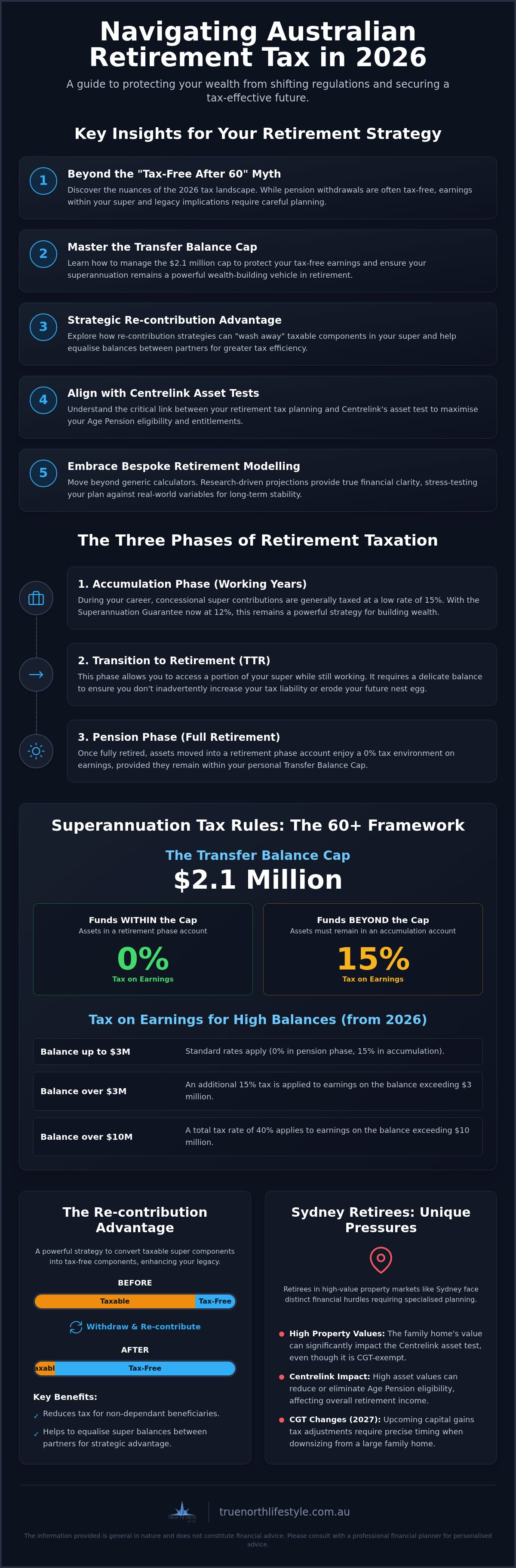
Effective tax planning for retirees Australia is no longer just about compliance; it is about sophisticated cash flow modelling that protects your wealth from shifting regulations. We understand the confusion surrounding the taxable components of superannuation and the new 15% tax rate for middle-income earners. By reading this guide, you will discover how to navigate the complex Australian retirement landscape to secure a stable, tax-effective income stream that lasts a lifetime.
We will provide a detailed breakdown of how to optimise your superannuation, structure your assets to maximise Centrelink entitlements, and ensure your legacy is shielded from unnecessary tax. From understanding the $2.1 million transfer balance cap to preparing for upcoming capital gains tax adjustments, this is your path to confident oversight of your retirement journey.
Key Takeaways
- Discover why the "tax-free after 60" rule is often a simplification and how to navigate the nuances of the 2026 Australian retirement tax landscape.
- Learn how to manage the Transfer Balance Cap to protect your tax-free earnings and ensure your superannuation remains a powerful wealth vehicle.
- Explore the strategic advantages of re-contribution to wash away tax components and help equalise super balances between partners.
- Understand the critical link between effective tax planning for retirees Australia and your Centrelink asset test to maximise your Age Pension eligibility.
- See how bespoke retirement modelling replaces generic calculators with research-driven projections that provide true financial clarity and stability.
Navigating the Australian Retirement Tax Landscape in 2026
Clarity creates confidence. For many, retirement feels like a destination, yet the financial reality is a multi-decade journey that requires constant calibration. Comprehensive tax planning for retirees Australia is not a one-off event or a box to be ticked at age 65; it is a dynamic, long-term strategy designed to evolve alongside shifting legislation. Relying on outdated advice can be a costly mistake, particularly as we move into a period of significant regulatory reform. In the 2026 context, tax-effective retirement income is defined as a cash flow stream structured to minimise levies across superannuation, private investments, and government entitlements while preserving capital longevity.
A common misconception is the "tax-free after 60" rule. While it is true that most pension withdrawals are tax-free for those over 60, this simplification ignores the complexities of the Taxation of superannuation in Australia. It fails to account for the tax on earnings within the fund, the implications for non-dependant beneficiaries, or the impact of the $2.1 million transfer balance cap. To protect your wealth, you must look beyond the surface and address the core pillars of superannuation, non-super assets, and Centrelink entitlements as a single, cohesive ecosystem.
The Three Phases of Retirement Taxation
Your tax obligations shift as you move through different stages of life. Understanding these transitions is vital for maintaining financial momentum:
- Accumulation phase: During your working years, concessional contributions are generally taxed at 15%. This remains a powerful tool for building wealth, especially with the Superannuation Guarantee now at 12%.
- Transition to Retirement (TTR): This phase allows you to access a portion of your super while still working. It requires a delicate balance to ensure you aren't inadvertently increasing your tax liability or eroding your future nest egg.
- Pension phase: Once you fully retire, assets moved into a retirement phase account enjoy a 0% tax environment on earnings, provided they remain within your personal transfer balance cap.
Why Sydney Retirees Face Unique Tax Pressures
Location dictates strategy. Retirees in Sydney, particularly across the Sutherland Shire and Miranda, face distinct financial hurdles due to high property values. While your family home is CGT-exempt, its value can significantly impact the Centrelink asset test, potentially reducing your Age Pension eligibility. Furthermore, with the 2027 changes to Capital Gains Tax approaching, managing the transition from a large family home to a more manageable residence requires precise timing. Bespoke modelling is essential here; it allows you to stress-test your portfolio against Sydney's cost of living and ensure your tax planning for retirees Australia accounts for the specific nuances of the local real estate market.
Superannuation Tax Rules: The 60+ Framework
Turning sixty is a financial milestone. It signals a fundamental shift in how the Australian Taxation Office views your retirement savings. While most pension withdrawals become tax-free at this age, the underlying mechanics of your fund remain complex. Professional tax planning for retirees Australia requires a deep understanding of how these rules interact with your total wealth. It's not just about the money you take out, but how the remaining balance is treated within the system.
The Transfer Balance Cap serves as the primary regulator. As of 1 July 2026, this cap has increased to $2.1 million. It represents the maximum amount you can transfer into a retirement phase account where earnings are taxed at 0%. Any wealth held in super beyond this limit must stay in an accumulation account, where earnings are taxed at the concessional rate of 15%. For those with substantial savings, the 2026 thresholds add further nuance. Earnings on balances exceeding $3 million now incur an additional 15% tax, while balances over $10 million face a total tax rate of 40% on the excess. Understanding how super works at these higher levels is essential for preserving your capital's longevity.
Taxable vs Tax-Free Components: The Hidden Trap
Structure determines legacy. Your superannuation is comprised of different tax components that aren't always obvious at first glance. The tax-free component generally stems from after-tax contributions, while the taxable component consists of employer contributions and investment earnings. This distinction is vital because non-dependant beneficiaries, such as adult children, often face a 17% tax on the taxable portion of an inherited super death benefit. You can identify these proportions on your member statement, allowing you to plan for a more tax-effective transfer of wealth.
Transition to Retirement (TTR) Strategies
Work-life balance is achievable. A TTR strategy allows you to draw a pension while still in the workforce, provided you've reached your preservation age. This approach is often used to facilitate salary sacrifice arrangements, effectively replacing taxable salary with lower-taxed super contributions. It's a methodical way to boost your retirement nest egg in the final years of your career. If you are looking for superannuation advice Sutherland Shire, we can assist in reviewing your superannuation to ensure these strategies align with your broader lifestyle goals.
Strategic Tax Minimisation: The Re-contribution Advantage
Strategy is the bridge between accumulated wealth and a lasting legacy. For many, the re-contribution strategy represents a sophisticated tool in tax planning for retirees Australia, allowing you to proactively manage the internal structure of your superannuation. It is essentially a process of "washing" your retirement savings to convert taxable components into tax-free ones. While the funds remain within the superannuation environment, their character changes, offering profound benefits for both your current cash flow and your future beneficiaries.
This approach is particularly valuable for couples. By withdrawing funds from one partner's account and re-contributing them to the other's, you can effectively equalise superannuation balances. This ensures both partners remain comfortably under the $2.1 million transfer balance cap, maximising the total amount of wealth held in a 0% tax environment. It also addresses the estate planning concerns mentioned previously; by increasing the tax-free component, you shield your adult children from a potential 17% tax liability on inherited super death benefits.
How the Re-contribution Strategy Works
Precision is required to execute this correctly. The process typically involves three distinct steps designed to optimise your position without breaching contribution limits:
- Step 1: We assess the taxable component of your current balance, identifying exactly how much of your super is subject to potential future levies.
- Step 2: Once you meet a condition of release, such as reaching age 60 and retiring, you access these funds as a tax-free lump sum.
- Step 3: You make a non-concessional contribution back into the fund, which is then classified as a tax-free component.
Timing remains critical. You must navigate the annual non-concessional contribution cap, which is $130,000 for the 2026-2027 financial year. For those looking to move larger sums, the "bring-forward" rule may allow you to contribute up to $390,000 over a three-year period, provided your total super balance allows it. This careful sequencing ensures you stay within the law while significantly improving your fund's tax profile.
Is an SMSF Right for Your Tax Strategy?
Control brings both opportunity and responsibility. A Self-Managed Super Fund (SMSF) often provides the structural flexibility needed for complex re-contribution strategies, especially when dealing with diverse asset classes or property. The trade-off, however, is a significantly higher compliance burden and the need for disciplined record-keeping. Choosing an SMSF should be a deliberate decision based on your desire for oversight and the complexity of your financial goals. If you require a more tailored approach to your portfolio, our bespoke investment advice Sydney can help you determine if an SMSF aligns with your long-term vision for stability and growth.
Balancing the Books: Centrelink and Asset Testing
Financial harmony requires a dual focus. While reducing your tax liability is essential, it must not come at the expense of your government entitlements. Integrated tax planning for retirees Australia ensures that your income streams and asset structures work in tandem with Services Australia regulations. A common misconception among Sydney residents is that having significant assets automatically disqualifies them from the Age Pension. In reality, the strategic placement of wealth can often unlock part-pension benefits and, perhaps more importantly, the Commonwealth Seniors Health Card.
Gifting rules remain a strict boundary. You can generally only gift $10,000 per financial year, or $30,000 over a rolling five-year period, before the excess is "deprived" and counted as an asset for five years. Deeming rates also play a pivotal role in how your income is assessed. As of 1 July 2026, the first $110,600 of a couple's combined financial assets are deemed to earn 1.25%, with anything above this amount deemed at 3.25%. Managing these thresholds is a core component of our Centrelink structuring services, helping to ensure your portfolio remains as efficient as possible.
Maximising Centrelink Age Pension Entitlements
Sheltering assets is a legitimate and effective tactic. If you have a younger spouse who has not yet reached Age Pension age, funds held in their superannuation accumulation account are generally exempt from your asset test. This allows couples to "park" wealth in a tax-effective environment while potentially increasing their own pension payments. Additionally, the family home remains a sanctuary. Regardless of whether your residence is in Miranda or the Sutherland Shire, its full value is exempt from the assets test, provided it is your principal place of residence. For those seeking stable cash flow, certain lifetime income streams also offer favourable asset-test concessions compared to traditional account-based pensions.
Downsizing and the Tax Consequences
Transitioning to a smaller home offers a unique window for wealth injection. The Downsizer Contribution allows individuals to contribute up to $300,000 into superannuation from the sale of their primary residence without these funds counting towards standard contribution caps. This is a powerful tool for those who have already utilised their non-concessional limits. However, you must distinguish between selling the family home and an investment property. Selling the latter will trigger Capital Gains Tax, which requires careful timing to mitigate the impact of the upcoming 2027 CGT reforms. You can read more about these shifts in our guide to tax planning for retirement Australia.
Bespoke Retirement Modelling: Your Path to Clarity
Confidence follows structure. While generic online calculators provide a broad estimate of your future, they often fail to account for the intricate variables that define your personal journey. Effective tax planning for retirees Australia requires more than a simple estimation; it demands rigorous, research-driven projections that stress-test your strategy against market fluctuations and legislative shifts. By moving beyond basic assumptions, you can step into a role of confident oversight, knowing your financial future is grounded in real-world probability rather than hope.
Generic tools cannot account for "sequence of returns" risk or the complex interplay between tax-minimisation and government entitlements. A bespoke model allows us to visualise the long-term impact of every decision, from the timing of a home sale to the sequencing of superannuation withdrawals. This level of detail replaces the inherent anxiety of retirement with a sense of calm and order. You deserve a plan that is as unique as the lifestyle you've built, ensuring your wealth is protected and your income stream remains stable regardless of the economic climate.
The True North Approach to Tax Minimisation
Our methodology is built on quiet certainty. The True North Investment Committee focuses on constructing low-volatility, tax-aware portfolios that prioritise sustainable income over high-risk gains. We don't view your assets in isolation; we integrate your immediate tax needs with long-term estate planning strategies to ensure your legacy remains protected from unnecessary levies. Having a Miranda-based adviser who understands the Sutherland Shire market provides an additional layer of insight, particularly when managing the high property values and unique lifestyle expectations of our local community. We focus on the human outcome of every strategy, moving you toward a state of steady oversight.
Your Next Steps Toward a Calm Retirement
Preparation precedes peace. A comprehensive financial review before the June 30 deadline is essential for implementing the re-contribution or Centrelink strategies discussed earlier in this guide. We invite you to visit our Sydney or Miranda offices for a consultation that prioritises your personal goals over mere numbers. Now is the time to replace uncertainty with a structured, well-defined path that secures your wealth for the decades ahead. Organise a retirement modelling session today and begin the transition toward a more stable, tax-effective future.
Step Into Your Retirement with Quiet Certainty
Retirement is not merely a destination; it's a dynamic phase of life that requires a disciplined, research-driven approach. You now understand how the 1 July 2026 changes impact your superannuation and why strategic re-contributions can shield your legacy from unnecessary death taxes. Effective tax planning for retirees Australia replaces the fear of outliving your capital with a structured map for long-term stability. By balancing your private wealth with optimised Centrelink entitlements, you ensure every dollar works toward your lifestyle goals.
True North Lifestyle provides professional fee-for-service advice tailored to the unique complexities of Sydney estate and tax planning. Our in-house Investment Committee oversees bespoke portfolio construction designed to manage volatility while protecting your income stream. We invite you to move beyond the anxiety of shifting regulations and embrace a state of confident oversight. Secure your financial future with bespoke retirement modelling from True North Lifestyle. Your path to a calm and prosperous retirement begins with a single, informed choice.
Frequently Asked Questions
Is my superannuation pension completely tax-free after age 60?
Generally, yes, pension payments from a taxed fund are tax-free for those over 60. However, this only applies to funds held within your $2.1 million transfer balance cap. Earnings on any balance remaining in an accumulation account are taxed at 15%. For those with very high balances, the 2026 reforms introduce additional taxes on earnings for balances exceeding $3 million, making precise management essential for wealth preservation.
How much can I contribute to my super to reduce my tax before I retire?
You can make concessional contributions up to $32,500 for the 2026-2027 financial year to reduce your taxable income. These contributions, which include employer payments and salary sacrifice, are generally taxed at a lower rate of 15% within the fund. Utilising these caps is a foundational element of tax planning for retirees Australia, allowing you to build your nest egg more efficiently in the years leading up to your retirement.
What is the "re-contribution strategy" and how does it save on tax?
The re-contribution strategy involves withdrawing a lump sum from your super and re-depositing it as a non-concessional contribution. This process effectively converts "taxable" components into "tax-free" ones. While it doesn't change your balance, it can significantly reduce the 17% tax your non-dependant beneficiaries might otherwise pay on your death benefit. It also assists in equalising balances between couples to stay under the $2.1 million transfer balance cap.
How do the 2026 tax changes affect my retirement income stream?
The 2026 tax changes introduce a lower 15% income tax rate for those earning between $18,201 and $45,000, which may increase your net cash flow. Conversely, retirees with super balances over $3 million will face an additional 15% tax on earnings. For balances exceeding $10 million, the total tax on earnings for the excess portion rises to 40%. These shifts require a disciplined review of your income stream structures.
Will selling my Sydney home affect my Centrelink Age Pension entitlements?
Selling your principal place of residence in Sydney generally doesn't trigger capital gains tax, but the cash proceeds can impact Centrelink tests. If you intend to buy a new home, the proceeds used for the purchase are typically exempt from the assets test for up to 24 months. You might also consider a Downsizer Contribution of up to $300,000 to move proceeds into the tax-effective superannuation environment without affecting your standard contribution caps.
Can I still get the Age Pension if I have a large superannuation balance?
Eligibility for the Age Pension depends on the interaction between the income and assets tests. While a large super balance is counted under the assets test, certain strategies can help you qualify for a part-pension or the Commonwealth Seniors Health Card. For example, assets held in a younger spouse’s super account, before they reach Age Pension age, are currently exempt from your assessment. This nuanced approach ensures you maximise your government entitlements.
What happens to the tax on my super when it is passed to my children?
When super is passed to non-dependant adult children, the "taxable" portion of the benefit is generally taxed at 17% including the Medicare levy. This can result in a significant erosion of your legacy. Identifying these components on your member statement is the first step in implementing a re-contribution strategy. By washing these funds while you are alive, you can ensure your children receive their inheritance with a much lower tax burden.
How often should I review my retirement tax planning strategy?
We recommend a comprehensive review of your tax planning for retirees Australia at least once a year, ideally before the 30 June deadline. However, major life events or significant legislative changes, such as the 2026 budget reforms, should trigger an immediate consultation. Regular reviews allow you to adjust your modelling for new deeming rates or inflation-indexed thresholds, ensuring your strategy remains a reliable anchor in a fluctuating environment.


