

Wealth is fragile. For many high earners, the realisation that nearly half of every additional dollar earned is redirected to the ATO remains a source of persistent frustration. You aren't simply looking for a few extra deductions at the end of June; you're seeking a structural shift that provides long-term stability. Implementing the right tax minimisation strategies Australia permits within its legal framework is essential for anyone who wants to replace the anxiety of high marginal rates with a sense of quiet certainty. It's exhausting to watch Capital Gains Tax erode the returns you've worked decades to build, especially when the rules for trusts and superannuation feel increasingly complex.
We believe that tax should be a managed variable rather than an annual surprise. This guide provides a clear roadmap for using sophisticated financial structures to protect your retirement nest egg and ensure your wealth lasts as long as you do. By moving away from reactive habits and toward a research-driven methodology, you can regain a sense of calm and control over your financial destiny. We'll explore how bespoke portfolio construction, strategic superannuation reviews, and rigorous lifestyle modelling can help you preserve family wealth for the next generation.
Key Takeaways
- Shift your focus from reactive year-end deductions to a proactive structural discipline that shields your wealth from high marginal tax rates.
- Optimise your retirement savings by implementing sophisticated tax minimisation strategies Australia provides through concessional and non-concessional superannuation contributions.
- Evaluate the benefits of SMSFs and family trusts to determine which vehicle offers the greatest control and tax efficiency for your investment portfolio.
- Reduce your exposure to Capital Gains Tax by understanding how holding periods and strategic timing can preserve your investment returns over the long term.
- Utilise bespoke financial modelling to transform complex tax laws into a clear, predictable roadmap that ensures your retirement lifestyle remains secure.
Beyond Basic Deductions: The Philosophy of Tax Minimisation in Australia
Wealth creation is often viewed through the lens of investment returns alone. However, the most disciplined investors recognise that what you keep is far more important than what you earn. Tax is not a fixed cost. It's a variable that can be optimised through the deliberate application of tax minimisation strategies Australia provides within its legislative framework. Unlike tax evasion, which involves the illegal concealment of income or falsification of records, strategic minimisation uses legitimate financial structures to ensure you don't pay a cent more than required. It's about order, logic, and the intelligent arrangement of your affairs.
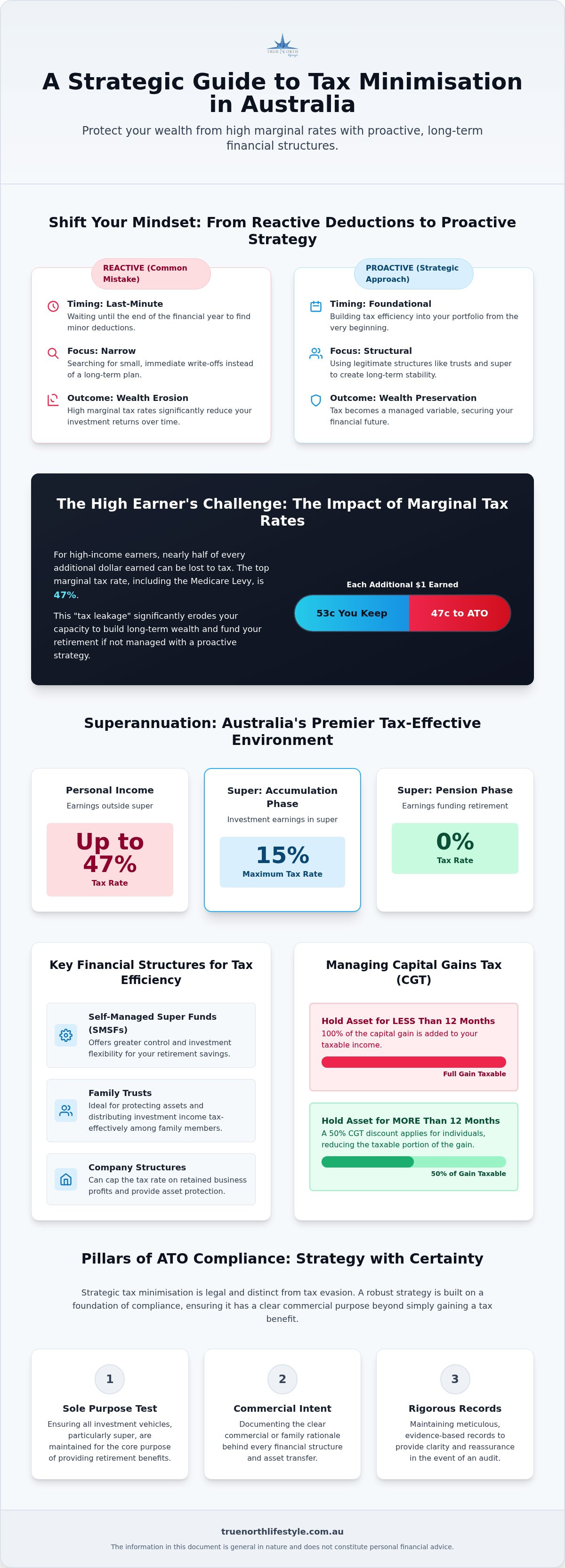
Moving from a reactive PAYG mindset to a proactive wealth-owner mindset is the first step toward financial stability. Many Australians wait until June to look for minor deductions. A strategic approach, however, builds tax efficiency into the very foundation of your portfolio. This shift is vital for high-income earners who face the highest marginal rates, where the primary objective is often to defer or reduce current taxable income. In contrast, retirees focus on generating tax-free income streams to support their lifestyle. Understanding these nuances allows you to transition from a state of uncertainty to one of confident oversight.
The Impact of Tax on Your Retirement Longevity
Efficiency is the silent engine of a successful financial plan. Over a thirty-year retirement, even a small percentage of annual tax leakage can significantly erode your total capital and reduce the duration of your nest egg. When you're in your peak earning years, being taxed at 47 per cent (including the Medicare levy) means nearly half of your effort is diverted away from your future self. This is why immediate structural shifts are necessary. By integrating the sophisticated retirement planning Sydney specialists utilise, you can identify where your current setup is leaking value and redirect those funds back into your compounding assets.
The Legal Framework: Navigating ATO Compliance
Stability requires strict adherence to the law. The Australian Taxation Office (ATO) monitors financial arrangements through Part IVA, the general anti-avoidance provision. It's essential to ensure that any strategy has a clear commercial or family purpose beyond simply gaining a tax benefit. Professional advice ensures your strategy remains within the spirit of Australian law while maximising your position. We focus on three core pillars of compliance:
- Ensuring all investment vehicles meet the "sole purpose" test for retirement benefits.
- Documenting the clear commercial intent behind every financial structure and asset transfer.
- Maintaining rigorous, evidence-based records to provide emotional reassurance during an audit.
A well-documented strategy isn't just about efficiency; it's about protection. When your tax minimisation strategies Australia-wide are built on research and evidence, you can move forward with quiet certainty, knowing your family wealth is secure.
Superannuation: The Ultimate Tax Haven for Australians
Superannuation remains the most tax-effective environment in the Australian financial landscape. It is a purpose-built structure designed to encourage self-sufficiency, offering a unique set of rules that, when mastered, can significantly accelerate your wealth preservation goals. By utilising the specific tax minimisation strategies Australia provides within this framework, you can move assets from a high-tax environment into one where earnings are taxed at a maximum of 15 per cent, or even zero per cent during the pension phase. This isn't merely about saving; it's about the strategic construction of a fortress for your future self.
Optimising your contribution caps for 2026 requires a forward-looking approach. Whether you are utilising concessional contributions to reduce current taxable income or non-concessional contributions to shift personal wealth into a protected environment, timing is everything. For those who have had interrupted work histories or periods of lower income, "catch-up" concessional contributions allow you to carry forward unused cap amounts from previous years. This creates a powerful opportunity to make larger, tax-deductible contributions in years where your income, and therefore your marginal tax rate, is at its peak. Transition to Retirement (TTR) strategies further refine this process, allowing you to access a portion of your super while still working, effectively recycling your income to reduce tax without compromising your current lifestyle.
Maximising Concessional Contributions
Salary sacrifice is a fundamental tool for the disciplined professional. By redirecting a portion of your pre-tax salary into super, you effectively lower your assessable income and your overall tax liability. For business owners and contractors, personal deductible contributions offer similar flexibility, allowing for precise control over your year-end tax position. While the top marginal tax rate sits at 45 per cent plus levies, the 15 per cent tax applied to concessional superannuation contributions represents a significant structural advantage for high-income earners. A tailored superannuation review can reveal which of these levers will have the greatest impact on your long-term projections.
The Re-contribution Strategy for Couples
Protecting your legacy requires looking beyond your own lifetime. The re-contribution strategy involves withdrawing a portion of your super and contributing it back as a non-concessional payment. This process effectively converts the "taxable component" of your balance into a "tax-free component." While this has no immediate impact on you, it is a vital tool for estate planning. It minimises the potential tax burden, often referred to as the "death tax," that adult children or non-dependants may face on the taxable portion of an inherited super balance. Integrating this with the specialised superannuation advice Sutherland Shire residents rely on ensures that your family wealth is preserved for the next generation with minimal leakage.
Structural Minimisation: SMSFs, Family Trusts, and Companies
Structure dictates outcome. Choosing the right vehicle to hold your assets is the most critical tax decision you will make. It's the difference between a portfolio that leaks value and one that functions with high-level efficiency. By moving beyond individual ownership, you can access tax minimisation strategies Australia reserves for those who use sophisticated legal entities. These structures provide the logical grounding required to protect your capital and ensure your family's future remains secure.
SMSF vs. Industry Funds for Tax Control
Control is the primary advantage of a Self-Managed Super Fund (SMSF). While industry funds offer simplicity, they often lack the granular control needed for precise tax optimisation. In an SMSF, you can determine the exact timing of asset disposals. This allows you to offset capital gains against specific losses, effectively minimising your CGT liability. For business owners, the ability to hold business real property within the fund is a significant benefit. Your business pays market-rate rent to the SMSF, which is taxed at a maximum of 15 per cent, or potentially zero per cent once the fund enters the pension phase. You must weigh the compliance costs against these potential savings, but for many, the bespoke nature of an SMSF provides a level of stability that generic funds cannot match.
The Power of Income Splitting via Family Trusts
Discretionary trusts remain the gold standard for family wealth management. They allow for the flexible distribution of investment income to family members who may sit in lower tax brackets. This process of income splitting can significantly reduce the total tax paid by the family unit. Trusts also provide a layer of protection, shielding your assets from creditors while maintaining the flexibility to adapt to changing tax laws. These entities are essential components of wealth preservation strategies that aim to keep capital intact across generations.
When family members have exhausted their lower tax thresholds, a corporate beneficiary, or "bucket company," becomes a vital tool. This strategy allows you to distribute trust income to a company, capping the tax rate at 25 per cent or 30 per cent rather than paying the top individual marginal rate. This retained capital can then be reinvested, allowing your wealth to compound in a lower-tax environment. It is a methodical approach that replaces the anxiety of high tax bills with a structured, well-defined path toward financial longevity.
Managing Capital Gains Tax (CGT) and Investment Income
Capital Gains Tax (CGT) is often the largest tax bill a retiree will face. It can feel like a significant erosion of your life's work, but it doesn't have to be an unmanaged cost. Planning for this liability starts years in advance. The 50% CGT discount is your most effective tool for wealth preservation. By holding an investment for at least 12 months, you legally halve the taxable portion of your gain. This holding period is your greatest tax ally, turning a standard investment into a highly efficient vehicle for long-term growth.
Strategic asset disposal is about timing. It involves selling assets during financial years when your other taxable income is at its lowest. This often occurs in the transition phase after you have ceased full-time work but before you begin drawing a formal pension. By carefully managing the sequence of these sales, you can stay within lower tax brackets and minimise the total bill. These tax minimisation strategies Australia permits allow for a more stable and predictable financial transition. When you understand that the ATO effectively becomes a partner in your capital gains, the importance of timing becomes clear.
Franking Credits: The Australian Retirement Secret
Franking credits are a cornerstone of Australian retirement income. They represent the corporate tax already paid by companies on their profits. When these companies distribute dividends, they attach a credit that you can use to offset your own tax liability. For many retirees in lower tax brackets, this results in a direct cash refund from the ATO. This is why bespoke investment advice Sydney specialists provide focuses on building portfolios with fully franked dividends. Beyond reducing income tax, these credits can also be used to offset the Medicare Levy, providing a rare opportunity to protect your net returns from multiple angles.
Small Business CGT Concessions
Sydney business owners have access to powerful concessions that can transform a business sale into a secure retirement. The 15-year exemption is particularly valuable; if you've held an active asset for 15 years and are retiring, the entire gain may be tax-free. If you don't meet the 15-year criteria, the retirement exemption still allows for a tax-free injection of up to A$500,000 into your superannuation. Navigating the "active asset" test is essential to ensure your property or business equipment qualifies under ATO rules. These specialised tax minimisation strategies Australia-wide are designed to reward the risk taken by business owners by allowing them to transition into retirement with their capital intact.
To understand how these concessions can be integrated into your personal wealth plan, you can review our bespoke portfolio construction services.
Bespoke Tax Modelling: The True North Lifestyle Approach
A generic approach to finance often ignores the human element. Tax isn't just a compliance task; it's a structural component of your lifestyle. While many firms offer standard templates, True North Lifestyle prioritises a research-driven methodology that aligns your tax position with your personal journey. By applying the advanced tax minimisation strategies Australia allows, we move beyond simple deductions to build a framework that supports your specific retirement goals. This methodical approach replaces the year-end scramble with a year-round discipline of wealth preservation, ensuring every financial move is purposeful and logical.
Clarity Through Retirement Modelling
Visualising your future requires more than a spreadsheet. It demands sophisticated modelling that projects your tax obligations over a 20 or 30-year horizon. We stress-test your portfolio against potential legislative changes, ensuring that your wealth preservation plan remains robust in a fluctuating environment. This process transforms the anxiety of the unknown into a state of quiet certainty, allowing you to implement the tax minimisation strategies Australia permits with absolute confidence. You aren't just hoping for the best; you're stepping into the role of the "Steady Navigator," empowered by data and logical foresight. We integrate tax planning for retirement Australia with your estate planning strategy to ensure that your legacy is protected from unnecessary leakage during the intergenerational transfer of wealth.
Taking the Next Step in Miranda and Sydney
Strategic implementation requires collaboration. We don't replace your accountant; we work alongside them to ensure our strategic framework is executed with precision. This partnership ensures that every structural shift is documented and compliant, providing you with a seamless experience. For families in the Sutherland Shire and across Sydney, local expertise provides an additional layer of reassurance. Our fee-for-service model reflects our commitment to unbiased, bespoke advice that prioritises your outcomes over product sales. It's about providing a clear, well-defined path toward a future where your wealth is both protected and optimised. You can organise a consultation with True North Lifestyle to begin mapping your tax-efficient future today.
Securing Your Legacy Through Structural Discipline
Order brings peace. Protecting your wealth requires a shift from reactive habits toward a structured, evidence-based methodology. By implementing the right tax minimisation strategies Australia permits, you can ensure that nearly half of your additional effort isn't lost to high marginal rates. We've explored how sophisticated vehicles like SMSFs and family trusts provide the control needed to manage Capital Gains Tax and income splitting with precision.
True North Lifestyle acts as your steady navigator in this complex environment. Our specialists in long-term retirement modelling and our research-driven Investment Committee ensure that every decision is grounded in real-world probability. With deep local Sydney and Miranda expertise, we help you replace financial anxiety with a sense of quiet certainty. Secure your financial future with a bespoke tax strategy from True North Lifestyle and move toward a well-defined path where your family's future is secure. You've worked hard to build your nest egg; now is the time to ensure it's protected by logic and order.
Frequently Asked Questions
Is tax minimisation legal in Australia?
Tax minimisation is entirely legal in Australia and involves the legitimate arrangement of your financial affairs to reduce your tax liability. It differs fundamentally from tax evasion, which is the illegal concealment of income. Our Miranda based team focuses on structural efficiency that ensures you remain compliant with ATO regulations while protecting your capital. By using research-driven strategies, you can optimise your position without fear of regulatory breach. It's about order and compliance.
How much can I contribute to super to reduce my tax in 2026?
For the 2026 financial year, you should verify the current concessional contribution caps with the ATO, as these are subject to indexation. These pre-tax contributions are taxed at 15 per cent, which is significantly lower than the top marginal rates. Utilising "catch-up" provisions can also allow you to contribute more if you have unused cap amounts from previous years. This is a primary component of the tax minimisation strategies Australia offers to high-income earners seeking stability.
What is the difference between a Family Trust and an SMSF for tax purposes?
A Family Trust is a discretionary vehicle used primarily for income splitting among family members in lower tax brackets. In contrast, an SMSF is a retirement savings vehicle that benefits from a concessional tax rate of 15 per cent on earnings, dropping to zero in the pension phase. While trusts offer flexibility for current wealth, SMSFs are purpose-built for long-term retirement longevity. Choosing the right structure depends on your specific lifestyle goals and wealth preservation needs.
How does the 50% CGT discount work for Australian residents?
Australian residents who hold a capital asset for at least 12 months are generally entitled to a 50 per cent discount on the capital gain. This means only half of the profit is added to your assessable income for the year. It's a powerful tool for those in Sydney managing investment portfolios, as it effectively rewards long-term holding periods. Planning the timing of asset disposals is essential to ensure you don't trigger unnecessary tax liabilities.
Can I still use a transition to retirement strategy if I am over 60?
You can certainly use a transition to retirement (TTR) strategy if you are over 60 and still working. Between the ages of 60 and 65, your superannuation pension payments are generally tax-free, which provides a significant advantage. This allows you to draw an income from super while simultaneously making salary sacrifice contributions to reduce your taxable income. It's an effective way to recycle your wealth and boost your retirement nest egg simultaneously without compromising your lifestyle.
What are franking credits and how do they help retirees?
Franking credits represent the corporate tax already paid by Australian companies before they distribute dividends. When you receive a franked dividend, you receive a credit for that tax, which can offset your personal tax liability. For many retirees in Sydney with lower taxable incomes, these credits can result in a cash refund from the ATO. This creates a "tax-free" income stream that supports your lifestyle without eroding your underlying investment capital or creating unnecessary anxiety.
Should I hold my investments in my own name or a company?
Holding investments in your own name allows access to the 50 per cent CGT discount, which is unavailable to companies. However, a company structure caps the tax rate at 25 or 30 per cent, which can be beneficial for reinvesting income. Our bespoke modelling helps you determine which vehicle provides the greatest long-term stability for your specific portfolio. There is no one-size-fits-all answer; the choice must reflect your broader wealth preservation strategy and commercial intent.
How often should I review my tax minimisation strategy?
You should review your tax minimisation strategies Australia-wide at least once a year or whenever significant legislative changes occur. Tax laws are rarely static, and a strategy that worked three years ago might now be inefficient. Regular reviews with your adviser in Miranda ensure your structures remain optimised for your current income and future retirement projections. Consistent oversight is the only way to maintain a state of quiet certainty in a fluctuating and complex environment.


