

What if providing for your partner today could unintentionally change what your children inherit later? In blended families, an informal promise may not match how assets are owned or ultimately distributed. Estate planning for blended families Sydney families undertake needs to consider both your intentions and how property, superannuation and other assets may pass on.
It’s understandable to want your partner to feel secure while also protecting the legacy you hope to leave your children. Inheritance can be a delicate subject, but a clear plan helps make family intentions easier to discuss and financial decisions easier to assess.
This guide explains the family and financial details that shape a blended-family estate plan, from property ownership and superannuation to the trade-offs between competing priorities. It also outlines where financial strategy and legal advice each fit, so you can prepare for a considered discussion in Sydney, including Miranda, and make decisions with greater clarity.
Key Takeaways
- Map family relationships, assets, ownership, debts and existing superannuation nominations before making estate-planning decisions.
- Compare ways to support your partner, provide for your children and retain flexibility as circumstances change.
- Estate planning for blended families Sydney households undertake benefits from coordinating financial considerations with legal advice, because different assets can follow different pathways.
- Use a practical preparation checklist to clarify your intentions and identify decisions that need further consideration.
- Scenario modelling can help show how retirement needs, lifespans and changing family circumstances may affect your intended legacy.
Why estate planning for blended families in Sydney needs more than a standard will
Blended-family estate planning starts with a practical question: how should your financial resources support the people who matter to you, given the way your family and assets are structured? The answer involves more than choosing beneficiaries. Property ownership, superannuation, financial commitments and changing circumstances can all affect how your intentions may be carried out. This introduction to estate planning explains how a will fits within a wider set of arrangements.
The balance can be delicate. You may want your current partner to have financial security while also preserving benefits you intend for children from an earlier relationship. Recognising both priorities is a useful starting point. Estate planning for blended families in Sydney should bring these intentions into focus without assuming that one must automatically come at the expense of the other.
A will records important instructions, but an estate plan considers how your family circumstances, asset ownership and financial arrangements work together. A will doesn’t necessarily govern every asset. For example, superannuation death benefits may be dealt with under fund rules and nominations rather than passing automatically through the will. Financial strategy can help clarify the financial implications; legal advice is important for questions about documents, rights and eligibility.
Which family relationships should the plan account for?
Map who is part of your financial picture, not just who lives in your home. Record your current partner, children from previous relationships, children you share and anyone who depends on you financially. Include relevant former relationships and ongoing commitments, such as support payments or other responsibilities. This gives you a clearer basis for discussing your intentions.
Don’t assume each person has the same legal status or potential entitlement. In NSW, the position of a spouse, biological or adopted child, stepchild and former partner can differ, and the relevant circumstances matter. A family map is a planning prompt, not a conclusion about anyone’s rights.
Why do blended-family intentions become difficult to carry out?
Intentions can be affected by real-life change. Relationships may evolve, assets may be sold or acquired, and a surviving partner’s needs may shift over time. In NSW, marriage generally revokes an earlier will unless it was made in contemplation of that marriage. Relationship changes are therefore an important reason to review arrangements with appropriate legal advice.
Consider a Sydney couple where one partner has two children from an earlier relationship and the other has a child from a previous relationship. They may agree that the surviving partner should remain financially comfortable while hoping particular assets will eventually benefit their respective children. If the arrangement rests only on an informal promise, later circumstances or decisions may mean it doesn’t produce the expected outcome. That result isn’t inevitable, but it shows why intentions, ownership and the pathways assets follow need to be considered together.
How Sydney families can map assets, ownership and superannuation
Start with a clear snapshot. For estate planning for blended families, Sydney households can begin by listing assets and financial commitments before deciding who they hope will benefit. This can reveal gaps between an intended outcome and the way an asset may legally or practically transfer.
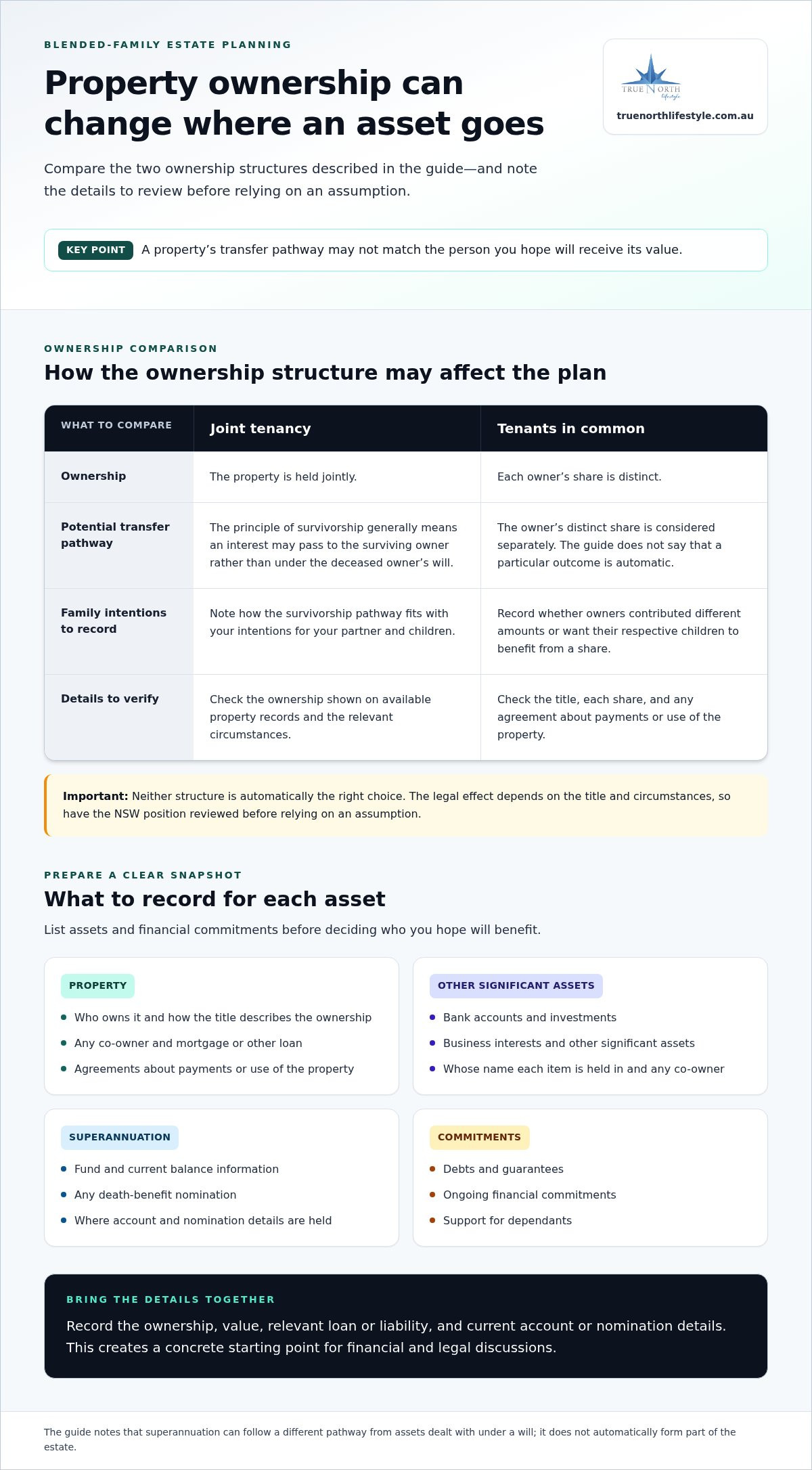
For each item, record whose name it’s held in, any co-owner, approximate value, relevant loan or liability, and where current account or nomination details are held. Include:
- Property, including ownership details shown on available records and any mortgage.
- Bank accounts, investments, business interests and other significant assets.
- Superannuation accounts, the fund, current balance information and any death-benefit nomination.
- Debts, guarantees and ongoing financial commitments, including support for dependants.
Review ownership and beneficiary arrangements together, because an asset’s transfer pathway may not match the person you hope will receive its value. The Moneysmart guide to wills and estate planning is a useful Australian reference for understanding how estate-planning arrangements can fit together.
What does property ownership change in an estate plan?
Record whether a property is held by one person or shared, how the ownership is described, and what loans or private arrangements relate to it. With joint tenancy, the principle of survivorship generally means an interest may pass to the surviving owner rather than under the deceased owner’s will. With a tenants-in-common arrangement, each owner’s share is distinct. The legal effect depends on the title and circumstances, so have the NSW position reviewed before relying on an assumption.
Neither structure is automatically the right choice. Partners may, for example, have contributed different amounts or want their respective children to benefit from their share. Note those intentions alongside the title details, mortgage and any agreement about payments or use of the property. This gives financial and legal discussions a concrete starting point.
How should superannuation fit into the family picture?
Superannuation can follow a different pathway from assets dealt with under a will. It doesn’t automatically form part of the estate; a valid binding death-benefit nomination directing payment to the estate can affect that pathway. Without a valid binding nomination, the fund trustee decides who receives the benefit under the applicable rules. Nomination types, validity and eligible recipients matter. Record what’s in place and have the details reviewed rather than treating a nomination as a guaranteed outcome.
For a broader view of how fund choices and nominations fit into your finances, explore superannuation advice in the Sutherland Shire. A financial review can connect these details with retirement needs and your wider legacy intentions. Legal advice addresses the legal effect of ownership and estate documents.
Which estate-planning approaches may balance a partner’s needs and children’s inheritance?
There’s no single arrangement that suits every blended family. Some people prioritise the surviving partner’s immediate security; others want to define how and when children may benefit while still allowing the survivor room to adapt. Start with practical questions: what income and housing might the survivor need, which assets could support that need, and how much flexibility should remain if circumstances change?
This comparison can help organise a discussion. These are broad planning objectives, not legal recommendations. The effect of any structure depends on personal circumstances, asset ownership and legal design.
| Planning objective | Potential consideration or trade-off | Questions for review |
|---|---|---|
| Support the surviving partner | Access to income, housing or capital may help meet immediate needs, but could reduce what remains for children later. | What support may be needed, and for how long? Which assets or income sources could provide it? |
| Provide for children | Clear beneficiaries and timing can express intentions, though restricting access or control may affect flexibility and family relationships. | Should benefits be available immediately or at a later stage? How might each child’s circumstances differ? |
| Preserve flexibility | Giving the survivor discretion may help them respond to changing needs, but children may have less certainty about a future inheritance. | Who makes decisions, and what safeguards or guidance should be considered? |
When might a plan prioritise a surviving partner’s security?
Consider the survivor’s housing, day-to-day income, access to cash and likely changes in health or living costs. A life interest is one concept that may allow someone to use or benefit from an asset for a defined period or purpose, while another person may benefit later. Its practical effect depends on the legal terms and circumstances. It isn’t automatically suitable: weigh support needs alongside the intended benefit for children.
How can parents express intentions for children from different relationships?
Be specific about who you intend to benefit, what you hope they receive and when access might be appropriate. A testamentary trust is a trust established through a will, but its structure and implications need specialist legal consideration. It may be relevant when discussing how to balance support and future benefit. Also consider costs, administration, control and family dynamics.
For example, a parent may want their partner to remain in the family home while preserving value for children from an earlier relationship. The plan needs to consider how the partner’s housing and financial needs could change, alongside when the children are intended to benefit. Giving the survivor more discretion may provide adaptability but less certainty for the children. More defined arrangements may clarify intentions while limiting flexibility.
No structure guarantees fairness or prevents every future disagreement. A considered estate-planning strategy can clarify trade-offs and guide questions for financial and legal review, but it can’t control every future circumstance or family response. For those managing cross-border family assets or looking to understand estate administration principles, resources like probateestate-planning.com offer helpful insights into probate and asset protection.
A practical Sydney checklist for preparing a blended-family estate plan
Preparation can make difficult conversations more manageable. Before reviewing your arrangements, gather information about who matters to you, what you own and what you want your resources to achieve. Use this checklist as a starting point for estate planning for blended families in Sydney, then adapt it to your circumstances. It isn’t a set of legal instructions or a substitute for legal advice.
- Map your family relationships. Record your current partner, children from previous relationships, shared children and anyone financially dependent on you. Include relevant former relationships and existing support commitments, noting questions about family members’ circumstances or status.
- Write down your priorities. Describe the support you hope to provide your partner and the benefit you intend for each child. Note the purpose behind each intention, such as housing, ongoing income, education or a future inheritance. You don’t need to settle every detail at this stage.
- Build an asset and liability inventory. List property, investments, bank accounts, superannuation, debts and other significant commitments. For shared assets, record ownership details, loans and any arrangements about contributions or use.
- Gather existing records. Collect available estate-planning documents, superannuation fund details and beneficiary nomination information. Note where each record is held and when it was last reviewed. Don’t assume a document or nomination still reflects your intentions.
- Identify uncertainties. Flag unclear ownership, competing priorities, changes in family relationships or questions about how an asset may transfer. Keep these as questions for financial and legal review rather than trying to resolve them by assumption.
- Prepare for a calm discussion. Choose a suitable time to talk about priorities and trade-offs. Family members may have different needs, and the discussion doesn’t have to produce an immediate agreement. A clear record of your intentions is useful even while decisions are still being considered.
Once this groundwork is in place, a financial planning discussion in Sydney can connect your intentions with retirement needs, superannuation and longer-term wealth considerations. Explore blended-family estate-planning strategy as part of that preparation; legal advice remains important for questions about documents and rights.
What information should you organise before reviewing your plan?
Keep the information together in a simple folder or secure digital record. Include asset and liability details, ownership, superannuation and nominations, existing estate documents, intended beneficiaries and the purpose each asset is meant to serve. Add major life changes, financial dependants and questions you’d like addressed. A concise, current summary helps keep conversations focused.
When should a blended-family plan be reviewed?
Revisit your intentions when relationships or family circumstances change, a child becomes financially dependent, you acquire or sell a significant asset, ownership changes, or retirement plans shift. These events may alter both financial needs and the path an asset could take. Broader wealth-transfer strategies can also help you consider how your legacy intentions fit into your longer-term financial picture.
How a Sydney financial strategy can support your blended-family legacy
Your intentions need to work alongside the financial resources available to support them. Financial advice can connect estate-planning priorities with retirement income, superannuation and long-term wealth preservation, making trade-offs easier to see. For estate planning for blended families in Sydney, this broader view can help assess whether a proposed level of support for a partner is compatible with other goals for children.
The focus isn’t on predicting exactly what will happen. It’s on understanding how different choices may affect your financial position over time, so discussions with family and legal advisers can be better informed.
What can financial modelling clarify for a blended family?
Retirement modelling can explore how different assumptions might affect long-term resources. For example, a plan can consider the potential impact of different income needs for a surviving partner, a longer lifespan, changing retirement dates or a shift in family support responsibilities. Comparing scenarios can help identify pressure points and show where a decision may involve a trade-off between present security and future inheritance intentions.
A financial review can also bring superannuation and wealth-preservation considerations into the wider picture. The purpose is to examine how these parts relate to your objectives, not to assume any one asset will be available for a particular purpose. Modelling explores possible scenarios using stated assumptions. It doesn’t guarantee future returns, asset values or outcomes, and results can change as circumstances evolve.
- Partner support: Explore how different income or housing needs could affect resources over time.
- Children’s intended benefit: Consider how timing and changing asset values may influence what could remain for children.
- Changing circumstances: Test how retirement timing, longevity or revised family responsibilities may alter the balance between priorities.
This financial perspective complements, rather than replaces, legal advice. A financial strategy can help assess projections and implications; legal professionals advise on the interpretation and preparation of wills and other legal documents. For families navigating multi-layered estate and succession concerns, resources from firms like Northeast Legal Team illustrate how tailored legal frameworks help protect family assets and long-term peace of mind. Keeping those roles distinct supports a coordinated plan, with each decision considered in the right context.
What is a useful next step for Sydney families?
Bring your family and asset overview, existing financial information and questions to a strategy discussion. You don’t need to have every answer first. The aim is to clarify your objectives, identify the assumptions that matter and consider which financial decisions may need further review alongside legal advice.
A calm, structured conversation can turn broad intentions into clearer questions and a more deliberate path forward. To discuss a tailored financial strategy in Sydney, learn about financial strategy with True North Lifestyle.
Turn your intentions into a considered next step
A blended-family legacy isn’t a one-off decision. It’s a set of intentions that may need to adapt as relationships, financial needs and priorities change. Treating the next conversation as a chance to clarify what matters, rather than settle every detail at once, can make the process more manageable.
For estate planning for blended families, Sydney families can bring their priorities into a broader financial discussion. Estate-planning strategy, retirement modelling and superannuation review can help examine how different choices may affect long-term financial plans. Legal advice remains essential for wills and other legal documents; financial advice helps you understand the wider financial implications.
When you’re ready, bring your questions and family overview to a considered discussion about the path ahead. Discuss your financial strategy with True North Lifestyle.
Frequently Asked Questions
Can a blended family have one estate plan that provides for everyone?
Yes, one coordinated plan can address the needs of a partner and children, even though different assets may be dealt with through different arrangements. Estate planning for blended families in Sydney can bring your will, superannuation arrangements, property ownership and financial objectives into the same discussion. The practical aim is consistency: consider each part alongside the others rather than assuming one document controls every asset or resolves every family question.
Does a will control who receives my superannuation in Australia?
Not necessarily. Superannuation death benefits are generally handled under the fund’s rules and applicable nomination arrangements, rather than automatically passing under a will. For example, a valid binding death-benefit nomination may direct a benefit to the estate, but its effect depends on the nomination and fund requirements. Review the nomination recorded with each fund, including whether it remains current and who may be nominated, as part of your wider planning.
What happens to jointly owned property when one owner dies in NSW?
It depends on how the property is owned. For joint tenants, survivorship may mean the deceased owner’s interest passes to the surviving owner. With tenants in common, each owner holds a distinct share that may be dealt with through their estate. The title and circumstances matter, so don’t rely on a mortgage statement or family understanding alone. Check the registered ownership details and get legal advice about the consequences for your situation.
Can children from a previous relationship make a claim on an estate in NSW?
A child may be eligible to apply for family provision in NSW, but eligibility doesn’t mean a claim will succeed. The court considers the circumstances and whether provision from the estate is adequate. A stepchild isn’t automatically eligible; factors such as membership of the deceased’s household and some degree of dependency may be relevant. NSW family provision claims generally must be filed within 12 months of death, so obtain legal advice promptly about a specific situation.
Is a testamentary trust suitable for a blended family?
It may suit some families, but it isn’t a default solution. A testamentary trust is created under a will and may offer a way to manage when and how beneficiaries access assets. Consider who would control it, the ongoing administration involved, the beneficiaries’ needs and the intended balance between survivor flexibility and children’s future benefit. Its legal and tax implications depend on the design and circumstances, so discuss suitability with legal and financial advisers.
How can I provide for my partner while protecting my children’s inheritance?
Start by defining what “provide for” means in practical terms: ongoing income, secure housing, access to funds or a combination. Then consider how those needs could change over time, what you intend children to receive and when. For instance, retaining use of a home may meet a partner’s housing need while affecting when children can benefit from its value. Financial projections can help assess trade-offs; legal advice can address the available arrangements.
When should blended families in Sydney review their estate plan?
Review it after a significant change, rather than waiting for an arbitrary date. Marriage, separation, a new child, a child becoming financially dependent, buying or selling property, retirement or a major shift in health or income can all affect your intentions. If you live in Miranda or elsewhere in Sydney, record what changed and which arrangements may be affected. A financial review can assess updated projections; legal advice can address documents and rights.


