

The more tangible investment isn’t automatically the better choice for retirement. A property can feel reassuring because you can see and manage the asset, while superannuation may offer a more diversified approach without the demands of being a landlord. If you’re searching for “investment property vs superannuation Sutherland Shire”, the useful comparison starts with what each option needs to do in your broader financial plan.
It’s reasonable to weigh up potential growth, tax, debt, cash flow and access to your money, especially when your retirement timeline and other assets also matter. There isn’t one strategy that suits everyone. The right fit depends on your circumstances, priorities and capacity to manage risk.
This 2026 guide compares the key trade-offs and explains how Australian tax and super rules may affect your decision. We’ll look at property ownership and super investments, consider retirement implications, and outline the personal information worth gathering before seeking tailored advice. Retirement modelling can help compare possible scenarios, not predict guaranteed outcomes, so you can approach the decision with greater clarity.
Key Takeaways
- Compare property and super by the role each needs to play in your overall financial plan, not by treating either as an automatic winner.
- Assess property income and potential price movements alongside super’s investment mix, fees and exposure to market changes.
- Use the investment property vs superannuation Sutherland Shire comparison to weigh your time horizon, cash-flow capacity, debt, diversification and access needs.
- Gather your income, spending, debts, assets, super balance and expected retirement timing before testing different scenarios.
- Retirement modelling can help show how property, super and other assets may work together, while accounting for income needs, tax and estate considerations.
Investment property vs superannuation: why the Sutherland Shire choice is not one-size-fits-all
Where should your long-term savings sit, given your goals, cash flow and retirement timeline? For some Sutherland Shire investors, a residential property offers direct ownership and a hands-on role. Superannuation provides a different pathway: a retirement savings structure that can hold a range of investments. The investment property vs superannuation Sutherland Shire decision isn’t simply a contest over which asset might grow more. It’s about what each option can contribute to your overall plan, and what constraints come with it.
Start with the broad trade-offs:
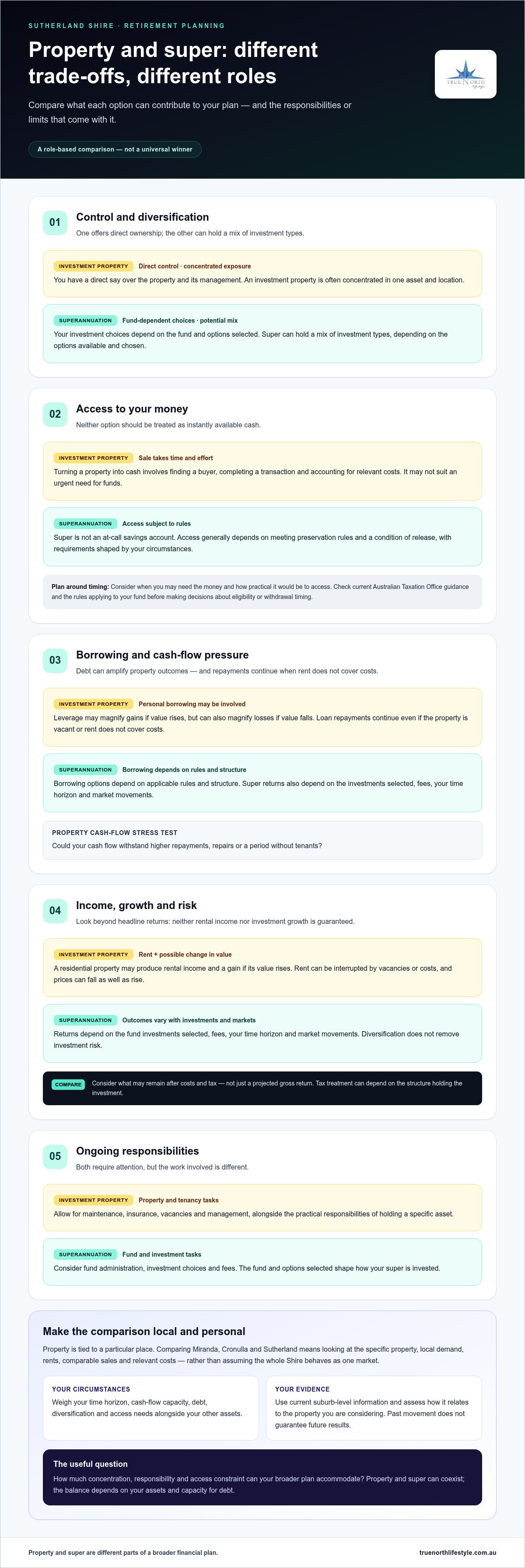
| Consideration | Investment property | Superannuation |
|---|---|---|
| Control | Direct say over the property and its management. | Investment choices depend on the fund and options selected. |
| Diversification | Often concentrated in one asset and location. | Can hold a mix of investment types. |
| Liquidity | Typically takes time and effort to sell. | Access is subject to superannuation rules. |
| Borrowing | May involve personal borrowing and repayments. | Borrowing options depend on applicable rules and structure. |
| Ongoing responsibilities | Maintenance, insurance, vacancies and management. | Fund administration, investment choices and fees. |
What does each option mean for a long-term investor?
Direct property ownership means buying a residential property as an investment, usually with the aim of earning rent and potentially benefiting from a change in its value. You own a specific asset, make decisions about it and remain exposed to the costs and practical responsibilities of holding it.
Super is different. It’s a framework for saving and investing for retirement, not a single investment type: the money inside a super fund may be allocated across different investment options. For a broad background to the Australian system, see Superannuation in Australia. Keep the distinction clear: an investment is what your money is placed in; the legal and tax structure describes how it’s held and treated. The structure can affect access, administration and tax, so the two questions shouldn’t be conflated.
Why does location matter to a Sutherland Shire comparison?
Property is tied to a particular place. Researching Miranda, Cronulla and Sutherland means comparing the specific property, local demand, rents, comparable sales and relevant costs, rather than assuming the whole Shire behaves as one market. Look for current suburb-level evidence and assess how it relates to the property you’re considering.
Past movement doesn’t guarantee future results, and no suburb is a certain investment opportunity. Local knowledge can inform your assumptions, but it can’t remove property risk or replace a broader financial assessment.
Both can coexist. You might hold property outside super while continuing to build retirement savings through super, or have a different balance shaped by your existing assets and capacity for debt. The useful question is how much concentration, responsibility and access constraint your plan can accommodate. That role-based comparison is more personal, and more practical, than choosing a universal winner.
How property and super work: access, returns, risk and tax
The headline return is only part of the picture. A residential investment property may produce rental income and a gain if its value rises, but neither is guaranteed. Rent can be interrupted by vacancies or costs, while prices can fall as well as rise. Super returns depend on the investments selected within the fund, their fees, your time horizon and market movements. For a fair comparison, consider what may remain after costs and tax, not just a projected gross return.
How accessible is your money in each strategy?
Property isn’t quickly converted to cash. Selling involves finding a buyer, completing a transaction and accounting for relevant costs, so it may not suit an urgent need for funds. Super is also not simply an at-call savings account. Access generally depends on meeting preservation rules and a condition of release, with the applicable requirements shaped by your circumstances.
Before relying on either asset to fund a particular expense, consider when the money might be needed and how practical it would be to access. Check current Australian Taxation Office guidance and the rules applying to your super fund before making decisions about eligibility, ages, conditions or exceptions. Don’t build a plan around an assumed withdrawal date.
How do leverage, diversification and tax affect the comparison?
Borrowing can increase the impact of property price movements on your equity. If a property rises in value, leverage may magnify the gain relative to the money invested; if its value falls, losses can also be magnified. Loan repayments continue regardless of whether the property is vacant or rents cover costs, so test whether your cash flow could withstand higher repayments, repairs or a period without tenants.
A single property can place a substantial share of your wealth in one asset and location. Super investments can be spread across different asset classes, depending on the options available and selected, although diversification doesn’t remove investment risk. Property also requires ongoing decisions about maintenance, insurance, tenants and management. Super involves monitoring investment choices, fees and fund arrangements instead.
Tax needs its own comparison, based on the relevant rules and your circumstances. For property, consider how rental income, eligible expenses and capital gains may be treated. For super, assess the tax treatment of contributions and investment earnings under the applicable rules. The result can depend on timing, ownership structure and personal circumstances, so avoid assuming one option is always more tax-effective.
- Property: model rent after expenses, potential vacancies, loan repayments and tax.
- Super: compare investment options, fees, time horizon, access conditions and applicable tax treatment.
For the investment property vs superannuation Sutherland Shire decision, use current ATO guidance and individual figures rather than generic tax shortcuts. A personalised review of your super and broader financial position can help you compare the trade-offs; superannuation and retirement planning should be considered alongside your property exposure and cash-flow needs.
Which suits your circumstances: investment property or superannuation?
The better fit depends on how each strategy works with your time horizon, existing assets and capacity to absorb setbacks. Use this matrix as a starting point, not a verdict. Your circumstances may point to super, property or a deliberate combination of both.
| Factor | Property may fit if… | Super may fit if… |
|---|---|---|
| Time horizon | You can hold through changing market conditions and don’t need a quick sale. | Your savings are intended for retirement and you can plan around access rules. |
| Cash flow | You can manage repayments and ownership costs if rent is interrupted. | You can make contributions while keeping enough accessible money for other needs. |
| Debt | You’re comfortable taking on and servicing borrowing. | You prefer to assess investment choices without taking on a personal property loan. |
| Diversification | Your broader assets can accommodate a concentrated property holding. | You value investment options that may spread exposure across asset types. |
| Access needs | You can plan for the time and costs involved in selling. | Your likely access timing aligns with superannuation rules. |
When might property align with an investor’s goals?
Property may suit someone who values direct ownership, accepts the responsibilities and is comfortable with debt and concentration in one asset. Test the cash flow under less favourable conditions: a vacancy, unexpected maintenance, insurance costs or a change in interest rates. A plan that only works when rent arrives on time and costs stay steady may leave little room for resilience. Neither rental income nor property values rise predictably.
Existing exposure matters. If you already own a home and other property, another investment property may increase your reliance on the same asset class and local market. For the investment property vs superannuation Sutherland Shire decision, consider what a further purchase adds to your whole portfolio, not only whether a particular property appears attractive.
When might super align with an investor’s goals?
Super may be worth closer attention if you want a retirement-focused structure with a choice of investment options, rather than responsibility for a single property. The fit depends on contribution capacity, investment selection, fees and when you may need access. Review the fund’s options and your broader assets together; diversification can help distribute exposure, but it doesn’t remove market risk. The superannuation advice guide for Sutherland Shire explores fund considerations in more detail.
For investment selection, bespoke investment advice in Sydney provides further portfolio context. The key is to understand how your super investments complement assets held outside super, rather than judging the fund in isolation.
As retirement approaches, liquidity and dependable income may become more prominent: there may be less time to recover from a downturn, and regular spending needs take centre stage. That doesn’t automatically rule out property or make super the answer. Retirement modelling can compare possible scenarios using your expected timing, asset mix and income needs, without treating any projection as a guaranteed outcome.
A practical Sutherland Shire checklist for comparing both strategies
A sound comparison starts with your own numbers, not a headline return or someone else’s investment story. Use the steps below to organise the decision, identify assumptions that need checking and see how each option might support the future you have in mind.
- Define your goals. Set out what you want your wealth to provide, such as future income, flexibility, or a planned retirement date. Note when you expect to need the money and how much uncertainty you’re comfortable carrying.
- Gather your figures. Record household income and spending, debts, assets, super balances and expected timing. For property, include loan details, expected rent, ongoing costs and any planned purchase or sale. For super, note contributions, investment options, fees and your intended access timeframe.
- Check the source and date. Use recent loan and super statements, actual household spending records and current property estimates where available. Verify tax assumptions against current official guidance and your circumstances rather than relying on an old estimate or a general rule.
- Test comparable scenarios. Compare a property-focused approach, a super-focused approach and a blended option against the same goals and time horizon. Keep assumptions consistent, and test how each scenario responds to higher borrowing costs, vacant periods, lower investment returns and unexpected spending.
- Compare trade-offs, then review. Look beyond projected balances. Consider cash-flow pressure, diversification, access, management responsibilities and potential tax effects. Revisit the comparison when your income, family needs, assets or retirement timing change.
What figures should you gather before comparing?
For a property scenario, list the proposed purchase or sale timing, loan balance and repayment details, expected rent, insurance, maintenance and other regular ownership costs. Separate known amounts from estimates so it’s clear which assumptions may change. Include existing property and debt too, as these affect your overall exposure and capacity to manage another commitment.
For super, collect current balances, contribution details, selected investment options and fees, along with when you expect to access the savings. Put these beside your household income, spending, debts and other assets. A tidy one-page summary can make gaps and inconsistencies easier to spot before a more detailed review.
How can scenario testing make the decision clearer?
Use the same starting information for each scenario, then vary one assumption at a time. For example, test the property case with a period without rent and higher borrowing costs; test the super case with lower returns and different time horizons. Also allow for an unexpected expense in each. This won’t predict the future, but it can show where a strategy may place pressure on cash flow or retirement income.
Retirement modelling can project how different choices may affect long-term outcomes without promising a particular result. The wider context matters too: retirement planning in Sydney considers how assets and future income needs fit together. For a personalised comparison, discuss your property and super scenarios with True North Lifestyle.
Build a retirement strategy around property and super with local advice
There’s no universal winner in the property-versus-super comparison. The more useful question is how each option could support your retirement income, spending needs and wider financial position. For Sutherland Shire residents, a considered plan may bring together property, super, savings and other assets rather than treating one decision in isolation.
Personal recommendations depend on your goals, eligibility, finances and the rules in force at the time. Tax treatment, super access and contribution rules can change, so assumptions need to be checked against current official Australian guidance. A strategy that suited your circumstances several years ago may need review if your assets, income or retirement timing have shifted.
What can retirement modelling reveal?
Retirement modelling compares possible outcomes using defined assumptions. For example, it can show how different contribution levels, debt-repayment plans or investment choices might affect projected assets and income over time. It can also help explore how long your resources may need to last, how inflation could affect spending, and how market variability may influence the path.
These projections are estimates, not guarantees of future performance. Their value lies in making assumptions visible: if a result depends on uninterrupted rent, a particular investment return or a set retirement date, you can see how the picture changes when that assumption changes. Modelling can support informed decisions, but it can’t remove uncertainty.
How to move from comparison to a considered decision
Before acting, write down your priorities and the trade-offs you’re prepared to accept. You might value flexibility, prefer to reduce debt, or want to understand how existing property exposure sits alongside your super. Then consider the whole retirement picture, including regular spending, other assets, tax planning and estate considerations. Reviewing these together can reveal gaps or competing demands that a property-versus-super comparison alone may miss.
For the investment property vs superannuation Sutherland Shire decision, bring together your current financial information, likely timeframes and key questions. A tailored discussion can help assess how different scenarios relate to your retirement outlook, without treating a projection as a promise or pushing you towards a predetermined answer.
- Clarify the goal: what income, flexibility or security do you want your assets to support?
- Review the whole position: include property, super, other assets, debt and anticipated spending.
- Check the assumptions: verify relevant tax and super rules using current official Australian guidance.
True North Lifestyle works with clients in Miranda and the broader Sutherland Shire area. If you’re ready to consider how property and super may fit together, discuss a tailored financial strategy with the team.
Choose your next step with greater clarity
The next decision doesn’t need to be a permanent bet on one asset. It can be a thoughtful adjustment to how your existing resources support the life you want in retirement. Start by identifying what matters most now, whether that’s flexibility, reducing financial pressure or building a dependable plan for future income.
A tailored review can connect those priorities with your broader financial position. True North Lifestyle can use retirement modelling to compare scenarios, alongside superannuation optimisation and bespoke portfolio construction, so you can consider how potential decisions fit together. Projections are tools for exploring possibilities, not promises about outcomes.
If you’re weighing up investment property vs superannuation Sutherland Shire, take the next step with a clear view of your goals and questions. Discuss a tailored property and super strategy with True North Lifestyle. A considered plan can help you move forward with more confidence and a retirement strategy shaped around your circumstances.
Frequently Asked Questions
Is property or superannuation better for retirement in Australia?
Neither is automatically better; suitability depends on your circumstances and what you need your retirement savings to do. For example, someone planning to reduce work gradually may have different timing and income needs from someone expecting to retire soon. Compare scenarios using the same time horizon and include debt repayments and ownership costs. A projection can help explore possibilities, but it can’t guarantee returns or replace advice tailored to you.
Can I invest in property and superannuation at the same time?
Yes, you can hold property personally while also having investments within super, subject to the rules applying to each arrangement. The useful question is how they work together. If most of your wealth is already tied to property, consider whether another purchase would leave you overly reliant on one asset type. Review how your super investment choices complement that exposure, and seek current advice on any proposed ownership structure.
How does investment property tax compare with super tax in Australia?
The tax treatment differs, and there isn’t one comparison that applies to everyone. For example, the outcome may depend on who owns the property, rental income, eligible deductions and any capital gain, as well as your super arrangements and personal circumstances. Don’t compare headline tax rates alone. Check current Australian Taxation Office guidance and obtain personalised tax advice before acting, particularly if a change in ownership or timing is being considered.
What happens if I need access to my money before retirement?
Access depends on whether your funds are held in property, super or another asset, and on the rules applying to that asset. If you need cash for a planned expense, such as helping a family member or covering a major home repair, a property sale may not align with the timing. Super withdrawals are subject to preservation and release conditions. Check current official guidance before relying on access to super.
Is an investment property riskier than superannuation?
Neither is risk-free, and the risks are different. A property owner might face an extended vacancy or an urgent repair at the same time as a change in borrowing costs. Super investors may see their balance fluctuate as markets move or investment settings change. Consider how each risk could affect your day-to-day finances, and whether you could maintain your plan without selling at an unfavourable time.
Can I use superannuation to buy an investment property?
Some superannuation structures can hold property, but strict legal, tax and compliance rules apply; super isn’t generally money you can withdraw freely to buy an investment in your own name. As at 2026, the supplied research brief states that new SMSF borrowing arrangements for residential property are no longer allowed, while existing arrangements are grandfathered. Rules can change, so verify current ATO requirements and get specialist advice before considering this approach.
How should Sutherland Shire residents compare property and super?
Start with your own figures and the specific property, rather than assuming a whole suburb will perform in one way. For a Miranda resident, for example, compare a property’s expected rent and holding costs with your current super settings and planned retirement timing. The phrase investment property vs superannuation Sutherland Shire is a starting point for that analysis, not a prediction. Current local evidence and personalised modelling can help connect the comparison to your wider finances.


