

Is your current financial plan built for your future, or is it simply a relic of who you were a decade ago? For many Australians approaching retirement, the realisation that they have outgrown their current partnership often brings more anxiety than action. You might feel like just another number in a large corporate firm, or perhaps you're unsettled by a lack of transparency regarding how your fees actually translate into performance. If you are considering switching financial advisors in NSW, it's vital to recognise that this transition isn't a betrayal; it's a strategic realignment to ensure your wealth remains sustainable for the next thirty years.
We believe you deserve a partnership defined by clarity and order. You need to know that your retirement modelling is accurate and that your investments are structured to withstand volatility while protecting your lifestyle. This guide provides a methodical path toward a more bespoke arrangement. We will examine the 2026 regulatory landscape, the process of decoupling from your current firm without disrupting your income, and how to identify a research-led team that prioritises your long-term security over generic benchmarks.
Key Takeaways
- Recognise the signs of life-stage misalignment, such as when a wealth-creation strategy fails to evolve into the complex modelling required for a stable retirement.
- Learn how to verify credentials on the ASIC Financial Advisers Register to ensure your practitioner meets the rigorous 2026 qualification standards for NSW-based professionals.
- Discover the methodical "Quiet Audit" process for switching financial advisors in NSW, allowing you to transition seamlessly without disrupting your retirement income or portfolio stability.
- Understand the impact of "risk drift" and learn how to quantify whether your current advisor is providing genuine value beyond a standard low-cost index fund.
- Explore how a research-driven Investment Committee approach can replace financial anxiety with a bespoke, low-volatility strategy designed for long-term wealth preservation.
Signs It Is Time to Consider Switching Financial Advisors in NSW
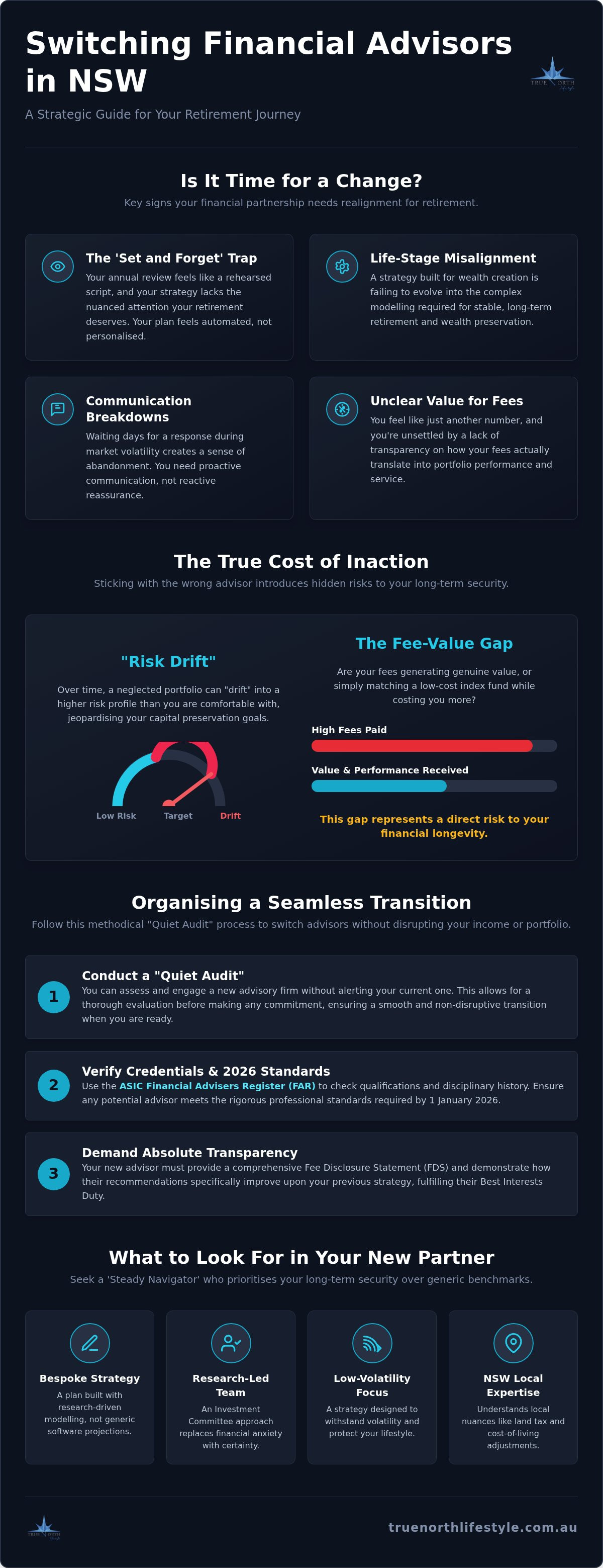
Stability matters. If your annual review feels like a rehearsed script rather than a strategic update, you've likely entered the 'set and forget' trap. This occurs when an advisor's process becomes automated, losing the nuanced attention your retirement deserves. You might notice your advisor was exceptional during your wealth-creation years but now lacks the technical depth required for complex retirement modelling and tax-minimisation. As your goals shift from accumulation to preservation, your partnership must evolve accordingly.
Communication breakdowns add unnecessary weight to your decision. Waiting days for a response during market volatility creates a sense of abandonment that no retiree should endure. Simultaneously, you may question if your management fees align with the actual value delivered. If your portfolio is drifting without active oversight, the cost of inaction becomes a direct risk to your financial longevity. Recognising these friction points is the first step toward reclaiming control.
Evaluating Strategic Alignment for Your Retirement
Effective retirement planning relies on precision. Many generalist firms rely on generic software that produces broad, optimistic projections. In contrast, a bespoke approach uses research-driven modelling to test your strategy against real-world scenarios. Your portfolio should reflect your risk appetite today, not the version of you from a decade ago. Under current Australian financial regulations, advisors are held to high standards of best interest, yet simple compliance doesn't always equal customisation. You need a strategy that considers the specific nuances of NSW retirement living, from land tax implications to local cost-of-living adjustments in the Sutherland Shire or Greater Sydney.
The Emotional Weight of the Decision
Loyalty is a significant hurdle. Many retirees stay with a subpar advisor because they've known them for years or share a social circle. This emotional comfort can be costly. Switching financial advisors in NSW isn't an act of betrayal; it's an act of responsibility toward your future self. Recognising that you've outgrown a generalist practice is a sign of financial maturity. You aren't just looking for someone to manage money; you're seeking a 'Steady Navigator' who provides the quiet certainty that your strategy is sustainable for the next thirty years. Moving past the social discomfort allows you to prioritise your financial security and the legacy you wish to leave behind.
Navigating the NSW Regulatory Landscape for Financial Advice
The regulatory environment in 2026 demands a higher level of accountability than ever before. As of 1 January 2026, all financial advisers must meet the rigorous qualification standards set out in the Corporations Act. This transition period has effectively filtered the industry, ensuring that only those committed to professional excellence remain authorised to provide advice. When you are switching financial advisors in NSW, your first step should always be a thorough verification on the ASIC Financial Advisers Register (FAR). This register confirms an advisor's qualifications and reveals any disciplinary history, providing the essential peace of mind that your wealth is in capable hands.
While federal bodies like ASIC oversee licensing, local expertise remains vital for Sydney and Sutherland Shire residents. NSW-specific issues, such as land tax thresholds and the nuances of the state's probate laws, require an advisor who understands the local landscape. If disputes arise during a transition, the Australian Financial Complaints Authority (AFCA) serves as the primary body for resolution, as NSW Fair Trading typically directs investment-related issues to this federal authority. A partner who understands these structural boundaries can help you move forward with quiet certainty.
Compliance and Fiduciary Duties in 2026
The 'Best Interests Duty' is no longer a vague concept; it is a strictly enforced legal requirement. During a transition, your new advisor must demonstrate how their recommendations specifically improve your situation compared to your previous strategy. You should expect a comprehensive Fee Disclosure Statement (FDS) that outlines every cost with absolute transparency. It's critical to ensure your new partner is research-driven rather than product-aligned. Choosing a financial adviser who operates without the influence of product-based commissions ensures that every strategic decision is made solely for your benefit. At True North Lifestyle, we prioritise this independence, offering bespoke retirement modelling that puts your personal goals at the centre of the process.
Protecting Your Assets During the Move
Asset security is a primary concern during any structural change. Most modern, research-focused firms utilise 'wrap platforms' to hold your investments. This model provides a layer of custodial safety, as your assets are held by a third-party custodian rather than the advisory firm itself. This structure ensures that even if an advisory firm closes, your underlying investments remain secure and accessible. Before signing any new agreement, always confirm the firm's Professional Indemnity insurance status. This coverage is a mandatory safeguard that protects clients against potential errors or omissions, providing a final layer of stability for your financial future.
The True Cost of Inaction: Fees, Performance, and Risk Drift
Inertia is expensive. While the immediate logistical effort of switching financial advisors in NSW might seem daunting, the long-term price of staying with a misaligned firm is often far higher. You might be paying 'active' management fees for what is essentially 'closet indexing'. This occurs when a strategy merely mimics a low-cost index fund without providing the professional 'alpha', or outperformance, required to justify the expense. Over a thirty-year retirement, these fractional inefficiencies, combined with unaddressed 'platform clip' fees, can quietly erode hundreds of thousands of dollars from your total capital.
Risk drift presents a more subtle danger to your security. Without rigorous and ongoing oversight, a portfolio that was once balanced can become unintentionally aggressive as certain asset classes outperform others over time. For a Sydney retiree, this lack of rebalancing creates a vulnerability to market corrections that your original strategy wasn't designed to absorb. True wealth preservation requires a partner who monitors these shifts with clinical precision, ensuring your risk profile remains static even when the markets do not. Choosing 'cheap' advice often results in the highest cost of all, as missed opportunities for tax optimisation and structural efficiency compound into significant losses.
Auditing Your Current Advisor's Value Proposition
To understand where you stand, start by reviewing your last three Statements of Advice (SOA). You should look for clear evidence of tax minimisation strategies Australia-wide that are specifically tailored to your income needs. If your reviews feel like generic templates rather than strategic updates, you are likely paying for administration rather than genuine expertise. During this audit, you must adhere to the guidelines on the transfer of financial records to ensure your personal data remains protected while you evaluate your options. A transparent advisor will always welcome this scrutiny, providing clear breakdowns of all underlying costs without hesitation.
Strategic Modelling vs. Simple Investment Advice
There is a fundamental difference between 'picking stocks' and the comprehensive retirement planning Sydney residents can rely on for the long haul. A generalist might focus on short-term returns, but a specialist focuses on longevity risk, which is the probability of outliving your capital. We use an in-house Investment Committee to move beyond simple investment advice and provide research-driven stability. This group of experts constructs low-volatility portfolios that prioritise income consistency and capital preservation. This level of strategic modelling ensures that your plan isn't just a collection of assets, but a structured pathway designed to survive every stage of your retirement journey.
A Step-by-Step Guide to Organising a Seamless Transition
Transitioning to a new partnership is a methodical process. It requires a structured approach to ensure your retirement income remains uninterrupted while your strategy is realigned. Many retirees delay switching financial advisors in NSW because they fear the administrative burden, yet a disciplined transition can be completed with minimal disruption to your daily life. By following a clear sequence of actions, you can move from a generic service to a bespoke arrangement that prioritises your long-term stability.
- Step 1: The Quiet Audit. Begin by gathering your current portfolio data, recent Statements of Advice (SOA), and fee disclosure statements. Conducting this review privately allows you to evaluate your options objectively without being subjected to a premature 'retention' pitch from your current firm.
- Step 2: The Interview. Evaluate potential new partners on their research methodology and the depth of their technical expertise. You are seeking the bespoke investment advice Sydney residents rely on when their goals move beyond simple wealth accumulation toward complex longevity planning.
- Step 3: The Formal Break. Once you have selected a new firm, issue a professional termination letter. This document should clearly state the cessation of services and the immediate end of all ongoing fee arrangements.
- Step 4: Data Migration. Your new advisor will manage the transfer of your cost-base history. This step is vital for avoiding Capital Gains Tax (CGT) complications during future portfolio rebalancing.
Managing Your Superannuation and Centrelink During a Switch
Continuity is paramount for NSW retirees. When switching financial advisors in NSW, you must notify the ATO and your superannuation fund of the change in 'Authority to Act' to ensure your new partner can manage your interests effectively. If you receive the Age Pension, updating your Centrelink schedules is a priority. This prevents payment disruptions and ensures your asset valuations remain accurate in the government's records. When seeking superannuation advice Sutherland Shire residents should also ensure their new advisor audits existing insurance policies within their fund before any structural changes occur to avoid a loss of coverage.
The 'Clean Break' Protocol
Outgoing advisors may attempt a 'save' conversation. Stay focused on your strategic goals; your decision is a professional realignment, not a personal slight. Ensure all legacy fee structures or trailing commissions are switched off immediately upon termination. Requesting a final 'exit' data file is a practical step that simplifies your future tax returns and provides your new firm with a complete historical record. If you are ready to move toward a more transparent partnership, we invite you to organise a confidential portfolio review with our research-driven team.
Transitioning to True North Lifestyle: Our Research-Driven Approach
Confidence through structure. When you make the decision to begin switching financial advisors in NSW, you are looking for more than a new name on your quarterly reports. You are seeking a 'Steady Navigator' who can transform financial complexity into a sense of calm and order. At True North Lifestyle, we replace the inherent anxiety of transition with a methodical framework designed to protect your capital and your peace of mind. Our role is to act as your authoritative guide, ensuring every strategic move is grounded in evidence and real-world probability.
Our methodology is anchored by an in-house Investment Committee. This group of specialists conducts the rigorous testing and heavy lifting required to construct low-volatility, income-focused portfolios. Unlike generic, bank-aligned advisors who may rely on off-the-shelf templates, our approach is entirely research-driven. We provide bespoke retirement modelling that doesn't just look at the next five years; we project your lifestyle needs through to age 100. This ensures your strategy accounts for longevity and the specific cost-of-living nuances in Sydney and the Sutherland Shire. By positioning our Miranda and Sydney offices as hubs for local expertise, we provide a stable anchor in an often fluctuating environment.
The First 90 Days: What to Expect
Clarity begins immediately. Our comprehensive 'discovery' phase goes significantly deeper than a simple audit of your bank balance. We seek to understand the human outcomes you desire for your retirement, using these insights to build your bespoke portfolio from the ground up. Within the first 90 days, we move you from a state of uncertainty toward a structured path. We establish your 'clarity dashboard', which serves as a central point for ongoing monitoring and ensures you always have a transparent view of your progress toward your long-term goals.
Achieving Financial Longevity and Calm
Longevity requires discipline. Integrating wealth preservation strategies into every decision is the foundation of our partnership. We aim to provide the quiet certainty you need to enjoy your Sydney lifestyle without the urge to check the markets daily or worry about portfolio sustainability. This level of oversight allows you to step into a role of confident oversight while we manage the technical complexities. If you are ready to realign your strategy for 2026 and beyond, we invite you to book a confidential strategy session at our Miranda or Sydney CBD offices to begin your transition.
Securing Your Financial Future Through Strategic Realignment
Choosing to realign your financial path is a significant step toward long-term peace of mind. By identifying the signs of misalignment and understanding the robust regulatory protections available, you can move away from generic advice and toward a partnership that prioritises your specific lifestyle goals. The process of switching financial advisors in NSW doesn't have to be a source of stress; instead, it's an opportunity to ensure your retirement modelling is accurate and your investment strategy is built to withstand the complexities of the 2026 market.
At True North Lifestyle, we act as your 'Steady Navigator', using our research-driven Investment Committee and bespoke modelling to project your wealth sustainability through to age 100. Whether you visit our Miranda or Sydney CBD offices, our focus remains on providing the quiet certainty you deserve. You shouldn't have to settle for being just another number in a corporate firm. We invite you to Book a Confidential Strategy Consultation with True North Lifestyle today to begin your journey toward a more stable and personalised financial future. Your retirement is too important to leave to chance.
Frequently Asked Questions
Will switching financial advisors in NSW trigger Capital Gains Tax (CGT)?
Switching financial advisors in NSW typically doesn't trigger Capital Gains Tax if your assets are transferred 'in specie' through a wrap platform. This means the underlying investments aren't sold; they're simply moved to the oversight of your new partner. However, if your new strategy requires selling existing assets to realign with a low-volatility model, that sale may trigger CGT. We recommend a thorough audit of your cost-base history before any trades occur.
How long does the actual process of changing advisers take?
The administrative transition usually takes between two and six weeks to complete. While the initial strategy and 'discovery' phase can happen relatively quickly, the migration of data between platforms and the processing of 'Authority to Act' documents rely on third-party timelines. We manage this process closely to ensure your retirement income remains stable and uninterrupted throughout the move, providing a seamless shift between firms.
Can I switch advisors if I have a Self-Managed Super Fund (SMSF)?
You can certainly switch advisors while maintaining a Self-Managed Super Fund. The transition involves updating the 'Authority to Act' for your fund's assets and ensuring your new advisor has access to your historical compliance data. This is a common part of switching financial advisors in NSW for those seeking more bespoke, research-driven modelling for their fund's long-term sustainability and wealth preservation.
Do I have to tell my old advisor why I am leaving?
You aren't legally or professionally required to provide a reason for leaving your current firm. A formal termination letter that clearly states your intention to end the service agreement is sufficient. While your outgoing advisor may request a 'save' conversation, you can choose to decline and focus on your new strategic direction. Maintaining a professional, 'clean break' is often the most efficient path toward your new partnership.
What are the typical exit fees when leaving a financial planning firm in Australia?
Most modern, fee-for-service firms in Australia don't charge specific exit fees for ending an advice relationship. However, you should check your original service agreement for any 'notice periods' that might require a final monthly payment. Additionally, some legacy investment products or older life insurance policies may have internal withdrawal costs; therefore, a 'Quiet Audit' of your current fee disclosure statement is an essential first step.
How do I check if a new advisor in Sydney is actually licensed?
You can verify an advisor's credentials by searching the ASIC Financial Advisers Register (FAR). This public database confirms their authorisation, qualification status, and any disciplinary history. For a Sydney-based practitioner, ensure they are linked to a valid Australian Financial Services Licence (AFSL). This verification provides the quiet certainty that you're partnering with a qualified professional who meets the rigorous 2026 industry standards.
Will my insurance inside super be affected if I change advisors?
Your insurance cover inside superannuation typically remains unaffected if you're only changing the advisor linked to the account. The policies stay active as long as the underlying super fund remains the same. If your new strategy involves moving to a different superannuation provider, you must carefully review the new policy terms and ensure successor fund transfer rules or new underwriting don't leave you with a gap in coverage.
What documents should I ask my current advisor for before I leave?
Before you depart, you should request your most recent Statement of Advice (SOA), your latest Fee Disclosure Statement (FDS), and a current valuation of all holdings. Most importantly, ask for a comprehensive 'cost-base' report for your investments. Having this data ready allows your new advisor to model your transition with clinical precision and helps avoid unnecessary tax complications or 'CGT headaches' during the migration process.


