

Changing your financial partner isn't a disruption to your retirement plan; it's often the only way to protect it. If you've started to feel like a nameless entry in a large firm's database, or if the proactive communication you were promised has fallen silent, your hesitation to move is understandable. Many Australians stay in stagnant relationships because they fear exit fees or the loss of historical data, even when their current strategy no longer reflects the economic realities of 2026. It's time to view switching financial advisors in NSW as a strategic audit of your future rather than a logistical burden.
You deserve a transition that feels like a genuine upgrade. We'll show you how to navigate this change with quiet certainty, ensuring you gain a bespoke retirement model that prioritises lower volatility and a local partner who truly understands your Miranda or Sydney-based lifestyle. This guide outlines the methodical five-step process for a seamless handover, from verifying credentials on the ASIC register to managing the administrative transition without losing your momentum.
Key Takeaways
- Identify the subtle indicators of "adviser coasting" and understand why a standard annual review may no longer safeguard your retirement in the 2026 economy.
- Master the methodical five-step framework for switching financial advisors in NSW to ensure your strategy remains stable throughout the transition.
- Learn how the latest 2026 professional standards and fee-for-service models offer Sutherland Shire retirees greater transparency and accountability.
- Clarify the legal reality of exit fees and discover how a dedicated partner can handle the administrative heavy lifting of your portfolio handover.
- Transition from a generic plan to bespoke retirement modelling that focuses on wealth preservation and reduced volatility through research-driven construction.
Recognising the Need for Change: Signs Your NSW Financial Adviser is Coasting
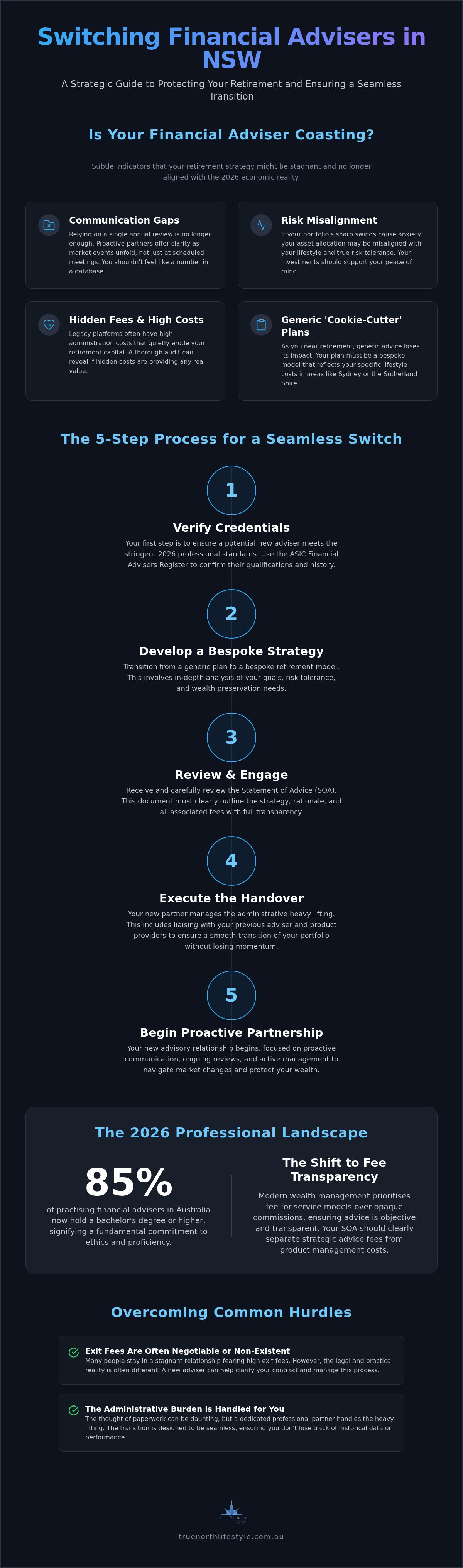
Stagnation is often silent. In many long-term advisory relationships, the initial energy of a strategic plan slowly gives way to a "set and forget" mentality. While a passive approach might have sufficed a decade ago, the 2026 economic environment demands a more rigorous level of active retirement modelling. If your portfolio feels like it is on autopilot, it's likely that your strategy is no longer keeping pace with your evolving goals.
A significant indicator of a coasting partner is the presence of communication gaps. Relying on a single annual review is no longer a viable way to manage wealth in a fluctuating market. Proactive partners don't wait for a scheduled meeting to discuss volatility; they provide clarity as events unfold. When considering switching financial advisors in NSW, many retirees realise their current arrangement lacks the urgency required to protect their capital against inflation and shifting interest rates. You shouldn't feel like a number in a large firm's database.
Another red flag involves a disconnect between your actual risk tolerance and the volatility you see in your statements. If your portfolio experiences sharp swings that cause genuine anxiety, your asset allocation is misaligned with your lifestyle requirements. Additionally, you should scrutinise your platform fees. Over time, high administration costs on legacy platforms can quietly erode the very capital you intend to live on. A disciplined audit often reveals that these hidden costs are eating into your retirement capital without providing a corresponding increase in value.
The "Strategy Gap" in Retirement Planning
Generic superannuation advice often loses its effectiveness as you approach your preservation age. At this stage, "cookie-cutter" portfolios fail to account for the specific lifestyle costs associated with living in Sydney or the Sutherland Shire. Bespoke modelling is essential. It moves beyond simple projections to simulate how your wealth preservation strategy will perform under various real-world scenarios, ensuring your plan reflects 2026 market realities rather than outdated assumptions.
Regulatory Red Flags in New South Wales
Transparency is the bedrock of trust. You should regularly confirm that your professional meets the latest Financial adviser regulations in Australia, specifically the updated ASIC education standards that came into full effect on 1 January 2026. Review your Financial Services Guide (FSG) to identify any potential conflicts of interest. If an adviser is not truly independent, their recommendations may be influenced by institutional ties, which can complicate the process of switching financial advisors in NSW if you feel your interests are no longer the primary focus.
The NSW Landscape: Professional Standards for Financial Advice in 2026
The industry has reached a pivotal point. As of September 2026, 85% of practicing financial advisers in Australia hold a bachelor's degree or higher. This shift isn't just about academic credentials; it represents a fundamental commitment to professional ethics and technical proficiency. When you are switching financial advisors in NSW, verifying these standards is your first step toward long-term stability. Consult ASIC's guide to choosing a financial adviser to understand how to verify these credentials on the official register.
The Importance of Fee Transparency
Clarity creates confidence. Modern wealth management in Sydney has moved decisively toward fee-for-service models, distancing itself from the opaque commission-based legacy structures of the past. It's essential to distinguish between strategic fees, which represent the cost of the intellectual heavy lifting, and management fees for specific products. High-net-worth individuals increasingly demand this separation to ensure advice remains objective. When reviewing a Statement of Advice (SOA), look for a clear breakdown of ongoing costs. If the document is cluttered with jargon that obscures the total dollar amount, it's a signal that the relationship lacks the transparency required for a bespoke partnership.
Research-driven methodology is the hallmark of a disciplined firm. Rather than relying on the subjective views of a single individual, professional firms utilise in-house Investment Committees to construct portfolios. This collaborative approach ensures that your strategy is grounded in real-world evidence and rigorous testing. This level of oversight is particularly vital for retirees who prioritise wealth preservation over speculative growth.
Local Expertise: From Miranda to the CBD
Geography influences strategy. A local Miranda or Sydney-based partner brings a nuanced understanding of NSW-specific retirement factors that a national firm might overlook. Land tax implications and the complexities of property downsizing in the Sutherland Shire require specific local knowledge. Sydney-specific cost-of-living modelling is also crucial for accurate retirement projections. Whether you are structuring for the Age Pension or navigating Centrelink's asset tests, having a partner who understands the local landscape ensures your strategy remains anchored in reality. This local insight is often the missing piece for those switching financial advisors in NSW who feel their current plan is too generic for their lifestyle. If you are ready for a more tailored approach, you can explore our bespoke portfolio construction services to see how we align with these modern standards.
The 5-Step Process for Switching Financial Advisers in NSW
Transitioning to a new partner is a methodical exercise in due diligence. It requires moving beyond emotional hesitation to focus on the technical integrity of your retirement strategy. By following a structured path, you ensure that switching financial advisors in NSW becomes an upgrade in clarity rather than a logistical burden. This process is designed to replace uncertainty with a well-defined roadmap for your capital.
- Step 1: Strategy Audit. Evaluate your current plan to identify where it falls short of 2026 economic realities and your personal lifestyle goals.
- Step 2: Bespoke Fit Interview. Use a rigorous framework to assess the technical competence and investment philosophy of potential partners.
- Step 3: Formalisation. Sign a Letter of Authority to allow your new partner to coordinate the professional data handover from your previous firm.
- Step 4: SOA Review. Critically examine the new Statement of Advice (SOA) to ensure every recommendation is specifically tailored to your cash flow needs.
- Step 5: Sustainability Modelling. Establish a rhythm of ongoing projections to adapt your portfolio to market fluctuations and longevity requirements.
Interviewing Your New Sydney Adviser
Finding a partner who aligns with your values requires asking direct, purposeful questions. You should probe their investment philosophy, particularly their methodology for managing volatility during market downturns. Request a sample of their retirement modelling to see how they project long-term income sustainability under different stress-test scenarios. It is also essential to confirm they adhere to the Financial Advice Association Australia standards, which ensures a commitment to ethical conduct and research-driven excellence. Understanding their relationship with research houses will reveal if their advice is truly independent or influenced by institutional bias.
The Data Handover: What You Need from Your Old Firm
A clean break is necessary for a fresh start. This stage involves securing your historical transaction data and cost-base records, which are vital for future tax-minimisation strategies. Your new partner should facilitate the administrative heavy lifting by coordinating with your previous firm to ensure no historical data is lost. This is particularly critical for those managing SMSF records or complex superannuation structures where continuity is paramount. Once the data is migrated, ensure you formally end any ongoing service agreements to stop further fee deductions. This structured approach to switching financial advisors in NSW protects your records while positioning you for a more proactive future.
Managing the Exit: Overcoming Fees, Paperwork, and Awkwardness
Transitioning away from a long-term professional relationship often feels more personal than it should. Many retirees hesitate to make a change because they fear the perceived awkwardness of the "exit conversation" or anticipate a mountain of administrative hurdles. However, your financial future is a business priority that requires objective oversight. A professional handover is not a personal slight; it is a necessary step to ensure your retirement capital remains aligned with the economic realities of 2026.
The reality of exit fees has changed significantly. In 2026, explicit exit fees for advice services are uncommon and often restricted. However, you must remain vigilant regarding product-specific costs. While your adviser may not charge a fee to leave, the underlying investment platforms or managed funds may incur buy-sell spreads or administration costs during a transfer. A disciplined partner will audit these costs before you commit to switching financial advisors in NSW, ensuring you have a clear dollar-figure understanding of the transition's impact.
Continuity of protection is paramount during this period. You should never cancel existing insurance policies or wealth protection structures until your new coverage is fully underwritten and active. Your new partner should facilitate the paperwork heavy lifting, using a formal Letter of Authority to coordinate directly with your previous firm. This professional protocol ensures that your fee consents are formally ended and that no legacy commissions or charges continue to erode your balance after you have moved on.
Minimising Transactional Friction
Efficiency saves capital. One of the primary risks when rebalancing a portfolio is the accidental triggering of significant Capital Gains Tax (CGT) liabilities. To avoid this, we often utilise "In-Specie" transfers, which allow assets to be moved between platforms without the need to sell and repurchase them. This technical approach keeps your market exposure consistent while minimising tax leakage. Incorporating bespoke investment advice into this transition period ensures that every movement of capital is strategically timed and tax-optimised.
The Emotional Side of Financial Change
Loyalty is a virtue, but it should not compromise your financial longevity. Many clients stay with "coasting" advisers out of a sense of duty, even when communication has stalled and performance has lagged. Reframing switching financial advisors in NSW as a business decision for your family's future can alleviate this emotional weight. The role of a Steady Navigator is to provide the logical grounding and structured path needed to replace transition anxiety with a sense of calm and order. If you feel your current strategy has lost its way, you can speak with our Miranda-based team to discuss a more disciplined path forward.
Beyond the Switch: Achieving Clarity with True North Lifestyle
Success is stability. Once you've navigated the logistics of switching financial advisors in NSW, the focus shifts from the transition to the long-term construction of your lifestyle. At True North Lifestyle, we replace generic advice with research-driven wealth preservation strategies that prioritise capital security. Our in-house Investment Committee meticulously builds low-volatility portfolios specifically designed for Sydney retirees who cannot afford to leave their future to chance. This collaborative oversight ensures your strategy is grounded in real-world probability rather than speculative hope. We act as your Steady Navigator, providing the technical depth required to manage complex wealth while maintaining an empathetic focus on your personal outcomes.
Bespoke Modelling vs. Generic Projections
Detail matters. We don't rely on the "cookie-cutter" templates common in larger firms. Instead, we model your specific lifestyle goals in the Sutherland Shire, accounting for everything from local property trends to your desired travel frequency. By integrating tax-minimisation and superannuation optimisation into a single, cohesive plan, we create a clear path toward longevity. Our stress-testing methodology simulates various market conditions, including inflation spikes and sequence-of-return risks, providing the peace of mind that comes from knowing your plan is built to withstand 2026 market realities. This bespoke approach ensures that your retirement model actually reflects your lived experience in Sydney.
Your First 90 Days with True North Lifestyle
Order brings calm. Your first three months with us are focused on establishing a disciplined rhythm and replacing uncertainty with structure. We begin with a deep-dive discovery session to refine your objectives, followed by the strategic implementation of your bespoke portfolio construction. During this time, we establish your preferred communication frequency and reporting preferences, ensuring you feel empowered and informed without being overwhelmed by technical jargon. Whether you visit our Miranda office or our Sydney CBD location, you'll find a partner who values directness and proven outcomes over flashy innovation. If you're ready to move toward a more structured and certain future, you can book a consultation with our Sydney advisers to begin your journey.
Charting a Clear Path Forward for Your Retirement
Your financial strategy shouldn't be a source of constant background noise. If your current relationship feels stagnant, remember that the process of switching financial advisors in NSW is a proactive step toward reclaiming control of your future. It's about replacing generic projections with bespoke retirement modelling that accounts for your specific lifestyle in the Sutherland Shire or Sydney CBD. By following a structured handover and addressing the technical realities of exit fees and data migration, you can move from a state of uncertainty to one of quiet confidence.
At True North Lifestyle, we act as your Steady Navigator. Our research-driven Investment Committee and specialists in complex retirement modelling ensure your capital is protected against the volatility of the 2026 economy. We've done the heavy lifting so you don't have to; allowing you to focus on the human outcomes of your wealth. Secure your financial future with a confidential strategy audit at True North Lifestyle. You deserve a partner who is as invested in your journey as you are. It's time to anchor your strategy in a plan that truly reflects your lifestyle goals.
Frequently Asked Questions
Is it difficult to switch financial advisers in NSW?
Switching is a methodical process rather than a difficult one. Your new partner handles the administrative heavy lifting by coordinating the professional data handover via a formal Letter of Authority. While the transition requires due diligence, the actual movement of files and fee consents is a standard procedure. Most of the effort involves your initial strategy audit and selecting a partner whose philosophy aligns with your long-term retirement modelling and lifestyle goals.
Will I be charged exit fees for leaving my current financial planner?
In 2026, explicit exit fees for advice services are restricted and uncommon. However, you should check for transaction costs within your investment products, such as buy-sell spreads or platform administration charges. A disciplined audit of your current Statement of Advice will reveal these underlying costs. Your new partner should help you identify these expenses before you commit to switching financial advisors in NSW, ensuring you have total cost transparency.
Do I need to tell my current adviser why I am leaving?
You aren't legally or professionally required to provide a specific reason for your departure. A formal notification is usually sufficient to end the relationship and stop ongoing fee deductions. While some prefer to offer feedback, reframing the change as a business decision for your family's future can reduce any perceived awkwardness. Your new firm will manage the formal data request, allowing you to move forward without unnecessary emotional friction or personal stress.
How long does the transition to a new financial adviser usually take?
The transition period typically spans four to twelve weeks, depending on the complexity of your portfolio. This timeframe includes the discovery sessions, the construction of a new bespoke Statement of Advice, and the administrative migration of your assets. While the data handover often happens quickly, the implementation of tax-minimisation strategies and portfolio rebalancing requires a deliberate pace to ensure every movement of capital is strategically timed, documented, and aligned with your goals.
Can a new adviser take over my existing superannuation fund?
Most existing superannuation funds allow for a change of adviser through a simple administrative form. This allows your new partner to gain oversight of your account without necessarily moving your capital to a new platform. However, a specialist will first review your fund to ensure it remains the most efficient vehicle for your superannuation review and optimisation. If a more cost-effective or research-driven structure is available, they may recommend a strategic rollover to improve your longevity.
Will switching advisers trigger Capital Gains Tax (CGT)?
Switching advisers doesn't automatically trigger CGT, but rebalancing your portfolio might. To minimise tax leakage, we often utilise in-specie transfers, which move your existing assets between platforms without selling them. This technical approach maintains your market exposure while avoiding unnecessary tax events. A bespoke investment strategy will always prioritise tax-minimisation, ensuring that any sales are part of a broader, longevity-focused plan rather than a byproduct of switching financial advisors in NSW.
What documents should I have ready when switching advisers?
To facilitate a seamless handover, you should gather your most recent superannuation and investment statements, your current Statement of Advice (SOA), and your latest tax records. Having your historical cost-base records is also essential for future tax-minimisation planning. Providing these documents during your initial discovery session allows your new partner to conduct a more accurate strategy audit and simulate how your wealth preservation strategy will perform under 2026 market conditions and Sydney-specific lifestyle costs.
How do I know if a new financial adviser in Sydney is truly independent?
True independence is found by reviewing an adviser's Financial Services Guide (FSG) and their ownership structure. Look for firms that aren't owned by banks or insurance companies and don't receive commissions on investment products. Independent partners typically operate under a fee-for-service model and use an in-house Investment Committee to construct portfolios based on objective research rather than institutional product lists. This ensures your strategy is built on real-world evidence and a commitment to your personal outcomes.


