

Volatility is optional. For those planning an Australian retirement in 2026, the transition from accumulating wealth to drawing a steady income requires a fundamental shift toward low volatility investment portfolios that prioritise stability over speculation. It is a strategic pivot designed to replace the noise of global markets with the quiet certainty of a well-structured plan.
We understand that watching your balance fluctuate can trigger genuine anxiety, especially when you're standing on the threshold of a new life chapter. You want to ensure your capital is protected against sequence of returns risk without sacrificing the growth needed to outpace inflation. It's a delicate balance, yet it's entirely achievable when you move away from generic models toward a more disciplined, research-driven methodology.
This article provides the clarity you need to protect your wealth and generate a sustainable income that lasts a lifetime. We'll examine how bespoke portfolio construction and rigorous risk modelling can shield your assets; we'll also preview the critical superannuation changes and interest rate trends defining the 2026 financial landscape. By the end, you'll have a clear roadmap for a secure, "sleep at night" retirement.
Key Takeaways
- Recognise why the unique economic landscape of 2026 demands a strategic shift from aggressive growth toward capital preservation to safeguard your retirement lifestyle.
- Learn how the "Minimum Variance" approach can help you organise assets that perform independently, reducing the overall impact of market swings on your super.
- Evaluate the critical differences between growth and defensive strategies to see how low volatility investment portfolios balance necessary growth with reliable income.
- Master the process of stress testing your portfolio against sharp market corrections to ensure your assets remain protected regardless of global headlines.
- Understand the value of bespoke portfolio construction and research-driven oversight in creating a truly sustainable, "sleep at night" retirement plan.
What are Low Volatility Investment Portfolios in the 2026 Market?
Volatility is the speed and scale of price swings within your superannuation balance. For many Australians, it represents the gap between a peaceful weekend and a Monday morning spent refreshing news headlines with a sense of dread. While aggressive growth strategies might have served you well during your working years, the transition to retirement in 2026 demands a more disciplined approach. What is low-volatility investing? At its core, it is a strategy that seeks to capture a significant portion of market gains while providing a sturdy cushion during inevitable downturns. It's a method of prioritising the preservation of what you've built.
It's vital to distinguish between risk and volatility. For a retiree, risk is the permanent loss of capital or the possibility of outliving your savings. Volatility, conversely, is the temporary fluctuation of market prices. By utilising low volatility investment portfolios, we aim to manage the latter to prevent it from triggering the former. This approach allows you to stay invested through market cycles without the emotional turbulence that often leads to costly mistakes.
The Psychology of Market Swings
Emotional resilience matters. Research consistently shows that the psychological pain of a 20% loss is far more intense than the satisfaction of a 20% gain. This loss aversion often leads investors to make reactive choices, such as selling at the bottom of a market cycle and locking in losses that were previously only on paper. In the context of a new retirement, we must account for Sequence of Returns Risk; this is the heightened danger that a market downturn occurring early in your retirement phase will disproportionately deplete your capital and shorten the life of your portfolio. Managing this risk is the primary goal of a stabilised strategy.
The 2026 Australian Economic Context
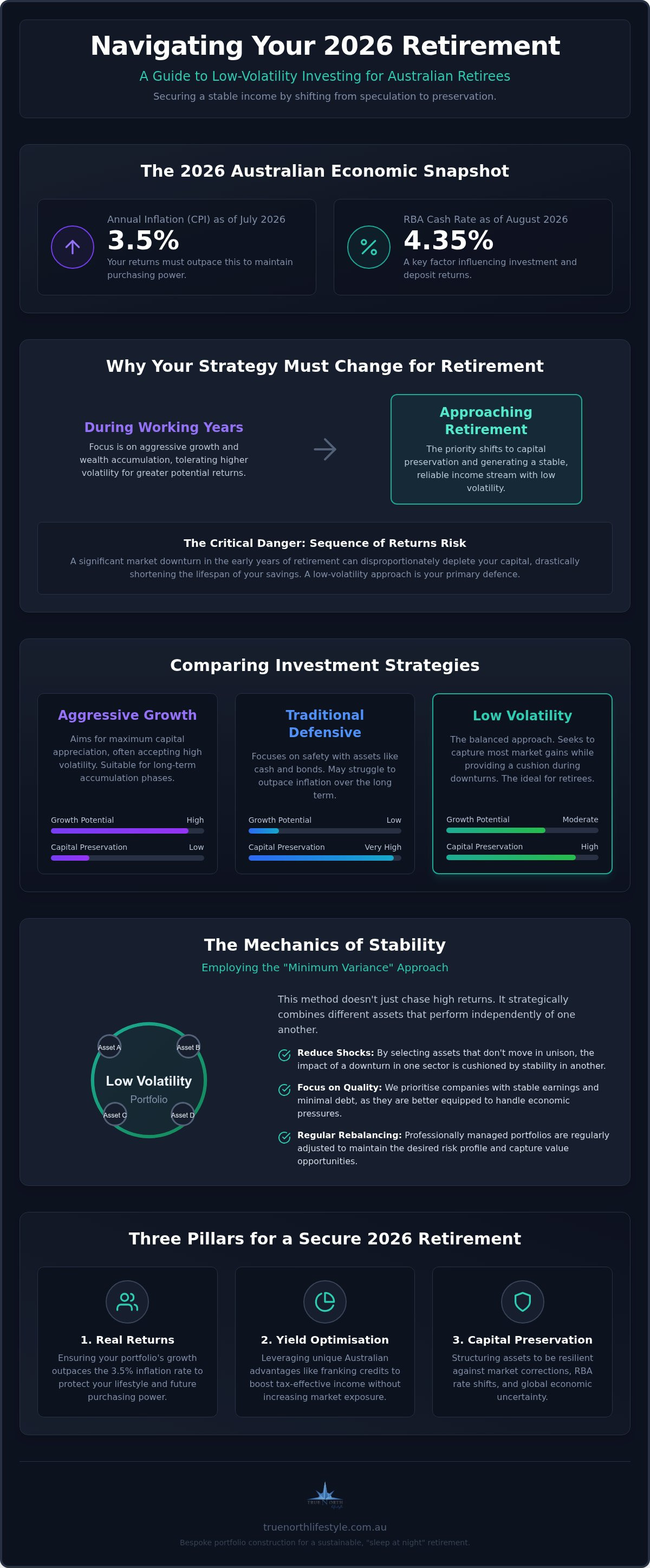
The current environment presents unique challenges that require a steady hand. With the Reserve Bank of Australia maintaining a cash rate of 4.35% as of August 2026 and annual inflation recorded at 3.5% in July, the need for real, after-inflation returns is paramount. Cash and term deposits, while providing a sense of safety, may struggle to maintain your purchasing power over a twenty-year retirement. We focus on three key pillars for the 2026 landscape:
- Real Returns: Ensuring your portfolio outpaces the 3.5% CPI to maintain your lifestyle.
- Yield Optimisation: Using franking credits to boost income without increasing market exposure.
- Capital Preservation: Structuring assets to withstand RBA rate shifts and global uncertainty.
The role of franking credits remains a cornerstone of Australian retirement. They provide a tax-effective yield that supports your cash flow without requiring you to sell down assets during periods of market stress. By focusing on these local advantages, low volatility investment portfolios provide a path toward a secure and predictable future.
The Mechanics of Stability: How to Organise Your Assets
Structure creates confidence. To build effective low volatility investment portfolios, we employ a "Minimum Variance" approach. This methodology doesn't simply seek the highest return; instead, it identifies asset combinations that have historically shown lower collective fluctuations. By selecting assets that don't move in unison, we can dampen the overall impact of market shocks. It's about ensuring that when one sector faces headwinds, another remains resilient. Professional managers then rebalance these holdings regularly, selling assets that have over-performed to buy those that offer better value, maintaining your desired risk profile.
Modern diversification requires looking beyond a simple mix of defensive and growth investments. While the traditional 60/40 split once served as a reliable benchmark, the economic shifts of 2026 have necessitated a more sophisticated arrangement. We prioritise quality by focusing on companies with exceptionally stable earnings and minimal debt. These entities tend to be better equipped to handle higher interest rates and inflationary pressures without compromising their dividend output. It is this disciplined focus on balance sheet strength that protects your capital during periods of uncertainty.
Asset Allocation Strategies for 2026
Alternative assets play a vital role. In a bespoke portfolio, we often include infrastructure and private credit to provide returns that aren't strictly tied to the volatility of the ASX. For many Sydney families, we also implement a "cash bucket" strategy. This involves setting aside two to three years of living expenses in liquid accounts, providing both a financial buffer and the psychological peace of mind to ignore short-term market noise. If you're looking to refine your current setup, a professional superannuation review and optimisation can identify where these stabilising elements are missing.
Quality and Defensive Equities
Not all shares are equal. We target "Low Beta" stocks, which are companies that historically move less than the broader market. These typically include essential services like utilities or consumer staples. Dividends act as a critical stabilising force, providing a return that is independent of share price movement. When you combine Value and Quality factors, you effectively create a portfolio of reasonably priced companies with robust balance sheets that work together to reduce total volatility. This dual-factor approach ensures you aren't overpaying for safety while still capturing the defensive benefits of high-quality earnings.
Comparing Growth, Defensive, and Low Volatility Strategies
The choice of an investment strategy is a decision about how you wish to experience your retirement. It is a fundamental alignment of your financial resources with your personal need for security. Growth portfolios aim to maximise capital by leaning into market cycles, yet they require a high tolerance for "white-knuckle" rides that can be difficult to stomach once you've transitioned away from a regular salary. On the other end of the spectrum, purely defensive portfolios offer high safety but carry the risk of losing purchasing power to inflation, which sat at 3.5% in mid-2026. Low volatility investment portfolios offer a sophisticated middle path. They are specifically designed for wealth preservation, aiming to keep you invested while significantly dampening the impact of market shocks.
There is a common misconception that lower risk must always result in lower long-term outcomes. However, historical data often points to the "Low Volatility Anomaly," where stocks with lower price swings actually deliver competitive returns over the long term. This occurs because these portfolios avoid the catastrophic drawdowns that require years of growth just to return to break-even. During your accumulation phase, you had the time to wait out market cycles. In the pension phase, your strategy must evolve. You need a reliable engine that supports regular income without forcing you to liquidate assets at the bottom of a market cycle.
The Trade-off: Returns vs. Peace of Mind
Boring investments often win the race. By avoiding the deep troughs of market corrections, a stabilised portfolio doesn't need to work as hard to recover. This creates a smoother journey that is better suited to the pension phase of retirement, where you're drawing down capital to fund your lifestyle. It's about prioritising the longevity of your assets over the potential for speculative gains, ensuring that your "sleep at night" factor remains high regardless of global headlines.
Tax and Centrelink Implications in Australia
Stability also provides a structural advantage for Australian retirees. It is a cornerstone of effective tax planning for retirement Australia, as predictable returns allow for more precise management of income streams within the superannuation environment. Beyond these tax considerations, a stable portfolio value is essential for managing the Centrelink Assets Test. Roughly 56% of Australians over 65 receive some form of government pension, and sharp fluctuations in your portfolio value can lead to unexpected changes in your payment rates. By maintaining a consistent valuation, you ensure that your entitlements remain stable and your minimum pension drawdown requirements are met without unnecessary stress.
Stress Testing Your Super: A Guide for Australian Families
Testing builds certainty. A well-constructed portfolio is only theoretical until it is challenged by a simulated crisis. For those planning their 2026 retirement, conducting a "What If" analysis is a vital step in moving from anxiety toward oversight. Consider a scenario where the ASX drops 15% in a single week. While a growth-heavy portfolio might see a devastating hit to its capital base, low volatility investment portfolios are engineered to absorb the shock, allowing you to maintain your lifestyle without panic. This process involves examining your income floor to ensure that your essential spending, from groceries to private health insurance, is covered by stable, income-producing assets rather than being dependent on capital gains.
Correlation is the silent threat to many Australian retirees. Often, what looks like a diverse collection of investments is actually a group of assets that all react the same way to a global event. If your domestic shares, international holdings, and even your property interests all drop simultaneously, your diversification is an illusion. We look for assets that move independently of one another. Your time horizon also dictates the level of protection you need; money required for the next two years should be treated with far more caution than funds intended for use in twenty years' time.
Practical Steps for Portfolio Oversight
Start by scrutinising your latest superannuation statement. Look beyond the total balance and identify the underlying volatility; if your balance swings by several thousand dollars every month, your current allocation may be too aggressive for your needs. We frequently recommend maintaining a cash buffer equivalent to two or three years of living expenses. This liquidity ensures you aren't forced to sell shares during a market trough just to fund your daily life. If your current modelling lacks this level of detail, it may be time to seek bespoke investment advice Sydney to refine your strategy.
Longevity Risk Management
Longevity Risk is the risk of outliving your money. With many Australians now living well into their nineties, your portfolio must be capable of sustaining your lifestyle for thirty years or more. This requires a delicate calculation: your returns must be high enough to outpace the 3.5% inflation rate but stable enough to prevent capital erosion. As you age, your priority should shift toward wealth preservation strategies that lock in your gains. By stress testing your super today, you can ensure your low volatility investment portfolios remain robust enough to support you until age 95 and beyond.
If you are unsure how your current assets would perform in a market downturn, we can help you review and optimise your superannuation for the years ahead.
Bespoke Portfolio Construction with True North Lifestyle
Strategy requires execution. At True North Lifestyle, we believe that low volatility investment portfolios shouldn't be mass-produced; they should be meticulously crafted to reflect your unique circumstances. While many institutions rely on generic "model portfolios" that treat every retiree the same, our approach is fundamentally different. We move beyond the one-size-fits-all mentality to provide bespoke solutions that prioritise your specific income needs and risk tolerance. This ensures your capital is positioned to withstand market shifts while still capturing the growth necessary for a multi-decade retirement.
Our methodology is deeply research-driven. We collaborate closely with Resonant Asset Management, utilizing their technical expertise to inform our decision-making process. This partnership allows our in-house Investment Committee to maintain a role of confident oversight. We monitor global market fluctuations and technical indicators so you don't have to. By integrating this high-level investment strategy with our comprehensive retirement modelling, we create a seamless connection between your financial assets and your long-term lifestyle goals.
The True North Difference
Quiet certainty matters. We define success not by beating an arbitrary market benchmark, but by ensuring you can fund your desired lifestyle without fear. Our local presence in Miranda allows us to provide advice that truly understands the Sutherland Shire way of life. We know that for our clients, wealth preservation is about more than just numbers; it is about the freedom to enjoy your time with family and community. As a fee-for-service firm, our advice is transparent and objective. We put your goals first, ensuring our interests are always aligned with your long-term success.
Taking the First Step Toward Stability
Clarity replaces confusion. When you meet with us for an initial consultation, our focus is entirely on your situation rather than specific financial products. We take the time to listen to your concerns and understand what you want your retirement to look like. Using sophisticated projections, we map your "True North," providing a clear visual representation of how your assets will support you over time. This process allows us to identify potential gaps in your current strategy and implement the necessary stabilising elements. If you're ready to secure your future, you can organise a consultation with our Miranda team to stress-test your current portfolio and begin your journey toward a more predictable retirement.
Charting Your Path to a Quiet Retirement
Securing your future is about more than just numbers. It's about the confidence to live your life without constantly checking the markets. We've explored how low volatility investment portfolios act as a stabilising anchor, protecting your capital from the sharp swings of the 2026 economy while ensuring your income remains sustainable. By prioritising wealth preservation and longevity, you can replace the anxiety of market noise with a clear, structured plan.
As specialists in wealth preservation with a deep presence in Miranda and the Sydney CBD, True North Lifestyle provides the professional oversight you need. Our research-driven Investment Committee works tirelessly to model risks and optimise outcomes. This allows you to step into a role of confident oversight. You don't have to navigate these complexities alone. We invite you to secure your lifestyle with a bespoke investment strategy tailored to your specific goals. Let's work together to ensure your retirement is defined by order, clarity, and the freedom to enjoy what matters most.
Frequently Asked Questions
Are low volatility portfolios the same as "safe" investments like term deposits?
No, they are quite different. Low volatility portfolios still include growth assets like shares and infrastructure, whereas term deposits are purely defensive. While term deposits offer capital certainty, they often struggle to outpace inflation, which reached 3.5% in mid-2026. These portfolios aim for a middle path. They provide the growth necessary for a thirty-year retirement while using sophisticated modelling to ensure the journey remains far smoother than a traditional high-growth fund.
Can a low volatility portfolio still beat inflation in 2026?
Yes, beating inflation is a core objective of low volatility investment portfolios in the current economic climate. With the RBA cash rate at 4.35% as of August 2026, cash alone may not provide sufficient real returns. We focus on high-quality companies and alternative assets that have the pricing power to grow their earnings alongside rising costs. This ensures your purchasing power is protected without exposing your capital to unnecessary market turbulence.
How often should a low volatility portfolio be rebalanced?
Rebalancing should occur systematically to maintain your target risk profile. At True North Lifestyle, our Investment Committee monitors portfolios continually, but formal rebalancing typically happens when an asset class drifts significantly from its intended weighting. This disciplined process forces the sale of high-performing assets to buy undervalued ones. It's a "buy low, sell high" mechanism that removes emotion from the decision-making process for our clients in Miranda and Sydney.
Is this strategy suitable for someone with a small superannuation balance?
Stability is valuable regardless of your balance size. While bespoke portfolio construction is often sought by those with larger balances, the principles of risk management apply to everyone. Protecting a smaller balance from a 15% market drop is critical because you have less capital to recover from losses. Every Australian retiree deserves a strategy that prioritises wealth preservation and ensures their superannuation lasts as long as they do.
What is the "Low Volatility Anomaly" in the Australian share market?
The "Low Volatility Anomaly" describes the historical tendency for lower-risk stocks to outperform higher-risk stocks over long periods. In the Australian market, "boring" companies with stable earnings often deliver better risk-adjusted returns than speculative growth shares. This happens because avoiding large losses is mathematically more important than capturing every market peak. It's a core reason why low volatility investment portfolios are so effective for long-term wealth preservation.
How do franking credits affect the returns of a low volatility portfolio?
Franking credits are a powerful tool for boosting retirement income without increasing market exposure. They represent tax already paid by Australian companies, which can be returned to you as a tax offset or refund within your superannuation pension account. For a retiree, this creates a high-yield income stream that acts as a natural stabiliser. It allows you to meet your pension drawdown requirements while keeping more of your capital invested for the future.
Should I switch to a low volatility strategy if the market is already falling?
Strategic shifts are most effective when made before a crisis, yet protecting your remaining capital is always a priority. If the market is falling, switching to a stabilised strategy can help prevent the "Sequence of Returns Risk" that often devastates new retirees. It's about stopping the bleed and ensuring you don't sell at the absolute bottom. We help Sydney families evaluate their current position to determine if a defensive pivot is appropriate.
Do I need a financial adviser to build a low volatility portfolio?
While you can select individual low-beta stocks yourself, professional advice provides the rigour of an Investment Committee and sophisticated risk modelling. Building a truly bespoke portfolio requires deep research into asset correlations and longevity planning. Our team in Miranda specialises in this strategic construction. We take the "heavy lifting" off your shoulders, allowing you to enjoy the quiet certainty that your financial future is being managed by seasoned experts.


