

The cap is a starting point, not the whole strategy. For anyone weighing superannuation contribution strategies in the Sutherland Shire, the concessional contribution cap is A$30,000 per year for the 2025-26 financial year, according to the Australian Taxation Office. How you use that limit can affect both your tax position and the amount building towards retirement.
It’s understandable to focus on contribution caps: exceeding them can have tax consequences, while a considered approach may help align your super with your wider financial goals. Look at employer payments and personal contributions together, rather than treating each decision in isolation.
This guide explains how concessional and non-concessional limits work, what spouse and downsizer contributions may offer, and how employer super payments fit into your plans. You’ll get a practical framework for weighing the rules against your circumstances and deciding what to consider next.
Key Takeaways
- Compare salary sacrifice and personal concessional contributions to understand how each can affect taxable income and your super balance.
- Track employer payments alongside your own contributions so you can plan within the applicable limits.
- Explore spouse contributions and contribution splitting as ways to consider super across a household.
- If you’re selling your home, learn how downsizer contributions may fit into your retirement planning.
- Bring contribution choices together with your tax position and long-term retirement goals before settling on a strategy.
1. What is the concessional contribution limit?
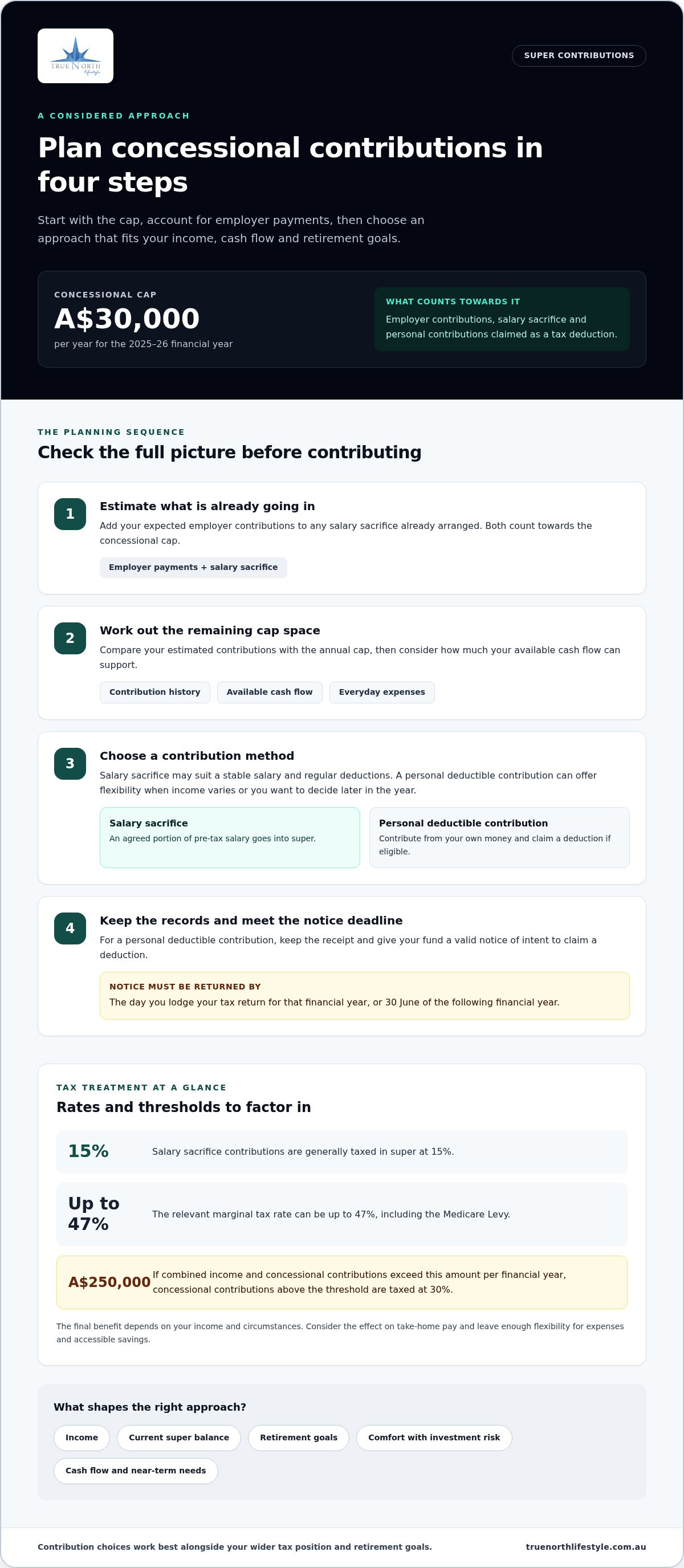
The concessional contribution cap is A$30,000 per year for the 2025-26 financial year, according to the Australian Taxation Office. It covers before-tax contributions, including employer payments, salary sacrifice and personal contributions claimed as a tax deduction.
The right approach depends on your income, current super balance, retirement goals and comfort with investment risk. A younger worker may prioritise regular contributions and a long investment horizon; someone closer to retirement may focus on available cap space and near-term income needs.
Salary sacrifice directs an agreed portion of your pre-tax salary into super. It may reduce taxable income while increasing retirement savings. Before choosing an amount, estimate your employer contributions for the financial year and add any salary sacrifice payments. This helps you see how much concessional cap space may remain.
The tax treatment can make the comparison useful. Salary sacrifice contributions are generally taxed in super at 15%, while the relevant marginal tax rate can be up to 47%, including the Medicare Levy. The difference may make concessional contributions appealing, but the final benefit depends on your income and circumstances. If combined income and concessional contributions exceed A$250,000 per financial year, concessional contributions above the threshold are taxed at 30%.
Personal deductible contributions offer another route. You make a contribution from your own money, then claim a tax deduction if you meet the requirements. This can suit someone whose income varies, or who wants to decide later in the year how much to contribute. Keep the contribution receipt and give your fund a valid notice of intent to claim a deduction. The notice must be returned by the day you lodge your tax return for that financial year, or by 30 June of the following financial year.
Use a simple sequence before contributing:
- Estimate employer contributions and any salary sacrifice already arranged.
- Compare the remaining cap space with your available cash flow.
- Choose salary sacrifice or a personal deductible contribution based on timing and income.
- Keep records and submit any required deduction notice before claiming.
For example, someone with uneven earnings might wait until their income is clearer before deciding whether to make a personal deductible contribution. Someone on a stable salary may prefer regular salary sacrifice deductions. Either way, account for everyday expenses, accessible savings and your tolerance for investment risk. A contribution strategy should support retirement goals without leaving too little flexibility outside super.
2. Concessional and non-concessional contributions
Concessional contributions enter super before tax, while non-concessional contributions come from after-tax money. According to the Australian Taxation Office, the concessional contribution cap in Australia is A$30,000 per year for the 2025-26 financial year. Employer contributions, salary sacrifice and personal contributions claimed as tax deductions all count towards this cap.
For 2026-27, treat the concessional and non-concessional caps as separate limits. The first applies to before-tax contributions; the second applies to after-tax contributions. Your contribution strategy should account for the relevant financial-year limits and your circumstances, rather than assume both caps work the same way.
Non-concessional contributions can suit someone using savings outside super to build retirement savings. The non-concessional cap is A$120,000 for 2024-25 and 2025-26. Some people may be able to make larger after-tax super contributions, depending on their eligibility and circumstances. Whether that option fits depends on eligibility and previous contributions. Keep enough accessible cash for planned expenses before moving savings into super.
Tax treatment differs, too. Before-tax superannuation contributions are taxed at 15%. If combined income and concessional contributions exceed A$250,000 per financial year, concessional contributions above the threshold are taxed at 30%. Consider those rates alongside your income and the effect of making a contribution on your take-home pay. A contribution that supports long-term retirement savings should also leave your everyday budget workable.
Catch-up concessional contributions involve unused cap amounts from earlier years. Review your contribution history and expected employer payments, then assess whether the carry-forward rules may apply to you. This can help show whether extra concessional contributions could fit your plan, tax position and cash flow. A retirement plan needs both a savings target and a clear view of contribution limits.
Before contributing, work through these steps:
- Separate concessional contributions from after-tax contributions in your records.
- Add employer payments and salary sacrifice when estimating concessional contributions.
- Review prior contributions before considering the bring-forward rule or catch-up options.
- Compare the proposed amount with your income, cash needs and retirement goals.
Spouse contributions are another distinct strategy, with their own eligibility and tax-offset rules. Keeping them separate from your personal contribution calculations makes it easier to assess each option. A retirement contribution projection can help organise limits, tax effects and future income goals into one considered plan.
3. Spouse contributions and tax offsets
Spouse contributions can help direct super savings towards a partner with lower income or a smaller balance. In Australia, an eligible contributor may receive a tax offset of up to A$540 per year for making contributions to their spouse’s super. The spouse’s income must be less than A$40,000 for the contributor to qualify for this offset.
The amount of a spouse contribution may depend on the applicable limits and the couple’s circumstances. The offset is calculated against an eligible contribution, not against every amount deposited into a partner’s account. Consider the contributor’s own cash flow, the receiving spouse’s income and whether the contribution fits both partners’ retirement plans. The potential tax advantage is only one part of the decision.
Age matters for the receiving spouse. They generally need to be under 67 years old to receive spouse contributions, unless they meet the work test. That makes timing important for couples approaching this age threshold. Check the receiving spouse’s age and eligibility before arranging a payment, then keep the contribution details with household financial records.
Contribution splitting works differently. Rather than making a separate after-tax payment for a spouse, an eligible person may split up to 85% of their concessional contributions from the previous financial year with an eligible partner. This can shift some super savings between accounts, but it does not mean the couple’s total super increases. It changes how existing contributions are allocated between them.
For example, one spouse may have earned most of the household income and built up more super, while the other took time away from paid work. Spouse contributions and contribution splitting are different ways to address this imbalance. Compare whether a direct contribution may qualify for a tax offset with what splitting could achieve and when. Your incomes, ages and intended retirement dates all matter.
Before acting, review the relevant details together:
- Confirm the receiving spouse’s income against the A$40,000 threshold for the tax offset.
- Check whether the spouse is under 67 or meets the work test.
- Separate new spouse contributions from splitting concessional contributions already made.
- Keep payment records and review the super statement to confirm the contribution was received.
Household planning can also consider how super fits into estate arrangements. An estate planning strategy can help couples review nominations and how super may be distributed, alongside their contribution decisions.
4. Downsizer contributions
Selling a home can create an opportunity to move some proceeds into super. Eligible Australians aged 55 or older may contribute up to A$300,000 as a downsizer contribution. Eligible couples may contribute up to A$600,000 combined from the sale of their home.
The main home must have been owned for at least 10 years to qualify for the downsizer contribution described here. These contributions don’t count towards the annual super contribution cap. That distinction can matter if you’ve already made concessional contributions or after-tax contributions during the financial year.
A downsizer contribution may suit someone who has sold a qualifying home and wants to move some proceeds into super for retirement. This can increase a super balance, but the money will no longer be as readily accessible as cash in a bank account. Before deciding how much to contribute, consider upcoming expenses, other assets and the lifestyle you want the proceeds to support.
Downsizer contributions and the First Home Super Saver Scheme serve different purposes. The downsizer pathway may let an eligible person aged 55 or older contribute up to A$300,000 from a home sale. An eligible first home buyer can withdraw up to A$50,000 under the First Home Super Saver Scheme, plus associated investment returns, towards buying their first home.
Assess any downsizer contribution alongside your existing retirement savings and investment strategy. A larger super balance can change the mix of assets supporting your retirement, so consider how the contribution fits your income needs and tolerance for investment risk. The amount will depend on the sale proceeds, cash reserves and plans for future spending.
Use a practical sequence to organise the decision:
- Establish whether you’re aged 55 or older and whether the home meets the 10-year ownership condition.
- Estimate how much of the sale proceeds you may want to contribute, within the applicable individual or couple limit.
- Set aside funds for planned costs and lifestyle needs outside super.
- Review how the contribution fits with other assets and existing super investments.
For example, a couple selling a long-held home can consider whether each partner’s contribution helps meet their separate retirement goals. A person buying their first home instead may look at the First Home Super Saver Scheme, not the downsizer pathway. These options have different eligibility conditions and purposes. Financial advice can help assess how a home sale, super balance and investment strategy fit together, including the effect on retirement income and estate planning.
5. Employer Superannuation Guarantee contributions
Employer super is the foundation to include before planning voluntary contributions. According to the Australian Taxation Office, Australian employers typically contribute 12% of an employee’s Qualifying Earnings to super under the Superannuation Guarantee. These employer payments add to retirement savings, so include them when considering how much extra to contribute.
Check your payslips and super fund statement to confirm that payments are being made and credited. Compare the amounts with your employment records and the fund’s transaction history. If a payment appears missing or incorrect, raise the discrepancy with your employer and keep the relevant payslip and statement. These records show what has reached your super account.
Employer payments are an essential part of contribution planning. Include expected payments in your annual concessional contribution estimate before arranging extra salary sacrifice or deductible contributions. Otherwise, your total may exceed the applicable cap and affect the tax treatment. Keep a running record of employer payments, voluntary contributions and when each appears in your fund.
Review your fund’s fees at the same time. Account-keeping and investment fees reduce the amount remaining in your savings, even when employer payments arrive as expected. Compare the fees on your fund statement with the services and investment approach that suit your retirement goals. Consolidating accounts may simplify your records and potentially reduce account-keeping fees, but weigh this against insurance and other account features before changing funds.
Common mistakes include leaving employer payments out of your concessional contribution estimate, assuming a payslip proves the fund has received the money, and overlooking fees. Timing matters too: allow enough time for a contribution to reach and be processed by the fund before a financial-year deadline. Keep transaction records and check your fund statement, not just your payroll record.
For parents receiving government-funded Parental Leave Pay for a child born or adopted on or after 1 July 2025, super is also paid at 12% of their Parental Leave Pay. Include this employer-related payment when reviewing your account and contributions. It can be easy to miss if you only track super shown on ordinary salary payslips.
Residents of the Sutherland Shire can seek superannuation help from a local financial planning practice that reviews fund arrangements and retirement goals. Ask for advice from a licensed financial adviser whose scope matches the decision you’re making.
- Reconcile employer payments against payslips and your super fund statement.
- Include employer contributions when estimating annual concessional contributions.
- Review fund fees and account features before consolidating accounts.
- Keep records of voluntary contributions and allow time for fund processing.
Review your super and employer contributions to bring fund records, fees and retirement goals into one considered plan.
True North Lifestyle: Retirement modelling & long-term projections
True North Lifestyle uses retirement modelling and long-term projections to bring contribution choices into focus. If concessional limits, spouse contributions or a home sale are part of your plans, scenario modelling can show how each decision may fit your retirement timeline, income needs and wider financial position.
A superannuation review can bring employer payments, voluntary contributions and fund arrangements into one view. Tax-minimisation strategies and bespoke portfolio construction can then be considered alongside your goals, rather than in isolation. The result is a structured plan that reflects your circumstances and supports informed decisions about what to do next.
If you’d like to consider how your super contributions fit your retirement plans, contact True North Lifestyle for a conversation.
Build a plan around the retirement you want
For households weighing superannuation contribution strategies in the Sutherland Shire, connect today’s decisions with the retirement lifestyle you want to sustain. Consider how much flexibility you need, when you may draw on your savings and how super fits alongside your other assets. These priorities give contribution choices a clearer purpose.
True North Lifestyle can help turn those priorities into a structured plan. Retirement modelling and long-term projections can map possible paths, while superannuation review and optimisation can bring existing arrangements into view. Tax-minimisation strategies can also help assess how financial decisions interact, so you can approach the next stage with greater clarity.
You don’t need to resolve every decision at once. Start with the question that matters most to you, whether it’s contribution planning, tax or how your super may support future income.
Start a conversation with True North Lifestyle and take a considered next step towards your retirement goals.
Frequently Asked Questions
What is the concessional contribution limit?
The concessional contribution cap is A$30,000 per year for the 2025-26 financial year, according to the Australian Taxation Office. It includes employer contributions as well as salary sacrifice and personal contributions claimed as a tax deduction. To track your position, compare your fund transactions with payslips and personal payment records. That can help identify contributions that may not yet appear in your super account.
Do I need an SMSF or is a regular super fund enough?
A retail or industry super fund suits many Australians. An SMSF may suit people seeking greater control who are prepared to manage the added responsibilities. Trustees are legally responsible for compliance, the investment strategy and the annual audit. For example, wanting exposure to property or alternative investments may prompt an SMSF assessment, but greater control also brings ongoing administration and decision-making duties.
How does salary sacrifice work?
Salary sacrifice is arranged through your employer, which directs part of your pre-tax salary into super. Before setting it up, check your payslip and consider how the change affects take-home pay and ordinary expenses. Then track employer and salary-sacrifice payments together in your fund records. This shows how contributions are building and helps you review the arrangement if your income changes.
How do government or legislative changes affect super?
Changes can affect contribution rules, tax treatment or the way super earnings are assessed, so review your plan when rules change. From July 2025, Australians with more than A$3 million in super may pay extra tax on a portion of fund earnings, which can include unrealised gains. A change may affect long-term projections even if you don’t alter contributions, making periodic plan reviews useful.
What are the main superannuation contribution strategies for Australians?
Common approaches include employer contributions, salary sacrifice, personal deductible contributions and after-tax contributions. Couples may also consider spouse contributions or contribution splitting, while eligible home sellers may assess a downsizer contribution. For people considering superannuation contribution strategies in the Sutherland Shire, the right combination depends on income, existing super, cash needs and retirement timing. Bringing the options into one household plan helps clarify which may work together.
How do salary sacrifice and personal deductible super contributions compare?
Salary sacrifice is arranged through your employer and redirects pre-tax salary into super. A personal deductible contribution comes from your own money, and you claim a tax deduction after giving your fund a valid notice. Salary sacrifice may suit regular pay; a personal contribution can offer flexibility if income varies or you want to decide later how much to contribute. Both count as concessional contributions when paid or claimed under the relevant rules.
Who is eligible to claim a tax deduction for personal super contributions, and how do they notify their fund?
You may claim a deduction for an eligible personal super contribution by giving your fund a valid notice of intent to claim, then waiting for the fund’s acknowledgement before claiming it in your tax return. The notice must be returned by the day you lodge your return for that financial year, or by 30 June of the following financial year. Keep the contribution record and acknowledgement with your tax documents.
How do unused concessional cap carry-forward rules work, and who is eligible?
Carry-forward rules may let eligible people use unused concessional cap amounts from earlier years, subject to the rules that apply to them. If you’re assessing superannuation contribution strategies in the Sutherland Shire, review your contribution history and unused amounts, then compare them with planned employer and personal contributions. This may be useful if your income or contributions varied in earlier years. Check how the rules apply before contributing against unused cap space.


