

Valuable SMSF assets need to fit the fund’s investment strategy, members’ goals and capacity to manage risk. SMSF financial advice in the Sutherland Shire can help trustees assess whether the fund’s asset mix, diversification and liquidity remain aligned, especially when circumstances or retirement plans change.
It’s understandable to want clarity before making decisions about assets held for retirement. A high value alone doesn’t show whether an investment suits the fund or supports members’ longer-term needs.
This article explains when an SMSF strategy may need reviewing, what to consider when assessing valuable assets, and how financial advice can support a more structured approach. It also shows how investment decisions connect with retirement income, risk management and trustees’ practical responsibilities.
Key Takeaways
- Revisit an SMSF investment strategy when life changes, retirement plans or members’ risk priorities shift.
- Assess valuable assets in context, including their place in the portfolio, diversification and access to funds.
- Use the right professional support for investment advice, tax matters, legal questions, accounting and administration.
- Connect retirement projections and superannuation decisions with your personal goals, income needs and broader financial position.
- Consider tailored modelling and portfolio advice when you need a clearer view of how your SMSF may support your long-term plans.
Retirement planning
An SMSF retirement plan should connect members’ retirement goals with income needs, investment risk and the fund’s responsibilities. To assess whether an SMSF suits you, consider whether you can manage trustee duties and whether the structure fits your circumstances. The fund also needs an appropriate structure, trust deed, investment strategy, administration and annual audit.
Retirement strategies for different life stages
Couples can map their retirement goals together while accounting for different retirement dates, income needs and comfort with investment risk. A professional approaching retirement may focus on when to reduce work and how superannuation could support that transition. Retirees can review whether their current strategy still supports regular income and longer-term priorities.
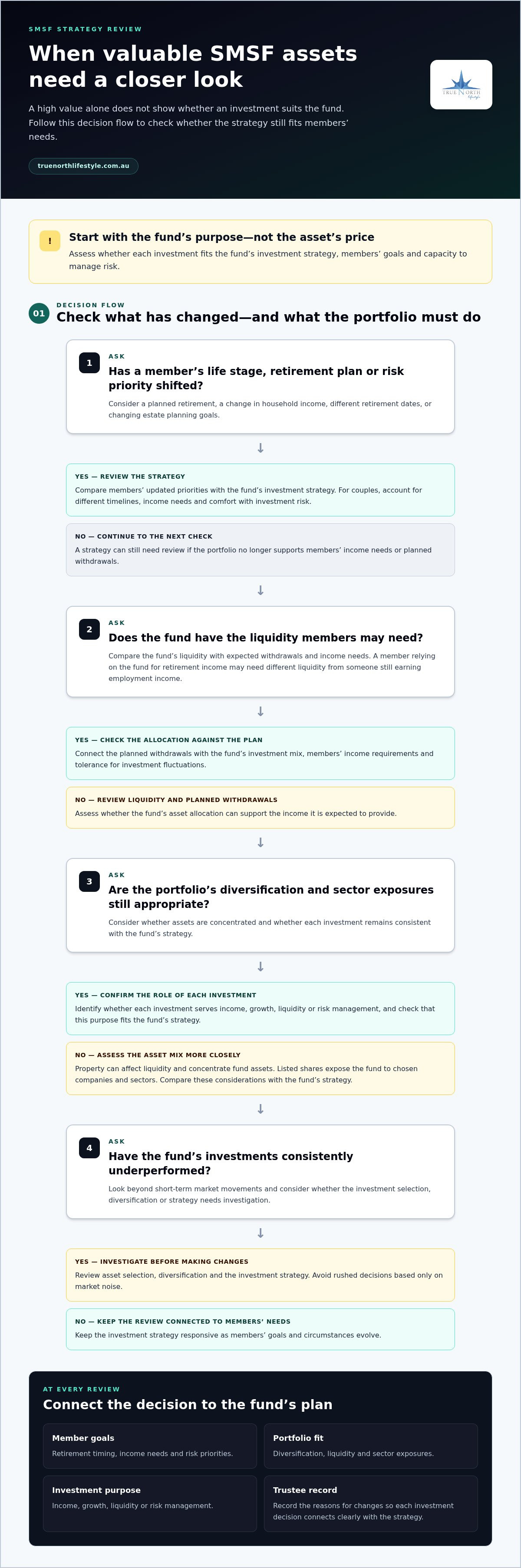
Start by listing expected changes for each member, such as a planned retirement or a shift in household income. Compare those priorities with the fund’s investment strategy. The aim is to agree on a shared direction while recognising that members may have different timelines and needs.
Retirement asset allocation and income needs
Asset allocation should reflect how the fund is expected to provide income and members’ tolerance for investment fluctuations. For example, a member relying on the fund for retirement income may need different levels of liquidity from someone still earning employment income. Review diversification, liquidity and sector exposures against the fund’s planned withdrawals.
A useful review connects each investment with a purpose: income, growth, liquidity or risk management. If the portfolio has become concentrated or no longer matches members’ needs, assess whether its allocation needs closer review instead of reacting to short-term market movements.
Retirement and superannuation strategy
A retirement strategy brings superannuation decisions together in one plan. Consider contribution timing, tax consequences, investment mix and the income members expect to draw. For a couple with different retirement dates, modelling each person’s timeline can show how one member’s continued employment may affect the household’s overall retirement plan.
Keep the investment strategy responsive as members’ goals evolve. Review it when a major life change affects retirement timing, risk tolerance or estate planning goals. If the fund’s investments consistently underperform, investigate asset selection, diversification and strategy before making changes.
Advice for pre-retirees and retirees
People approaching retirement can use retirement modelling to compare scenarios, such as finishing work earlier or continuing part-time. The model should bring together superannuation, other income sources, expected spending and investment risk, helping members understand how different choices may affect their plans.
For retirees, review the fund’s investment mix, risk profile and withdrawal strategy against income needs and capital preservation. An SMSF investment strategy should reflect members’ changing circumstances, without prompting rushed decisions based only on market noise. Record the reasons for any changes so trustees can clearly connect the strategy with each investment decision.
Support from investment, legal, tax, lending and administration professionals
SMSF fees and investment options vary with the fund’s structure, assets and services, so compare total running costs rather than focusing on one fee. Weigh administration, audit, advice and investment expenses against the fund’s control and investment choices, then compare these with pooled options in industry and retail super funds.
Professional support for SMSF advice
Different professionals address different parts of a self-managed super fund. A financial adviser can assess whether an SMSF suits your circumstances and help prepare, review or update its investment strategy. According to the Australian Securities & Investments Commission, licensed financial advisers in Australia are registered with ASIC.
Tax agents can lodge the fund’s annual return, provide tax advice and represent it in dealings with the ATO. An accountant can establish financial systems and prepare accounts and operating statements, while an administrator can support day-to-day running, reporting and administration.
Legal questions require separate attention. An Australian legal practitioner can prepare, review or update a trust deed and advise whether proposed actions are permitted by law. They can also explain legal implications arising from situations such as divorce or disputes between trustees.
Before the fund commits to borrowing, work through the proposed limited recourse borrowing arrangement. Consider the asset, cash flow, liquidity and how repayments may affect the fund’s investment strategy. Assign tasks clearly so advice, tax work, legal matters and administration each have distinct responsibilities.
SMSF suitability and investment strategies
Suitability depends on members’ circumstances, the fund’s purpose and trustees’ capacity to manage ongoing responsibilities. An investment strategy should explain how the fund’s assets support members’ goals. Regular investment reviews can assess whether diversification, liquidity and sector exposures remain appropriate.
For cryptocurrency and other digital assets, consider how ownership and records are managed. Digital wallets holding fund assets should be managed separately from trustees’ personal holdings. This distinction matters when documenting fund assets and keeping them separate from personal holdings.
Property and shares each bring different investment considerations. Property can affect liquidity and concentrate the fund’s assets, while listed shares expose the fund to chosen companies and sectors. Compare each option with the fund’s strategy before acting. Private business investments need particular care: SMSFs may invest in private businesses only if the company isn’t linked to a trustee or related party.
Keep a decision trail: record the investment considered, how it fits the strategy, and the risks reviewed. If professional input would help clarify those decisions, structured financial planning guidance can help connect the fund’s investment approach with members’ circumstances.
Financial advice for SMSF trustees in the Sutherland Shire
SMSF trustees in the Sutherland Shire remain accountable for fund decisions, even when professionals assist. Advice can clarify investment, legal and compliance questions, but it doesn’t transfer trustee responsibility.
Ongoing trustee responsibilities
Trustees need to connect fund decisions with its investment strategy and members’ circumstances. If a member’s retirement plans change, for example, review whether the fund’s approach still fits its objectives. Professional assistance can support administration, but trustees remain responsible for the fund. Keep records of decisions and the reasons behind them so the fund’s actions can be understood over time.
Trustee decision-making
Good decisions start with a clear question: does this action support the fund’s purpose and members’ interests? Before changing an investment, record the reason, the risks considered and how the change relates to the strategy. This creates a decision trail rather than a reaction to market noise. An adviser can help assess investment choices and strategy, while trustees remain responsible for deciding what the fund does.
For advice in Sydney and the Sutherland Shire, confirm that the adviser is registered. The Australian Securities & Investments Commission says licensed financial advisers in Australia are registered with ASIC. Using a licensed adviser also provides an avenue to lodge a complaint if something goes wrong.
SMSF trustee obligations
Compliance is ongoing. Trustees must appoint an SMSF auditor each year, and the auditor examines financial statements and checks whether the fund has complied with superannuation laws. An auditor must report to the ATO if the fund has breached or contravened certain superannuation laws. Treat the audit as a check on records and fund conduct, not a replacement for sound decisions throughout the year.
When a significant life event or change in superannuation obligations affects the fund, review the strategy and document the response. This helps trustees explain how decisions relate to the fund’s circumstances, rather than relying on memory during an audit or dispute.
Questions about an SMSF trust deed need legal guidance. An Australian legal practitioner can prepare, review or update a deed and advise whether proposed actions are permitted by law. They can also explain legal implications arising from personal situations, including divorce or trustee disputes. Keep legal advice distinct from financial advice: the deed governs the fund’s rules, while investment advice addresses strategy and assets.
A practical way to organise trustee work is to identify the decision, assign any specialist input, then record the trustees’ reasoning and follow-up. For example, a question about the deed may need legal advice, while a portfolio review concerns the investment strategy. Clear records help trustees manage their obligations without assuming a professional has taken over their role.
Personalised financial planning
Personalised financial planning starts with your financial situation, priorities and household or business structure. In Australia, a useful first step is to map income, assets, liabilities and major commitments. A family balancing school costs with retirement saving, for example, needs a different cash flow plan from a business owner preparing to sell.
Set clear goals before weighing financial strategies. Separate near-term needs, such as maintaining working capital, from longer-term aims, such as preserving wealth for retirement. Then identify which resources may support each goal. This helps reveal competing priorities and shows how a change in one part of your finances may affect another.
Business planning should account for personal and commercial finances without treating them as interchangeable. A Sutherland Shire business owner considering business premises through an SMSF should assess the proposed investment alongside business cash flow, fund liquidity and members’ objectives. Consider the decision before committing and identify how the asset would fit the fund’s investment strategy.
Business owners can organise planning around key decisions: whether to retain profits in the business, how to prepare for a future sale, and how business assets relate to personal wealth. A planned change in ownership, for example, may affect income, retirement timing and family priorities. Modelling these scenarios helps clarify which decisions to make first.
Estate planning connects financial assets with the people and purposes they are intended to support. Start by listing assets, ownership structures and intended beneficiaries. Then identify where an SMSF, business interest or other investment may need separate consideration. This overview can help families spot gaps between their financial intentions and the arrangements governing particular assets.
Questions about an SMSF trust deed require legal advice. An Australian legal practitioner can prepare, review or update a deed and advise whether proposed actions are permitted by law. They can also explain legal implications arising from personal situations such as divorce or trustee disputes. This helps distinguish legal questions from financial planning decisions.
For a practical review, gather current financial records, note major upcoming changes and rank your priorities. A couple with a business, an SMSF and adult children might consider succession, future income and estate intentions together. The plan should connect each decision to a specific goal, rather than treating investments, business planning and family arrangements as separate exercises.
Revisit the plan when circumstances change, such as a business transition, relationship change or shift in family responsibilities. Record what changed, which goals it affects and what decisions follow. This creates a clear framework for discussing wealth preservation and longevity planning while keeping family priorities and financial structure in view.
Financial advice for Sutherland Shire residents
Local financial advice should start with your circumstances, not a standard portfolio. For Sutherland Shire residents, that may mean coordinating an SMSF with business interests, property, family commitments and retirement plans. Write down your priorities first, such as supporting retirement income, preserving wealth or planning an estate. This gives an adviser a clear basis for discussing relevant options.
Sarah Broady has over 25 years of financial planning experience serving clients across the Sutherland Shire. An experienced financial adviser can help organise complex decisions into manageable steps. For example, a business owner approaching retirement might need to consider personal superannuation alongside business income and the timing of a transition.
Prepare for a planning discussion by gathering a clear snapshot of your finances. Include superannuation, other investments, debts, income needs and important family or business commitments. Note any upcoming decisions too, such as reducing work, changing an investment strategy or reviewing estate intentions. This preparation helps keep the conversation focused on choices that matter to you.
For SMSF trustees, connect each proposed investment decision with the fund’s strategy and members’ circumstances. Consider whether the portfolio remains diversified, whether the fund can meet expected cash needs and whether a major life change has altered members’ priorities. A sustained performance concern may warrant investigating the strategy, while short-term volatility alone doesn’t show long-term misalignment.
Local business circumstances can add another layer. A Sutherland Shire business owner considering business premises through an SMSF should assess the investment before committing. Review how it may affect fund liquidity, diversification and retirement plans. A financial adviser can help assess the investment strategy, while lending, legal and tax questions call for their respective specialist input.
Estate planning also deserves attention as part of wealth management. Consider how your family’s needs, intended beneficiaries and assets fit together. An estate planning strategy can help organise these considerations, while legal questions about an SMSF trust deed or trustee dispute require advice from an Australian legal practitioner. Keeping financial and legal questions distinct makes the next steps clearer.
When assessing financial advice, look for a process that explains the reasoning behind recommendations and connects them to your goals. The Australian Securities & Investments Commission says licensed financial advisers in Australia are registered with ASIC. This offers a practical starting point for understanding an adviser’s professional standing.
For residents seeking SMSF financial advice in the Sutherland Shire, the useful next step is to bring together your fund details, personal priorities and upcoming decisions. Discuss your wealth and retirement priorities to explore how a structured financial plan may address them.
True North Lifestyle: Retirement modelling & long-term projections
True North Lifestyle can help connect SMSF decisions with retirement income needs and longer-term goals. Its retirement modelling and long-term projections can help you explore how different assumptions may affect your plans, while a superannuation review can assess whether your fund remains aligned with your circumstances.
For trustees reviewing their investment approach, bespoke portfolio construction brings asset choices together with risk management and portfolio sustainability modelling. Tax-minimisation strategies can also form part of a broader plan, alongside wealth preservation. The focus is on clarity about the decisions ahead, not a promise of a particular outcome.
If you’re ready to discuss your retirement plans or SMSF strategy, contact True North Lifestyle to explore a considered next step.
Set your next SMSF decision in motion
Your next step can be simple: choose the decision you most need clarity on, then consider what information would help you approach it thoughtfully. For SMSF financial advice in the Sutherland Shire, a useful discussion can start with one priority, such as how retirement plans relate to your superannuation or what you want your financial strategy to support.
True North Lifestyle offers retirement modelling and long-term projections, tax-minimisation strategies, and superannuation review and optimisation. These services can bring connected decisions into focus and give you a clearer basis for considering your next move. You don’t need to resolve every question before starting a conversation.
Contact True North Lifestyle today to discuss your financial planning priorities. A considered next step can help you move forward with greater clarity and confidence.
Frequently Asked Questions
Need more clarity on highly valuable SMSF assets?
Check how each asset is owned, stored, valued and insured by the fund. SMSF collectables and artworks must be insured within 7 days, stored securely away from private residences, and not used by related parties. Their valuation and insurance should be considered as part of the fund’s asset management. For investment-grade precious metals, secure storage must be provided by an independent third party. These conditions make asset handling part of the investment decision.
What are the current ATO rules and compliance obligations for SMSFs?
Key ongoing checks include accurate financial records, an investment strategy that reflects the fund’s circumstances, and an independent audit each year. The auditor examines the fund’s financial statements and checks compliance with superannuation laws. If the auditor identifies certain breaches or contraventions, they must report them to the ATO. Trustees remain responsible for the fund’s decisions and obligations, even when they use professional support.
What are the risks and responsibilities of running an SMSF?
Trustees are responsible for decisions, records and the fund’s ongoing management. Investment risks can include an overly concentrated portfolio, insufficient liquidity for payments or assets that no longer suit members’ needs. For example, a fund heavily invested in one illiquid asset may have less flexibility when members need income. Trustees should understand each investment, document decisions and ensure professional support complements, rather than replaces, their oversight.
How can I check an Australian financial adviser’s licence, fees and disciplinary history?
Use the Australian Securities & Investments Commission’s adviser information to check whether an adviser is registered. Ask for a written explanation of the advice services, fees, ongoing charges and any relevant disciplinary history, so you understand the arrangement before proceeding. Licensed financial advisers in Australia are registered with ASIC, and using one provides an avenue to lodge a complaint if something goes wrong. Compare the proposed scope with your needs.
How do SMSF fees and investment options compare with industry and retail super funds?
SMSF fees and investment options vary with the fund’s structure, assets and services. Compare total running costs, including administration, audit, advice and investment expenses, with the control and investment choices offered, and with pooled options in industry and retail super funds.


