

The best-performing super fund may not be the best choice for your retirement. If you’re searching for the best super funds for over 50s Australia has to offer, a league table alone can’t show whether a fund’s investment approach, fees, insurance and retirement support suit your circumstances.
It’s reasonable to want a clear answer. But in your 50s, the right comparison depends on more than a single performance figure: your retirement timeline, comfort with investment risk and what you need your super to do next all matter. A higher return in one period doesn’t guarantee the same result in future. Switching without considering insurance or other features can also have consequences.
This 2026 comparison guide offers a practical framework for weighing those trade-offs. You’ll learn how to compare performance over meaningful timeframes, assess fees and investment options, and consider insurance and retirement-related services across different fund types. The aim isn’t to name a universal winner. It’s to help you decide whether a fund deserves a closer look, and whether tailored retirement modelling could put your super choices in context alongside your broader goals.
Key Takeaways
- Define what “best” means for your retirement plans before comparing funds, rather than relying on a generic ranking.
- When assessing the best super funds for over 50s Australia, compare equivalent investment options over matching time periods and note each figure’s disclosure date.
- Understand how industry, retail, corporate and self-managed funds differ in investment choice, administration and member responsibilities.
- Before switching, review your retirement timing, current fund details, fees, investment option, insurance and relevant services as one checklist.
- Use tailored retirement modelling to explore how different super choices may fit your broader plans, based on your goals and real-world assumptions.
Best super funds for over 50s: why the right choice depends on your plans
Choosing a super fund can feel more consequential as retirement gets closer. You may be weighing whether to stay with your current fund, change investment options or consider a different fund structure. The useful question isn’t simply which fund ranks highest. It’s whether the fund and its options suit your goals, investment preferences, costs, insurance needs and expected retirement timing.
No single super fund is automatically best for everyone over 50; the right choice is the one that fits your circumstances and the retirement you’re planning for. Age alone doesn’t tell you how much investment risk is appropriate or when to change your approach. Two people of the same age may have different goals, financial resources and plans for work. A ranking is a starting point, not a personal recommendation.
What changes when you compare super in your 50s?
Your timeframe becomes more visible. Someone planning to reduce their hours or retire in a few years may assess investment options differently from someone expecting to work for longer. Consider the timing and scale of possible work changes, as well as how you expect to use your super. Don’t assume that reaching a particular age means you should adopt a particular investment mix.
Also separate your intended retirement date from when you may access super. Under current rules, preservation age is 60 for people born on or after 1 July 1964, and reaching preservation age alone doesn’t necessarily allow access. A condition of release may also be required; turning 65 is another condition. Your circumstances matter, so treat these milestones as planning context, not a substitute for checking the rules that apply to you.
A fund name is only part of the decision
A super fund is the structure and administration behind your account. Within it, you generally select from investment options that determine how your super is invested. Comparing funds and comparing options are related, but they aren’t the same exercise. A fund’s name or overall ranking won’t tell you whether a particular option matches your timeframe and comfort with market ups and downs.
Look at the whole arrangement. Investment choice affects the mix of assets and level of risk; fees affect your balance over time; insurance may provide cover through the fund, subject to its terms; and services can influence how you manage your account and plan for retirement. A strong headline ranking can’t account for all these personal trade-offs. Check what each comparison measures and whether the options are genuinely similar.
For background on how Australia’s compulsory retirement savings system is structured, see Superannuation in Australia. To place fund decisions in a broader planning context, read superannuation advice in the Sutherland Shire. A tailored comparison can then consider how your super fits with your retirement goals, rather than treating a fund ranking as the whole plan.
How to compare super funds in your 50s: performance, fees and risk
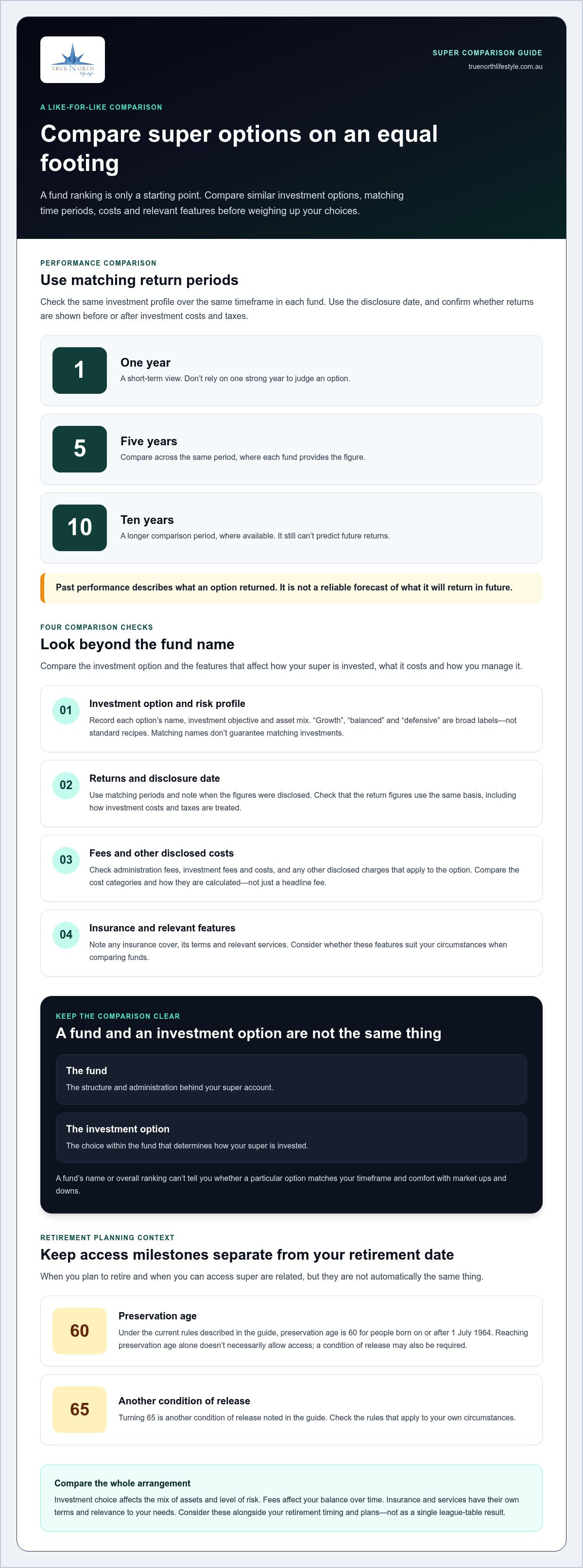
A useful comparison starts with equivalent options, not a list of fund names. Before weighing returns, check that each figure relates to a similar investment approach, covers the same period and comes from a current, dated disclosure. Otherwise, a table can look precise while comparing very different things.
Compare investment options and performance like for like
Labels such as “growth”, “balanced” and “defensive” are broad guides, not standard recipes. The asset mix and risk level behind a label can vary between funds. Read each option’s investment objective and asset allocation, then compare options with a similar profile. Don’t assume matching names mean matching investments.
Use a consistent set of time periods, such as one, five and ten years where the fund provides them, and record the disclosure date. Check whether returns are shown before or after investment costs and taxes, and ensure the figures use the same basis. Returns fluctuate, so multiple periods provide more context than a single strong year, though none predicts what happens next.
| Comparison detail | Fund A | Fund B |
|---|---|---|
| Investment option and risk profile | Record option name and asset mix | Record option name and asset mix |
| Return periods and disclosure date | Use matching periods; note date | Use matching periods; note date |
| Fees and other disclosed costs | Record cost categories and basis | Record cost categories and basis |
| Insurance and relevant features | Note terms and services | Note terms and services |
Past performance describes what an investment option returned; it is not a reliable forecast of what it will return in future. Treat it as one comparison point, alongside the risks taken to achieve those returns.
Look beyond headline returns to fees and insurance
Check each fund’s current product disclosure statement and other relevant disclosures. Identify administration fees, investment fees and costs, and any other disclosed charges that apply to the option. These may be presented in different ways, so compare the categories and calculation basis carefully. A low headline fee doesn’t necessarily mean the lowest overall cost for your circumstances.
Then assess the investment itself. Consider diversification across asset types, exposure to assets that may be harder to sell, and whether the option’s risk profile fits your timeframe and comfort with market movements. Also consider practical services that matter to you, such as retirement support or account access.
Insurance deserves its own check. Compare the cover, premiums, eligibility rules, exclusions and other terms in each fund’s current documents. A change in fund can affect existing cover, so understand the implications before acting. Retirement planning in Sydney also considers how super choices relate to income needs and long-term plans.
This framework makes comparisons of the best super funds for over 50s Australia more meaningful, but it can’t select an option for you. True North Lifestyle offers tailored retirement modelling to bring super, investment risk and retirement planning into one discussion.
Industry, retail or SMSF: which super fund structure suits your situation?
Fund structure shapes how super is governed, invested and administered, but it doesn’t tell you by itself whether a fund offers good value or suits your retirement plans. In your 50s, consider how much investment choice and involvement you want, which services matter to you, and how much administration you’re prepared to take on.
Industry, retail and corporate funds are generally managed by a trustee, while a self-managed super fund (SMSF) places trustee responsibilities with its members. The detail within each category varies. Compare the actual investment options, costs, insurance and services in current product disclosures rather than assuming every fund in a category works the same way.
What differs between industry, retail and corporate funds?
Industry funds are run by trustees for members and may offer a range of investment options and member services. Retail funds are commonly offered through financial institutions and may provide different investment and account-management choices. Neither label guarantees a particular fee level, investment result or service experience.
Corporate super describes arrangements connected with an employer. These may be offered through an existing fund or a separate arrangement, and the options and support available depend on its design. If you’re changing jobs or winding down work, consider how the arrangement fits your likely employment plans, as well as its investment choices and administration.
For any fund, read the current product disclosure statement and relevant updates. Compare specific features, including available investment options, how administration works, member support and the terms of any insurance. A category name is a useful signpost, not a substitute for checking the actual offer.
When does an SMSF comparison need extra care?
An SMSF can offer members greater control over investment decisions, but that control comes with responsibility. Members who act as trustees, or directors of a corporate trustee, must manage the fund in line with its obligations. Administration, record-keeping, investment decisions and governance need ongoing attention, whether handled personally or with professional support.
Ask yourself whether you have the time, expertise and interest to oversee the fund’s investment strategy and administration, including as your work and retirement plans change. An SMSF can have up to six members, but a larger membership doesn’t remove the need for clear decision-making and shared responsibility. Weigh the control you want against the work involved and the fund’s total costs, rather than treating greater choice as automatic value.
The best super funds for over 50s Australia depends on the fit between structure, investment approach and personal circumstances, not the category alone. Bespoke investment advice in Sydney can provide context for considering how investment decisions fit broader goals. For people in Miranda and across Sydney, a fund comparison is most useful when it clarifies the trade-offs you’re willing to make, including how much control and responsibility you want to carry into retirement.
A practical checklist before changing super funds after 50
A transfer is a significant decision, but it doesn’t need to be rushed. A clear review can show whether a change addresses a genuine need or simply reacts to a recent return. Before making a move, compare your current fund with the prospective fund using up-to-date disclosures, and consider how the change fits your retirement plans.
Before transferring, map what you have now
Gather your latest statements, investment-option details, fee information and insurance terms. Include other super accounts and existing arrangements that could be affected by a transfer. Then compare the current and prospective funds’ product disclosure statements and relevant updates. Use current ATO and fund guidance for transfer processes and rules that apply to your circumstances.
Work through the checklist in order
- Set your goals and timing. Write down what you want your super to support, your expected retirement timing and any planned changes to work. Keep your intended retirement date distinct from when you may be able to access super.
- Record your current position. Note your fund and investment option, account details, other super accounts, current fees and any insurance or services you rely on.
- Identify the reason for changing. Be specific. For example, are you seeking a different investment approach, clearer services or a structure that better suits your plans? A recent return by itself may not show that a switch is appropriate.
- Compare investment options. Assess the proposed option’s objectives, investment mix and risk against your retirement timeframe and comfort with volatility. Don’t assume options with similar labels are equivalent.
- Compare costs and services. Use current disclosures to review administration and investment costs, other applicable fees, and services that matter to you. Compare the information on a consistent basis rather than relying on a headline figure.
- Review insurance and transfer terms. Check the cover, premiums, eligibility, exclusions and conditions in both funds’ current documents. Understand how transferring may affect existing insurance or other arrangements before initiating the move.
Check how a change fits your retirement plan
A new fund or investment option should have a clear purpose in your plan. Consider how it may affect your expected retirement income, the timing of withdrawals and the level of market fluctuation you can tolerate. If the change is driven by a recent performance result, pause and assess the option over comparable periods and against your underlying needs.
Check the consequences of a fund transfer before requesting one. A comparison can help you identify trade-offs, while tailored retirement modelling can test how different choices may fit your goals using real-world assumptions. Tax considerations may also be relevant to your wider strategy; retirement tax planning in Australia is part of the broader planning picture. True North Lifestyle provides a superannuation review and retirement modelling to help put your scenarios in context.
How tailored retirement advice can put your super comparison in context
A fund comparison can help you identify differences in investment options, costs and services. On its own, it can’t tell you how those choices fit your retirement income needs, other investments, tax considerations or plans for work. That broader context matters: an option that looks attractive on a comparison table may not fit your objectives or timeframe.
Tailored advice brings these moving parts into one discussion. True North Lifestyle provides superannuation review and optimisation, retirement modelling and ongoing plan reviews. Its team includes 4 Certified Financial Planners, and the business manages $220 M+ in funds under management, excluding direct property assets. These figures describe the business, not a promise of investment results.
Connect fund decisions with long-term projections
Retirement modelling can compare scenarios using your goals and real-world assumptions. For instance, projections might explore how different retirement dates or investment approaches affect your longer-term position. Super choices can also interact with other investments, tax considerations and the timing of retirement income, so changing one assumption may alter the overall picture.
These comparisons are tools for understanding possibilities, not predictions or guarantees. Actual outcomes can differ as investment returns, personal circumstances and plans change. Recommendations depend on your objectives and situation, rather than your age or a generic fund ranking. The aim is to make trade-offs clearer, such as how a particular investment risk may relate to the timeframe and income strategy you have in mind.
What to expect from a tailored review
A review can bring your current super arrangements and potential alternatives into a structured assessment. This may include detailed long-term projections, comparisons between scenarios and clear explanations of the assumptions behind them. Rather than focusing on one performance figure, the discussion can consider how investment choices, costs, insurance and retirement timing fit together with your broader financial position.
As circumstances or priorities evolve, ongoing plan reviews can help you reassess whether your strategy still reflects your intentions. A tailored approach doesn’t remove uncertainty or guarantee a particular balance. It can give you a clearer basis for deciding whether to keep your current arrangement, investigate a change or seek further advice. That perspective is useful when comparing the best super funds for over 50s Australia, because suitability depends on more than a league-table position.
For a tailored discussion about how your super choices relate to your retirement goals, book a consultation with True North Lifestyle.
Turn your comparison into a considered next step
The next step isn’t necessarily to change funds. It’s to decide what you still need to understand before acting. If your comparison has raised questions about investment risk, insurance or how super could support your retirement plans, consider how those choices work together in your broader financial picture.
There’s no universal winner among the best super funds for over 50s Australia. A tailored discussion can help you test different scenarios against your priorities and retirement timing, so your decision rests on more than a ranking or a recent return. True North Lifestyle has supported 1,000+ Australians, including 400+ long-term clients across Australia, with tailored financial strategies.
Bring your questions and current fund information to a conversation about your options. Book a consultation to bring your super choices into a tailored retirement plan and take a steadier, more informed step towards the retirement you want.
Frequently Asked Questions
Can I change super funds after turning 50?
Yes, you can generally change super funds after turning 50, but first check what the transfer means for your account. For example, if you rely on insurance held through your current fund, read its terms and understand what happens to that cover before moving your balance. Compare the replacement fund’s current documents and use ATO guidance for transfer information. Avoid making the decision solely because another option recently had stronger returns.
Should I combine my super accounts when I’m in my 50s?
Combining accounts can simplify administration, but keeping accounts separate may suit some circumstances. Before consolidating, check whether an account has insurance, a particular investment option or another feature you’d lose by closing it. Also consider whether any employer contributions are directed to a specific account. A practical first step is to list each account’s balance, costs, cover and features, then compare the overall effect of consolidating against retaining them.
Is a conservative super option better when you’re over 50?
Not automatically. A more conservative option may reduce exposure to some market fluctuations, but it can also have different growth potential. Consider how soon you expect to draw on super and whether you’ll leave some savings invested after retirement. For example, stopping work doesn’t necessarily mean you’ll use your entire balance straight away. Read the option’s objective and risk information, then assess it against your timeframe and income plans.
Are industry super funds always better for people over 50?
No, an industry fund isn’t automatically better for every person over 50. The right fit depends on the specific fund, options and services, as well as how much involvement you want in managing super. Someone who prefers a straightforward account may value different features from a person seeking broader investment choice or considering an SMSF. Compare current fund documents and your needs, rather than treating the structure label as a verdict.
What happens to my insurance if I leave my super fund?
Your insurance may change or end when you transfer or close an account, depending on the fund’s rules and your circumstances. Before acting, locate the insurance schedule and check the cover type, terms and any conditions that apply. If you’re considering replacement cover, understand how it would work before giving up existing cover. Don’t assume a new account will provide equivalent protection, or that existing insurance will continue after the transfer.
How can I check whether my super fund has underperformed?
First, identify the exact investment option you hold, as a fund may offer options with different objectives and risk levels. Compare its dated returns with similar options over matching periods, and look at fees and investment objectives alongside the figures. Moneysmart and APRA provide Australian super information that can support your research. A single weak period doesn’t establish a lasting pattern. For people planning retirement in Miranda or wider Sydney, a tailored review can also test whether the option fits their timeframe.


