

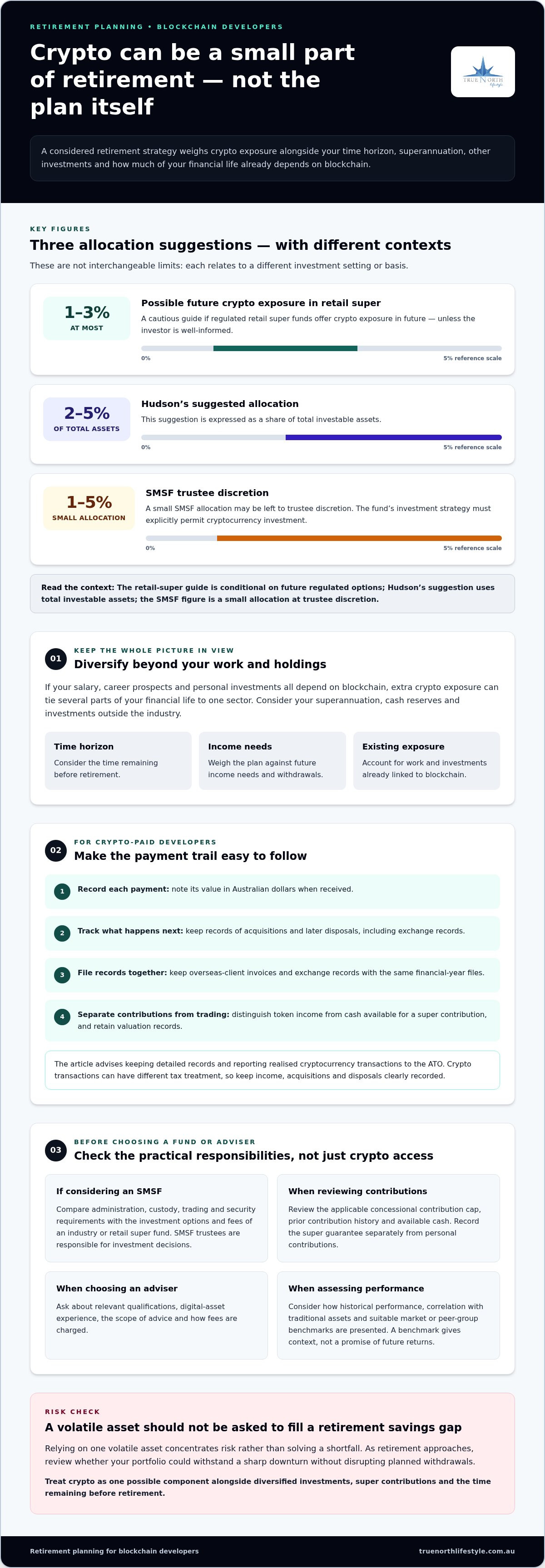
Crypto shouldn’t be asked to rescue your retirement. If regulated retail super funds offer crypto exposure in future, a cautious guide is to keep it to 1-3% at most unless you’re well-informed. For retirement planning for blockchain developers in Miranda, that makes crypto a possible small component, not a retirement plan in itself.
It’s understandable to see potential in an industry you know well, particularly when digital assets can rise sharply and fall just as quickly. The challenge is keeping your retirement plan resilient if crypto prices drop when you need to draw on your savings. A considered strategy weighs that risk alongside your time horizon, superannuation and other investments.
This article explains how to assess crypto’s long-term role, diversify beyond assets tied to your work, manage portfolio risk and reconsider exposure as retirement approaches. It also shows why an allocation that suits one investor may be too much for another, and how to think about future crypto options in super without relying on them to secure your retirement.
Key Takeaways
- Assess crypto as one part of a retirement portfolio, not a way to make up for a savings shortfall.
- Consider how future crypto options in retail super could affect your investment choices and the risks you take on.
- Build diversification around your time horizon, income needs and existing exposure to the blockchain industry.
- As retirement approaches, review whether your portfolio can withstand a sharp downturn without disrupting planned withdrawals.
- Understand how employer super contributions fit alongside personal investments and your broader retirement strategy.
Q: What if someone is behind financially and hoping crypto can ‘rescue’ their retirement?
Relying on one volatile asset to close a retirement savings gap concentrates risk rather than solving it. In Australia, assess crypto beside diversified investments, super contributions and the time remaining before retirement.
Retirement Options for Crypto-Paid Developers
Retirement options for crypto-paid developers include ways to build savings when income arrives in digital assets or through overseas payments. Irregular payment methods can make it harder to track income, contributions and investment exposure across accounts, so clear records are an important starting point.
Separate each payment record from the investment decision: record the payment’s value in Australian dollars when received, then track any later disposal. Keep overseas-client invoices and exchange records with the same financial-year files. Australian retirees are advised to keep detailed records and report realised cryptocurrency transactions to the ATO.
An SMSF can invest in cryptocurrency under certain conditions, but its investment strategy must explicitly permit it. Compare the fund’s administration, custody, trading and security requirements with the investment options and fees of an industry or retail super fund. SMSF trustees are responsible for investment decisions, so crypto access also brings operational work.
Don’t assume crypto can be transferred directly into super as a contribution. Distinguish income received in tokens from cash available for a contribution, then use the fund’s accepted contribution process and retain valuation records. Keeping these records separate from exchange activity makes the contribution trail easier to follow.
Super Contributions, Tax and Adviser Checks
Super contributions, tax and advice are the decisions that connect volatile income with a retirement plan. For blockchain developers, distinguishing employee wages, contractor income and overseas-client payments helps organise records and assess contribution planning.
Crypto transactions do not all receive the same tax treatment. Keep records of income, acquisitions and disposals, and report realised cryptocurrency transactions to the ATO. Record these separately from super contributions so you can distinguish a token payment from a later investment gain.
Concessional contribution caps and carry-forward amounts can shape how high-income contractors plan additional super contributions. Review the applicable cap, your prior contribution history and available cash before deciding on an amount. The super guarantee is a separate employer contribution stream, so record it apart from personal contributions when reviewing a pay arrangement.
When choosing a retirement adviser, ask about relevant qualifications, experience with digital assets, the scope of advice and how fees are charged. For investment services, assess how the proposed portfolio’s historical performance, correlation with traditional assets and suitable market or peer-group benchmarks are presented. A benchmark provides context, not a promise of future returns.
Automatic enrolment and default investments use friction to influence choices. If retail super funds offer crypto exposure in future, a suggested limit is 1-3% at most unless the investor is well-informed. Hudson suggests 2-5% of total investable assets; a small SMSF allocation of 1-5% may be left to trustee discretion. When comparable, prefer regulated investments over unregulated ones.
Long-term viability and diversification
For retirement planning for blockchain developers in Miranda, long-term viability means assessing whether a technology may endure, not whether its token price is rising today. Amara’s law describes how people tend to overestimate a technology’s short-term effects and underestimate its long-term effects. It offers perspective on blockchain’s potential, but does not establish that any particular cryptocurrency will retain value.
Separate the technology from the investment. Distributed ledger systems can change how digital assets are stored, recorded and transferred, while individual tokens face distinct adoption, security and market challenges. Thousands of cryptocurrencies are in circulation, so confidence in blockchain does not make every asset viable. A developer may understand a protocol’s design and still face changing demand, volatility or concentration in one project.
Assess evidence beyond industry familiarity. Ask what problem a network solves, who uses it and whether that use could persist under different market conditions. Then consider historical performance, correlation with traditional assets and comparisons with suitable market or peer-group benchmarks. These perspectives can help frame an investment decision, but past results cannot establish future returns.
Diversification applies to your entire financial position. If your salary, career prospects and personal holdings all depend on blockchain, additional crypto exposure can tie several parts of your financial life to one sector. Consider how superannuation, cash reserves and investments outside the industry may behave under different conditions. The aim is to avoid relying on one technology’s success.
Blockchain adoption may influence financial infrastructure without making cryptocurrency a suitable retirement asset. The ASX is exploring blockchain-inspired systems to replace its CHESS settlement system. That example concerns market infrastructure, not a recommendation to invest in digital assets. Retirement planning for blockchain developers in Miranda should distinguish possible changes to transaction systems from the risks and role of each investment.
Make the assessment practical. Write down your expected retirement timing, income needs and current sources of blockchain exposure. Compare a scenario where the sector grows with one where its investments fall while employment demand weakens. If either outcome disrupts essential plans, reconsider the balance between sector-linked assets and other investments. Wealth preservation planning can help frame that discussion around longevity and the assets intended to support it.
Assess how assets and income sources might perform under different conditions instead of relying on one favourable outcome. Blockchain’s effects on retirement systems are expected to develop gradually and incrementally in the short term. That gives you room to review assumptions as the technology and its uses evolve, without treating possible future changes as immediate certainty. Keep decisions tied to practical needs: whether accessible savings can cover planned spending, whether income depends on a narrow range of blockchain roles, and whether your investment choices still fit the time before retirement. Revisit the assessment when circumstances change, and don’t let enthusiasm for building or using a technology replace evidence that a particular holding supports your retirement goals. A resilient plan can adapt while keeping professional interest distinct from your financial capacity to absorb losses.
De-risking before retirement
The final 3-5 years before retirement can change how much investment risk your savings can absorb. Hudson identifies this period as a time for most people to shift from growth assets towards more stable, income-producing investments. For a blockchain developer in Miranda, the review should include super, personal investments and any cryptocurrency held directly. The goal is to connect the portfolio with planned spending, rather than rely on a favourable Bitcoin price.
Separate money needed for near-term spending from assets intended for longer-term growth. A fall in digital asset prices matters more if you have to sell to fund withdrawals. Compare that possibility with a scenario in which crypto prices rise but remain volatile. Retirement modelling can show how each scenario affects expected income and the timing of asset sales.
Next, examine concentration across your financial life. If your employment, share incentives and personal holdings all depend on blockchain, your exposure may overlap even when each account looks diversified on its own. List those exposures together. Consider whether other investments, super options and cash reserves could support planned expenses if the sector weakens. This whole-of-portfolio view can reveal risks individual account statements don’t show.
Digital assets also need an operational review before retirement. Distinguish Bitcoin ETF exposure held through a brokerage position from direct Bitcoin, where control of keys depends on the retirement structure and custodian rules. For direct holdings, document who controls the keys, where recovery information is held and how authorised access works. Align multisignature documentation with custody arrangements, particularly if account holders move countries or hold accounts in different places.
Inheritance needs the same practical attention. Heirs might inherit Bitcoin exposure or receive operational control of the assets, but these are different arrangements. Account type, custodian rules and access documentation affect what heirs can inherit. When reviewing cross-border arrangements, distinguish the country where a retirement account is domiciled from your tax residency.
Finally, include regulatory and security considerations in the transition plan. Australian retirees are advised to keep detailed records and report realised cryptocurrency transactions to the ATO. Retirees using exchanges are also advised to use exchanges registered with AUSTRAC and two-factor authentication. These measures don’t remove price risk, but make record-keeping and account access part of the retirement review alongside allocation and income planning.
Ensuring these digital arrangements are properly structured is well worth reviewing as part of a broader access plan, alongside recovery instructions and clear responsibilities for trusted people. Among survey respondents, 53.05% had heard of blockchain before the study. That level of prior awareness is not a substitute for explaining what an inheritance arrangement requires; write down whether beneficiaries are expected to receive investment exposure or operational access, and ensure the instructions can be understood without relying on informal conversations. True North Lifestyle specialists recommend reviewing the plan whenever custody or family circumstances change.
Risk management and portfolio allocation
For retirement planning for blockchain developers in Miranda, managing volatile income, crypto assets and tax starts with separating records and decisions. Track payments, investment purchases and disposals individually, then compare total portfolio exposure with your retirement income needs. This helps show whether your financial outcomes depend too heavily on cryptocurrency or blockchain-sector work.
Allocation is about the whole portfolio, not a token in isolation. Around 8% of Australian retirees have invested in cryptocurrency, and a 1-5% allocation may suit some people. These figures are reference points, not a target for every investor. Someone with substantial blockchain-related employment or share exposure may already carry more sector risk than their crypto balance suggests.
Preservation changes the calculation. Hudson says a 1% cryptocurrency allocation may be excessive for some people nearing retirement when preserving capital is the goal. A developer approaching retirement can compare that exposure with expected spending, other income sources and the consequences of a sharp price fall. The useful question is whether essential plans remain workable without selling crypto at an unfavourable time.
Base decisions on scenarios rather than confident price forecasts. Model a decline in digital assets alongside reduced work income, then consider whether superannuation and investments outside the sector could meet planned expenses. Compare this with a scenario where crypto rises but income remains irregular. These examples show whether your portfolio can withstand more than one outcome.
Keep a clear ledger for each transaction. Record crypto income, acquisition details, disposals and the value used for reporting. The ATO advises Australian retirees to keep detailed records and report realised cryptocurrency transactions. Separating those records from general household spending makes it easier to see available cash and keep the investment association distinct from day-to-day income.
Risk reviews also need a written rationale. Investment advisers should understand and communicate cryptocurrency’s expected volatility, then document relevant quantitative and qualitative factors. That record can explain why an allocation was chosen, what role it serves and which changes would prompt another review. Compare performance with suitable benchmarks and traditional assets, rather than treating a recent price rise as proof of long-term suitability.
For retirement planning for blockchain developers in Miranda, set review triggers for meaningful changes: a new employment arrangement, a change in retirement timing, or an allocation moving beyond its intended role. Reassess the whole portfolio after each change, including assets held through super and outside it. A disciplined review makes risk management ongoing rather than a reaction to a dramatic market headline.
What is the current Australian superannuation guarantee rate and how does it apply to blockchain developers?
The superannuation guarantee is an employer contribution towards eligible employees’ super. It is calculated as a percentage of ordinary time earnings, so check the current rate and earnings basis when reviewing a payslip or employment arrangement. This distinction matters for blockchain developers whose income may include salary, bonuses, token payments or contractor invoices.
Start by clarifying your work arrangement. An employee of an Australian technology company can compare payslips with employer super deposits and check whether both reflect the agreed salary arrangement. A contractor invoicing an overseas client should separate business income from any employee super contributions rather than assume an invoice automatically generates a super payment. The contract and working arrangement affect what applies.
Crypto-paid work adds another layer of record-keeping. For each token payment, record the date received, the amount of cryptocurrency and its value in Australian dollars at that time. Keep the client invoice, payment confirmation and exchange records together. These records help distinguish compensation for development work from a later investment decision, such as retaining or disposing of the tokens.
Review super contributions separately from digital assets held outside super. A developer paid partly in cryptocurrency might set aside Australian-dollar cash for a super contribution while keeping a clear record of the original token income. Don’t treat a wallet balance as a super contribution. The fund’s contribution process, the source of funds and the transaction records all matter to a coherent financial picture.
Employees can compare employer contribution records with their pay information for each relevant period. If a payslip shows salary but the super record doesn’t appear to align, note the dates, pay basis and amount, then raise the discrepancy through the appropriate employment or superannuation process. Contractors can build contributions into cash-flow planning instead of relying on irregular overseas payments or changes in token prices.
Contribution caps also affect planning for people adding personal amounts to super. A high-income developer should consider employer contributions, personal contributions and available carry-forward concessional contributions before deciding how much to add. The applicable cap and eligibility depend on contribution history and individual circumstances, so keep records that allow these figures to be assessed accurately.
A focused superannuation review can bring employer contributions, personal deposits and investment choices into one view. Arrange a superannuation review to assess how your current arrangements fit your retirement plans, particularly if your income combines employment, contracting and cryptocurrency payments.
For eligible employees, super is an employer contribution calculated as a percentage of ordinary time earnings. Blockchain developers can compare employer contributions with their pay records. Contractors shouldn’t assume that invoicing a client automatically generates a super payment, as the contract and working arrangement affect what applies.
True North Lifestyle: Retirement modelling & long-term projections
True North Lifestyle helps turn retirement decisions into a structured plan through retirement modelling and long-term projections. This can be useful when blockchain-related income fluctuates, crypto forms part of your investments, or retirement is approaching and you want to compare possible outcomes.
Projections bring superannuation, expected income and portfolio choices into one view. A superannuation review and bespoke portfolio construction can help align those decisions with your time horizon and risk capacity. Tax-minimisation strategies can also form part of the broader plan, without treating crypto gains as a substitute for diversified retirement savings.
If you’d like to explore how modelling could clarify your retirement options, contact True North Lifestyle.
Make your next decision with a clearer view
Start by deciding what you need your retirement savings to support, then identify which financial choices could make that outcome more resilient. For retirement planning for blockchain developers in Miranda, connect investment decisions with the life you want beyond work, rather than letting market movements set the direction.
True North Lifestyle can help bring your planning into focus through retirement modelling and long-term projections, superannuation review and optimisation, and tax-minimisation strategies. These services help you consider how your current arrangements fit together and where a more deliberate plan could support your goals.
When you’re ready to explore your options, contact True North Lifestyle to discuss your retirement plans. A thoughtful next step can make the path ahead feel more manageable.
Frequently Asked Questions
What are the ATO tax rules for cryptocurrency income, capital gains, and super contributions in Australia?
Cryptocurrency transactions do not all receive the same tax treatment. Keep records of income, acquisitions and disposals, report realised cryptocurrency transactions to the ATO, and record crypto activity separately from super contributions. For a contribution, use the fund’s accepted process and retain valuation records.
How do Australian superannuation caps and carry-forward concessional contributions work for high-income tech contractors?
Concessional contribution caps and carry-forward amounts can shape additional super contributions. Review the applicable cap, your contribution history and available cash before deciding on an amount. Record employer super guarantee contributions separately from personal contributions.


