

Your will may not decide who receives your SMSF savings. For Miranda and Sydney members making SMSF death benefit nominations, the fund deed and any valid nomination shape the outcome. A binding nomination can direct the trustee to pay eligible beneficiaries or your legal personal representative, while a non-binding nomination leaves the final decision to the trustee.
It’s understandable to expect an estate plan to settle the question, but SMSF benefits are distributed under the fund’s rules, which may differ from your will. Without a binding nomination, the remaining trustees decide how to distribute the benefit under the deed and superannuation law.
This guide explains who may receive an SMSF death benefit and how the deed, nomination type, trustee decisions and pension arrangements affect the outcome. You’ll also learn why deed wording matters, including whether it authorises binding nominations and sets requirements for making them. Understanding these rules can help you see how your intended beneficiaries fit within your fund’s arrangements.
Key Takeaways
- Your fund deed sets the framework for death benefit nominations, including whether a binding nomination can direct the trustee.
- A binding nomination can guide who receives your benefit, while a non-binding nomination records your preference but leaves the decision with the trustee.
- After a member dies, trustees must follow the deed and superannuation rules when managing the benefit and any required changes to the fund.
- Recipient eligibility and pension arrangements can affect how a benefit is paid and its tax treatment, so the details of your estate plan matter.
SMSF binding death benefit nominations and fund deeds
Your SMSF deed sets the rules for nominations and how trustees distribute death benefits. Its wording matters because a nomination only works as intended when it meets the fund’s requirements.
Binding and Non-Binding Nominations
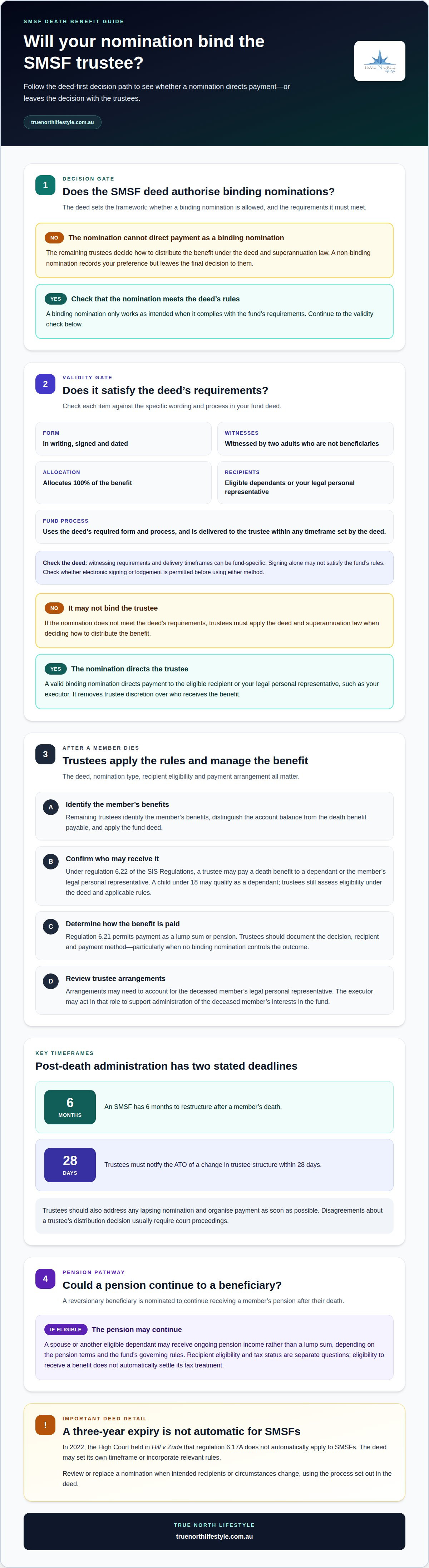
A binding nomination directs the trustee to pay your benefit to eligible recipients, while a non-binding nomination records your preference. The distinction matters: a valid binding nomination removes trustee discretion over who receives the benefit.
A non-binding nomination leaves trustees to decide under the deed and superannuation law. For example, you might name your children, but trustees must assess their eligibility and the deed’s requirements before deciding. A binding nomination may instead direct payment to a dependant or your legal personal representative, such as your executor.
Validity Requirements for Binding Nominations
To bind the trustee, a nomination must meet the fund deed’s requirements. It must be in writing, signed and dated, and witnessed by two adults who are not beneficiaries. Check the fund deed for the witnessing requirements that apply to the nomination.
The nomination must allocate one hundred per cent of the benefit to eligible dependants or your legal personal representative. The deed may also set a timeframe for delivery to the trustee. In 2022, the High Court held in Hill v Zuda that regulation 6.17A does not automatically apply to SMSFs, so a three-year expiry is not automatic.
Making or Updating a Nomination
To make or update a nomination, follow the process and use the form required by your SMSF deed, then give the completed document to the trustee within the deed’s stated timeframe. Signing alone may not satisfy the fund’s rules.
Review your nomination when your intended recipients or circumstances change, and replace or revoke it using the process set out in the deed. Check whether the deed permits electronic signing or lodgement before using either method.
Fund Deeds and Nomination Advice
The deed determines whether binding nominations are authorised and which requirements apply. The High Court’s 2022 decision in Hill v Zuda means regulation 6.17A does not automatically govern an SMSF nomination; deed wording can still incorporate relevant rules.
For advice in the Sutherland Shire, a financial planner familiar with SMSFs can assess how your deed, nomination and estate-planning intentions fit together. This can help clarify who may receive the benefit and how your nomination relates to your wider estate plan.
Trustee responsibilities after an SMSF member dies
After a member dies, the remaining SMSF trustees must identify the member’s benefits and apply the fund deed. They must distinguish the member’s account balance from the death benefit payable to eligible recipients. A binding nomination may remove trustee discretion, while a non-binding nomination leaves trustees to decide under the deed and superannuation law.
Trustee arrangements may also need to change. Trustee arrangements may need to account for the deceased member’s legal personal representative. The executor may act as legal personal representative. This appointment supports the administration of the deceased member’s interests within the fund.
Payment follows the governing rules. Under regulation 6.22 of the SIS Regulations, a trustee may pay a death benefit to a dependant or the member’s legal personal representative. Regulation 6.21 permits payment as a lump sum or pension. Trustees should document the decision, the recipient and the payment method, particularly if no binding nomination controls the outcome.
A child under 18 may qualify as a dependant, but receiving a benefit does not itself settle who manages the fund. Trustees must assess eligibility and follow the deed when deciding whether a child can receive a benefit. The distinction matters where a minor is named, because a dispute may arise if the nomination, deed and proposed payment do not align.
After a member’s death, an SMSF has 6 months to restructure. Trustees must notify the ATO of a change in trustee structure within 28 days. They should also address any lapsing nomination and organise payment as soon as possible. Where a disagreement concerns the trustee’s distribution decision, SMSF disputes usually require court proceedings. For the wider estate plan, estate planning strategy can help place the fund’s intended outcome in context.
Reversionary beneficiaries and pension dependants
A pension may continue to an eligible beneficiary after a member dies, depending on its terms and the fund’s governing rules. Recipient eligibility and tax status are separate questions, and both can affect the outcome.
Reversionary Beneficiaries
A reversionary beneficiary is a person nominated to continue receiving a member’s pension after their death. This arrangement can provide ongoing income for a spouse or another eligible dependant, rather than requiring the benefit to be paid as a lump sum.
The pension’s terms and SMSF deed determine how the arrangement operates. For example, a spouse named as a reversionary beneficiary may receive the continuing pension if they meet the relevant eligibility rules. Confirming the intended recipient and pension terms helps trustees assess the arrangement alongside any death benefit nomination.
Tax Dependency and Benefit Eligibility
Superannuation law and tax law use different dependant definitions, so eligibility to receive a benefit does not automatically settle its tax treatment. Under section 302-195 of the Income Tax Assessment Act 1997, tax-free treatment depends partly on whether a recipient is a death benefits dependant.
A lump-sum death benefit paid to a dependant of the deceased is tax-free. A payment to a non-dependant or the trustee of an estate may have different tax consequences. Under section 302-10, an estate’s treatment can depend on whether a dependant beneficiary is likely to benefit. Trustees and beneficiaries should assess both the payment route and the recipient’s tax status.
Qualifying as a Dependant
Under the SIS Act, a dependant may include a spouse, a child, or a person in an interdependency relationship with the deceased. A child under 18 qualifies as a dependant; a child aged 18 to under 25 must have been financially dependent on the member at the time of death.
A child of any age may qualify under superannuation law if they meet the SIS dependant definition, subject to the fund’s governing rules. Financial support and income can help establish whether an older child was dependent. Trustees assess the circumstances and relevant documents before deciding eligibility, rather than relying on family relationship alone.
SMSF deed requirements for death benefit nominations
An SMSF trust deed is central to whether a death benefit nomination can bind the trustee. Section 59 of the SIS Act and regulation 6.17A do not automatically apply to SMSFs unless the deed incorporates them. In Hill v Zuda, the High Court confirmed in 2022 that regulation 6.17A does not apply to SMSFs by default. The deed’s wording therefore matters.
The deed must authorise binding nominations and set the conditions for making them. It also governs who may receive a benefit, alongside superannuation law. In Munro v Munro [2015] QSC 61, a nomination failed because it did not nominate a dependant or the member’s legal personal representative as required by the deed and law. A spouse’s relationship to the deceased alone does not replace those requirements.
Trustees must ensure each nominated recipient is eligible under the deed and superannuation law. A nomination may direct payment to a legal personal representative, subject to the fund’s deed and applicable superannuation law. A nomination naming a dependant instead directs payment to that recipient. The deed helps determine whether the nominated person qualifies and how the benefit can be paid.
Electronic signing and lodgement also depend on the deed. Members should confirm it permits those methods before relying on them; otherwise, the nomination could fail to meet the fund’s requirements. A deed amendment may change the nomination rules, but trustees must follow the fund’s amendment process. This is particularly relevant when a relationship changes or members want to alter the recipient or transfer instructions. A coordinated estate planning strategy can help align the SMSF arrangements with wider intentions.
True North Lifestyle
True North Lifestyle can help you consider how your SMSF arrangements fit within your wider financial and estate-planning intentions. When a nomination, pension and intended recipients need to be considered together, a superannuation review can bring these moving parts into a clearer financial picture.
Planning may also involve considering how different benefit outcomes could affect retirement income, tax and the resources available to family members. True North Lifestyle’s estate planning strategy and long-term projections can help connect these considerations while keeping your broader financial goals in view.
If you’d like to discuss how your SMSF death benefit arrangements fit your financial plan, contact True North Lifestyle.
Shape your next planning decision
Make your intended legacy part of a broader financial plan. Consider how the people you want to support, your retirement income needs and your tax position fit together. For families considering SMSF death benefit nominations in the Sutherland Shire, this perspective can clarify which questions need attention as circumstances change.
True North Lifestyle can help you assess how superannuation arrangements fit alongside retirement modelling and tax-minimisation strategies. A considered review can bring the financial implications into focus while keeping your wider goals in view. The aim is a coherent plan, not a decision made in isolation.
Contact True North Lifestyle today to discuss your financial planning needs and take a considered next step.
Frequently Asked Questions
Who receives your SMSF death benefits?
The recipient depends on the fund’s rules, any effective nomination and the person’s eligibility. A nomination may direct the benefit to an eligible dependant or your legal personal representative, who administers your estate. If the nomination does not control the distribution, trustees decide under the deed and superannuation law. Your will alone does not direct the SMSF trustee to pay a particular person.
How often should members consider creating their death benefit arrangements?
Review your arrangements when a significant change could affect your intended recipients or their circumstances. Examples include marriage, separation, a new child or a change in financial dependency. There is no single review interval that suits every SMSF. Revisit the nomination and fund deed together to keep your chosen recipients, allocation and wider estate intentions consistent.
What are SMSF death benefit nominations?
They record how a member wants their superannuation benefit handled after death under the SMSF’s rules. A nomination may be binding if the deed authorises it and its requirements are met, or non-binding, leaving trustees to decide. For SMSF death benefit nominations in the Sutherland Shire, the key practical point is that the fund deed shapes how the document works.
What happens when the reversionary beneficiary dies?
If a reversionary beneficiary dies, the pension cannot continue to be paid to that person. The SMSF must apply the pension terms and fund deed to determine what happens to any remaining benefit. The deceased beneficiary’s own estate plan does not, by itself, decide the SMSF’s next payment. The outcome depends on the governing documents and applicable superannuation rules.
What if the member has both a Death Benefit Agreement and a binding Death Benefit Nomination?
The Death Benefit Agreement takes priority over a binding Death Benefit Nomination. Where both documents address the same benefit, the agreement can determine the distribution. For example, if the agreement directs payment differently from the nomination, trustees must apply the agreement’s terms. Reviewing both documents together can reveal conflicting instructions and clarify which arrangement governs the intended payment.
What if there are other superannuation benefits?
Benefits held outside the SMSF are dealt with under the rules of their own superannuation funds. An SMSF nomination does not direct another fund’s trustee. For example, if you have an SMSF and an account in an industry fund, each fund’s governing rules and nomination arrangements apply separately. Consider each account and intended recipient as part of your broader estate plan.


