

A diversified portfolio is shaped by your goals, time frame and comfort with risk, not simply by the assets closest to home. For investment portfolio construction in the Sutherland Shire, consider how different investments work together, including assets held outside superannuation. Your circumstances matter more than a standard mix.
When investment choices, tax considerations and future plans interact, a clear approach can help. This guide explains how tailored portfolio management brings those decisions into a considered structure, and how investments outside super and tax-effective structures may fit.
You’ll learn which factors influence portfolio design, why diversification matters and how risk management can support a strategy over time. Use these points to assess whether your current investments align with the life you want them to support.
Key Takeaways
- See how goals, time frames and risk tolerance can guide a diversified portfolio, rather than relying on a single investment type.
- Understand what investments held outside super may add to your financial plan and how access needs can shape their role.
- Learn why ownership structure, tax considerations and your broader circumstances belong in the same investment conversation.
- Explore how bespoke portfolio construction, retirement projections and superannuation review can help bring your investment decisions into a clearer plan.
Tailored, diversified investment portfolio management
A tailored portfolio connects investment choices to your goals, time frame and capacity for risk. For investment portfolio construction in the Sutherland Shire, local property may be one consideration, but it need not define the whole strategy.
Personalised portfolio management
Start with a practical question: what does the money need to do, and when might you need it? A portfolio for long-term wealth building can differ from one intended to support planned withdrawals. Portfolio construction then considers an allocation across assets, how each holding contributes, and whether the overall mix remains suitable as circumstances change.
Diversification means spreading exposure across investments with different characteristics, rather than relying heavily on one asset or market. For example, a portfolio combining Australian and international shares, fixed interest, cash and property may behave differently from one concentrated in local housing. The right balance depends on your goals, time frame, liquidity needs and tolerance for fluctuations.
Investment options for Sutherland Shire residents
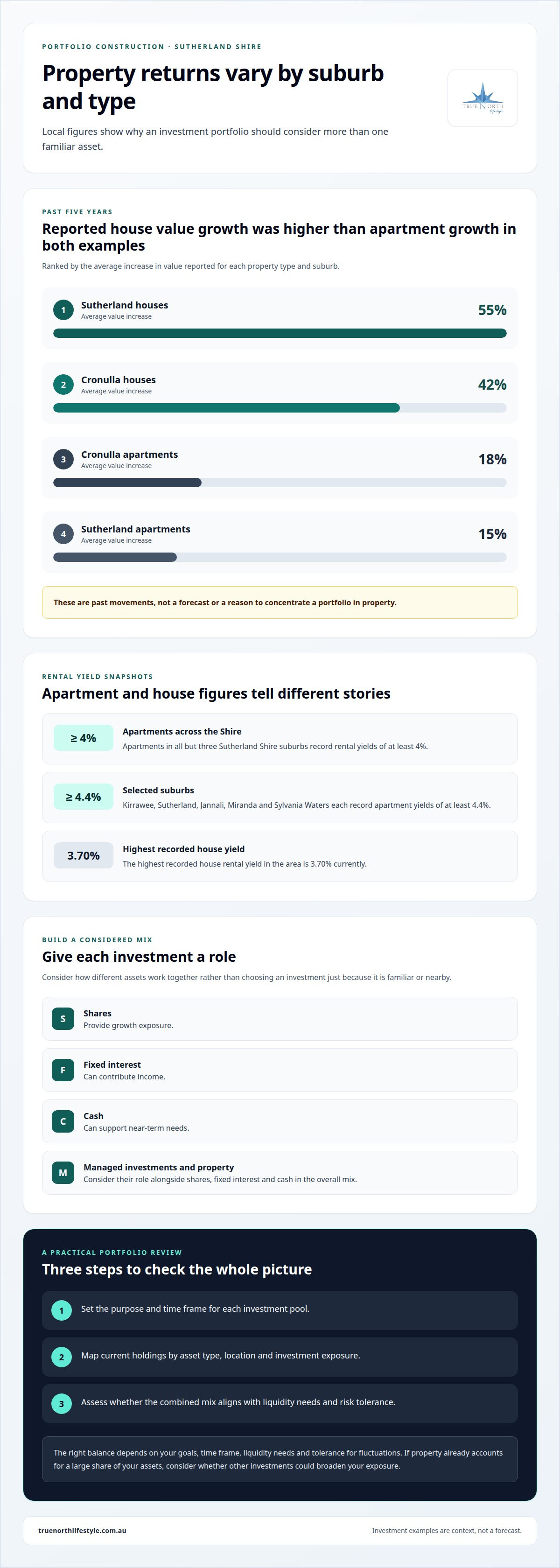
Options include shares, fixed-interest investments, cash, managed investments and property. Each can play a different role: shares provide growth exposure, fixed interest can contribute income, and cash can support near-term needs. Consider how these roles fit together instead of choosing an investment just because it is familiar or nearby.
Local property figures illustrate why comparing asset types matters. Apartments in all but three Sutherland Shire suburbs return rental yields of at least 4%. Kirrawee, Sutherland, Jannali, Miranda and Sylvania Waters each record yields of at least 4.4%. The highest recorded house rental yield in the area is 3.70% currently.
Past price movements also differ by property type and suburb. Over the past five years, Cronulla houses increased in value by an average of 42%, compared with 18% for apartments. In Sutherland, houses grew by 55%, while apartments grew by 15% over the past five years. These examples show variation, not a forecast or a reason to concentrate a portfolio in property.
A practical portfolio review can follow three steps:
- Set the purpose and time frame for each investment pool.
- Map current holdings by asset type, location and investment exposure.
- Assess whether the combined mix aligns with liquidity needs and risk tolerance.
A coordinated view makes trade-offs easier to see. If property already accounts for a large share of your assets, consider whether other investments could broaden your exposure. Bespoke portfolio construction can bring your holdings into a considered strategy, supported by risk management and portfolio sustainability modelling.
Investment accounts outside super
Investments outside super can provide a separate pool of assets for goals that don’t fit neatly within retirement savings. You might use them for a future home renovation, to support a family member, or to build wealth you can access before retirement. Choose the account type and investments with the timing of your needs in mind.
Choosing an account for its purpose
A cash account can hold money for near-term spending, while a share-trading account provides access to listed investments, with multi-asset platforms such as TradingPRO offering dedicated infrastructure for different investment styles. Managed investments offer another way to hold a portfolio of assets through a single investment vehicle. Since these options differ in how investments are held, accessed and administered, match the account to its intended purpose.
Money set aside for a planned expense may need ready access and less exposure to market movements. Funds for a longer-term goal may be suited to a broader investment mix. Separating these purposes helps you distinguish assets available to spend from those intended to remain invested.
Ownership and access
Accounts may be held individually or jointly, or through a company or trust. Ownership affects who controls an account and makes decisions. It can also have tax and estate-planning implications, so consider the intended owners and beneficiaries alongside the investments.
Access matters too. Investments outside super are subject to different conditions and administration. For example, a couple saving towards a shared goal may need to consider how contributions, control and withdrawals will work for both owners. Clear records of ownership and purpose help keep the plan understandable.
Before opening or reorganising an account, map each investment pool to its intended use:
- Identify the goal and likely timing for using the funds.
- Record the account’s owners and who will make investment decisions.
- Consider how quickly assets can be accessed and what happens when they’re sold.
- Review how the account fits alongside super and other investments.
This process helps distinguish accessible investments from retirement savings without treating them as unrelated plans. If ownership, family goals and future access need to be considered together, an integrated investment approach can help bring those decisions into focus.
Building a duplex to sell can have GST and income tax consequences. Owners should consult an accountant before choosing a structure.
Tax-effective investment structures
Ownership can influence how investment income, gains and records are handled. In Australia, investments held individually, jointly, through a trust or by a company involve different administrative and tax considerations. Choose a structure based on the investment’s purpose and owners, not solely on a perceived tax advantage.
Begin with who is involved and how the assets will be used. An individual account may suit someone managing their own holdings. Joint ownership can reflect a shared investment, while a trust or company creates a separate ownership arrangement. Each option affects control and how income and decisions are managed.
Tax outcomes depend on the asset, its ownership and what happens during the investment period. Rental income from an investment property, distributions from an investment fund and proceeds from selling shares are different events to record and consider. Keep clear records of ownership, income, costs and transactions so these details are easier to review.
Match structure to purpose
A structure needs to work beyond the initial investment decision. Consider whether owners may need income, expect to transfer assets or want investments to support family plans. A structure that adds administration may not suit a straightforward goal. Focus on how ownership, control and future use fit together.
Tax effectiveness also involves timing. Selling an asset, changing ownership or receiving income can affect your overall position. Before making a change, identify the likely transaction and its purpose. Selling shares to rebalance a portfolio, for example, differs from holding them for income, so the reason and records matter.
Use a structured review to connect investment decisions with tax and ownership considerations:
- List each asset, its owner and the account or structure holding it.
- Record the income it produces, such as dividends, distributions or rental income.
- Identify planned purchases, sales or ownership changes.
- Consider how the structure relates to family arrangements and estate planning.
Review the whole picture, not just one tax outcome. A choice that suits one asset may complicate another, particularly when owners have different goals or assets are intended for future beneficiaries. Estate planning can help clarify how investments fit into longer-term arrangements.
For a considered review of investment ownership and future planning, discuss tax-effective investment structures.
Tax outcomes depend on the asset, its owner and what happens during the investment period. Record dividends and other investment income, as well as ownership, costs and sale transactions. Income and capital gains may need to be considered differently.
True North Lifestyle: Bespoke portfolio construction
True North Lifestyle helps structure investments around your goals, time frame and comfort with risk. Its bespoke portfolio construction considers how investments fit together, while risk management and portfolio sustainability modelling support decisions about the portfolio’s resilience.
If you’re planning for retirement, retirement modelling and long-term projections can connect investment decisions with future income needs. Tax-minimisation strategies and superannuation review and optimisation can also help inform how your investments inside and outside super work together. The plan is tailored to your circumstances, not based on a standard allocation.
To discuss your investment approach, contact True North Lifestyle.
Shape the next stage of your investment plan
Your investment approach should support the life you want. As work, family priorities and retirement plans change, revisit the purpose of your investments and whether your arrangements still fit. A considered approach to investment portfolio construction in the Sutherland Shire gives these decisions clearer direction, without treating each asset in isolation.
True North Lifestyle can connect investment decisions with retirement modelling and long-term projections, tax-minimisation strategies, and superannuation review and optimisation. This advice can help when you’re preparing for retirement, reassessing your investments or bringing financial priorities into alignment.
Start with the questions that matter most to you: what should your investments help make possible, and what would you like greater clarity about? Contact True North Lifestyle to discuss a considered next step. A clear plan can help you move forward with purpose and confidence.
Frequently Asked Questions
What does investment portfolio construction involve for Australian investors?
Investment portfolio construction turns your financial objectives into an organised plan. First, identify what each pool of money is for, then set an approach for selecting, holding and reviewing assets. For a Miranda household, that might mean separating funds for a future renovation from investments intended to support retirement. Include existing assets and consider how investment decisions work together.
How should investors in Australia choose an asset allocation based on goals, time horizon and risk tolerance?
Match each goal to when you expect to use the money. A near-term goal may call for greater emphasis on stability and access, while a longer-term goal may allow more exposure to assets that fluctuate. Consider both your comfort with market changes and your ability to absorb losses without disrupting essential plans. Compare possible allocations with these needs before settling on a mix.
How do property, shares, bonds and cash compare for a diversified Australian portfolio?
These investments provide different exposures. Property can require substantial capital and take time to sell; shares represent ownership in companies and can fluctuate in value. Bonds provide exposure to debt securities, while cash offers ready access but may not play the same growth role as other assets. If you already rely on a single property, consider whether other asset types could broaden your exposure.
How can investors build and rebalance a diversified portfolio step by step?
Record each goal, its time frame and the money already assigned to it. Then choose an intended mix of asset types and select investments within that framework, checking for overlapping exposures. Keep a record of your target allocation. Review holdings against it periodically and after major life changes. If the mix no longer reflects your plan, rebalance by directing new contributions or adjusting holdings.


