

Staying under 183 days doesn’t automatically keep you outside Australia’s tax-residency rules. If you resume living here, the resides test may make you an Australian tax resident from your arrival date, even if fewer than 183 days remain in the Australian financial year. That’s an important consideration in retirement planning for expats returning to Australia in Miranda.
It’s natural to focus on your arrival date, but your Australian tax residency status is only part of the picture. This guide explains how residency can affect tax on worldwide income, what to consider before moving overseas retirement savings into Australian super, and how foreign assets and currency movements may shape your retirement plan.
You’ll also see how to bring these decisions together, from assessing super and investment options to building a clearer view of your long-term income. The aim is a more considered return, with the key financial questions organised before they become harder to untangle.
Key Takeaways
- Before moving overseas retirement savings, weigh the available options, transfer timing and Australian super contribution caps, including whether unused caps may be carried forward.
- Review how exchange-rate movements could affect the value of foreign assets and the tax outcomes when you return.
- Reassess offshore investments and income in light of Australian tax treatment, and consider whether retaining each asset still suits your plans.
- Factor residency history into retirement income planning: Services Australia says Age Pension eligibility generally requires at least 10 years of Australian residence in total, including at least 5 years without a break.
1. How is a foreign superannuation fund transfer taxed in Australia?
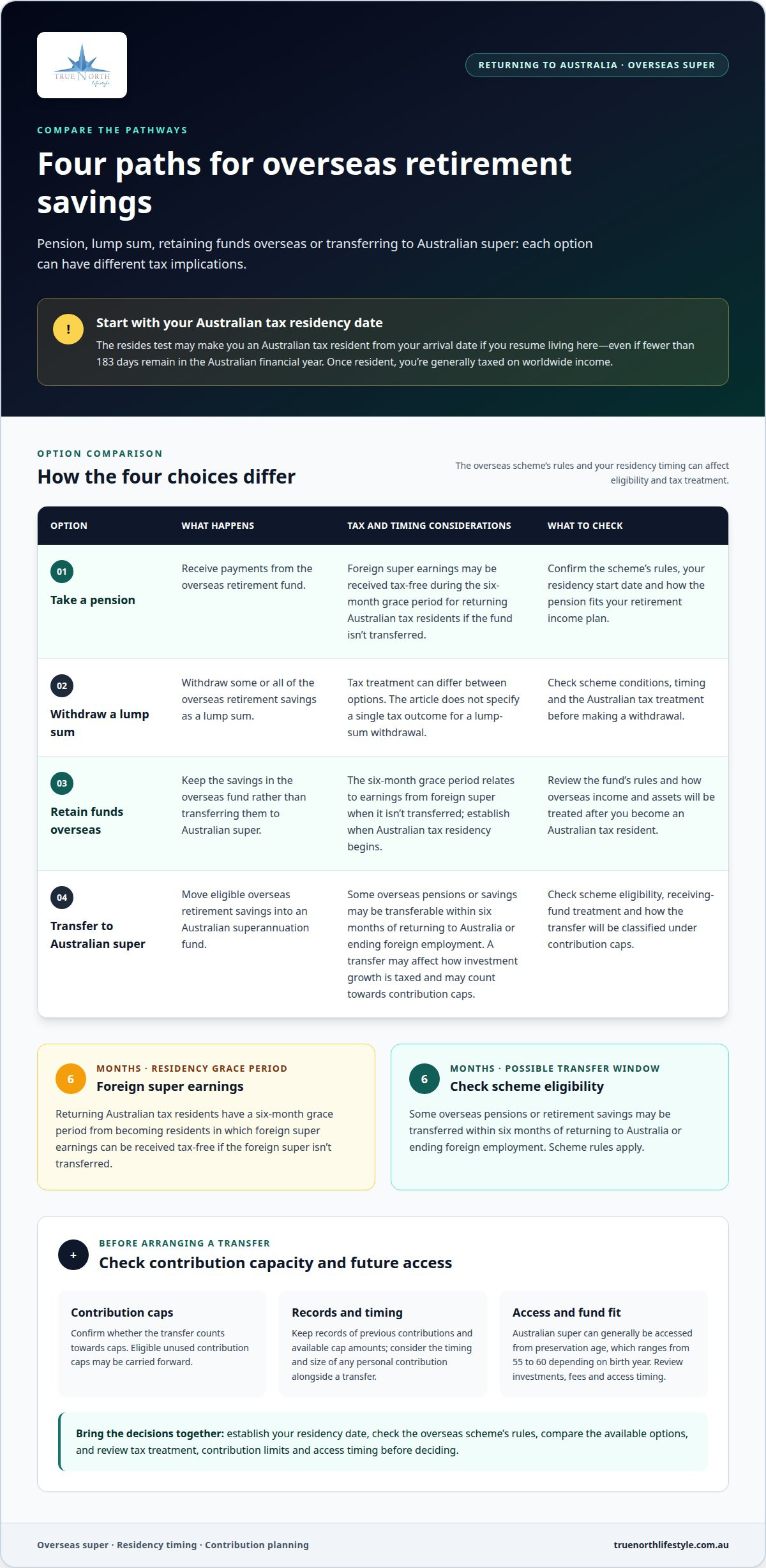
Start by reviewing the overseas fund’s rules and establishing your Australian tax residency date. Some overseas pensions or retirement savings may be transferred to an Australian superannuation fund within six months of returning to Australia or ending foreign employment. Compare taking a pension, withdrawing a lump sum, retaining the funds overseas or transferring them. Each option can have different tax implications.
Timing matters. Returning Australian tax residents have a six-month grace period from becoming Australian residents in which earnings from foreign super can be received tax-free if the foreign super isn’t transferred. A transfer may affect how investment growth is taxed, so establish when your residency begins and how the receiving fund treats the amount. Eligibility and tax treatment can also depend on the overseas scheme’s rules.
Australian contribution limits matter too. A transfer may count towards contribution caps, so confirm how the amount will be classified before arranging payment. Returning residents may be able to carry forward unused superannuation contribution caps, creating room for eligible contributions. Keep records of previous contributions and available cap amounts, then consider the timing and size of any personal contribution alongside a transfer.
Access comes with conditions. Australian super can generally be accessed from preservation age, which ranges from 55 to 60 years depending on birth year. A superannuation review can help assess investment options, fees, access timing and whether the fund supports your retirement income plan. Also review your will, powers of attorney and super beneficiary nominations; super benefits don’t automatically follow the terms of a will.
Returning Australians can access Medicare after moving back and enrolling. After five years overseas, re-enrolment requires proof of an intention to stay. Centrelink payments, including the Age Pension, have separate eligibility rules, so Medicare access doesn’t itself establish entitlement to income support.
For retirement planning for expats returning to Australia in Miranda, map the transfer, contribution capacity and access plan together. True North Lifestyle’s retirement modelling and superannuation advice can help coordinate decisions about overseas pensions, Australian super and estate planning.
2. Currency exposure and managing foreign assets
Returning Australians may have financial connections to more than one tax regime and currency. An overseas pension paid in a foreign currency, for example, must fund expenses largely paid in Australian dollars. Even if the pension amount stays unchanged in its original currency, its Australian-dollar value can shift with exchange rates, changing the spending power available for your lifestyle.
Plan the movement of money, not just its destination. List which assets, income and expenses will remain abroad, then identify when each transfer is needed in Australia. Converting a large balance at once locks in the prevailing exchange rate for that transfer. Staggering transfers may spread the timing, but it doesn’t remove currency risk. Compare the amount you’ll receive in Australian dollars after exchange costs before choosing a transfer method.
Foreign currency movements can have Australian tax consequences for returning expats. Keep clear records of the original transaction, the dates funds move and their Australian-dollar values. This helps you understand how currency changes affect the reported value of an asset or transaction. Foreign investments may also have tax consequences when income is received or an asset is sold, so consider these events alongside conversion timing.
Banking arrangements matter. Map which account receives each overseas payment, which account pays Australian expenses and whether you need to hold funds in more than one currency. Review account access and transfer processes before relocating, especially if you’ll still have obligations abroad. Inflation adds another planning layer: compare expected income with the future cost of Australian living expenses, rather than relying only on today’s converted balance.
A practical review brings currency, capital needs, tax considerations and investment timeframes into one picture. It can help clarify which assets should support near-term spending and which remain invested for longer-term goals. If overseas assets also shape how wealth may pass to family, an estate planning strategy can form part of the wider plan.
3. How does the ATO resides test affect a returning expat?
The 183-day test counts days physically spent in Australia, but the resides test can apply first. If you resume living here, you may be treated as an Australian tax resident from your arrival date, even when fewer than 183 days remain in the Australian financial year. Once resident, you’re generally taxed on worldwide income, not only income earned in Australia.
Residency changes how offshore assets are considered. Most overseas assets, other than taxable Australian property, are treated as acquired at market value when you become an Australian resident again. Retain valuations from your first day back; they can establish the cost base for calculating a later capital gain. The 50% capital gains tax discount on foreign assets applies only for periods you were an Australian tax resident.
Age Pension residency is a separate question. Services Australia says eligibility generally requires at least 10 years of Australian residence in total, including at least 5 years without a break. Time spent abroad can therefore affect when you meet the residence requirement, even after tax residency resumes.
Overseas bank accounts, property, pensions and investments can bring tax reporting and currency exposure into your Australian plan. Foreign rental income or asset sales may have Australian tax implications after your return. Review each holding’s ownership, income, value and intended role before deciding whether to retain it, sell it or consolidate investments.
Australian investment income also depends on residency status. Non-residents are generally taxed on Australian-source income, such as rent, rather than foreign income. Interest and unfranked dividends from Australian investments may face withholding tax of up to 30 per cent, with the rate varying by tax treaty.
If you’re a returning US expat, list US accounts, pension interests and investments separately from Australian holdings. Assess each asset’s income, tax treatment and fit with your overall portfolio before consolidating. This helps keep the transition focused on preserving wealth and aligning investments with your Australian retirement plans.
4. Financial planning when returning to Australia
Start planning six to 12 months before relocating, while you can still organise overseas accounts, income and investments. Beyond the paperwork, coordinating practical departure travel—such as arranging airport transfers with executive transport providers like JAMALimo for those returning from Canadian regions—ensures the physical move runs smoothly. Build one cash-flow picture covering Australian living costs, foreign income, superannuation and assets you may keep abroad. This helps connect tax decisions with the retirement lifestyle you expect, rather than treating each account separately.
Tax coordination matters across borders. Australia has double taxation agreements with over 40 countries. Depending on the agreement and income type, tie-breaker rules may allocate taxing rights to one country, or a foreign income tax offset may apply in Australia. Include the country, income source and tax already paid in your planning records, then coordinate financial advice with tax advice.
Property and investment decisions need the same joined-up view. Before selling an overseas asset or exchanging funds, consider the timing, its Australian-dollar value and possible capital gains tax implications. A sale, transfer or change in residency can affect more than cash flow, so map each decision against your other income and planned spending.
Age Pension eligibility also depends on residence history. Services Australia says it generally requires at least 10 years of Australian residence in total, including at least 5 years without a break. Returning to Australia doesn’t by itself establish eligibility; include prior residence and time abroad in your income planning.
Miranda and nearby Sutherland Shire suburbs follow the same Australian tax and superannuation framework. Your suburb doesn’t change the rules; relevant factors include your residency history, assets, income, retirement timing and expected spending. A financial plan should reflect your circumstances, not assume a different tax outcome based on postcode.
Bring your expected income, assets, debts and retirement timeframe into a single projection. This can show how an exchange-rate shift, asset sale or change in spending affects the plan, and where capital may need to last longer. Arrange retirement modelling and long-term projections to develop a structured view of your return.
True North Lifestyle: Retirement modelling & long-term projections
True North Lifestyle can bring your return-to-Australia decisions together in a structured retirement plan. Its retirement modelling and long-term projections help assess how Australian and overseas income, superannuation, assets and expected spending fit together over time.
Consider advice when weighing a foreign pension, reviewing your Australian super or deciding how overseas investments fit your future. True North Lifestyle’s tax-minimisation strategies, superannuation review and optimisation, and bespoke portfolio construction can help shape a plan around your circumstances and retirement priorities.
A clear projection lets you examine how changes in income, investment returns or spending could affect your longer-term position. Contact True North Lifestyle to discuss retirement planning in Miranda and book a consultation.
Turn your return plans into a clear direction
Returning to Australia is an opportunity to shape your finances around the life you want next. A useful plan isn’t simply a record of past decisions; it gives you a framework for making future choices as your priorities, income and circumstances change. For retirement planning for expats returning to Australia in Miranda, that means connecting financial decisions with the retirement you want to build.
True North Lifestyle can help bring that structure into focus through retirement modelling and long-term projections, tax-minimisation strategies, and superannuation review and optimisation. The aim is to give you a considered basis for decisions, with your goals and financial position at the centre.
If you’re ready to shape your next steps, contact True North Lifestyle to discuss your retirement planning. A clearer plan can make the move ahead feel more manageable.
Frequently Asked Questions
Does staying under 183 days prevent me from being taxed as a resident when I return?
No. The 183-day test isn’t the only way Australian tax residency is assessed. If you re-establish your life in Australia, the resides test may apply even when you spend fewer than 183 days here during the financial year. Your arrival date, accommodation, work arrangements and personal connections can help clarify when your circumstances changed and Australian tax treatment began.
How do double taxation agreements protect returning Australian citizens?
Tax treaties can help prevent the same income being taxed twice, but citizenship alone doesn’t determine which country has taxing rights. The relevant agreement may use tie-breaker rules to allocate those rights or allow a foreign income tax offset in Australia. The outcome depends on the agreement, your residence status and the income involved. Keep records of foreign tax paid and the income it relates to.
How does the ATO resides test affect a returning expat?
The test considers whether Australia has again become your home in practice, rather than relying only on your day count. Your usual accommodation, family arrangements, work and everyday living pattern can all help establish the relevant date. Once you’re an Australian tax resident, worldwide income may be taxable here, so timing can affect foreign income received around your move.
How is a foreign superannuation fund transfer taxed in Australia?
Tax treatment depends partly on the transfer’s timing, your residency date and the overseas fund’s structure. Some overseas pensions or retirement savings may be transferred to an Australian super fund within six months of returning or ending foreign employment. Before moving funds, gather statements showing balances and earnings, then consider whether a transfer, pension payment, lump sum or continued overseas holding best fits your circumstances.
Not sure where to start?
Begin with a clear snapshot of your move: expected return date, income sources, super accounts, foreign investments and planned spending. This helps identify which decisions are time-sensitive and which can wait. For retirement planning for expats returning to Australia in Miranda, True North Lifestyle can use retirement modelling and long-term projections to organise those decisions into a considered plan.
What should you consider in your retirement planning?
Consider how your income and assets will support the retirement you want, including spending needs, access to funds, investment risks and family responsibilities. Alongside financial planning, safeguarding assets and mitigating unexpected liabilities often involves working with an advisory firm such as Putney Insurance Group to evaluate suitable risk cover. Test different scenarios, such as a change in work plans, unexpected costs or a shift in investment income. Reviewing these factors together can show where your plan has flexibility and where decisions need closer attention.


