

VFX artists don’t have to stop creating to start planning for retirement. Retirement planning for VFX artists in Miranda can bring superannuation, personal savings and changing project income into one practical strategy, rather than relying on a traditional employer pathway.
Saving can feel difficult when work is contract-based or income varies. A plan can still take shape over time by matching contributions and saving habits to the realities of freelance and studio work.
This article explains how self-employed artists can approach superannuation and retirement saving in Australia, make contributions more manageable and build habits that last. It also shows how long-term projections can bring changing income, savings and retirement goals into a clearer plan.
Key Takeaways
- Build retirement saving around the rhythm of freelance income, so quieter project periods are part of the plan rather than a surprise.
- Make contributions manageable by considering what your cash flow can support and how saving can continue through changing workloads.
- Use a repeatable saving habit to help turn irregular income into a more consistent long-term approach.
- Plan beyond today’s balance: according to the Australian Bureau of Statistics, the share of Australians aged 65 or over is projected to reach around 21-23 per cent by 2066.
Pensions for self-employed artists
Retirement can take different forms for artists; it needn’t mean stopping creative work altogether. In Australia, superannuation is a key way to build retirement savings, while “pension” can also describe income received after work winds down. These terms refer to different parts of a longer financial picture.
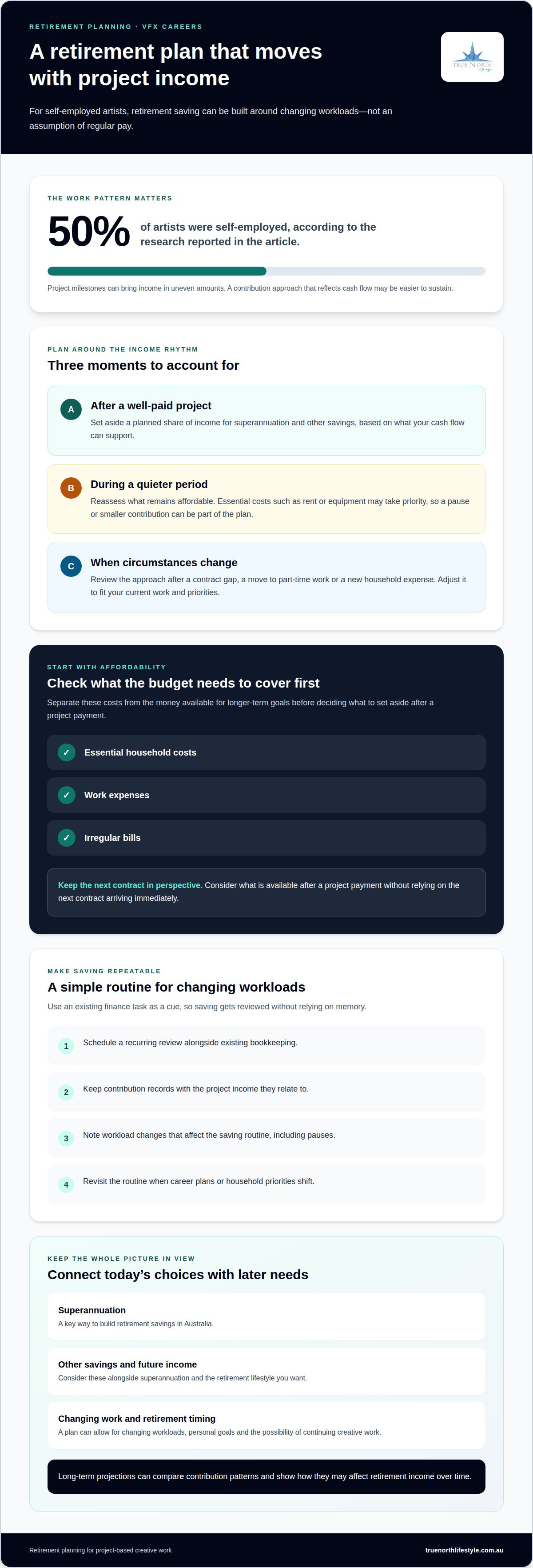
Self-employed artists need to make retirement saving part of their own income planning. The research reports that 50% of artists were self-employed, so planning around non-standard work is relevant across the sector. For a VFX freelancer, income may arrive around project milestones rather than in even, regular amounts. A contribution approach that reflects cash flow can make saving easier to sustain.
Think in stages. During a well-paid project, an artist might set aside a planned share of income for superannuation and other savings. In a quieter period, they can reassess what remains affordable without treating a missed contribution as a reason to abandon the plan. The aim is a structure that can adapt as workloads change.
Work arrangements can also vary. Australia has more work-from-home options and flexible hours than before, while a studio role may offer a different balance. For example, FIN VFX advertises a full-time hybrid Senior FX Artist role in Sydney, with some work-from-home days. Freelance and employed work can therefore create different patterns of income and saving.
For retirement planning for VFX artists in Miranda, consider how superannuation fits alongside other savings and future income needs. Artists in Australia have very few rules governing when they can retire, so the timing can reflect personal goals and work preferences. A useful plan connects contributions with project income, expected retirement lifestyle and the possibility of continuing creative work. That gives each decision a purpose, rather than leaving retirement savings to whatever happens to remain.
Affordability of retirement saving
Irregular freelance income can make contributions uneven, and career gaps may reduce what’s available for superannuation and other savings. A VFX artist between contracts, for example, may need to pause or reduce voluntary saving while covering essential expenses.
Start with affordability, not an idealised contribution target. Separate essential household costs, work expenses and irregular bills from money available for longer-term goals. Then consider what you can set aside after a project payment without relying on the next contract arriving immediately. This keeps retirement saving grounded in your actual cash flow.
For example, an artist could plan a contribution after receiving a project payment, then review the amount when income changes. In a quieter period, rent, equipment or other essential costs may take priority. A stronger period could make room to resume saving. The key is whether the pattern remains workable across changing workloads.
Some people in Australia’s arts sector have limited capacity to plan for a comfortable retirement. Flexibility matters: a fixed contribution that strains the budget may be harder to sustain than an adjustable approach. Income gaps also leave savings less time to grow, so extended breaks can affect long-term projections even if contributions resume later.
Saving decisions sit alongside tax, debt, household needs and likely future work. A projection can compare different contribution patterns and show how each may affect retirement income over time. It can also help distinguish a temporary pause from a longer-term shortfall. Retirement cash-flow projections can bring those moving parts into one view, supporting decisions based on both current affordability and future priorities.
For a self-employed artist, review the plan after a major change, such as a contract gap, a move to part-time work or a new household expense. Adjusting as circumstances change can make retirement saving more sustainable than treating every month as financially identical.
Artists’ pension-saving habits
A durable saving habit needs a reliable cue, not constant attention. For an independent VFX artist, that cue might be a regular finance review after closing project accounts. It gives superannuation and retirement savings a place in the working routine alongside invoices, tax records and equipment costs.
Make the routine easy to repeat. A simple record can show when contributions were made, which income period they relate to and whether the pattern changed. For example, a compositor could note a contribution after a completed project, then record a pause during a gap. This helps distinguish a planned adjustment from a habit that has quietly fallen away.
Useful prompts might include:
- Schedule a recurring review alongside existing bookkeeping.
- Keep contribution records with the relevant project income.
- Note changes in workload that affect the saving routine.
- Revisit the routine when career plans or household priorities shift.
These practices make future planning conversations more concrete. A financial planner can use your contribution history and changing work pattern to assess how your current approach fits your longer-term goals. The record also helps you see which routines are sustainable, rather than relying on memory or assumptions.
Creative careers can evolve in unexpected ways. A VFX artist might move from production work into supervision, teaching or occasional freelance projects. Each change can affect when income arrives and how retirement saving fits alongside other priorities. Reviewing your saving habits when your work changes keeps the plan connected to your actual career, not an outdated routine.
Superannuation and retirement strategy
A retirement strategy connects superannuation, other income and investment decisions with the life an artist wants later. For VFX professionals, it should also account for changing work patterns and retirement timing.
Retirement income choices
Retirement income choices combine government support with savings drawn from superannuation. The Age Pension may support eligible retirees, while an account-based pension provides income from super savings. The right mix matters because savings, income needs and eligibility affect how much each source can contribute. According to the Australian Bureau of Statistics, the share of Australians aged 65 or over is projected to reach around 21-23 per cent by 2066. This makes a considered plan for later-life income relevant to today’s artists.
Planning options in Miranda
For VFX artists in Miranda, NSW, planning can include reviewing superannuation, mapping retirement income and considering how investments may support future needs. A planner can model different retirement dates and income patterns, including a transition from full-time projects to fewer creative engagements. Artists may choose to keep working, change their workload or stop paid work at different times. A strategy can bring those choices together with savings and expected expenses.
Consolidating super and reducing fees
Super consolidation combines accounts, where appropriate, to make savings easier to oversee. Before recommending consolidation, a financial planner can review account balances, investment options, fees and insurance. Comparing these details can reveal duplicate costs and clarify the implications of keeping accounts separate. Pay particular attention to insurance: closing an account may affect cover attached to it. Reviewing that cover before a transfer can help avoid an unintended gap while simplifying retirement savings.
Investment and insurance risks
Investment risk is the possibility that market movements affect super balances and future income. VFX artists should consider how a downturn, concentrated investments or withdrawals during weaker markets could affect their retirement plans. Insurance is another consideration, especially if cover is linked to super. Reviewing investment mix, income needs and existing protection together helps ensure that a decision about one account is considered in the context of the wider strategy.
Discuss your super and retirement strategy to bring income choices, account structure and investment risks into one considered plan.
True North Lifestyle: Retirement modelling & long-term projections
True North Lifestyle helps VFX artists in Miranda connect changing project income, superannuation and retirement goals in a structured long-term plan. Retirement modelling compares different work and saving patterns, helping clarify how today’s choices may shape future income.
A superannuation review can assess whether your current arrangements fit your goals, while tax-minimisation strategies and bespoke portfolio construction can support the wider plan. This can help when freelance income shifts, you’re considering a change in workload or you want to bring separate retirement decisions into one view.
Share your priorities and financial details with a planner to build a clearer picture of your options. Contact True North Lifestyle in Miranda to discuss retirement modelling and long-term projections.
Give your next chapter a clear direction
Your creative career can change shape over time. A useful next step is to connect the later life you want with decisions you can revisit as your work evolves. For retirement planning for VFX artists in Miranda, treat your future as part of your career design, not a separate concern to put off until projects slow down.
A planning conversation can turn broad intentions into a considered direction, with advice shaped around your circumstances and priorities. True North Lifestyle can bring retirement modelling and long-term projections together with a superannuation review and tax-minimisation strategies, so decisions are considered in context rather than isolation.
You don’t need every detail settled before starting. Begin with the question that matters most to you, whether that’s when to reduce your workload or how you want creative work to fit later in life. Contact True North Lifestyle to discuss your plans and take a thoughtful step towards the future you want.
Frequently Asked Questions
Artists and retirement: do artists ever retire?
Yes, artists can retire, but retirement doesn’t have to mean ending creative work. An artist might take on fewer paid projects, move into mentoring or keep creating without relying on regular studio income. In Australia, working artists have considerable choice about when to retire. The practical question is how to fund that change, including how savings and other income can support a different working pattern.
Should I set up a Self-Managed Super Fund (SMSF)?
An SMSF may suit people who want direct control and are prepared to manage its responsibilities, but it isn’t automatically better than an existing super fund. Combined super balances above A$500,000 may make an SMSF viable; below A$300,000, it may not make sense. Consider administration, audit, investment decisions and insurance arrangements alongside control before choosing this structure.
When should I start seeing a financial planner?
Consider advice when a decision could materially change your retirement path, such as receiving a large project payment, changing to freelance work or planning to reduce hours. Turning 50, often 10 to 15 years before retirement, is a common trigger for seeking advice. Earlier planning can also help clarify how current savings and work choices relate to your preferred retirement timing.
What is the current Australian superannuation guarantee rate and how does it apply to VFX employees?
The superannuation guarantee is an employer contribution calculated as a percentage of eligible employees’ ordinary time earnings. It is paid through payroll when the working arrangement meets the relevant employment criteria. For a VFX artist, the key distinction is the actual work relationship, not simply whether a contract calls the role freelance. Project-based employees and independent contractors can have different contribution arrangements.
How does superannuation work for freelance or contract VFX artists in Australia?
Freelancers and contractors can build retirement savings through super contributions they arrange themselves. A contract label alone doesn’t determine every super obligation; the nature of the working relationship matters. For example, a VFX artist working through a company may have different arrangements from someone engaged directly for their labour. Reviewing income structure and existing super can clarify how contributions fit the artist’s circumstances.
How much super should an Australian VFX artist aim to have at retirement?
There isn’t one suitable super balance for every VFX artist. The amount depends on expected retirement spending, other income, housing costs, when paid work ends and whether creative work continues. An artist planning part-time projects, for example, may draw on savings differently from someone who plans to stop work completely. A retirement projection can translate those preferences into a personal income goal.


