

Your retirement date isn’t fixed by your job title. In Australia, there’s no official average retirement age, and you can keep working for as long as you like and are able. For UI designers in Miranda, retirement planning means weighing when you want to finish work against your super, savings and expected lifestyle.
It’s understandable to want a clear answer to two practical questions: when can you retire, and how much might you need? Super access is tied to preservation age, which ranges from 55 to 60 depending on your birth year. The right retirement date and savings target depend on how you plan to live and the income available to support that life.
This article explains how super, investments, Age Pension eligibility and tax coordination can shape your retirement options. It also shows how a retirement budget brings projected spending and income together, helping you compare scenarios and make informed plans.
Key Takeaways
- Understand how preservation age and pension options can influence when you draw on super and how you receive retirement income.
- See how an investment portfolio can balance growth needs with the risks of relying on savings over a long retirement.
- Learn why Age Pension eligibility and tax considerations belong in the same retirement plan as super and investments.
- Discover how a tailored retirement budget and long-term projections can help connect your preferred lifestyle with a practical plan.
Superannuation contributions and pension transition
Retirement planning for UI designers in Miranda brings together superannuation, work choices and the timing of income withdrawals. A useful plan shows how each decision may affect your assets and future income.
Moving from super to pension income
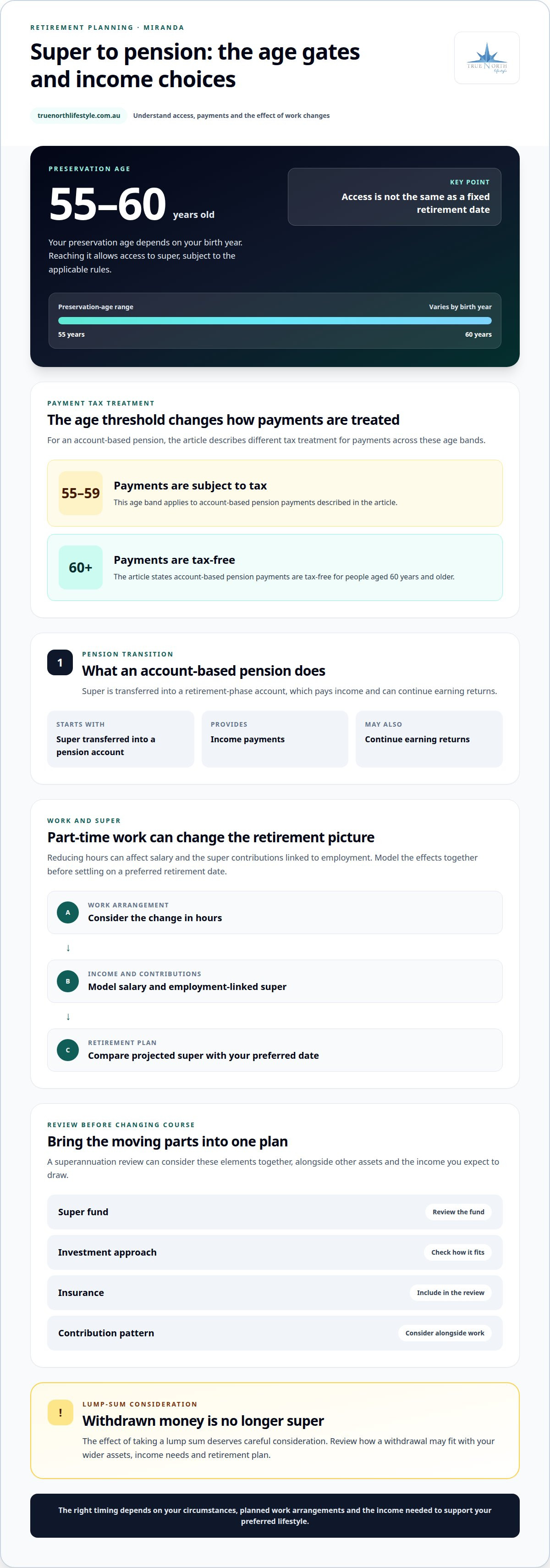
Super access depends on preservation age, which ranges from 55 to 60 years old according to birth year. Reaching preservation age allows access to super, subject to the applicable rules. An account-based pension transfers super into a retirement-phase account, pays income and can continue earning returns. Payments are subject to tax for people aged 55 to 59 years old, while payments are tax-free for people aged 60 years and older. Money withdrawn from a super fund is no longer super, so the effect of taking a lump sum deserves careful consideration.
Part-time work and full-time super
Reducing work hours can affect your salary and the superannuation contributions linked to employment. Federation University Australia advises staff approaching retirement to consider how changes to work arrangements may affect their salary and future superannuation payout. For example, a UI designer moving to part-time work can model the income change alongside projected super and compare the results with a preferred retirement date. This helps show whether the transition supports the overall plan.
Super reviews and contribution choices
A superannuation review can consider your fund, investment approach, insurance and contribution pattern together. These decisions affect how super fits with your other assets and the income you expect to draw. Contributions after retirement may be a tax-effective way to grow retirement savings, but their role depends on your circumstances and wider plan. Reviewing these elements before changing work or starting pension payments can clarify how each choice affects the next stage.
Seeking financial and superannuation advice
Federation University Australia advises staff planning retirement to seek advice from a financial adviser and their superannuation fund about the options suited to their circumstances. Advice can bring work changes, access to super and pension choices into one financial planning process. A super and pension age calculator can also help identify when super may be accessible and when Age Pension eligibility may arise.
Portfolio construction and investment risk
A retirement portfolio needs to support both future growth and income withdrawals. Its structure should reflect your time horizon, other assets and preferred lifestyle.
Diversified investment portfolios
Diversification spreads investments across different asset types, so your retirement plan does not depend on one holding or market segment. A portfolio review considers how each investment contributes to growth, income or stability. For example, a designer with super and investments outside super can assess them together instead of treating each account in isolation. The investment mix should reflect the purpose and timing of the money.
Retirement investment reviews
Investment reviews assess whether your portfolio still fits your retirement objectives as your work, income needs and circumstances change. They can examine asset allocation, concentration and the role of each holding. Loss aversion can also influence decisions: after a market fall, an investor might sell to avoid further discomfort. A structured review helps separate an emotional reaction from a genuine change in the plan’s needs.
Investment earnings in retirement
Investments may continue earning returns during retirement, while withdrawals provide money for living costs. Your portfolio therefore needs to balance income needs with the potential for longer-term growth. For instance, a plan can separate money intended for near-term spending from assets held for later years. The right structure depends on expected expenses, other income and your tolerance for investment fluctuations.
For a UI designer approaching retirement, professional modelling can show how different portfolio strategies may interact with planned spending and income withdrawals. A review can also identify whether a shift to part-time work changes the timing or purpose of particular assets. To explore how your portfolio could align with your retirement goals, consider a retirement portfolio review.
Age Pension eligibility and planning
Age Pension planning is part of your retirement income picture, not a substitute for reviewing your other wealth. A super and pension age calculator can help estimate when you might receive the Age Pension. A retirement projection can then show that estimate alongside income from super and investments, illustrating how these sources may work together.
Eligibility depends on personal circumstances, including age, income and assets. These details can change, so a single estimate may not represent your position throughout retirement. For example, a change in investment income or the assets you hold could affect an estimate. A financial plan can model these moving parts alongside your intended retirement date and spending needs.
It is easy to assume the Age Pension will either cover everything or contribute nothing. Planning is more useful when it tests a range of possibilities. One scenario might include a period without pension income; another could include an estimated payment alongside super withdrawals. Comparing the outcomes helps clarify how much other income may be needed to support your preferred lifestyle.
For UI designers in Miranda, retirement planning can connect pension estimates with decisions about work, savings and withdrawals. A financial adviser can assess how projected income and assets relate to potential eligibility, then show how different retirement dates may change the overall picture. This keeps pension planning connected to your wider financial plan instead of treating it as a separate calculation.
Good planning allows for change. As your circumstances shift, revisit projections to assess whether your income sources still support planned spending. This can help you make measured decisions about drawing on your wealth rather than relying on assumptions about future pension income. Financial advice is most useful when it explains the assumptions behind each scenario and how they shape the result.
Professional support with creating a retirement budget
A retirement budget compares projected living costs with income from superannuation and investments. A financial planner can organise these figures into a practical view of what your preferred lifestyle may require. For a UI designer in Miranda, the model can include everyday spending, housing, travel and planned larger expenses. It can also show how the picture changes if you finish work earlier than expected.
Start with the lifestyle you want, not an assumed savings target. A budget can separate regular costs from occasional spending, then match each category against expected income. For example, a plan might compare the cost of staying in Miranda with the costs and daily routines of living elsewhere. That choice can affect transport, housing and the income you need each year.
Retirement modelling brings income and spending assumptions together. An adviser can consider super, investment income and potential Age Pension income, then illustrate how different retirement dates affect the balance. A scenario involving part-time work can be compared with one where employment stops completely. This makes the trade-offs visible without treating any projection as a fixed outcome.
Tax coordination matters when a budget draws income from different sources. The timing and structure of withdrawals can affect how much is available for planned spending, so the model should consider them alongside investments and super. A useful review connects these decisions instead of assessing each asset separately. It can also revisit assumptions when work, household needs or retirement plans change.
Bring together your expected costs, preferred location, likely income sources and intended work changes for a professional assessment. That gives the adviser a clearer basis for comparing retirement scenarios and identifying which assumptions have the greatest effect on your budget. Arrange professional retirement budget modelling to explore how your spending and income could work together.
True North Lifestyle: Retirement modelling & long-term projections
True North Lifestyle provides retirement modelling and long-term projections to help you understand how super, investments and potential Age Pension income may support your preferred retirement date. The modelling compares scenarios, such as finishing work earlier, shifting to part-time hours or adjusting planned spending. A superannuation review, tax-minimisation strategies and bespoke portfolio construction can also connect your plan’s assumptions with your financial position.
This support may be useful when you’re weighing retirement timing, reviewing your super or bringing several income sources into one coordinated plan. The process focuses on your goals, assets and likely spending, then maps how the pieces may work together over time. To discuss your retirement plans, contact True North Lifestyle.
Give your next chapter a clear starting point
Before setting a retirement date, picture what a satisfying week might look like. Consider the balance you want between creative projects, time with family, travel and flexibility. These priorities give financial decisions a personal reference point, rather than making retirement feel like a single deadline. For UI designers in Miranda, retirement planning works best when it reflects the life you want beyond work, not just the point when you stop earning a salary.
Your priorities may shift as your career and circumstances change. Treat your plan as a framework you can revisit, so new choices stay connected to what matters most. You do not need every detail settled before taking a first step. A conversation can help turn your aims into a considered direction.
Contact True North Lifestyle to discuss your retirement plan and take a measured step towards the future you want.
Frequently Asked Questions
When should I retire and how much do I need?
Choose a retirement date by comparing your desired lifestyle with the income and assets available to support it. There is no single savings target that suits every UI designer. For example, someone planning to reduce hours gradually will have different income needs from someone intending to stop work completely. A financial planner can model both scenarios and show how spending choices affect your timing.
What superannuation contributions and retirement benefits apply to UI designers in Australia?
Super contributions and potential retirement benefits depend on your employment arrangement and super fund, not simply your UI design role. If you are employed, review how employer contributions appear in your fund and how changes in hours could affect future savings. Contract and freelance arrangements can differ. A super review can assess your contributions, fund settings and any insurance attached to the fund, based on its terms.
How much superannuation should a UI designer in Miranda aim to have at retirement?
There is no single super balance suitable for every UI designer in Miranda. The amount you may need depends on your planned spending, other assets, retirement timing and income sources. For example, a homeowner with modest expenses may need a different super balance from someone expecting higher housing or travel costs. A retirement projection can translate your preferred lifestyle into an estimated income requirement.
How do salary sacrifice and personal super contributions affect a UI designer's tax and retirement savings?
Salary sacrifice and personal contributions can change how much goes into super and how contributions are treated for tax. Their effect depends on your income, contribution type and eligibility. A planner can model the options alongside your take-home pay and retirement objectives, then assess how each approach affects projected savings. This is particularly relevant if your income varies between design contracts or changes during the year.
How can a financial planner help freelance or contract UI designers in Australia plan for retirement and make super contributions?
A financial planner can build a retirement strategy around uneven contract income, gaps between projects and changing business cash flow. For example, projections can compare regular contributions during stronger earning periods with lower contributions during quieter periods. The plan can also consider how super fits alongside other investments and retirement income. This gives freelance designers a clearer view of how work patterns may affect their long-term plans.
What Australian Age Pension eligibility rules and payment rates apply to retirees in Miranda?
Age Pension eligibility and payment amounts depend on the relevant age and assessment of your circumstances, including income and assets. Living in Miranda does not create a separate local payment rate. For planning, consider how your super, investments and other income may affect eligibility and the amount payable. A retirement projection can include potential pension income as part of your broader financial picture.


