

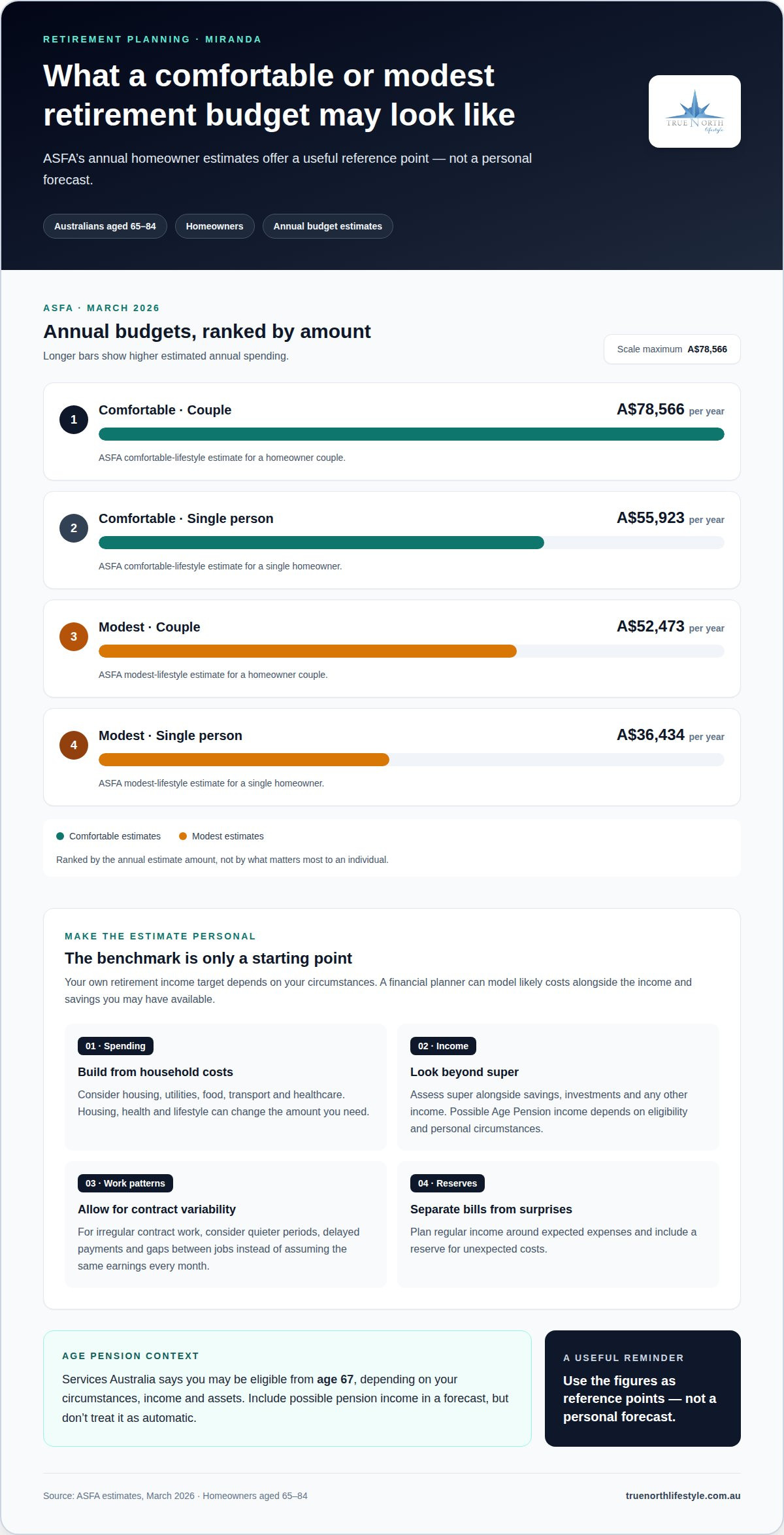
Your employer’s super contribution is a starting point, not proof that your retirement income will be enough. For retirement planning for sound engineers in Miranda, a useful benchmark is ASFA’s March 2026 estimate that a comfortable lifestyle for homeowners aged 65 to 84 requires A$55,923 a year for a single person or A$78,566 for a couple. Your own target depends on your housing, health, lifestyle and other income.
It’s understandable to want a clearer picture than your super balance alone can provide, especially when work and income patterns may shift over a long career. A financial planner can model expected retirement costs and income, review your super, and tailor investment strategies to your circumstances. This guide explains how to build those estimates, assess whether super may be enough, and consider estate planning alongside your retirement goals. The aim is a practical view of the income you may need, not a one-size-fits-all figure.
Key Takeaways
- Build a retirement income estimate around your expected living costs, housing and other income, rather than relying on a single benchmark.
- Assess employer super alongside any additional contributions and the relevant contribution caps to see how your retirement income plan may fit together.
- Services Australia says you may be eligible for the Age Pension from age 67, depending on your circumstances, income and assets.
- Review how your investment preferences balance access to income, long-term growth and risk, and keep your estate planning arrangements aligned with your wishes.
Estimating retirement living costs and income needs
Use a financial planner’s estimate to connect expected retirement costs with super, savings and other income. For sound engineers in Miranda, retirement planning is more useful when it reflects contract patterns as well as household spending.
-
Have a financial planner estimate retirement living costs
Ask a financial planner to model likely spending, starting with housing, utilities, food, transport and healthcare. ASFA’s March 2026 estimates for Australians aged 65 to 84 put a comfortable homeowner budget at A$55,923 annually for a single person and A$78,566 for a couple. Modest homeowner budgets are A$36,434 and A$52,473 respectively. Use these as reference points, not a personal forecast.
-
Plan regular retirement income and emergency reserves with a financial planner
Ask your planner to structure income around expected expenses and include a reserve for unexpected costs. This separates predictable bills from emergency funds. For sound engineers with irregular contracts, account for quieter periods, delayed payments and gaps between jobs. Model these against household spending, savings and ongoing commitments instead of assuming the same earnings every month.
-
Build retirement income and review superannuation with a financial planner
Have the planner assess superannuation alongside savings and other income, including how each source could support withdrawals. For self-employed sound engineers, a planner can assess low-fee industry fund and MySuper options by comparing fees, investment settings and insurance with your needs. Review whether the arrangements suit variable contributions. Avoid choosing on fees alone if the investment approach or cover doesn’t fit your circumstances.
-
Have a financial planner check Age Pension eligibility and income
Include possible Age Pension income in the forecast, without treating it as automatic. Services Australia says Australians may be eligible from age 67, depending on their circumstances, income and assets. A planner can model how superannuation, savings and other income relate to that assessment, then show how pension income may fit alongside other resources. This helps retirement planning for sound engineers in Miranda reflect their wider income picture.
Isn’t my employer’s super contribution enough?
Not necessarily. A retirement plan should consider super, savings, investments and government benefits together. In Miranda, planning can also include retirement projections, a superannuation review, tax-minimisation strategies and portfolio construction. Expected income depends on your balances, contribution history and retirement timing.
-
Review super contribution strategies with a financial planner
Ask a planner to assess whether additional super contributions suit your cash flow, then compare them with contribution caps. The stated annual concessional contribution limit is A$27,500, while the maximum non-concessional contribution is A$110,000. These limits shape how much may be contributed under each category. For sound engineers with equipment or a small business, model contributions around contract income and operating needs, rather than committing cash needed for work.
-
Have a financial planner assess savings, investments and government benefits
Ask your planner to model super alongside savings, investments and possible government benefits, rather than treating your super fund as your only retirement resource. Super income depends on your balance and withdrawal strategy; Age Pension income depends on eligibility and personal circumstances. A planner can also model how equipment costs, business income and gaps between contracts affect your capacity to save for retirement. This connects your work assets and income patterns with your longer-term plan.
-
Plan the retirement timeline and super access with a financial planner
Map your preferred retirement date against when super becomes accessible, because stopping work and accessing super are separate decisions. Preservation age depends on birth date: it is 55 for people born before 1 July 1960, then 56, 57 and 58 for successive cohorts through 30 June 1963. Some people may access some super from age 60 while continuing to work. Include contract changes and business commitments in the timeline. A superannuation review and optimisation can help assess how your fund fits that strategy.
Estate planning and avoiding retirement mistakes
- Ask a financial planner to connect your estate intentions with your retirement cash-flow plan. Include your super balance, savings, property and any regular payments you expect to make or receive. For example, planned support for family may affect the income available for your own later-life needs. Discuss the inheritance you hope to leave while keeping day-to-day spending and long-term needs visible in the same plan.
- Review your super beneficiary nominations, will and powers of attorney as you approach and enter retirement. In Australia, reviewing these arrangements can help keep them aligned with your wishes. Check that the people named and your intended distribution still reflect your circumstances. Changes in relationships, family responsibilities or assets can make older arrangements inconsistent with your current intentions. Dedicated advisory firms such as Her Financial Planning emphasise the importance of realigning financial priorities and wealth management during such major life transitions. Estate strategy should consider these documents together, while legal document drafting is a separate matter.
- Include possible aged-care needs when modelling how long your retirement assets may need to support you. Services Australia notes that decisions about where to live can depend on home ownership, housing maintenance or renovation costs, health, and connections to family and community. Ask your planner to consider how moving, modifying a home or changing care needs could affect your income, available assets and intended inheritance. Don’t assume your housing plans will stay the same.
- Include aged-care financial considerations in your planning before a major housing or care decision. Your planner can examine how future payments and asset use may interact with retirement income and estate intentions. For sound engineers, include business or equipment assets where they form part of the financial picture. Review the plan as health, family needs and living arrangements change, so decisions reflect current priorities rather than outdated assumptions.
Investment preferences in retirement
A financial planner can assess investment risks, insurance needs and the income your portfolio must support. Retirement planning for sound engineers in Miranda should reflect your work patterns, financial situation and preferences, not just your age.
- Explain the income and access you want from your investments. Tell your planner whether steady payments, long-term growth or ready access matters most. Services Australia advises balancing risk and return while maintaining access to long-term capital growth. Your priorities may change as you move from earning income to drawing on savings, so model that transition rather than assuming one investment setting will suit every stage.
- Ask the planner to test how different asset mixes could support your retirement income. A mixed portfolio can combine assets with different roles rather than relying on one investment type. In wider research, 89% of advisers recommended a mixed asset portfolio for investors in drawdown. Treat that as context, not a personal prescription. The right mix depends on your goals, time horizon, income needs and comfort with changing investment values.
- Include insurance and work-related risks in the assessment. A planner can consider whether existing cover still fits your income, dependants and financial commitments, including periods without contracts. They can also model how market falls or changes in investment income could affect the portfolio’s ability to fund spending. For example, compare a plan relying on regular withdrawals with one that keeps accessible funds for near-term costs.
- Review the plan as your work and retirement needs change. Running a sound-engineering business, reducing contract work or retiring fully can alter the balance between accessible income and longer-term investments. Ask the planner to revisit assumptions about spending, investment risk and insurance when circumstances shift. A tailored approach to retirement planning for sound engineers in Miranda can connect those changing preferences with a sustainable income strategy. Explore tailored retirement investment planning.
True North Lifestyle: Retirement modelling & long-term projections
True North Lifestyle can turn your retirement priorities into a structured financial plan. Its retirement modelling and long-term projections show how super, savings, expected spending and changing work patterns may fit together over time. This can help when contract income varies, retirement is approaching, or you want to review whether your investment approach still reflects your preferences.
Planning can also include a superannuation review and optimisation, tax-minimisation strategies and bespoke portfolio construction. Together, these connect your super and investments with the income you want your retirement assets to support. Detailed projections provide a basis for informed decisions, not a promise of a particular outcome.
For tailored retirement planning, contact True North Lifestyle.
Give your retirement plan room to adapt
Your working life may not follow a straight line from full-time contracts to retirement. A quieter season, a change in the work you take on or a shift in family priorities can all alter what you want your savings to support. Your plan should adapt to those changes rather than leave you relying on assumptions made years earlier.
Thoughtful retirement planning for sound engineers in Miranda can connect your preferred lifestyle with decisions about super, investments and future income. True North Lifestyle brings retirement modelling and long-term projections together with superannuation review and optimisation and tax-minimisation strategies, helping you understand how these parts fit your circumstances.
When you’re ready to discuss what a considered plan could look like, contact True North Lifestyle. A clear next step can make your retirement decisions feel more manageable.
Frequently Asked Questions
Should I set up a Self-Managed Super Fund (SMSF)?
An SMSF may suit you if you want greater involvement in investment decisions and have the time to manage its complexity. Consider administration, investment responsibilities and whether transferring balances could mean losing insurance or other benefits.
When should I retire and how much do I need?
Retire when your preferred lifestyle, work plans and available income align, rather than relying on a birthday alone. Australians have no fixed age at which they must retire, although super access rules apply. Some people may spend 40 years in retirement, so a planner can test how long your income needs to last and how part-time work could affect your timeline.
When should I start seeing a financial planner?
Start when you need to make connected decisions about super, work and future income, not only when retirement is close. For example, a sound engineer with fluctuating contracts may benefit from modelling how contribution patterns affect long-term projections. A planner can also help reassess your strategy after a change in business structure, family circumstances or retirement intentions.
What is the current Australian superannuation guarantee rate and how does it affect sound engineers?
The superannuation guarantee is an employer contribution calculated as a percentage of eligible earnings. Its effect depends on whether you’re an employee, your earnings and the relevant payroll period. If you combine employment and freelance work, separate employer contributions from personal contributions when assessing retirement savings. Your planner can include both in your projections.
How can a financial planner help freelance sound engineers in Australia make super contributions and claim tax deductions?
A planner can model contributions around irregular invoices, business expenses and quieter periods, then assess how the strategy fits your tax position. The stated annual concessional contribution limit is A$27,500, which can inform contribution planning. Ask the planner to distinguish contribution strategy from tax return preparation, and to explain how records of income and contributions inform your decisions.
What are the Australian Age Pension eligibility rules and income and assets tests?
Australians may be eligible for the Age Pension from age 67, depending on their circumstances, income and assets. Services Australia assesses eligibility using income and assets tests, so other earnings and financial resources can affect the outcome. A planner can model possible pension income alongside super and savings, helping you understand how government support may fit your wider retirement cash flow.


