

What if the retirement date you have in mind depends less on a single super balance and more on how your income, investments and clinical workload change over time? For clinicians exploring retirement planning for medical professionals Miranda, it can be difficult to see how those factors connect when financial decisions have to fit around a demanding schedule.
It’s reasonable to wonder whether your current resources can support the life you want after clinical work, particularly if you’re considering reduced hours, a career change or a different retirement timeline. A useful plan brings your lifestyle goals, superannuation and investments together, then tests how different assumptions and career scenarios could affect your options.
This article explains what retirement modelling can reveal, how to assess advice by its scope, assumptions, communication and review process, and why tax, investment and wealth-preservation decisions are best considered as part of a connected strategy. You’ll also find practical steps to clarify your position, without treating projections as guaranteed outcomes.
Key Takeaways
- Map your preferred work and lifestyle changes against your financial position to clarify what you want retirement to look like.
- Use retirement modelling to explore how different income, contribution and spending assumptions may affect your options, not as a guaranteed forecast.
- When comparing retirement planning for medical professionals Miranda, look for clear explanations of advice scope, modelling assumptions, fees and ongoing review.
- Prepare for a planning discussion by gathering superannuation and investment details, income information, existing advice documents and questions about upcoming decisions.
- Consider how superannuation, tax strategy and portfolio construction can work together as part of a long-term retirement plan.
Retirement planning for medical professionals in Miranda: start with your career and life goals
A demanding medical career can leave little room to consider when, or how, you’d like work to change. Retirement timing isn’t simply a date to choose and set aside. Your preferred lifestyle, career path and financial position all shape the options worth exploring. For retirement planning for medical professionals Miranda, start with your own priorities, not an assumed retirement age or standard income pattern.
Medical professionals may work in public or private settings, run or join a practice, move between roles, or combine different forms of work over time. Income can also vary with hours, seniority and career stage. A plan should reflect those circumstances and bring together lifestyle goals, superannuation, investments, tax considerations and timing. A general Retirement Planning Overview outlines how savings, investments, income and spending fit into the broader picture. The next step is to apply that framework to your Australian circumstances and the choices you’re weighing.
Which career and lifestyle decisions should the plan reflect?
Begin with the life you want, before deciding what the numbers need to achieve. Consider when you might like to reduce work or stop, what kind of work you’d want to keep doing, and what you hope retirement will make room for. You may be considering fewer clinical hours, a change in responsibilities or a different career stage. These are possibilities to explore, not assumptions that every clinician wants the same transition.
Write down goals separately from financial assumptions. For example, “I’d like to work fewer days” is a goal; the income you expect to earn while doing so is an assumption that can be tested. Separating the two makes modelling more useful: it can show how different choices may affect your financial position without treating an estimate as a promise.
- Timing: Note when you’d ideally like to change your work pattern and whether you’re open to adjusting that timing.
- Work: Consider whether you’d prefer to stop clinical work, reduce hours or move into another role.
- Lifestyle: Identify the priorities your finances may need to support, such as travel, family commitments or more time outside work.
Why does a medical career make personal context important?
There isn’t one medical career pattern for a retirement plan to follow. Two professionals at a similar career stage may have different working arrangements, income structures, superannuation and investments, as well as different views about when to step back. Occupation-based averages can’t capture those details. A sound starting point is your actual financial position and the choices you’re considering.
A useful retirement plan connects financial resources with personal timing and goals. From Miranda and the wider Sutherland Shire, that means starting with your preferred future, then examining how your super, investments, income and tax considerations relate to it. The aim isn’t to settle every decision at once. It’s to create a clearer basis for testing options and identifying what may need attention as your circumstances change.
What retirement modelling should show medical professionals before they decide
A retirement projection combines your current financial position with future assumptions to show how your resources may support your goals over time. For medical professionals, it can connect superannuation, investments, contributions and planned spending with decisions about when to reduce work or retire. In retirement planning for medical professionals Miranda, the value isn’t a single impressive-looking figure. It’s understanding what drives the result and how it might change.
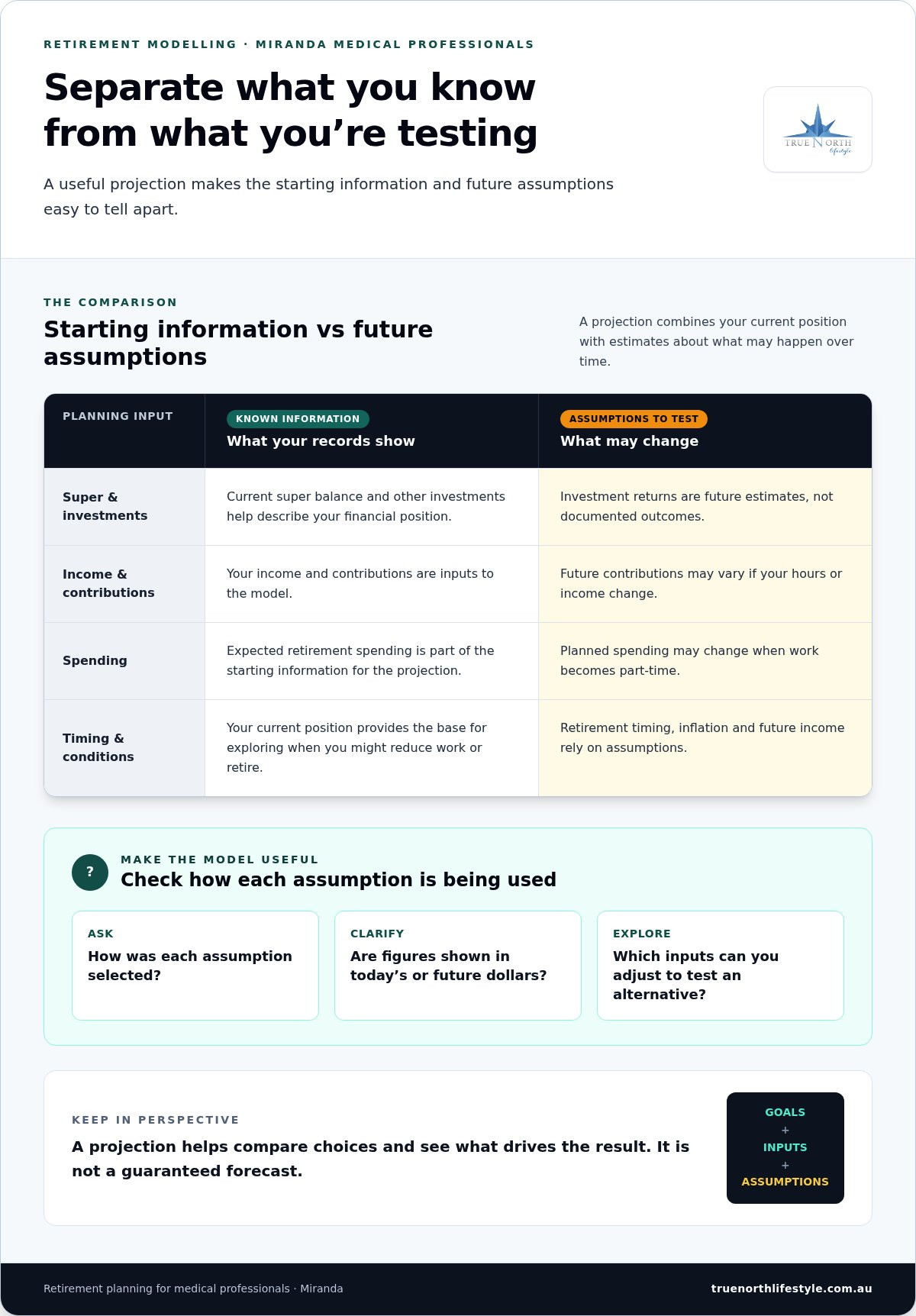
A useful model starts with information such as your current super balance, other investments, income, contributions and expected retirement spending. It should make clear how each input is treated. For instance, planned spending may change when work becomes part-time, while contributions may vary if your hours or income change. Tax considerations can also affect how resources are viewed, so the assumptions and scope should be explained in plain language.
Which assumptions should a retirement projection make visible?
Separate known information from estimates. Current account balances may be documented figures, while future contributions, investment returns, inflation and retirement timing rely on assumptions. A clear projection labels these differences and explains how it treats income, assets and spending. That makes it easier to distinguish information drawn from your records from illustrative inputs, rather than mistaking an estimate for a forecast.
Assumptions matter because changes can alter the picture over a long period. If a model uses a different inflation or investment return assumption, the projected value of future resources may change. That doesn’t mean the model predicts what will happen. Ask how each assumption was selected, whether figures are shown in today’s or future dollars, and which inputs you can adjust to test an alternative.
How can scenario modelling clarify retirement timing?
Scenario modelling lets you compare choices on consistent terms. You might examine retiring at one point versus working longer, keeping your current hours versus reducing them, or testing different spending goals. The purpose is to see how those changes may affect the projection and what trade-offs they create, not to identify one retirement age that suits every clinician.
A projection is a decision-support tool, not a promise of future returns. Results depend on the information entered, assumptions used and future circumstances. A useful discussion should show what changes between scenarios, which assumptions have the greatest effect and where more accurate information could improve the analysis. This can turn a broad concern, such as “Can I afford to cut back?”, into specific options to consider.
For a wider view of how long-term planning can bring personal goals and financial resources together, the Sydney retirement planning strategy guide offers related context. To see how your own assumptions and goals could be modelled, explore retirement modelling and long-term projections.
How to compare retirement advice in Miranda: assess the process, not the promise
A confident presentation or a medical-sector label can sound reassuring, but neither proves that advice fits your retirement goals. For retirement planning for medical professionals Miranda, compare the reasoning and process behind recommendations. The aim is to understand what the advice covers, how it responds to your circumstances and what support follows if your plans change.
Use consistent criteria when assessing retirement advice in Miranda and the Sutherland Shire. Clear explanations make it easier to compare approaches without relying on bold forecasts or broad claims.
| What to assess | What clear advice should explain |
|---|---|
| Scope | Which decisions are covered, such as superannuation, investments, tax considerations and retirement timing, and what sits outside the advice. |
| Modelling | What information and scenarios inform the analysis, and how the projection relates to your stated goals. |
| Assumptions | How estimates for income, spending, investment returns and timing are treated, including relevant limitations and trade-offs. |
| Implementation | How recommendations could be put into practice, who is responsible for each step and what decisions remain yours. |
| Communication | How recommendations are documented and explained, and whether the reasoning is understandable to you. |
| Review | Whether ongoing reviews are part of the arrangement, what they cover and how changes in circumstances are handled. |
What should a retirement advice process explain clearly?
A sound process should show how your information is gathered, what analysis is completed and how recommendations follow from it. Before proceeding, you should understand the advice scope, fee structure and any ongoing service arrangements. Fees should be disclosed clearly alongside what the agreed work includes, so you can assess the overall value rather than focus on a promised result.
Pay attention to how assumptions are communicated. A recommendation should explain why it may suit your goals, what limitations apply and what trade-offs you may face. If a proposed strategy relies on a particular retirement date or work pattern, the reasoning should be visible and open to discussion.
How can you assess medical-career relevance without relying on labels?
A medical-sector label alone doesn’t demonstrate a suitable retirement strategy. Discuss your actual work history, income arrangements and intended transition, including any changes you’re considering. Relevant advice should respond to those details, rather than assume that clinicians share the same earnings, superannuation or career trajectory.
Check whether recommendations connect superannuation, investments, tax considerations and personal goals into a coherent picture. For more on how superannuation strategy relates to long-term wealth decisions, the superannuation advice in the Sutherland Shire guide provides further context. You can also explore retirement planning support to understand how modelling and related advice can fit together.
Prepare for retirement planning: organise your goals, questions and financial picture
A focused conversation doesn’t require you to have every answer ready. A little preparation can connect your career decisions with the financial information needed to explore them. For retirement planning for medical professionals Miranda, bring a clear picture of what matters, what you know and what still feels uncertain.
Use this simple sequence to get organised:
- Define your goals. Note your preferred retirement timing, the work pattern you may want next and the lifestyle priorities you hope your finances will support.
- Gather key information. Collect current superannuation and investment statements, relevant income details and records of other financial resources.
- List your questions. Include anything you’d like explained, from a projection assumption to how a recommendation relates to your intended work transition.
- Identify decisions ahead. Record known changes or choices that may affect your planning, such as a possible shift in hours, role or career stage.
What information can make a first planning discussion more useful?
Bring the latest statements you have for superannuation and investments, along with a summary of your income arrangements. Existing financial strategies, advice documents or records of previous recommendations can show what’s already been considered. You don’t need to create a perfect financial dossier. A clear, current starting point is more useful than delaying because one document is missing.
Include the personal context behind the figures. A brief note about your career plans, retirement preferences, household priorities and known upcoming changes can keep the discussion grounded in real decisions. If you’re unsure whether a detail matters, include it or mark it as a question. You can also note where your information is incomplete rather than trying to resolve everything first.
Which questions help turn uncertainty into useful decisions?
Questions can make a planning conversation more focused. Ask how a projection is built, which assumptions have the greatest influence and how alternative work or retirement scenarios will be compared. You might also ask how recommendations link your retirement goals with superannuation and investment decisions, and what information would make the analysis more useful.
Write down the decisions you’re weighing, not just the answers you hope to hear. For example, you may want to understand what could change if you work fewer hours or adjust your intended timing. If tax considerations are part of your questions, this retirement tax planning guide offers further Australian context.
Preparation is a way to make the next step clearer. If you’re ready to talk through your priorities and the information you’ve gathered, discuss your retirement planning goals.
How True North Lifestyle approaches retirement planning for Miranda medical professionals
Clear projections can make retirement decisions easier to examine. True North Lifestyle provides retirement modelling and long-term projections, connecting the information you provide with the goals and choices you want to explore. For medical professionals in Miranda, this means considering how superannuation and investments relate to possible retirement timing and income needs, rather than relying on a generic career template.
A model is a planning tool, not a prediction. Its results depend on the information, assumptions and future circumstances used, so its purpose is to make the choices easier to discuss. A projection can help frame questions about whether a proposed work pattern or spending plan appears consistent with the resources being considered, and what may need further attention.
How can modelling and portfolio strategy work together?
Projections can inform discussions about income needs, investment strategy and portfolio sustainability. They provide a way to examine how an investment approach relates to your broader retirement objectives, while keeping assumptions visible and outcomes uncertain. True North Lifestyle constructs bespoke portfolios and oversees them through an in-house Investment Committee, bringing investment decisions into a considered planning process.
Modelling and portfolio decisions answer different but related questions. A projection explores how resources might support your plans under stated assumptions; portfolio strategy considers how investments are constructed and managed in light of those objectives. Neither removes uncertainty. Considering them together can clarify the reasoning behind a strategy and help identify when a change in circumstances may warrant a fresh discussion.
Superannuation optimisation and tax-minimisation strategies can also be considered alongside projections and portfolio construction. Depending on your circumstances and objectives, broader planning may include wealth preservation, longevity planning, Centrelink structuring and estate planning strategy. Bringing these considerations into view can help avoid treating each decision as an isolated task, while keeping recommendations shaped by your position and relevant rules.
What can ongoing planning help keep aligned?
Personal goals, financial circumstances and relevant rules can change. Review conversations provide an opportunity to revisit assumptions and consider whether a strategy still reflects your priorities, such as a changed work pattern, revised retirement timing or updated financial information. They’re a chance to reassess, not a promise that projections or outcomes will remain unchanged.
True North Lifestyle collaborates with Resonant Asset Management as part of its broader investment and planning work. The focus is on connecting long-term projections, investment considerations and your goals in a way that can be understood and revisited as circumstances evolve. The next step can be a discussion centred on what you want life after clinical work to look like and which decisions matter most.
If you’re ready to explore your options, talk through retirement planning in Miranda with True North Lifestyle.
Give your next decision a clear starting point
Retirement doesn’t need to be planned in one leap. Start by identifying the decision that would make the biggest difference to your sense of direction: whether to change your hours, when to review your position, or what information you still need. That focus can turn a broad concern into a manageable conversation and give future choices a clearer reference point.
For retirement planning for medical professionals Miranda, clarity comes from keeping your priorities at the centre and allowing your plan to evolve as your career and circumstances do. You don’t need certainty about every detail before taking a considered next step. Start with the question that matters most, then build from there.
You might also choose a point to revisit your plans, such as after a change in your work pattern or when a retirement decision comes into sharper focus. This helps keep planning connected to the life you’re building, rather than turning it into a document you set aside.
Discuss your retirement planning goals with True North Lifestyle and take a considered step towards greater confidence about the choices ahead.
Frequently Asked Questions
Are there special retirement planning rules for medical professionals in Australia?
Generally, retirement and superannuation rules apply according to personal circumstances, not medical occupation alone. A doctor or other clinician may still have a distinctive planning picture because of work arrangements, income patterns or career history. For example, someone who has worked across public and private roles may need to review how their super is distributed across accounts. Check current eligibility and tax rules against your individual position.
Can career breaks affect a medical professional’s retirement outlook?
Yes. A career break can affect the amount and timing of super contributions, and may change expected income or the date someone hopes to retire. Time away for study, caring responsibilities or a health-related pause could mean fewer contributions during that period. The effect depends on the person’s broader financial position and plans. Updating a projection after a substantial break can help show which assumptions need revisiting.
Can I access my superannuation as soon as I stop working?
Not necessarily. Stopping work by itself doesn’t automatically mean you can access superannuation. Access generally depends on meeting a condition of release under Australian superannuation rules, which can involve factors such as age and personal circumstances. Before relying on super to fund a career change or early retirement, check your fund’s current guidance and consider how access timing fits your other income sources. Rules can change, so confirm the requirements that apply at the time.
Is the Age Pension available to medical professionals who retire?
Medical professionals may be eligible for the Age Pension if they meet the relevant Australian Government requirements. Eligibility isn’t determined by occupation alone; factors include age, residency and means tests that consider income and assets. Superannuation and other financial arrangements may be relevant to that assessment. As rules and thresholds can change, use current Services Australia information to understand eligibility rather than assuming professional income or past earnings determine the outcome.
How early should a medical professional start retirement planning?
There’s no single ideal starting age. Starting when retirement is still some way off can leave more time to review super contributions, investment settings and possible career changes. Planning is also useful later, particularly before reducing hours or setting a retirement date. Similar principles apply across borders; for example, Canadian specialists Evergreen Wealth Management emphasise that structured pre- and post-retirement planning helps individuals map out income sustainability well before stepping back from work. For retirement planning for medical professionals Miranda, an early conversation about priorities can help identify what information to gather and which decisions deserve attention first.
Can retirement planning include my partner’s financial goals?
Yes. Planning can consider shared household priorities alongside each person’s separate financial position. You and your partner might have different preferred retirement dates, work plans or expectations for spending, so discuss both individual and shared goals. For instance, one person may want to reduce work while the other continues. Considering these preferences together can help clarify how decisions may affect household income, superannuation and the timing of future plans.


