

What if the care arrangement that feels right today also changes how long retirement savings need to last? For families in Miranda 2228 and Sydney 2000 considering aged care, care needs and financial decisions are closely connected. Aged care financial planners Miranda can help bring those moving parts into one clearer picture, so decisions are considered rather than rushed.
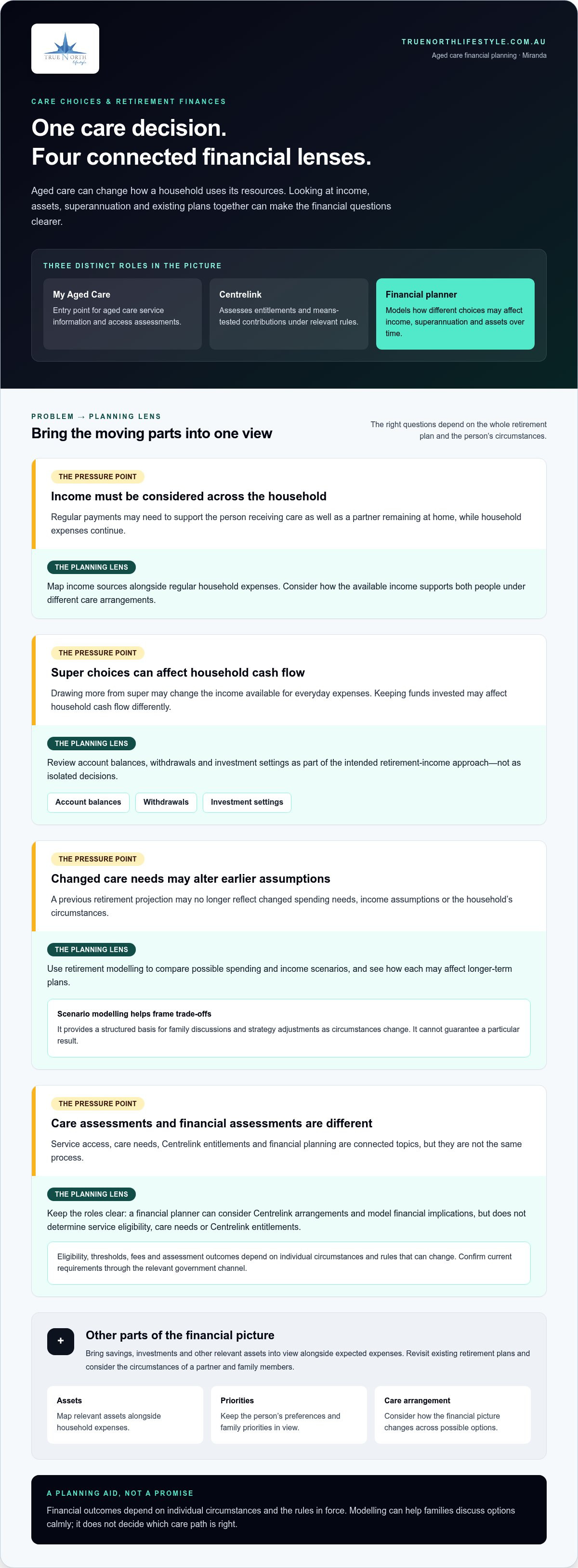
It’s understandable to feel uncertain. My Aged Care helps people access and understand aged care services, Centrelink assesses entitlements and means-tested contributions, and a financial planner can model how different choices may affect income, superannuation and assets over time.
This guide explains which financial questions to consider before choosing a care arrangement, how Centrelink and your broader financial position fit into the picture, and how scenario modelling can help your family weigh options calmly. With a tailored retirement strategy, you can take practical next steps with greater clarity and confidence.
Key Takeaways
- Separate care arrangements from financial planning so each decision is clearer and easier to work through.
- Bring superannuation, income, assets and Centrelink considerations together to understand how they may affect your retirement position.
- Compare support at home and residential care by considering household cash flow, accommodation and ongoing expenses.
- Prepare for advice by outlining priorities, gathering financial records and mapping the questions your family needs answered.
- Aged care financial planners Miranda can use retirement modelling and long-term projections to help you explore options within a broader financial strategy.
Aged care financial planning in Miranda: decisions to clarify early
A change in health can bring care decisions and money questions to the family table at the same time. You may need to consider a new care arrangement, keep household bills on track and understand how retirement savings could support the years ahead. Separating the care process from financial planning can make the next steps easier to understand.
My Aged Care is the Australian Government entry point for information about aged care services and access assessments. A financial planner doesn’t assess care needs, decide eligibility or recommend clinical care. Their role is to help you examine the financial implications of different options in light of the person’s circumstances and priorities. For broader context on the system, see Aged care in Australia.
Start with practical questions that help your family identify what matters and where you need more clarity:
- What care arrangement best reflects the person’s preferences and needs?
- Which income sources and regular household expenses need to continue?
- Which assets and superannuation may be relevant to future plans?
- What matters most to the person, their partner and other family members?
When should a Miranda family seek financial advice about aged care?
There isn’t one right moment for every family. Advice may be useful before a move, when care needs change, or after a partner’s health or circumstances shift. The aim isn’t to force an early decision. It’s to understand the financial questions while there’s still room to consider alternatives and involve the people who matter.
Modelling possible scenarios can make trade-offs easier to discuss. For instance, a family might compare how different care arrangements could affect retirement income, savings and the finances of a partner remaining at home. The relevant options depend on individual circumstances and the rules in force, so projections are a planning aid, not a promise of a particular outcome.
What an aged care financial planner can help bring together
Aged care financial planning considers how care choices may affect income, savings and longer-term financial goals. A planner can bring retirement income, superannuation, assets, Centrelink structuring and existing plans into one view. This can help you see how decisions may interact, rather than treating each figure in isolation.
For families looking for aged care financial planners Miranda, this financial perspective can sit alongside care assessments and family discussions. It doesn’t replace care recommendations, clinical assessments or legal document drafting. True North Lifestyle provides retirement modelling and long-term projections, including consideration of superannuation and Centrelink arrangements. The aim is to help you understand the financial choices before deciding which path fits your family.
How aged care choices interact with super, income and Centrelink
Aged care can change how a household uses its resources, but there isn’t one financial outcome that applies to everyone. Income sources, assets, superannuation, a partner’s circumstances and the care arrangement can all affect the picture. Assessment rules and fee settings also depend on individual circumstances and the rules current at the time.
Look at these parts together rather than making an isolated decision about one account or asset. For example, drawing more from super may change the income available for everyday expenses, while keeping funds invested may affect household cash flow differently. The right questions depend on the whole retirement plan, not a single assumption.
- Income: Consider regular payments and how they support both the person receiving care and any partner remaining at home.
- Assets: Map savings, investments and other relevant assets alongside expected household expenses.
- Superannuation: Review how account balances, withdrawals and investment settings fit the intended retirement-income approach.
- Existing plans: Revisit earlier retirement projections to see whether changed care needs call for different assumptions.
The role of superannuation and retirement income
Superannuation decisions don’t sit in a vacuum. A withdrawal, a change in investment settings or a shift in other income sources may affect how long funds are expected to support retirement. A superannuation advice guide can provide broader context for reviewing these choices.
Retirement modelling can compare scenarios, such as different spending needs or income assumptions, and show how each may affect longer-term plans. It can’t guarantee a particular result. Instead, it gives families a structured basis for discussing trade-offs and adjusting a strategy as circumstances change.
Centrelink and aged care assessments are different processes
Centrelink considerations relate to payments, entitlements and how a person’s financial position is assessed under relevant rules. My Aged Care is the access point for aged care services and assessments of care needs. These are distinct processes, and a financial planner doesn’t determine service eligibility or Centrelink entitlements.
Eligibility, thresholds, fees and assessment outcomes depend on official processes and rules that can change. Before relying on a figure or making a decision, confirm the current requirements through the relevant government channel. ASIC’s Moneysmart guide to aged care and finances also offers independent information about financial considerations. For broader context, explore this retirement planning guide for Sydney.
For families considering aged care financial planners Miranda, a joined-up view can help make financial implications easier to weigh without assuming a particular benefit or outcome. True North Lifestyle’s retirement modelling and long-term projections can help you consider possible scenarios alongside broader goals.
Support at home or residential care: compare the financial questions
Choosing between support at home and residential aged care involves more than comparing a care bill. Each arrangement can affect household spending, available assets, accommodation needs and the income required to support a partner. Care suitability and availability are separate questions, assessed through official aged care channels such as My Aged Care. Financial modelling helps families consider the financial side alongside those care decisions.
Comparing scenarios is more useful than relying on a generic estimate because it shows how each option may fit the household’s actual income, assets and priorities.
| Planning area | Support at home | Residential aged care |
|---|---|---|
| Cash flow | How might ongoing household bills sit alongside care-related contributions and retirement income? | Which ongoing expenses would change, and what income would be available for care and the partner’s needs? |
| Assets and property | What property upkeep, modifications or household costs may need to be factored into the plan? | How might a move affect the home, other assets and the couple’s day-to-day financial arrangements? |
| Accommodation | How will the home suit the person’s needs, and what costs may arise from continuing to live there? | What accommodation payment choices and related contributions need to be understood under current rules? |
| Family priorities | Can the household arrangement support the person receiving care as well as others living at home? | How could a move affect routines, shared finances and the partner who remains at home? |
Financial questions when care is provided at home
Set care-related contributions alongside everyday costs such as utilities, food, transport and property upkeep. A home may remain a significant part of the household’s financial position, while the partner’s needs and living arrangements also shape available income. Staying at home isn’t automatically cheaper or financially preferable. The comparison depends on the services required and the household’s wider circumstances.
Map expected expenses against regular income, then consider how that picture might change if care needs increase. This keeps the discussion grounded in practical trade-offs rather than assumptions about what home support will cost or how long a particular arrangement will suit.
Financial questions when considering residential aged care
For residential care, explore accommodation payment options, applicable contributions and the effect of ongoing expenses on cash flow. Current rules and individual assessments matter, so don’t rely on old figures or broad estimates. A move may also change how a couple uses assets and manages household costs, particularly if one partner continues living at home.
These decisions connect with wider questions about sustaining wealth over time. A broader wealth preservation strategy can put care-related choices in the context of longer-term financial goals. Families working with aged care financial planners in Miranda can use scenario modelling to compare options based on their circumstances, rather than treating any one arrangement as the default.
A practical preparation checklist for aged care financial advice
A little preparation can make a family discussion more focused. You don’t need every answer or document in place before starting. The aim is to identify what matters, gather a useful snapshot of the finances and separate confirmed details from questions that still need attention.
Use this sequence to organise the conversation:
- Outline priorities. Note the person’s care preferences, what they hope to preserve financially and any immediate concerns for a partner or household.
- Gather records. Collect current information about superannuation, income, assets and regular expenses, along with relevant care correspondence.
- Map the questions. Write down what the family needs to understand about cash flow, Centrelink considerations, care contributions or future planning.
- Compare scenarios. Identify the options you want to discuss and the assumptions that may affect each one, such as a change in care needs or household expenses.
Documents and details to organise before a planning discussion
Start with a practical financial snapshot, rather than trying to assemble a perfect file. Useful records may include:
- Recent superannuation statements and details of other income sources.
- Information about savings, investments, property and other relevant assets.
- A list of regular household expenses, including costs that may continue for a partner.
- Known care information and relevant correspondence from My Aged Care.
- Existing financial advice documents or retirement projections that may inform the discussion.
Share personal and financial documents securely, and include only information relevant to the planning conversation. If a detail is missing, mark it as unknown rather than relying on a guess.
Questions to take into a family planning conversation
Keep the person receiving care at the centre of the discussion. Ask what matters most to them, which preferences should guide decisions and what they want their finances to support. Then clarify who needs to contribute to each decision, and distinguish family choices from matters that require professional advice or an official assessment.
Write down agreed priorities, assumptions and unanswered questions. A short record can help family members stay aligned, especially if they can’t all attend the same conversation. Note who will follow up each action and when the family plans to revisit decisions if circumstances change.
Bring your priorities and financial snapshot to a discussion about retirement planning support from True North Lifestyle. A structured conversation with aged care financial planners Miranda can connect immediate questions with your broader retirement goals.
Working with an aged care financial planner in Miranda
A care transition can affect more than one part of a retirement plan. Retirement modelling and long-term projections bring possible care costs, income needs and existing goals into a single financial view. For families in Miranda and Sydney, this can make it easier to identify questions to resolve now and assumptions to revisit if circumstances change.
True North Lifestyle connects aged care-related decisions with superannuation review, Centrelink structuring, tax-minimisation strategies and wealth preservation. The focus is on how these considerations fit together for your circumstances, rather than assuming one approach suits every household. Advice can be shaped around your goals and the information available, while recognising that fees, eligibility and assessment rules may change.
What a tailored planning process can address
A planning discussion can begin by organising the financial details that matter: income sources, assets, superannuation, regular expenses and existing retirement plans. From there, relevant scenarios can be modelled to explore how different assumptions may affect retirement income and the sustainability of a portfolio. This gives families a clearer basis for discussing trade-offs, while keeping the person’s preferences and the needs of a partner in view.
The strategy may also consider whether current investment settings and income arrangements remain aligned with longer-term priorities. Modelling is a way to test possibilities, not a forecast or promise of a particular outcome. Its value lies in showing how a change in one assumption can flow through the broader plan, helping you make decisions with more context.
Financial planning has clear boundaries. A financial planner can consider financial strategy, but care eligibility and service assessments remain with the relevant aged care assessment processes. Legal document drafting is also separate. Keeping these roles distinct helps families direct each question to the right process without confusing financial modelling with care or legal decisions.
A calm next step for Miranda families
You don’t need to arrive with every answer. Begin with a clear account of what has changed, what the person receiving care values, the household’s main financial concerns and any questions you’ve already identified. If some details are uncertain, say so. That gives the discussion a practical starting point and helps clarify what information or decisions may be useful next.
For people searching for aged care financial planners Miranda, a conversation with True North Lifestyle can explore how retirement modelling, superannuation review, Centrelink structuring and wealth preservation relate to the family’s situation. It’s an opportunity to understand relevant planning options, not a guarantee of a particular benefit or result. The advice can take account of your circumstances and long-term goals, with care decisions remaining with the person and the appropriate aged care processes.
Miranda and Sutherland Shire families can Speak with True North Lifestyle to discuss their situation and the financial questions they’d like to bring into focus.
Turn uncertainty into a considered next step
A family doesn’t need to settle every question at once. Begin by agreeing on what needs attention first, what can wait and who should be involved in each decision. That shared understanding can help keep the person receiving care at the centre while giving family members a clearer way to contribute.
For families exploring aged care financial planners Miranda, tailored advice can connect immediate choices with longer-term retirement priorities. True North Lifestyle’s retirement modelling and long-term projections can help examine possible scenarios, while superannuation review, Centrelink structuring and wealth preservation inform the broader financial strategy. The value is in understanding the choices in context, not expecting a guaranteed result.
Bring your questions, priorities and current understanding of the household’s finances to a conversation with the team. Speak with True North Lifestyle about your next steps and begin shaping a plan around your family’s circumstances. A calm, informed start can make the path ahead feel more manageable.
Frequently Asked Questions
Can an aged care financial planner help with Centrelink and aged care costs?
Yes. A financial planner can help you understand how Centrelink considerations and expected care expenses may fit into your broader financial plan. For example, they can model how different income or asset assumptions affect household cash flow. Centrelink makes decisions about entitlements, while aged care costs and contributions are subject to relevant assessment processes and current rules. Planning can clarify the questions to resolve, but it can’t guarantee a particular payment or fee outcome.
Does My Aged Care provide financial advice?
No. My Aged Care provides information about Australian Government-funded aged care services and helps people access the care assessment process. It doesn’t create a personalised retirement strategy or advise how to organise superannuation and other finances around care. Families can use its service information to understand the care pathway, then consider separate financial advice to assess how possible arrangements may relate to income, savings and household priorities.
Can I get financial advice before an aged care assessment?
Yes. You can seek financial advice before an aged care assessment, particularly if you want to understand the household’s financial position before decisions progress. A planner can work with the information you have, clearly identifying assumptions that may change once care needs or assessment outcomes are known. For instance, a family could discuss how to keep a partner’s regular expenses covered under different possible care arrangements, then revisit the plan as official information becomes available.
What should I bring to an aged care financial planning meeting?
Bring a recent snapshot of finances and any documents that explain upcoming decisions. Useful additions may include Centrelink correspondence, details of existing income streams, a current household budget and any written information about proposed care arrangements. If family members are helping, note who is authorised to discuss the person’s finances and what they’re comfortable sharing. Don’t delay a discussion because one document is missing; label estimates and unknown details so they aren’t mistaken for confirmed information.
How can aged care affect a couple’s finances when only one partner needs care?
It can change how the couple balances care-related spending with the costs of maintaining two different living arrangements. The partner remaining at home may still need funds for housing, utilities, transport and everyday expenses, while the other partner’s care arrangement brings new financial considerations. A useful planning exercise is to map each person’s income and spending separately, then review the shared household position. This can reveal where assumptions about pooled finances need a closer look.
Can gifting assets change aged care or Centrelink assessments?
Potentially. A gift may be treated under rules that consider assets or financial transfers, so giving money or property away doesn’t necessarily mean it will be disregarded in an assessment. The effect depends on the circumstances and the rules that apply to the particular assessment. Before making a gift, seek current information from the relevant government agency and consider financial advice about the consequences for both the person giving the asset and their partner.
How do I find an aged care financial planner in Miranda?
Look for advice that connects aged care decisions with the wider retirement position, including superannuation, income, assets and Centrelink considerations. Ask how the discussion will account for your goals and what information will make it useful. True North Lifestyle provides retirement modelling, superannuation review, Centrelink structuring and wealth preservation for clients in Miranda 2228 and Sydney 2000. The phrase aged care financial planners Miranda can help you find locally relevant guidance for your next steps.


