

A bigger super balance isn’t the only measure of a sound retirement plan. For hospitality workers in Miranda, retirement planning means understanding how super, investments and future income needs fit together, even when shifts and earnings vary.
It’s understandable to want your super working as hard as possible before retirement, while keeping investment risk aligned with your plans. From 1 July 2026, according to the Australian Taxation Office, employers generally must pay employees’ superannuation contributions into their fund within 7 business days after payday.
This guide covers practical ways to review your super, assess investment risk and update your plan as circumstances change. It also explains how retirement modelling can help you judge whether your savings are on track for the lifestyle you want.
Key Takeaways
- Align your investment mix with your retirement timeframe, comfort with risk and need for steady income.
- Review your plan when work, health, family or financial circumstances change, and revisit it regularly.
- Bring super, investments, tax considerations and potential government benefits into one retirement income plan.
- Model expected spending against your savings to identify whether your retirement goals may need adjusting.
Investment portfolios and risk management
Superannuation is one part of retirement wealth, alongside investments and property. A suitable strategy connects investment choices with your goals, timeframe and comfort with risk. For retirement planning for hospitality workers Miranda, consider how changing shifts or earnings could affect contributions and investment decisions.
Market volatility and investment risk
Investment values can rise or fall, so a downturn may reduce your balance when you need access to savings. Consider whether your portfolio’s mix of growth and defensive assets suits your timeframe and expected income needs. Hospitality work can involve variable earnings or career breaks, so assess whether your savings approach can accommodate periods with lower contributions.
Super funds, fees and performance
There isn’t one best super fund for every hospitality worker in Australia. Compare fees, investment options, insurance and performance over consistent periods, while accounting for the risk behind each option. Past performance doesn’t show what a fund will return in future. Financial advisers can help assess whether a fund’s costs and investment mix fit your circumstances, rather than relying on headline returns alone.
From 1 July 2026, according to the Australian Taxation Office, employers generally must pay employees’ superannuation contributions into their fund within 7 business days after payday. To find lost super, review account statements and search for other accounts through myGov. Before consolidating, consider whether transferring could mean losing insurance or other benefits. Simpler account management may be useful, but the implications deserve attention.
Borrowing to buy an investment property adds loan repayments and property costs to your plan. A career break can pause contributions, while market falls can affect investment values. For retirement planning for hospitality workers Miranda, weigh these factors against your super and other assets before deciding how to invest or borrow. Advice can help you understand how each choice may shape long-term wealth and retirement income.
Financial advice for pre-retirees and retirees
Retirement decisions often start with questions about when you can access super and how you might fund daily life. Australia has no fixed age when you must retire, but super access depends on meeting a condition of release. For people born from 1 July 1964, preservation age is 60. Super can generally be accessed after a condition is met, such as ceasing employment at age 60 or over; some people may access part of it from age 60 while continuing to work. These rules help frame retirement planning for hospitality workers Miranda.
Hospitality workers may receive income from super and, if eligible, the Age Pension. Eligibility depends on applicable rules, asset and income tests, and personal circumstances. Super can remain in an accumulation account or support an account-based pension; government minimum drawdown rules apply to annual withdrawals from an account-based pension. A plan should consider how these income sources work together, rather than treating either as guaranteed retirement income.
Personalised financial advice links your objectives with expected spending, super, investments, tax position and potential Centrelink entitlements. Starting more than 10 years before retirement can provide greater flexibility. Within five years, the focus often shifts to reviewing spending, investment risk, tax considerations and possible Age Pension entitlements. For hospitality workers in Miranda, advice can account for changing shifts, career breaks and their impact on contributions and retirement timing.
For clearer decisions, prepare an overview of your super, assets, debts, expected expenses and preferred retirement timing. A financial adviser can assess how your resources align with your goals. Before seeking advice, check the adviser’s details on ASIC’s Financial Advisers Register. Services Australia also offers a free Financial Information Service to help people understand super and government payments. This gives retirement planning for hospitality workers Miranda a practical starting point, grounded in your priorities and circumstances.
How often should I review my retirement plan?
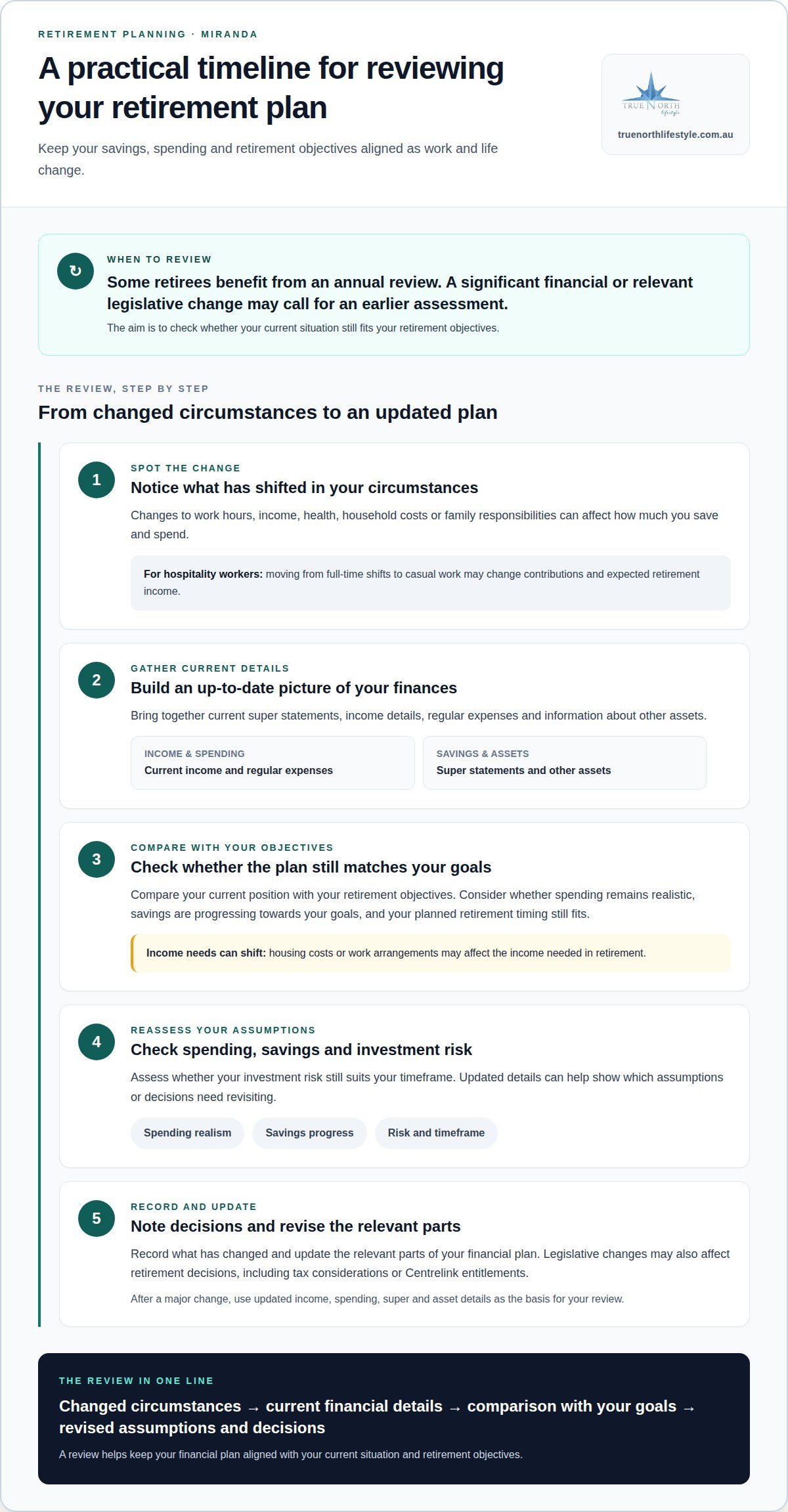
Some retirees benefit from annual reviews, while major changes may call for an earlier assessment. A review helps keep your financial plan aligned with your current situation and retirement objectives.
Reviewing plans as circumstances change
Changes to work hours, income, health, household costs or family responsibilities can affect how much you save and spend. For hospitality workers, moving from full-time shifts to casual work may change contributions and expected retirement income. A review can update those assumptions and show whether your planned retirement timing still fits.
Legislative changes may also affect retirement decisions, including tax considerations or Centrelink entitlements. After a major change, bring updated income, spending, super and asset details to your review. This gives advisers a clearer basis for assessing the effect on your plan, rather than relying on figures from an earlier situation.
Ongoing retirement strategy reviews
An ongoing review compares your current position with the actions and objectives in your retirement plan. Some retirees benefit from an annual review; a significant financial change or relevant legislative change may make an earlier review useful. The aim is to identify which assumptions or decisions need revisiting.
During a review, assess whether spending remains realistic, savings are progressing towards your goals, and your investment risk still suits your timeframe. For someone living in Sydney, changes in housing costs or work arrangements may affect the income needed in retirement. Record the change and update the relevant parts of your financial plan.
Make each review practical. Gather current super statements, income details, regular expenses and information about other assets. Compare them with your retirement objectives and note decisions that need attention. This helps ensure your strategy reflects your circumstances, rather than treating an old projection as fixed.
Keep a brief record of the review date, changed assumptions and agreed next steps. This makes the next discussion more focused and shows how your plan has evolved. Your retirement strategy should stay connected to your situation as work, family needs and financial priorities change.
Assessing whether retirement savings meet lifestyle goals
Start with the life you want, then assess whether projected income and savings can support it. Retirement timing, housing, regular expenses and leisure plans all affect the financial position you need to build.
Retirement age and super rules
Australia has no fixed age at which a person must retire, but super access depends on meeting a condition of release. For people born from 1 July 1964, preservation age is 60. Super can generally be accessed after a condition is met, such as ceasing employment at age 60 or over; some people may access some super from age 60 while continuing to work.
Use your intended retirement date as a planning assumption, not a requirement to stop work. Compare projected super income with the lifestyle you want, including housing costs and everyday spending.
Savings for casual and seasonal workers
Casual, part-time and seasonal workers can build retirement savings by tracking employer contributions alongside personal savings. Review contributions through busy and quieter work periods, then set a regular savings amount that fits variable income. During a career break, update your projection to reflect the pause and consider how later contributions may affect your goals.
For example, compare a projection based on your current shifts with one that includes reduced hours or a break. This shows how timing and contribution patterns affect your position without assuming earnings will be the same every year.
Retirement can span 20 to 30 years or more, so assess both the amount you may need and how long it must support you. List essential costs separately from optional spending, such as travel or dining out. Then compare those needs with projected super, other savings and potential Age Pension entitlements, which depend on applicable asset and income tests.
Retirement modelling can help develop scenarios for different retirement dates, spending levels and income patterns. Use the results to identify whether your goals, timing or savings approach need adjustment. Explore retirement planning options to assess how your savings align with the lifestyle you’re aiming for.
True North Lifestyle: Retirement modelling & long-term projections
True North Lifestyle can turn your retirement goals and current financial position into practical long-term projections. This can help if you’re unsure whether your super and savings can support your preferred lifestyle, or want to understand how changing work patterns could affect your plans.
The modelling brings expected income needs, superannuation and investments into a clearer picture. A superannuation review can assess whether your current arrangements align with your objectives, while bespoke portfolio construction can reflect your timeframe and comfort with investment risk. Tax-minimisation strategies can also inform how your broader plan is structured.
The modelling gives you a basis for weighing options, such as adjusting retirement timing or revisiting savings goals. Contact True North Lifestyle to discuss retirement modelling tailored to your circumstances.
Choose your next retirement planning step
Turn a broad retirement goal into a decision you can act on. You might want to clarify when you hope to reduce your hours, what you want retirement to make room for, or which financial question needs attention first. For hospitality workers in Miranda, a considered plan can put those priorities in context without requiring you to make every decision at once.
Choose one priority and gather the relevant details, such as your current super information, expected spending or preferred retirement timing. A focused conversation can help organise your questions and identify a practical direction for your circumstances. You can then decide what to address now and what to revisit as your plans evolve.
Start a conversation with True North Lifestyle about your retirement plan. A clear next step can make long-term decisions feel more manageable.
Frequently Asked Questions
How can I make the most of my super before retirement?
Start by checking that your super details, investment option and beneficiary nominations reflect your current intentions. Compare the fund’s fees and insurance cover with the features you use, and consider how its investment mix fits your timeframe. If you hold multiple accounts, understand any insurance or benefits you could lose before consolidating. A superannuation review can bring these decisions together and identify practical changes.
How do I know if I have enough to retire?
Compare expected retirement income with a realistic picture of future spending. Separate essential costs, such as housing and bills, from discretionary spending, such as travel or eating out, and consider how expenses may change over time. A projection can test different retirement dates and spending assumptions, including inflation and investment outcomes. This helps show which goals fit your current position and where adjustments may be needed.
What does a retirement financial adviser do?
A retirement financial adviser turns your financial details and retirement priorities into a structured plan. This can include modelling future income, reviewing super, assessing investments, and considering tax, Centrelink entitlements and estate planning. For example, an adviser can explain how changing your retirement date affects projected income, then outline relevant options and trade-offs. Recommendations should be tailored to your circumstances and clearly explained.
What retirement planning financial advisers and services are available in Miranda, NSW?
In Miranda, True North Lifestyle provides financial planning and retirement strategy services, including retirement modelling, superannuation review and optimisation, tax-minimisation strategies and bespoke portfolio construction. These services connect your super and investments with your retirement objectives. A local conversation can focus on your circumstances, including variable hospitality earnings, preferred retirement timing and the lifestyle you want to fund in Miranda or elsewhere.
What steps should a hospitality worker take to plan retirement, including budgeting and investment choices?
Start with a clear snapshot of your income, regular spending, debts, super and other savings. Set out the retirement lifestyle and timing you’re working towards, then compare investment options with your timeframe and comfort with market fluctuations. If you work casually or seasonally, budget for quieter periods as well as busy shifts. Revisit your assumptions when work patterns, household costs or priorities change.


