

Irregular income doesn’t have to mean an uncertain retirement plan. For retirement planning for gig economy workers in Miranda, the practical starting point is to make saving part of your financial plan, with contributions and investments suited to how your income flows.
It’s understandable to put immediate expenses first when work and earnings vary. But without a clear approach to super and long-term savings, retirement can be easy to leave until later. This article explains why planning matters for gig workers in Australia, the cash-flow and consistency challenges to expect, and how access to suitable savings options and financial education can support better-informed decisions. It also explores how a long-term view can bring your retirement goals into focus, even when your working life doesn’t follow a predictable pattern.
Key Takeaways
- Understand why retirement planning matters for independent workers, and how super can form part of a long-term strategy.
- Explore how voluntary contributions and a savings routine can help make retirement saving more consistent when income varies.
- Identify how cash-flow fluctuations and unexpected expenses can interrupt long-term saving, and why a plan should account for them.
- Learn how access to retirement accounts and financial education can help you make more informed decisions about saving for later life.
Why should gig workers prioritise retirement planning?
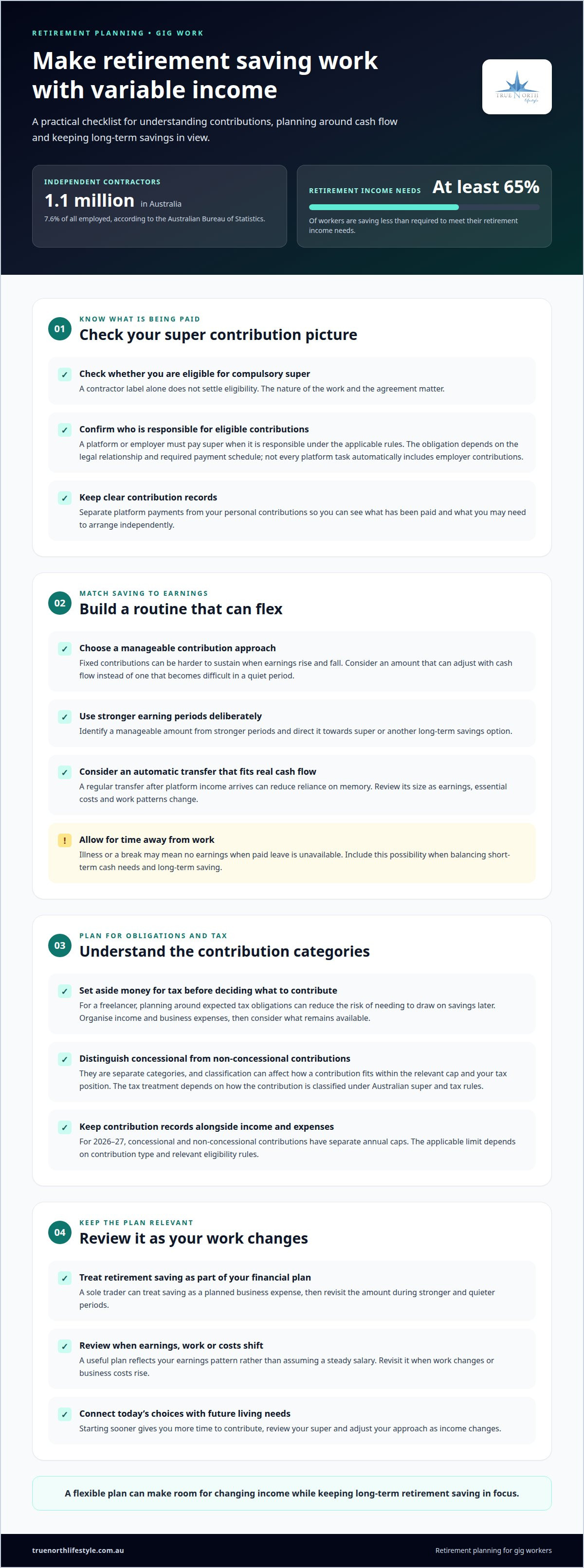
Gig work can offer flexibility, but income and benefits may differ from those available to employees. According to the Australian Bureau of Statistics, there were 1.1 million independent contractors, 7.6% of all employed.
Benefits of planning early
Early retirement planning means deciding how to build savings over time, rather than relying on last-minute contributions. Starting sooner gives you more time to contribute, review your super and adjust your approach as income changes. For example, a sole trader can treat retirement saving as a planned business expense, then revisit the amount during stronger and quieter periods. A clear plan connects today’s choices with future living needs.
Compulsory super eligibility and payments
Australian gig workers may be entitled to compulsory super when their working arrangement makes them eligible as employees for super purposes. A contractor label alone does not settle the question: the nature of the work and the agreement matter. Genuine independent contractors generally organise their own retirement saving, including any voluntary super contributions.
A platform or employer must pay super when it is responsible for an eligible worker under the applicable rules. The obligation depends on the legal relationship and required payment schedule, not on every platform task automatically. This distinction matters: a worker who assumes every gig includes employer contributions may overlook a gap in retirement savings.
Gig workers may have fewer employer-sponsored benefits, such as paid leave, than employees. Time away from work can mean no earnings during illness or a break, making it harder to keep contributing. Including this possibility in a retirement plan helps balance short-term cash needs with long-term savings.
There can be benefits for platforms, too. A platform that makes super information accessible or supports voluntary contributions could help workers understand their options and save more consistently. For workers, clear contribution records can make it easier to see whether super is being paid or needs to be arranged independently.
The Gig Economy and You: What Does It Mean For Your Retirement?
Gig workers can shape retirement saving around variable earnings, but need to understand contribution options and their tax treatment. For 2026-27, concessional and non-concessional contributions have separate annual caps; the applicable limit depends on contribution type and relevant eligibility rules.
Government and platform contributions
Government incentives and platform support may help workers engage with retirement saving, but they are not interchangeable. A platform could provide contribution records or make it easier to direct part of an earning towards super. This support can clarify the options without implying that every platform contributes automatically.
For a gig worker in Miranda, the practical first step is to identify which contributions are actually being made. Clear records help distinguish platform payments from personal contributions and show what to include in a broader savings plan.
Tax relief on voluntary contributions
The tax treatment of a voluntary contribution depends on how it is classified under Australian super and tax rules. Concessional and non-concessional contributions are distinct categories, and the classification can affect how a contribution fits within the relevant cap and the saver’s tax position.
A freelancer can keep contribution records alongside income and business expenses, then consider the tax effect as part of their overall financial planning. This avoids assuming every super payment has the same tax outcome, particularly when earnings vary during the year.
Automating retirement contributions
An automatic transfer can move a chosen amount into retirement savings regularly, reducing reliance on memory. A gig worker might arrange a transfer after platform income arrives, then review its size as earnings and essential costs change.
Automation should fit real cash flow, not create pressure during quieter periods. Some workers may prefer a modest recurring transfer; others might add contributions after stronger earning periods. Reviewing the arrangement when work patterns shift helps keep saving manageable and aligned with longer-term retirement goals.
Retirement savings challenges for gig workers
Variable income can make regular retirement saving difficult, while tax obligations compete for available cash. A flexible plan accounts for both without treating every earning period as equally strong.
Saving with irregular income
Irregular income means earnings rise and fall, making fixed contributions harder to sustain. A quiet month may leave little room for retirement savings after essential costs, while a busy period may offer more capacity. Consider a contribution approach that can adjust with cash flow, rather than an amount that becomes difficult to maintain.
To start or increase saving, identify a manageable amount from stronger earning periods and direct it towards super or another long-term savings option. At least 65 percent of workers are saving less than required to meet their retirement income needs. A goal can help turn occasional contributions into a deliberate pattern.
Tax obligations and retirement planning
Tax obligations affect how much income remains available for living costs and retirement saving. For a freelancer, setting aside money for tax before deciding on a contribution can reduce the risk of needing to draw on savings later. Organise income and business expenses, then plan contributions around the cash left after expected obligations. For independent contractors running growing enterprises, engaging specialised business accounting and advisory support from True North Consulting can make tracking income, deductions, and ongoing tax commitments far more manageable.
Tax and income fluctuations can also change how much you can contribute across the year. A retirement plan is more useful when it reflects your earnings patterns rather than assuming a steady salary. Review it when your work changes or business costs rise—such as outfitting a home workspace with EKOBOR Office Ergonomic Furniture or upgrading essential equipment—to ensure short-term operational expenses remain balanced with your long-term goals.
Retirement savings options
Freelancers can consider super contributions alongside savings held outside super. Super can form part of a long-term retirement strategy, while accessible savings can help meet nearer-term needs. The right balance depends on when you may need the money, your income pattern and your retirement goals.
Relying on super alone exposes savings to investment fluctuations and may not suit every cash-flow need. Savings held outside super can also lose purchasing power over time. The Age Pension may contribute to retirement income, but relying on it alone leaves less control over the lifestyle your own resources can support.
Flexible ways to build savings
Flexible saving means matching contributions to what your income can support, then reviewing the approach as circumstances change. Set a retirement savings goal, identify an amount you can contribute during stronger earning periods and consider automatic transfers that can be adjusted when income shifts.
For example, a freelancer could begin with a modest recurring contribution, then add more after a stronger month. Keep a cash buffer for unexpected expenses so short-term pressure does not repeatedly disrupt long-term saving. Review the approach when work, costs or retirement goals change.
Access to retirement accounts and financial education
Gig work can leave retirement saving less connected to an employer’s systems. Portable access and clear financial education help individuals make informed decisions across changing jobs and income sources. For retirement planning for gig economy workers in Miranda, understanding how personal accounts fit across platforms is a useful starting point.
Access to retirement accounts
Access means being able to make and manage retirement contributions without relying on one employer’s plan. For Australian gig workers, super can remain part of a personal strategy even when work moves between platforms or clients.
A retirement arrangement tied to the individual, rather than one workplace, can make saving more portable. For example, a freelancer changing clients can keep a long-term savings approach in view as income sources shift. Clear account information also helps workers understand whether contributions are being made or need to be arranged themselves.
Retirement planning and financial education
Financial education explains how retirement accounts, investment choices and contribution decisions fit together. For someone balancing gig work with household spending, understanding these basics can turn financial planning into considered decisions rather than guesswork.
A useful learning approach is to connect each decision to a practical question: what income is available, what needs to remain accessible, and what can be set aside for later? Financial wellness information can also help platforms explain saving options and encourage workers to plan beyond their next payment. For gig workers in Miranda, retirement planning can be easier to organise when information is clear and connected to real financial decisions.
Financial planners for gig workers
A financial planner can help connect changing income with retirement goals and savings choices. For example, planning can account for variable earnings, existing super and the retirement lifestyle someone wants to support.
For gig workers, the benefit is a coordinated long-term view, rather than treating each contribution or investment decision in isolation. Retirement modelling can illustrate how different saving patterns may affect future income. A planner can also help consider how super, other assets and expected retirement income fit together as work circumstances change.
If you’re ready to bring your retirement goals and changing income into one plan, explore tailored retirement planning.
True North Lifestyle: Retirement modelling & long-term projections
True North Lifestyle helps gig workers bring variable income, super and retirement goals into one considered plan. Retirement modelling & long-term projections can show how different saving patterns may shape your longer-term position and help you assess whether your current approach aligns with the future you want.
This support can be useful when your income changes, you are unsure how much to direct towards retirement, or you want to review your super strategy. Depending on your circumstances, tax-minimisation strategies, superannuation review & optimisation, and bespoke portfolio construction can also form part of a broader plan.
For a considered discussion about your retirement goals, contact True North Lifestyle in Miranda.
Give your retirement goals a clear direction
Your next step is to turn a broad retirement goal into a practical plan that reflects your working life. For retirement planning for gig economy workers in Miranda, that means connecting your preferred future lifestyle with income patterns, existing super and a sustainable savings approach. A clear projection helps show how today’s choices relate to your longer-term position.
True North Lifestyle offers retirement modelling and long-term projections, tax-minimisation strategies, and superannuation review and optimisation. These services bring key financial decisions into one considered strategy, connected to your retirement objectives.
When you’re ready to explore how a tailored plan could fit your circumstances, contact True North Lifestyle. A thoughtful next step can bring greater clarity to the future you’re building.
Frequently Asked Questions
How can gig workers manage their finances?
Start by separating work-related income and expenses from household spending. For example, a delivery worker can track platform payments, fuel and other work costs, then plan personal spending from what remains. Keep money for upcoming tax obligations separate from day-to-day funds, and review the budget when client work or platform earnings change. This gives you a clearer view of available cash before making longer-term commitments.
What retirement savings options are available to gig economy workers in Australia?
Australian gig workers can consider personal super contributions and savings or investments held outside super. A worker moving between clients might use their existing super account as the central record of retirement contributions, while relying on accessible savings for nearer-term goals. The choice depends on when funds may be needed, income stability, investment preferences and retirement objectives. Review these options together so each has a clear role in your overall plan.
How can self-employed gig workers make personal super contributions and claim tax deductions?
Self-employed workers can make personal contributions to super, then assess whether a deduction is available under applicable Australian tax rules. Keep clear records of contribution dates and amounts, and distinguish personal payments from any employer contributions. Before claiming a deduction, consider your eligibility and its effect on your broader tax position. Tax-minimisation strategies can place super contributions within a wider financial plan, but not every contribution is automatically deductible.
What government retirement benefits can gig workers receive, including the Age Pension and tax offsets?
Depending on eligibility, gig workers may receive the Age Pension, and some may qualify for tax offsets. These are separate from super: the Age Pension provides government retirement income support, while an eligible tax offset affects tax payable. Include possible government support in retirement projections alongside super and other income sources. The amount and availability depend on individual circumstances, so do not build a retirement budget on an assumed entitlement alone.
What retirement planning services and financial advisers are available in Miranda, NSW?
In Miranda, NSW, True North Lifestyle provides financial planning and retirement strategy services for individuals and businesses. Support relevant to gig workers includes retirement modelling and long-term projections, superannuation review and optimisation, and tax-minimisation strategies. These services help connect irregular work income with longer-term objectives. Speak with an adviser about your work arrangements, current super position and the retirement outcomes you want to plan towards.


