

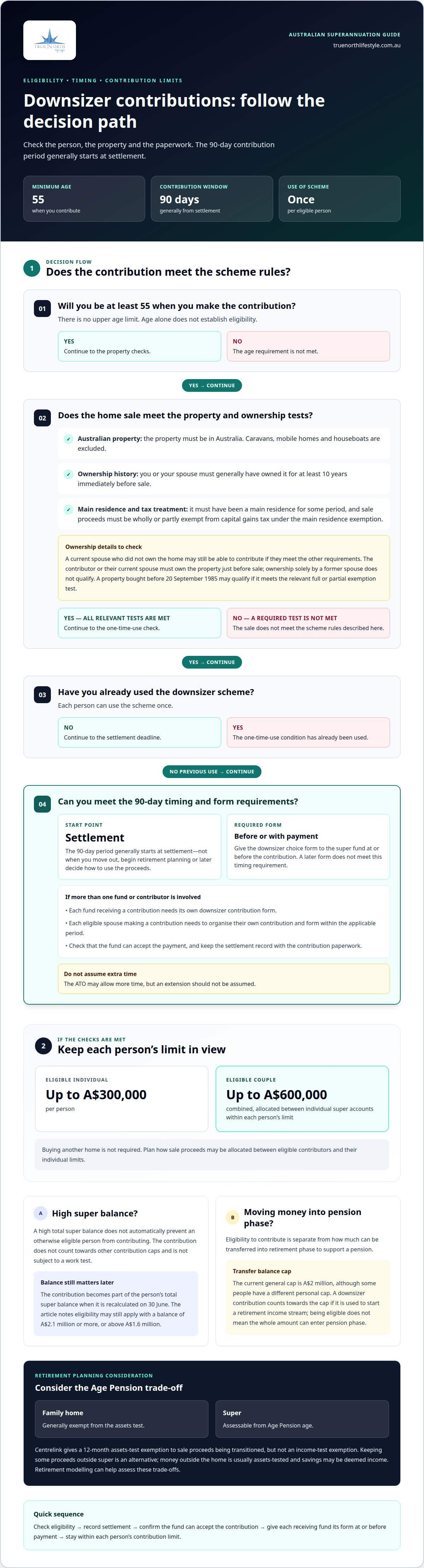
The 90-day period for making a downsizer contribution generally starts at settlement of the home sale. Eligible individuals can contribute up to A$300,000, while eligible couples can contribute up to A$600,000 combined. A downsizer super contribution strategy in Miranda 2228 should account for these limits and the timing before sale proceeds are allocated.
It’s understandable to want clarity before making a significant decision with the proceeds from your home. The timing, eligibility rules and effect on your super balance all matter, but they can be considered in a clear order.
This guide explains when the 90-day period begins, how age and super balance affect eligibility, and how the contribution limits work for individuals and couples. You’ll have a clearer framework for understanding what may apply to your circumstances.
Key Takeaways
- Assess age, ownership history and main-residence status together to understand whether a home sale may qualify.
- Mark settlement as the starting point for the contribution deadline and factor in the required form.
- A high super balance alone doesn’t rule out a downsizer contribution, but consider how it may affect your retirement planning.
- For a couple, plan how the proceeds could be allocated between individual super accounts within each person’s limit.
Is there a maximum age for downsizer contributions?
There’s no upper age limit for an Australian downsizer contribution. You must be at least 55 when you make it. A downsizer super contribution strategy in Miranda 2228 may suit eligible homeowners selling property, but age alone doesn’t establish eligibility. The property, its ownership history and its connection to your main residence also matter.
The home must generally have been owned by you or your spouse for at least 10 years immediately before sale. It must have been your main residence for some period, but not necessarily throughout those 10 years. A partial main residence exemption can be enough. A property you never used as a main residence doesn’t qualify.
The sale proceeds must be wholly or partly exempt from capital gains tax under Australia’s main residence exemption. A property bought before 20 September 1985 may qualify if it meets the relevant full or partial exemption test. The property must be in Australia. Caravans, mobile homes and houseboats are excluded.
Ownership details can catch people out. A current spouse who didn’t own the home may still contribute if they meet the other requirements. The contributor or their current spouse must own the property just before sale; ownership solely by a former spouse doesn’t qualify. Each person can use the scheme once, and buying another home isn’t required. The 90-day contribution period begins at settlement, so overlooking that date can put the deadline at risk.
For Miranda homeowners, the strategy can work if the Australian property sale and personal eligibility meet these rules. The main risk is its effect on the age pension: the family home is generally exempt from the assets test, while super is assessable from Age Pension age. Centrelink gives a 12-month assets-test exemption to sale proceeds being transitioned, but not an income-test exemption. Keeping some proceeds outside super is an alternative, though money outside the home is usually assets-tested and savings may be deemed income. Retirement modelling can help assess these trade-offs.
When does the 90-day requirement to make the contribution start?
In Australia, the 90-day period generally starts at settlement of the home sale. It doesn’t begin when you move out, start planning retirement or later decide how to use the proceeds. Treat the settlement date as the key point in your timeline, even if the money reaches your account later. The ATO may allow more time, but an extension shouldn’t be assumed.
This timing matters for each eligible contributor. If spouses both plan to contribute, each person needs to organise their own contribution within the applicable period. A home’s ownership history, including the 10-year ownership requirement, is part of eligibility; it doesn’t change when the deadline starts. Keep the settlement record with your contribution paperwork so the relevant date is clear.
The downsizer choice form must be given to the super fund at or before the contribution is made. Sending the money first and following with the form later doesn’t meet that timing requirement. Contact the fund before contributing to check it can accept the payment. This gives you time to address the fund’s process while the 90-day window is still running.
Contributing to multiple super funds adds a paperwork step: you need a separate downsizer contribution form for each fund receiving a contribution. For example, if one eligible person contributes to two funds, each fund needs its own form by the time it receives the payment. A spouse contributing to a separate account also needs to submit the correct form for that contribution.
Build the deadline into your sale-to-super plan. Note settlement, allow time for the fund’s acceptance process and submit the relevant form with each payment. The 90-day rule is about timing and paperwork, not whether a contribution will count towards your total super balance or other contribution caps. An estate planning strategy can also help place super decisions in the context of your longer-term plans.
If I have a high total super balance, does this prevent me from qualifying?
No. A high total super balance doesn’t automatically prevent an eligible person from making a downsizer contribution. The key distinction is between eligibility to contribute and how super is treated when money moves into a retirement pension.
Contribution caps and total super balance
A downsizer contribution may be treated differently from some other super contributions. This means a person may qualify even with a balance of A$2.1 million or more, or above A$1.6 million.
It also isn’t subject to a work test. That exemption can matter for older Australians who want to add sale proceeds to retirement savings. The contribution still becomes part of the person’s total super balance when it’s recalculated on 30 June. A high balance doesn’t erase the eligibility conditions or the contribution deadline.
Keep the distinction clear: the contribution itself doesn’t count towards other contribution caps, but it does affect the balance recorded at the financial year’s end. That later balance may matter for other super rules. The contribution must still meet the scheme’s requirements, including the 90-day timeframe.
Transfer balance cap implications
The transfer balance cap limits how much super a person can transfer into retirement phase to support a pension. A downsizer contribution counts towards this cap if it’s used to start a retirement income stream. So, being eligible to contribute doesn’t mean the entire amount can enter pension phase.
The current general cap is A$2 million, although some people have a different personal cap. For example, someone with little remaining transfer balance cap space may be able to make an eligible downsizer contribution, but not transfer all of it into a pension. Any amount retained outside retirement phase remains in super and is treated under the applicable rules.
Separate the decisions: first, assess whether the contribution qualifies; then consider how it fits your transfer balance cap and retirement income plans. This helps prevent mistaking an exemption from contribution limits for an exemption from pension-phase limits.
Contribution limits for individuals and couples
Each eligible person can contribute up to A$300,000 from the proceeds of selling a home. An eligible couple can contribute up to A$600,000 combined, with each person’s limit applying separately. The contribution cannot exceed that person’s share of eligible sale proceeds. It’s not a concessional contribution, isn’t tax deductible and isn’t taxed when paid into super.
How a couple divides contributions depends on their circumstances and the amount available. If a home sells for A$800,000, the couple may contribute A$600,000 combined under the downsizer measure, leaving A$200,000 outside that limit. If the sale proceeds are A$400,000, they could contribute A$200,000 each, or allocate A$300,000 to one super account and A$100,000 to the other.
The title doesn’t have to include both partners. For example, after a A$600,000 sale, each spouse may be able to contribute up to A$300,000, even if only one spouse was named on the title. Both still need to meet the other eligibility rules, and each person can make a downsizer contribution only once. The split should reflect each person’s retirement savings and intended super account balance.
You can’t treat contributions exceeding the available proceeds or an individual’s limit as downsizer contributions under the measure. If a contribution is later found ineligible, the ATO is likely to reclassify it as a non-concessional contribution. An ineligible contribution may affect the recipient’s wider super position.
Before allocating the proceeds, map the proposed split against each person’s eligibility, contribution history and wider super position. For tailored support assessing the contribution strategy alongside your broader financial circumstances, discuss your super contribution plan.
True North Lifestyle: Superannuation review & optimisation
True North Lifestyle can help you assess how a downsizer contribution fits your superannuation and broader retirement plans. A review can consider your existing super accounts, how to allocate the contribution, and how the added savings may affect your retirement income strategy.
This can be useful after a home sale, particularly when weighing contribution limits against pension-phase access, tax-minimisation strategies or estate planning. Retirement modelling can bring these factors together, helping you assess the proceeds in light of your longer-term priorities, not just the immediate contribution opportunity.
If you’d like to discuss how a downsizer contribution fits your circumstances, contact True North Lifestyle.
Make your next decision part of a wider plan
A home sale can create a rare opportunity to reshape how your retirement savings support the life you want next. Rather than treating the super payment as an isolated transaction, consider how it fits with income needs, future flexibility and the legacy you hope to leave. That broader perspective can give a downsizer super contribution strategy in Miranda 2228 a clearer purpose.
True North Lifestyle brings superannuation review and optimisation together with retirement modelling and long-term projections. Tax-minimisation strategies can also form part of your plan, helping you consider the contribution alongside your wider financial position. The aim is to clarify your choices and their implications, not rush you towards a particular outcome.
If you’re ready to explore how the proceeds could support your plans, contact True North Lifestyle to discuss your next step. A considered plan can help you move forward with greater clarity.
Frequently Asked Questions
Can my spouse make a downsizer contribution if I own the property?
Yes. Your current spouse may be eligible even if the property title is only in your name. They must still meet the scheme’s other requirements, including the minimum age and main residence exemption conditions. For example, a spouse who didn’t own the home may contribute from its sale proceeds if eligible. A former spouse’s ownership alone doesn’t establish eligibility for your current spouse.
Does the contribution count towards my non-concessional contribution cap?
No. An eligible downsizer contribution doesn’t count towards your non-concessional contribution cap. It’s a separate contribution category, not a concessional contribution or a deductible payment. Keep evidence that the contribution meets the downsizer rules: if it’s later found ineligible, the ATO may treat it as a non-concessional contribution. That reclassification could affect other contributions made during the relevant period.
Does the property need to be my home at the time of sale?
No. The property doesn’t have to be your home when it’s sold, but it must have been your main residence for some period and qualify for a full or partial main residence exemption. For instance, a former home that became a rental may still meet this condition. A property never used as your main residence doesn’t qualify under this test.
How does it work?
After an eligible Australian home sale, qualifying proceeds can be contributed to super as a downsizer contribution. The fund must receive the required choice form at or before the payment. The contribution generally needs to be made within the deadline measured from settlement. If both spouses contribute, each payment goes into the relevant person’s super account, with a separate form for each.
What is the downsizer super contribution strategy in Australia?
A downsizer contribution lets eligible Australians put some proceeds from selling a qualifying home into super, subject to individual contribution limits. It isn’t tax deductible and isn’t taxed when it enters super. Its usefulness depends on more than the amount transferred: consider retirement income needs, super arrangements and any age pension implications before deciding how much to contribute.
Who is eligible to make a downsizer super contribution?
A person must be at least 55 when making the contribution and meet the property and sale conditions. Generally, they or their spouse must have owned the Australian property for at least 10 years immediately before sale. The home must have been a main residence for some period, with sale proceeds eligible for a full or partial main residence exemption. A person can use the scheme once.


