

The first aged care means test is not the calculator result. For families using an aged care means test calculator in Sutherland Shire, My Aged Care’s estimators provide a free, anonymous way to estimate fees before applying. They are a guide, not a final assessment: the estimator uses a simplified flat rate above the asset-free threshold, while the official means test uses a tiered taper, so actual costs may differ.
It’s understandable to want a clear figure before making decisions about care, accommodation and household finances. The first assessment considers income and assets, and the formal assessment determines the applicable fees. This article explains what the estimators show, how residential means testing works, who may qualify for subsidised aged care and what information matters at the outset. An estimate is a useful starting point, but it cannot show exactly how the assessment will apply to your circumstances.
Key Takeaways
- Understand why the date someone enters residential care can affect which fee arrangements apply.
- Learn the age and assessment requirements that shape access to government-subsidised aged care.
- See which personal and financial details matter when the first formal assessment is prepared.
- Explore how fee caps and the treatment of assets can influence longer-term aged care planning.
Residential aged care means testing
Residential aged care costs combine daily living charges, accommodation payments and contributions shaped by a formal income and assets assessment. The fee rules depend partly on when someone entered care, including changes introduced from 1 November 2025.
How means assessments determine fees
A means assessment considers a resident’s income and assets to calculate applicable aged care contributions. Services Australia or the Department of Veterans’ Affairs completes the formal assessment. Each member of a couple is assessed on half their combined income.
The basic daily fee is not means-tested and helps cover meals, cleaning, laundry and administration. For people entering residential care from 1 November 2025, the means-tested care fee was replaced by a hotelling contribution and a non-clinical care contribution. If a protected person, such as a partner, remains in the home, the principal home is exempt from the residential means test.
Estimating residential aged care fees
My Aged Care offers free, anonymous fee estimators to help estimate care costs before applying. The residential estimator gives an indicative result, not the outcome of a formal assessment.
The estimator’s simplified flat rate above the asset-free threshold differs from the official means test’s tiered taper, so the estimate and assessed contribution can vary. The estimator also warns that actual costs may differ. A person’s circumstances, type of care and provider charges all affect costs, particularly when financial details are missing.
Residential care accommodation costs
Accommodation costs are separate from daily living fees and means-tested care contributions. A resident may pay through a refundable accommodation deposit (RAD), a daily accommodation payment (DAP), or a combination of the two.
A RAD is a lump sum for a room and works like an interest-free loan to the aged care home. It is generally refundable when the resident leaves, or returned to their estate if they die. A DAP is non-refundable, similar to rent, and calculated using a government-set interest rate. A RAD or refundable accommodation contribution counts as an assessable asset, even when someone else pays it.
Income and asset thresholds and fee caps
Thresholds and caps help determine contributions, but the applicable figures depend on entry arrangements. For entrants from 1 November 2025, the maximum hotelling contribution is A$8,084 per year, and the maximum non-clinical care contribution is A$39,171 per year.
For residents who entered before 1 November 2025, the residential means-tested care fee has an annual cap of A$37,055.98 and a lifetime cap of A$88,934.57, under the stated 20 September 2026 settings. The former family home included in the means test is capped at A$219,858.40 from 20 September 2026. Financial hardship assistance may help with care costs, depending on circumstances.
Eligibility for government-subsidised aged care
In Australia, age is one part of access to an aged care assessment. A person generally needs to be 65 years or older, or 50 years or older if they are Aboriginal or Torres Strait Islander. The assessment considers support needs and determines eligibility for government funding. Reaching the age threshold alone doesn’t establish that a person qualifies for a particular type of care.
Care needs also matter. An assessment considers how a person manages everyday activities and what support would help. For families evaluating alternatives to facility care, providers of in home personal care services durham nc show how practical daily assistance can help individuals remain supported at home. For someone entering residential care, the care needs and financial assessments serve different purposes: one establishes care needs and funding eligibility, while income and asset information helps determine care costs. A pension may form part of a person’s financial situation, but it does not replace the aged care assessment.
Low means status relates to the financial assessment, not a person’s age or care needs. The assessment considers income and assets, and individual circumstances determine how these affect contributions and accommodation costs. A fee estimate can illustrate possible costs, but it does not establish low means status or confirm government support. The formal assessment determines the applicable outcome.
For a couple, each person’s circumstances remain relevant to the assessment. If financial details are missing or out of date, Services Australia may require information about the applicant and their partner, where applicable. Providing accurate details helps the formal assessment reflect their situation rather than relying on an estimate or incomplete information. People receiving a means-tested income support payment from the Department of Veterans’ Affairs should discuss aged care costs with DVA.
Eligibility decisions can also affect household planning beyond the care assessment. A considered financial plan for aged care can help connect expected contributions and accommodation choices with longer-term family priorities.
The first aged care means test
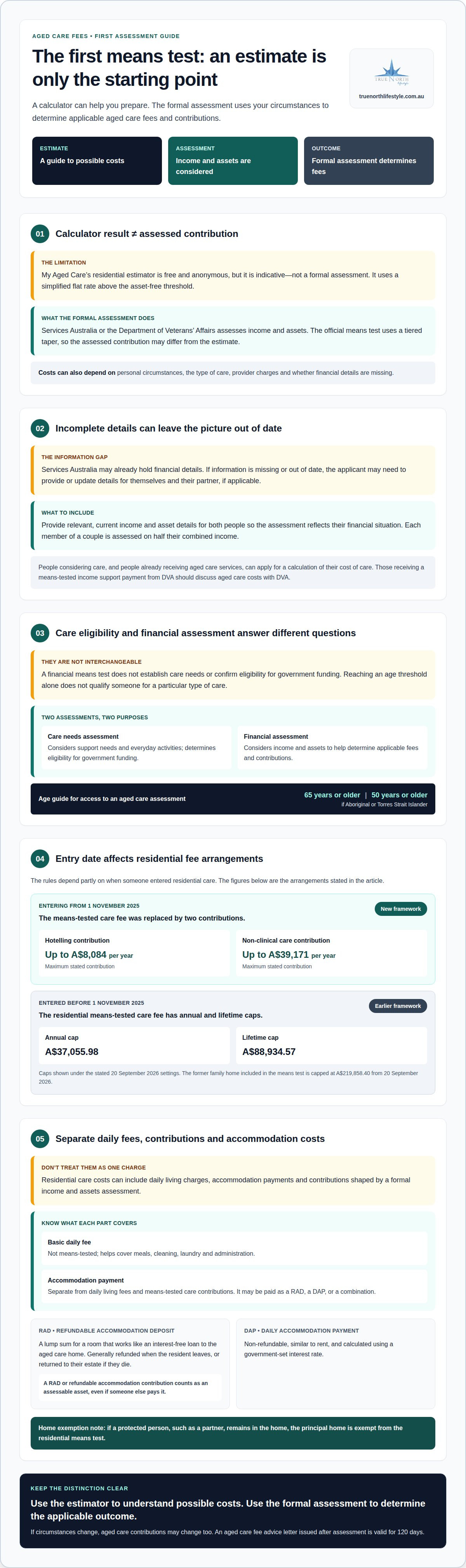
The first means test turns financial information into a formal assessment of aged care costs. Services Australia or the Department of Veterans’ Affairs assesses income and assets to help determine applicable fees and contributions. This is separate from the care needs assessment: one considers finances, while the other establishes support needs and eligibility for government funding.
Services Australia may already hold the applicant’s financial details. If information is missing or out of date, the applicant may need to provide or update details for themselves and their partner, if applicable. Include relevant income and assets for both people so the assessment reflects their current financial situation. People considering care, as well as those already receiving aged care services, can apply for a calculation of their cost of care.
The first assessment also creates a reference point for later changes. An aged care fee advice letter issued after assessment is valid for 120 days. If circumstances change, a person’s aged care contribution may change too. From 1 November 2025, new and continuing residential aged care residents must report changes to personal and financial circumstances within 28 days.
Timing matters. If a resident reports a change within the 28-day timeframe, any resulting increase takes effect when Services Australia updates the means assessment. If they report outside that timeframe, an increase can be backdated by up to 28 days from the update. Services Australia says that when a resident reports a change within the 28-day timeframe, any resulting increase takes effect when it updates the means assessment.
Entering care under different arrangements can also affect which fee rules apply. The income and assets counted, and the treatment of the family home, did not change when the new Act started on 1 November 2025. However, the contribution framework changed for people entering residential care from that date. An initial assessment therefore matters for understanding the applicable arrangements, rather than relying on an estimate alone.
What are the current aged care income and asset thresholds and fee caps?
The applicable thresholds and caps depend partly on when a person entered residential aged care. The arrangements introduced from 1 November 2025 use hotelling and non-clinical care contributions, while some earlier residents remain under previous fee arrangements.
Income and assets affect the formal means assessment, but the assessment applies thresholds and contribution limits rather than treating every dollar alike. For residents on the 1 July 2014 fee arrangements, an income-tested amount equals 50% of income above the income free area. The official assessment uses a tiered taper, unlike the estimator’s simplified flat rate above the asset-free threshold.
The family home has a specific asset cap. From 20 September 2026, the maximum value of a former family home included in the residential aged care means test is A$219,858.40. If a protected person, such as a partner, still lives there, the home is exempt from the means assessment. A refundable accommodation deposit remains assessable, including when another person pays it.
Some payments are excluded. National Redress Scheme payments have been exempt as an asset since 1 January 2025. Specified Stolen Generations redress payments have been exempt since 1 October 2026. These exemptions affect the assets considered, rather than changing the separate accommodation payment chosen for an aged care room.
For residents who entered before 1 November 2025, the stated means-tested care fee cap is A$380.46 per day under the 20 September 2026 settings. The annual cap is A$37,055.98, and the lifetime cap is A$88,934.57. These limits help frame possible contributions under those arrangements.
For entrants from 1 November 2025, the maximum hotelling contribution is A$8,084 per year, and the maximum non-clinical care contribution is A$39,171 per year. To relate these limits to broader estate decisions, discuss an aged care estate strategy.
True North Lifestyle
True North Lifestyle can help you consider aged care decisions as part of your broader retirement plan. If you’re weighing accommodation choices, income needs and how to preserve savings, retirement modelling and long-term projections can bring these factors together in one financial picture.
This planning can consider how superannuation, tax-minimisation strategies and portfolio sustainability fit alongside expected care costs and your other priorities. It does not replace the formal means assessment by Services Australia or the Department of Veterans’ Affairs. Instead, it helps you consider how different decisions may affect your retirement arrangements over time.
If you’re preparing for residential aged care or reviewing your plans after an assessment, book a consultation with True North Lifestyle to discuss your financial planning needs.
Bring your next decisions into focus
An aged care means test calculator in Sutherland Shire can help frame one part of a much wider decision. Consider how your preferred care arrangements fit with retirement income, household priorities and plans to preserve flexibility. Taking a broader view can make family discussions more focused, particularly when decisions affect a partner or other loved ones.
True North Lifestyle supports this planning with retirement modelling and long-term projections, tax-minimisation strategies, and superannuation review and optimisation. These services help you consider financial choices in context, alongside your retirement goals and the lifestyle you want to maintain. The aim is a considered plan shaped around your priorities, not a single estimate in isolation.
If you’d like to explore how aged care decisions fit your financial plans, contact True North Lifestyle to discuss your next steps. A thoughtful conversation can help you move forward with greater clarity.
Frequently Asked Questions
What if I am worried about the cost?
Start with an estimate to see how care charges may fit your budget. My Aged Care’s fee estimators are free and can be used anonymously before applying. For households in the Sutherland Shire, an aged care means test calculator can help frame questions about affordability, but it is not a formal assessment. Aged care financial hardship assistance may help with costs, depending on individual circumstances.
What if you disagree with the result?
Contact the agency responsible for the assessment and ask about starting a review. In Australia, you can call Services Australia on 1800 227 475 to discuss an aged care assessment and start a review. If you receive a means-tested income support payment from the Department of Veterans’ Affairs, contact DVA on 1800 838 372 about aged care costs. Explain which part of the result concerns you.
What is means testing and how does it work?
Means testing uses financial information to determine aged care contributions. The assessment considers relevant income and assets, including a partner’s details where applicable, and applies the rules for the person’s care arrangements. For a couple, each person is assessed on half the couple’s combined income. This helps distinguish a person’s assessed contribution from charges that apply regardless of their financial means.
What is the means-tested care fee?
The means-tested care fee was a contribution towards residential care costs for residents under earlier fee arrangements. It was separate from the basic daily fee and accommodation payments. For residents entering care from 1 November 2025, this fee was replaced by a hotelling contribution and a non-clinical care contribution. Residents on the 1 July 2014 arrangements may still pay a means-tested care fee if their assessment finds they can contribute.
Who needs a means assessment?
People considering or already receiving aged care services can apply for a calculation of their care costs. A formal income and assets assessment is needed to determine applicable fees. Anyone who skips the means assessment is automatically charged the maximum possible fees. Services Australia may already hold financial information, but missing or outdated details may need to be updated, including a partner’s information where relevant.
How does the Australian aged care means test work in 2026?
In 2026, the rules applied depend partly on when a person entered residential aged care. Entrants from 1 November 2025 fall under the newer contribution arrangements, while earlier residents may remain under previous fee arrangements. Aged care fees and charges are updated twice yearly, on 20 March and 20 September. This means an estimate can change as settings are updated, so note its date.


