

What if the most useful retirement projection isn’t a single answer, but a set of scenarios showing how your plans might hold up as life changes? If you’re considering retirement modelling Sydney, you may want to know whether your superannuation and other resources can support the lifestyle you have in mind as costs and inflation change.
A projection’s value depends on the information and assumptions behind it. A tailored model makes those assumptions visible, compares different possibilities and helps identify where your plan may need attention. It can’t promise what the future will bring, but it can give you a clearer basis for decisions today.
This article explains how retirement modelling connects your goals and financial details to practical projections, how scenario comparisons can reveal strengths and pressure points, and how inflation, superannuation, tax and investment strategy can shape the picture. You’ll also find steps to prepare for a discussion and make the most of your projections.
Key Takeaways
- Understand what a retirement projection can show and why results depend on the information and assumptions used.
- Prepare for retirement modelling Sydney by gathering details about your superannuation, investments, income needs and intended retirement timing.
- See how comparing scenarios can reveal where changing costs may put pressure on your plans.
- Go into an advice discussion with lifestyle priorities and questions, not just a fixed savings target.
- Learn how True North Lifestyle uses tailored modelling, scenario comparisons and conservative, real-world assumptions to inform practical recommendations.
Retirement modelling in Sydney: what it can tell you about your future
Retirement readiness isn’t captured by one savings target. The amount you may need depends on the lifestyle you want, when you plan to retire, your likely income and how your resources could change over time. For Sydney households, housing, travel and everyday spending priorities vary widely. A useful model reflects your circumstances rather than relying on a standard template.
In brief: Retirement modelling estimates how your finances may support your goals under stated assumptions. It helps inform decisions, but it doesn’t guarantee a particular balance or income.
That distinction matters. Changing the information or assumptions can change the results. Use the model to understand the choices in front of you, not as a prediction of exactly what will happen.
What does a retirement model estimate?
A model brings together your financial starting point, the assumptions used and the outcomes those inputs may produce. Starting information may include superannuation, investments, other income and expected spending. Assumptions may cover investment performance, inflation, retirement timing and how long your savings may need to support you.
These projections can help you assess whether your current direction appears aligned with goals such as reducing work, retiring at a particular time or maintaining a preferred lifestyle. They can also show which inputs have the greatest effect, helping you focus on decisions that matter rather than a headline balance alone.
Retirement planning considers lifestyle and potential income streams together. The Retirement Planning Overview provides broader context. A tailored model applies assumptions to your own financial position. If the projection shows a possible shortfall, treat it as a prompt to review timing, spending expectations or strategy, not as a verdict.
Who can benefit from retirement modelling in Sydney?
Retirement modelling can be useful whether retirement is approaching or still years away. Those planning ahead may have more time to review their approach. People nearing retirement can compare how different timings or income choices may affect their plans. Individuals and couples can both benefit, with the model reflecting their distinct goals, resources and priorities.
Professionals and business owners may also need to consider how their financial arrangements connect with personal goals. The aim is to make the moving parts easier to understand and identify what may deserve attention.
For people in Miranda and the wider Sydney area, True North Lifestyle offers tailored retirement modelling and long-term projections. Its local presence in Miranda connects personal goals with advice grounded in your circumstances, rather than a generic retirement target.
How retirement modelling works: inputs, assumptions and projections
A useful projection is built in stages, not produced from a single balance. Retirement modelling Sydney connects your goals with financial information, then applies stated assumptions to explore how your position may develop. Each stage matters: incomplete details or unclear priorities can make results harder to interpret and act on.
Projection quality depends on the quality of the inputs and assumptions. The aim isn’t to remove uncertainty. It’s to make the reasoning clear, so you can understand what the projections suggest and which decisions may influence them.
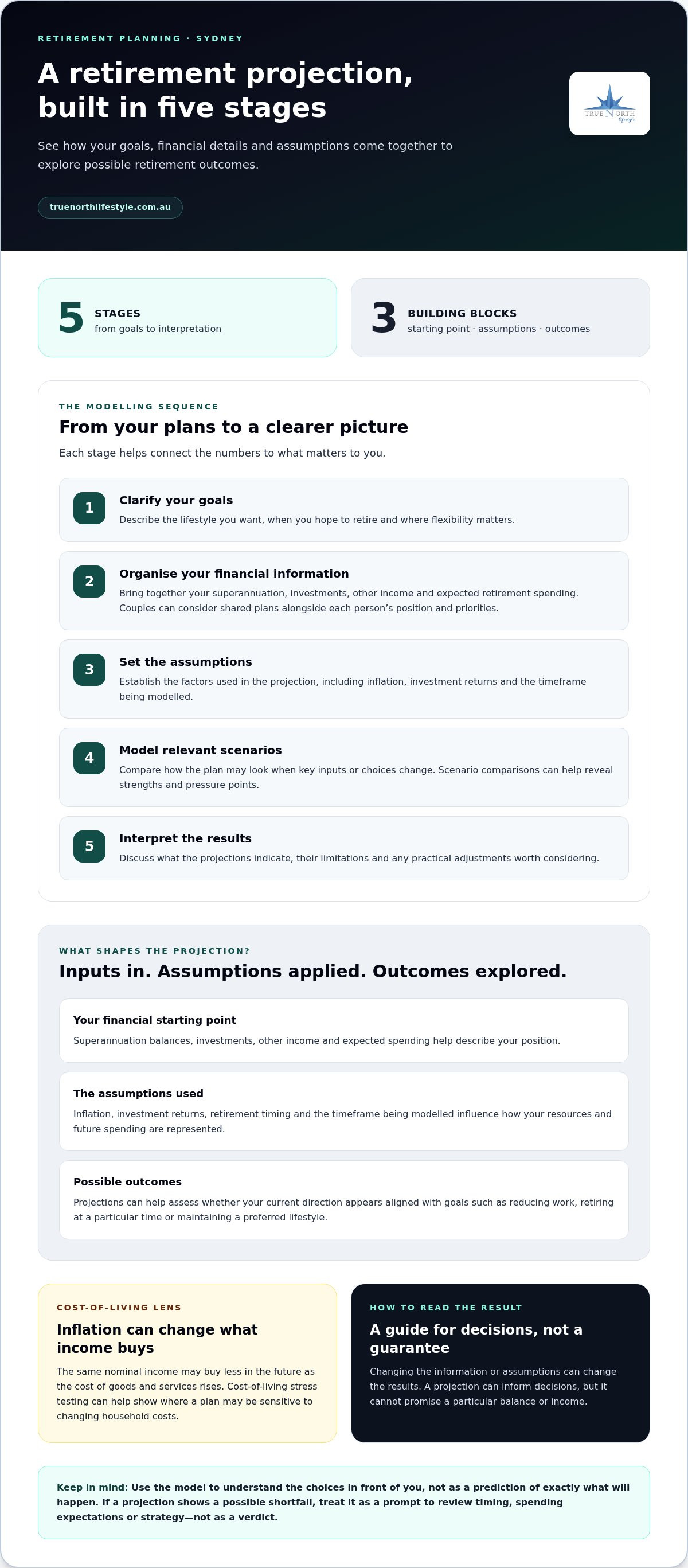
The modelling process generally follows this sequence:
- Clarify your goals. Describe the lifestyle you want, when you hope to retire and where flexibility matters.
- Organise your financial information. Bring together details of superannuation, investments, income and expected retirement spending.
- Set the assumptions. Establish the factors used in projections, including inflation, investment returns and the timeframe being modelled.
- Model relevant scenarios. Compare how the plan may look when key inputs or choices change.
- Interpret the results. Discuss what the projections indicate, their limitations and any practical adjustments worth considering.
What information helps build a useful projection?
Start with an accurate snapshot of your finances and a clear description of your intended retirement. Useful details may include superannuation balances, investments, other income, regular spending and the age or stage at which you hope to change or stop work. Couples can consider shared plans alongside each person’s financial position and priorities.
Clear information helps an adviser connect the numbers to your goals and explain how the projection was developed. The Australian Government Retirement Planning Guide offers general information, while tailored modelling brings personal circumstances and assumptions into the discussion. You don’t need every answer before you begin. It’s useful to identify what you know and what remains uncertain.
How assumptions shape long-term projections
Assumptions influence how your resources and future spending are represented over time. For example, inflation means the same nominal income may buy less in the future as the cost of goods and services rises. Changes in household costs can also affect the lifestyle a projected income could support. Cost-of-living stress testing can help show where a plan may be sensitive to these changes.
Conservative, real-world assumptions provide a disciplined way to examine uncertainty, but they can’t eliminate it. Actual investment performance, expenses and personal circumstances may differ from the model. Read results alongside the assumptions and limitations, rather than treating a projected balance as a promise. True North Lifestyle’s retirement modelling uses tailored projections to help structure this discussion.
Compare retirement scenarios instead of relying on one forecast
A single projection can look reassuring while hiding how sensitive the result is to changing conditions. Comparing scenarios makes those sensitivities easier to see. Rather than asking which forecast will come true, consider what different assumptions could mean for your choices and where your plan may need flexibility.
Retirement modelling Sydney can compare changes to retirement timing, spending needs or investment conditions. The table below sets out questions each scenario can raise. It doesn’t predict which situation will occur or assign a likelihood to it.
| Scenario to explore | Assumption being changed | What to review |
|---|---|---|
| Retire later than planned | Employment income continues for longer before retirement begins | Would the revised timing support your goals, and how might it affect your planned transition from work? |
| Higher living costs | Retirement spending rises more than assumed as prices change | Which expenses have the greatest effect, and could your lifestyle priorities or spending plan adapt? |
| Less favourable investment conditions | Investment outcomes differ from the central assumptions | How sensitive is the projection, and what does that suggest about risk and portfolio sustainability? |
| Different spending pattern | Your expected income needs change across retirement | Do your projected resources remain aligned with the lifestyle you want at each stage? |
What should a retirement scenario comparison show?
A useful comparison makes the changed input clear, then explains its implications without implying certainty. For example, model a later retirement date while keeping other assumptions consistent, then compare the result with the original plan. This helps isolate the effect of timing. Repeat the process for spending or investment conditions to see which choices are within your control and which may need monitoring.
How stress testing can make a plan more resilient
Stress testing examines how a plan responds when costs rise or other assumptions become less favourable. Inflation can reduce the purchasing power of future income, while higher household costs may put additional pressure on resources. Testing these possibilities can reveal a potential shortfall and prompt a review of goals, timing, spending assumptions or strategy. It doesn’t remove uncertainty or guarantee resilience, but it gives you a clearer basis for decisions.
Look beyond which scenario produces the most comfortable projection. Ask what drives the difference, whether the assumptions make sense for your circumstances and what practical options each result brings into view. A tailored comparison turns a forecast into a planning conversation. It isn’t a verdict on your retirement, but a structured way to consider trade-offs and prepare for different conditions.
Prepare for a retirement modelling conversation in Sydney
A useful discussion starts with more than a target balance. Think about what you want retirement to look like, what financial details you have and which questions you’d like answered. You don’t need a perfectly organised file or a fixed plan. A sense of your priorities and uncertainties gives the conversation direction.
Preparing for retirement modelling Sydney can help make projections more relevant to your circumstances. It also gives you a chance to understand what the model can show, which assumptions shape its results and what it can’t predict with certainty.
What to gather before reviewing retirement projections
Collect what’s readily available. Complete information is helpful, but missing details don’t need to stop you preparing. Notes about your plans can be just as valuable as financial documents when discussing the life you want.
- Recent information about your superannuation and investments.
- Details of income sources and regular spending, including costs you expect to change in retirement.
- Your preferred retirement timing, or a range of dates you’re considering.
- Lifestyle priorities, such as travel, time with family, volunteering or continuing some paid work.
- Questions or uncertainties, including concerns about inflation, investment performance or how long your resources may need to last.
Use this as a starting point, not a test. An adviser can use your available information and personal context to shape relevant projections, identify gaps and explain which details would make the model more useful. If your plans are evolving, describe the options you’re weighing rather than forcing them into one fixed target.
Questions that help you interpret a retirement model
Understanding how a projection was built matters as much as reviewing the result. These questions can keep the discussion clear and focused on decisions you can consider.
- Which assumptions have the greatest influence on this projection?
- How have inflation and changing living costs been considered?
- What changes if I retire earlier or later, or my spending needs differ?
- What does a potential shortfall signal, and which goals or strategies could be reviewed?
- What can this model help me decide, and what does it not account for?
- How and when should we review the plan as my circumstances or assumptions change?
Ask for plain-language explanations, including the limits of the projection. A model supports decision-making, but it can’t establish exactly what future markets, costs or personal circumstances will be. Understanding its assumptions helps you weigh options without treating one result as a promise.
For broader context on how retirement choices connect with long-term financial strategy, explore this retirement planning guide for Sydney. You can also explore retirement modelling with True North Lifestyle and discuss your goals and financial details.
How True North Lifestyle delivers tailored retirement modelling in Sydney
Good modelling should make the next decision clearer. True North Lifestyle develops tailored retirement projections around your goals and financial position, then compares scenarios to show how different assumptions may affect your plan. Recommendations are explained in context, so you can understand the reasoning behind them.
The modelling uses conservative, real-world assumptions and includes inflation and cost-of-living stress testing. This helps examine how rising expenses could affect future purchasing power and where a plan may be sensitive to change. Results aren’t guarantees, but they can provide a structured basis for considering your options.
Modelling can sit alongside advice on superannuation optimisation, tax minimisation, Centrelink structuring and wealth preservation. These areas are considered as part of your broader retirement strategy, rather than as disconnected decisions.
From projections to a tailored retirement strategy
A projection can inform a strategy, but it doesn’t dictate one outcome. Advice may connect your retirement goals with superannuation, tax and investment considerations, then identify decisions to review. For more context on fund strategy, explore superannuation advice in the Sutherland Shire.
When portfolio construction forms part of the advice, True North Lifestyle draws on its in-house Investment Committee and Resonant Asset Management. This connects portfolio considerations with the assumptions used in your projections while keeping recommendations tailored to your circumstances.
Ongoing reviews as circumstances change
Retirement plans aren’t set and forget. A change in your goals, finances or the assumptions used in a projection may be a reason to revisit the model. Ongoing reviews help keep the plan connected to your circumstances, clarify whether earlier decisions still fit and identify questions that need attention.
True North Lifestyle has a local presence in Miranda and three NSW office locations. You can discuss your priorities with the team without needing to attend in person. The focus is on clear explanations and advice shaped around your circumstances.
Retirement modelling Sydney can’t promise certainty. Its purpose is to help you understand possible paths and choose practical next steps with greater confidence. If you’re ready to discuss your goals and projections, Book your consultation.
Take the next step with greater clarity
Your retirement plan doesn’t need to be settled before you review it. Start with the questions you still have and the lifestyle you hope to support. A thoughtful conversation can help turn uncertainty into priorities you can examine, with room to adjust as your circumstances change.
For retirement modelling Sydney, True North Lifestyle brings experience supporting 1,000+ Australians, including 400+ long-term clients. Its team includes 13+ members, including 4 Certified Financial Planners, and manages $220 M+ in funds under management, excluding direct property assets. These figures provide context, not a promise of any particular outcome. The focus is on tailored advice and decisions you can understand.
Your next step can be a conversation about what matters most to you, what you want your projections to clarify and where you’d like more confidence. Book your consultation with True North Lifestyle and start shaping a considered path towards the retirement you want.
Frequently Asked Questions
What is retirement modelling?
Retirement modelling uses your financial details and goals to explore how your resources may support your plans over time. It can turn a broad concern, such as whether you can reduce work, into a focused discussion about timing, income needs and choices. For retirement modelling Sydney, the value lies in seeing how your circumstances shape the analysis, rather than relying on a generic retirement target.
How accurate are retirement projections?
Retirement projections are estimates, not exact predictions. Their usefulness depends on the information provided and assumptions about factors such as investment performance, spending and inflation. For example, outdated spending details may no longer reflect your plans. Ask which inputs have the greatest effect, what the model leaves out and how alternative assumptions change the results. This helps you use the projection as decision support, not certainty.
Can retirement modelling account for inflation and rising living costs?
Yes. Modelling can include inflation and test how changing expenses may affect the purchasing power of future income. You can also consider costs that may vary, such as healthcare, travel or home maintenance, according to your circumstances. Stress testing these pressures can highlight areas for closer review. It can’t tell you exactly what future prices will be, but it can help you consider how your plans might respond.
How much do I need to retire in Sydney?
There isn’t one reliable figure for every Sydney resident. The amount depends on factors such as housing, desired lifestyle, retirement timing, income sources and whether you’re planning alone or with a partner. Someone intending to travel regularly may have different spending needs from someone focused on local activities. Tailored modelling can connect those priorities with your financial position, rather than treating a general benchmark as a personal answer.
Can I use the Moneysmart retirement planner before speaking with an adviser?
Yes. The Australian Government’s Moneysmart retirement planning resource can help you explore retirement income estimates and organise initial questions. Treat the result as a starting point, not a complete assessment of your circumstances. Note what information you entered and what the estimate didn’t address, such as a specific lifestyle goal, then use those points to guide a more detailed advice discussion.
How often should I review my retirement projections?
Review them when a meaningful change could affect your plans, such as a shift in work, household circumstances, spending priorities or investment arrangements. It can also be useful to revisit assumptions if costs or financial conditions change. Ask your adviser how reviews fit into your ongoing plan and what kinds of changes should prompt an earlier discussion.
Does retirement modelling include superannuation and Centrelink considerations?
It can. Superannuation may form a central part of your retirement resources, while Centrelink structuring can be considered where relevant to your circumstances. The discussion may also connect these areas with income needs, tax-minimisation strategies and wealth preservation. For example, a change in your planned retirement date could make it useful to revisit how these parts of your strategy work together. Advice should reflect your individual position and goals.


