

What if the best first decision after receiving an inheritance is to wait before making a big one? Grief, family responsibilities and a sudden change in your finances can make it feel as though you need to act quickly. For managing inheritance money advice Sutherland Shire residents can use to bring order to the choices ahead, a considered sequence matters more than a rushed investment decision.
You may already know that an inheritance could help reduce debt, support retirement or provide for your family. But cash, property, shares and superannuation death benefits each bring different considerations, and the right approach depends on your circumstances and goals. Australia has no inheritance tax, although tax may apply when inherited assets such as property or shares are sold. Centrelink and retirement outcomes can also depend on how assets are held and used.
This guide explains how to organise the information you’ve received, understand the options and weigh relevant tax, superannuation and Centrelink considerations before deciding what comes next. You’ll see how tailored advice and scenario modelling can help connect an inheritance with your broader financial plan, so decisions feel clearer, more deliberate and aligned with your long-term future.
Key Takeaways
- Pause before committing to a major decision; an inheritance can be organised and considered in stages.
- Separate inherited cash, property, shares and super-related benefits, then map them against your current finances and priorities.
- Compare options by purpose, access to funds, timeframe and risks before deciding what may suit your household.
- Use managing inheritance money advice Sutherland Shire residents can tailor to their circumstances to explore trade-offs and relevant financial considerations.
- Build a staged plan and use scenario modelling to compare possibilities, remembering that projections are not guarantees.
Received an inheritance in the Sutherland Shire? Start by slowing the decision down
An inheritance can arrive while you’re grieving, supporting family members or trying to make sense of unfamiliar paperwork. There may be conversations about what the person who died would have wanted, alongside practical questions about who receives which assets. It’s understandable to feel pressure to decide quickly. But receiving an inheritance doesn’t mean you need to invest, sell property or make a permanent financial choice straight away.
Start with organisation, not allocation. For managing inheritance money advice Sutherland Shire residents can put into practice, the first response can be simple:
- Secure statements, letters and other estate correspondence in one place, and keep copies of important records.
- Write down any known dates or time-sensitive matters, including requests for information or decisions.
- Pause before making choices that could be difficult to reverse, such as selling an asset or committing funds to a long-term arrangement.
This is an administrative step, not a substitute for advice about tax, investments or estate matters. Different assets can have different rules and implications, so gathering information first helps you identify what needs closer attention. For a general explanation of understanding inheritance, including how inheritance relates to succession, you can also consult this broad overview.
What to gather before deciding what the inheritance should do
Make a clear inventory of what you’ve received or may be entitled to receive. Note whether it involves cash, property, shares or a super-related benefit, and record what you know about ownership and the current status of each asset. Collect available statements and correspondence, but don’t assume that one asset’s paperwork explains another’s treatment. If a legal document is unclear, seek qualified guidance from an estate firm such as Aquarius Lawyers to understand its meaning before acting on it.
Keep the list factual. You don’t need to settle every question at once. Mark details that are missing, such as an up-to-date statement or information about an asset, and note who may be able to provide it. A record of what’s known, what’s uncertain and any relevant dates can make later conversations more focused.
How to make room for a considered decision
Separate immediate household needs from decisions about the inheritance’s longer-term role. For example, you might first identify upcoming commitments in your existing budget, while leaving investment or property decisions for a later review. This doesn’t dictate what you should prioritise; it simply distinguishes near-term cash-flow questions from choices that could shape your finances over time.
Where appropriate, include family members who are affected by a decision, while recognising that grief, responsibilities and personal needs differ. General online information can help you identify questions, but it can’t account for your complete financial position or the details of the assets you’ve received. A considered pause gives you room to understand those facts before choosing a direction.
Build a clear financial picture before allocating inherited money
Before comparing what to do with an inheritance, understand what you’ve received and how it fits with your existing finances. Cash, property, shares and super-related benefits aren’t interchangeable: each may raise different questions about access, ownership, ongoing costs and tax treatment. Build a snapshot of your whole position first, rather than treating the inheritance as a separate pool with an obvious use.
Record your household income, regular expenses, debts, savings, existing investments and major commitments. Include upcoming costs you already know about, such as education expenses, home maintenance or a planned reduction in work hours. Then note your near-term needs alongside longer-term aims, which might include greater financial flexibility, retirement income or support for family. There’s no universal priority order; what matters is seeing the trade-offs in the context of your circumstances.
How the asset type can shape the questions to investigate
For cash, consider how much you may need to keep accessible and how it relates to existing savings or debt. For property, record ownership, current use, upkeep and any possible sale or retention decision. For shares, gather holding statements and details of the investments. For a super-related benefit, collect the available benefit and payment information. These details help frame professional advice without assuming identical rules apply to every asset.
Connect the inheritance to your wider financial position
Look at inherited assets alongside what you already own, rather than assessing each in isolation. An inherited share portfolio may overlap with existing investments; property may affect your household’s overall exposure to real estate. Consider whether your retirement timing or income goals have changed, and what level of access to funds you may need along the way. Wealth preservation strategies can provide broader context for thinking about long-term resilience.
Tax and Centrelink outcomes depend on the asset, how it is held or used, your wider circumstances and the rules that apply at the time. Avoid assuming that an inheritance will automatically have a particular tax result or effect on a payment. Instead, note the questions that need current, situation-specific guidance. That distinction matters: a financial snapshot helps you frame decisions, but it doesn’t settle tax or eligibility questions by itself.
This is where managing inheritance money advice Sutherland Shire can help turn scattered details into a clearer picture. Tailored financial advice can connect your assets, cash flow and goals, while long-term projections can help you explore how different assumptions may affect retirement plans. If you’d value support bringing those moving parts together, True North Lifestyle’s tailored financial advice can help you consider the inheritance as part of your broader financial future.
Compare ways to use an inheritance without assuming one choice suits everyone
Once you understand the assets and your wider financial position, compare possible uses against what matters to you. The same option can suit one household and create pressure for another. Consider the purpose, access to funds, timeframe and trade-offs, then identify which questions need tailored financial or tax guidance. The table is a framework for weighing choices, not a recommendation or a prediction of results.
| Option | Purpose and access | Risks and questions to explore |
|---|---|---|
| Retain cash | Keep funds available for planned needs or unexpected changes. Access is generally more direct than with property or long-term investments. | Consider how much flexibility your household may need and whether holding cash supports your goals over time. |
| Reduce debt | Lower or clear a liability, potentially changing your ongoing cash flow. | Compare the debt’s interest and terms with other priorities. Would using funds here leave enough accessible for upcoming needs? |
| Invest | Put capital towards longer-term financial goals, with access depending on the investment. | Values can fluctuate and returns aren’t guaranteed. Consider time horizon, diversification and how the investment fits your existing portfolio. |
| Super-related options | Assess whether an eligible contribution or other superannuation decision aligns with retirement planning. | Contribution rules, access conditions and tax implications depend on current rules and personal circumstances. Verify them before acting. |
| Property decision | Retain, use or sell an inherited property, depending on household needs and intentions. | Consider ongoing upkeep, access to funds, ownership and potential tax consequences before deciding. |
When keeping funds accessible may matter
Liquidity means being able to access funds when a planned cost arises or circumstances change. That flexibility may be important if your income is shifting or substantial household expenses are approaching. Longer-term investments may serve different goals, but can fluctuate in value or be less readily accessible. There’s no universal cash reserve target: the right balance depends on your commitments, income and comfort with uncertainty.
How to assess debt, investments and super-related choices
Debt repayment is one option to assess, not an automatic first step. Compare interest costs, the effect on cash flow and what you might give up by using funds to repay it. With investments, diversification spreads exposure across assets but doesn’t remove risk or prevent losses. Superannuation choices also require care: check current contribution rules, eligibility and tax implications against your own circumstances rather than relying on general examples.
For a practical comparison, write down what each option could help you achieve, when you may need the funds and what assumptions the decision depends on. Avoid treating an illustrative scenario as a forecast. A tailored discussion can help weigh competing priorities and consider how choices connect with retirement, wealth preservation and your broader plan. This is where managing inheritance money advice Sutherland Shire can help bring structure to the decision without presuming there’s one right destination. Tailored financial advice can help you compare those trade-offs in the context of your goals.
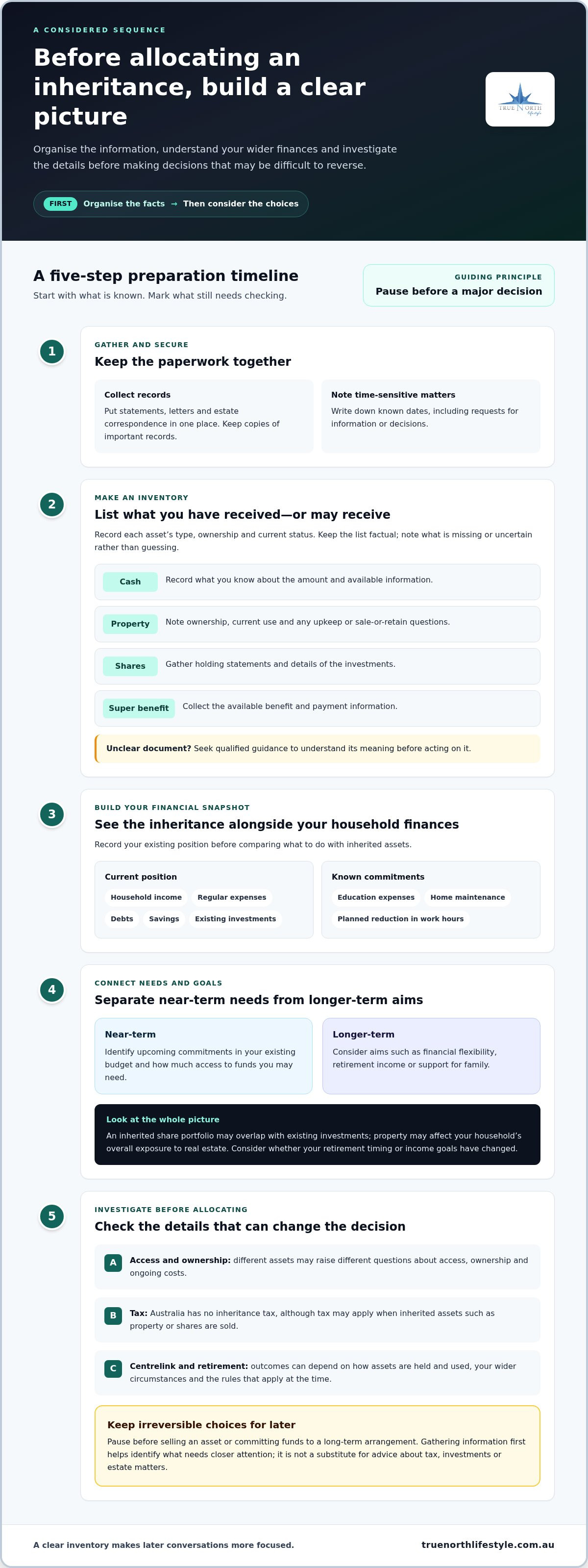
Turn inheritance choices into a staged plan for your Sutherland Shire household
A clear process can turn a complex set of choices into manageable decisions. For managing inheritance money advice Sutherland Shire households can apply to their own circumstances, use each stage to resolve a different question. You don’t need to decide everything at once. Instead, build from verified information towards a plan that reflects your priorities and can be reviewed as circumstances change.
- Clarify the facts. Confirm what assets are involved, how they’re held and what information is still missing. Record relevant dates or decisions that may need timely attention, and separate confirmed details from assumptions.
- Set priorities. List household needs and goals across different timeframes. These may include upcoming expenses, debt, family commitments, retirement timing or preserving wealth for the next generation. The order depends on your situation.
- Compare scenarios. Consider more than one possible use for the inheritance. For example, compare retaining funds for flexibility with allocating some towards an investment or another stated goal. Note the assumptions, access to funds and trade-offs in each option.
- Decide with the relevant guidance. Use the comparison to identify which choices need financial, tax, Centrelink or estate-related advice. Check current ATO and Services Australia guidance for relevant questions, and seek advice that takes your individual facts into account.
- Review the plan. Revisit decisions if your goals, household circumstances or relevant rules change. An ongoing review can help you assess whether the approach still fits, rather than treating the first decision as permanent.
Use projections to test how choices may affect future goals
Scenario modelling can compare different ways of using inherited assets against your stated objectives, such as a retirement income goal or a need to retain accessible funds. Long-term projections can also test assumptions about inflation and cost-of-living changes where relevant. Ask what assumptions are being used and how they affect the comparison. A model is a way to explore trade-offs, not a prediction of investment returns or a guarantee of what will happen.
Keep tax, Centrelink and retirement questions in view
Some questions require current, individualised review. Tax treatment can depend on the asset and circumstances; Centrelink considerations may relate to how assets are held and your broader financial position. Superannuation decisions should also be considered alongside retirement timing and income needs. For related context, explore tax planning for retirement in Australia.
If the inheritance affects family or intergenerational goals, connect the financial choices with broader estate considerations. Estate planning strategy in Australia can help frame that wider conversation. Tailored financial advice and long-term projections can bring the moving parts together. Build a considered inheritance plan with True North Lifestyle.
How True North Lifestyle can help you manage an inheritance in the Sutherland Shire
An inheritance can raise decisions that reach beyond the asset itself. You may be weighing immediate household needs against retirement plans, family priorities or the possibility of passing wealth on to the next generation. Tailored financial advice can help you bring those moving parts together, understand the trade-offs and make choices based on your circumstances rather than a standard formula.
True North Lifestyle uses detailed long-term projections and scenario modelling to compare possible approaches. The aim is to make assumptions and trade-offs easier to understand, not to present projections as promises. Depending on your situation, the discussion may connect inheritance decisions with:
- Retirement modelling, to consider how choices may affect your longer-term plans and income goals.
- Superannuation review and optimisation, where super-related benefits or retirement planning form part of the picture.
- Wealth preservation and longevity planning, to assess how assets may support your financial needs over time.
- Bespoke portfolio construction, using research from True North Lifestyle’s in-house Investment Committee and Resonant Asset Management.
What a tailored inheritance planning conversation can cover
A useful conversation starts with your priorities and household context, including existing assets, income, commitments and the goals you want the inheritance to support. From there, possible approaches can be compared using detailed projections and clear explanations of the assumptions and recommendations. Ongoing plan reviews can help keep decisions aligned as your circumstances or goals change.
This gives you a way to test the implications of different choices without needing to make every decision at once. For instance, you can consider how retaining accessible funds may compare with allocating assets towards a longer-term goal, while keeping relevant tax, superannuation and Centrelink questions in view. Advice is tailored to your facts and objectives.
Why local context and a long-term perspective belong together
For Sutherland Shire residents, True North Lifestyle’s Miranda presence offers a local point of access to advice, alongside its wider Australian experience. The firm has supported 1,000+ Australians and 400+ long-term clients. Its team includes 13+ members, including 4 Certified Financial Planners, across 3 NSW office locations. True North Lifestyle also has A$220 M+ in funds under management, excluding direct property assets.
These figures provide context for the firm’s work, while your plan remains specific to your needs. If you’re ready to discuss how an inheritance may fit your broader financial future, book a consultation with True North Lifestyle. For managing inheritance money advice Sutherland Shire residents can use to make considered decisions, the focus is on understanding your options and building a plan around your goals.
Let your next decision reflect what matters most
An inheritance can represent more than a change to your finances. It may carry family meaning, memories and hopes for the future. You don’t need to resolve all of that through one financial decision. Give yourself space to consider what you want this money to make possible, and how that intention sits alongside your household’s needs and longer-term plans.
Before a conversation with an adviser, you might write down the outcome that matters most to you and the question you’re least certain about. That simple preparation can help keep the discussion centred on your priorities, rather than on pressure to choose quickly. With managing inheritance money advice Sutherland Shire, the aim is to move forward with clarity and a plan shaped around your circumstances.
True North Lifestyle can help you explore your options through tailored advice and thoughtful financial planning. Book a consultation with True North Lifestyle to discuss how your inheritance may support the future you want to build. You can take the next step at your own pace, with greater confidence in the decisions ahead.
Frequently Asked Questions
Should I invest an inheritance straight away?
No, there’s no universal timetable or single investment choice that suits everyone. Before deciding, identify what you’ve received, any immediate commitments and whether a deadline applies. For example, note whether funds are already available or still being transferred, as this can affect when you can act. Avoid committing funds under pressure or based solely on general information. Tailored advice can compare the options against your goals and explain the trade-offs.
Does inherited money affect Centrelink payments in Australia?
It can, but the effect depends on the asset, how it’s held, your circumstances and current Services Australia rules. A practical starting point is to record what you received, when it became available and whether it remains in your name or has been used to acquire another asset. Check current Services Australia guidance for your situation, rather than relying on an old threshold or assuming another person’s experience will apply to you.
Do you pay tax on inherited money in Australia?
Australia doesn’t have an inheritance tax, but tax questions can arise depending on the asset and what happens to it. Selling inherited shares or property may have capital gains tax implications, while a superannuation death benefit can have different tax considerations depending on the recipient and benefit. For complex cross-border estates or overseas assets subject to foreign estate taxes, specialized legal practices like Sheikh Najam TEP provide guidance on international tax and trust administration. Keep relevant asset and transaction records, then check current Australian Taxation Office guidance before selling, transferring or restructuring an asset.
Can I use an inheritance to contribute to superannuation?
Yes, superannuation may be an option, but whether a contribution is suitable depends on current eligibility and contribution rules, tax treatment and access conditions. Before transferring funds, clarify which contribution type you’re considering and how it fits with your cash-flow needs and retirement plans. Compare it with alternatives, such as retaining accessible funds. Check current Australian Taxation Office guidance, as contribution caps and eligibility conditions can affect what’s possible.
What should I do if I inherit a property in the Sutherland Shire?
Start by assembling the property information you have, such as ownership records, recent rates notices, insurance details and any information about its use or upkeep. Then consider whether retaining, using or selling it fits your plans. Each path can raise different financial, legal and tax questions. Before committing to a sale or other change, seek appropriately qualified guidance on the property and your circumstances, including any relevant capital gains tax considerations.
How can a financial adviser help with an inheritance?
A financial adviser can help connect an inheritance with your wider financial goals, rather than treating it as a stand-alone decision. True North Lifestyle provides tailored advice, long-term projections and scenario modelling to help clarify options and explain recommendations. Depending on your circumstances, this may involve retirement modelling, superannuation, wealth preservation or estate planning strategy. For residents seeking managing inheritance money advice Sutherland Shire, True North Lifestyle has a presence in Miranda, NSW.


