

Stability in retirement. What if your financial strategy was built to survive a storm you haven't even imagined yet? Achieving a resilient future requires more than just hope; it demands portfolio stress testing Australia to ensure your capital remains secure regardless of market shifts.
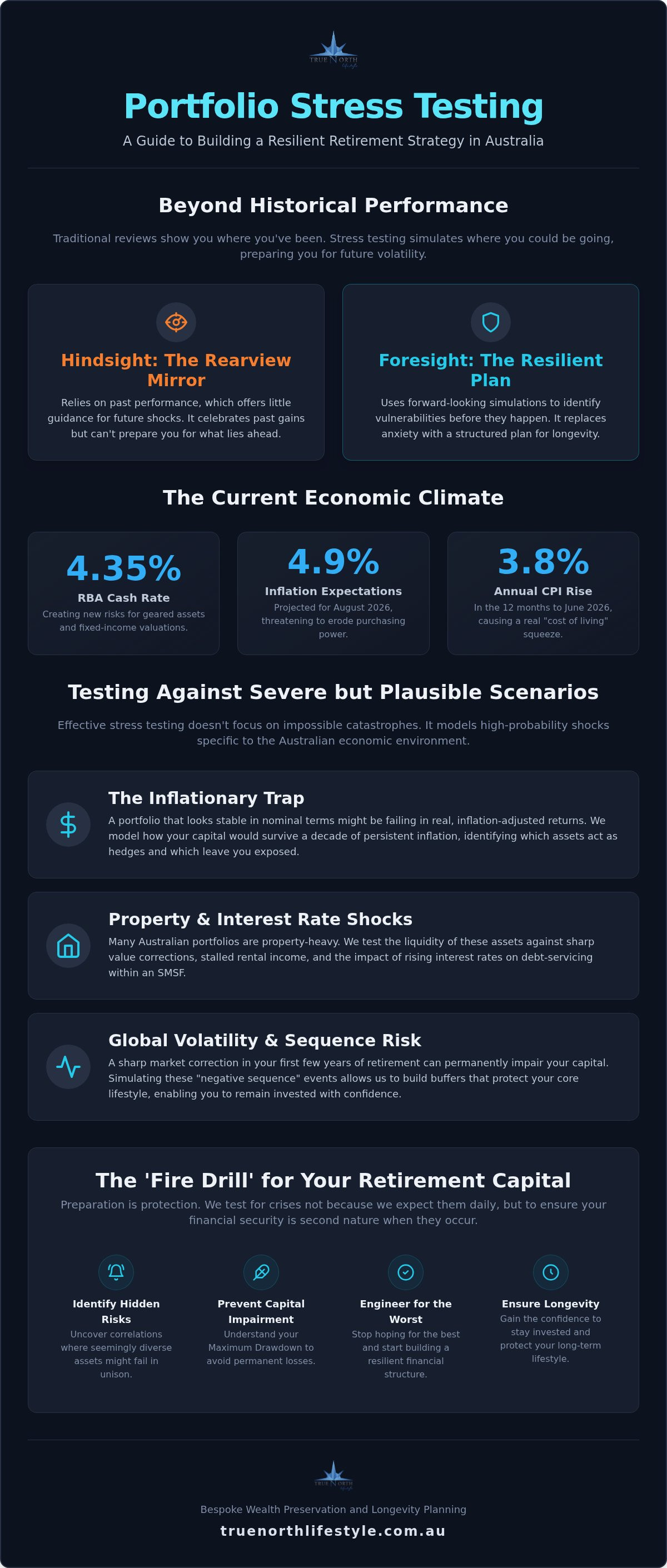
For many Australians, the current economic climate creates a persistent sense of unease. With the RBA holding the cash rate at 4.35% and inflation expectations sitting at 4.9% for August 2026, the fear of outliving your savings is a heavy burden to carry. You deserve to know exactly how your capital will behave when the next market cycle turns. By applying professional modelling and strategic construction, you can replace anxiety with a sense of quiet certainty. We will explore how bespoke stress-testing frameworks identify hidden risks and provide a structured plan to protect your longevity. You'll gain the clarity needed to remain invested with confidence, knowing your path is anchored in evidence and rigorous research.
Key Takeaways
- Understand the vital difference between historical performance and forward-looking simulations to better anticipate future market shocks.
- Identify "severe but plausible" economic scenarios, such as persistent inflation, that could impact your retirement income and lifestyle.
- Learn to evaluate your "Maximum Drawdown" and identify concentration risks within the Australian market to prevent permanent capital impairment.
- Discover why the sequence of returns in your early retirement years is more critical than your long-term average performance.
- Explore how portfolio stress testing Australia serves as the foundation for bespoke wealth preservation and longevity planning.
What is Portfolio Stress Testing for Australian Investors?
Clarity replaces anxiety. For many Australians, looking at an annual superannuation statement feels like checking the rearview mirror while driving through a storm. Historical performance tells you where you've been, but it offers little guidance on where you're going. This is where portfolio stress testing Australia becomes essential. At its core, a stress test is a sophisticated simulation designed to see how your specific assets would behave under "worst-case" economic shocks.
Understanding what is a financial stress test? allows you to move from hindsight to foresight. While hindsight celebrates past gains, foresight prepares for future volatility. Relying on traditional models, such as the classic 60/40 split between shares and bonds, may no longer be sufficient. In a landscape where the RBA cash rate sits at 4.35% and inflation rose 3.8% in the 12 months to June 2026, asset classes that once moved in opposite directions often now fall in unison. Stress testing reveals these vulnerabilities before they manifest as a loss in your bank balance.
The "Fire Drill" for Your Retirement Capital
Preparation is protection. We don't conduct fire drills because we expect a fire every day; we do them so that if one occurs, the exit is second nature. Testing your portfolio follows the same logic. It identifies hidden correlations where seemingly different investments might all fail at once during a domestic property downturn or a global credit squeeze. By modelling for the worst, you stop hoping for the best and start engineering it. This structured preparation creates a stabilising effect, allowing you to maintain your lifestyle without the constant weight of market anxiety.
Institutional Rigour for the Family Office
Professional standards matter. While the Australian Prudential Regulation Authority (APRA) mandates stress tests for massive super funds to ensure systemic stability, True North Lifestyle brings this same level of discipline to your personal retirement strategy. We use a research-driven methodology to identify your specific vulnerabilities, whether they're related to tax-minimisation or sequence of returns risk. Our goal is to simplify complex data into actionable lifestyle insights. This bespoke approach ensures your portfolio isn't just a collection of assets, but a resilient framework designed to support your longevity and wealth preservation goals.
Severe but Plausible: Australian Scenarios to Test Against
Realistic modelling matters. Effective portfolio stress testing Australia doesn't focus on impossible catastrophes; it examines events that are severe but plausible. This disciplined approach follows Australian regulatory guidance, which emphasises identifying specific vulnerabilities within investment functions. By testing against high-probability shocks, you can transform vague fears into a structured, resilient plan.
The Inflationary Trap
Purchasing power erodes silently. With the CPI rising 3.8% in the 12 months to June 2026 and consumer inflation expectations for August 2026 hitting 4.9%, retirees face a genuine "cost of living" squeeze. A portfolio that looks stable in nominal terms might be failing if it isn't generating real, inflation-adjusted returns. We model how your capital would survive a decade of persistent inflation, identifying which of your assets act as natural hedges and which would leave you exposed. This ensures your lifestyle remains consistent even as prices at the supermarket or the petrol pump rise.
Property and Interest Rate Shocks
Australian portfolios are often property-heavy. While residential property has historically provided growth, the current 4.35% cash rate environment introduces new risks, especially for those with geared assets in an SMSF. Stress testing evaluates the liquidity of these "lumpy" assets. We ask the difficult questions: could you meet your pension requirements if property values corrected sharply or if rental income stalled? Understanding how rising interest rates impact both debt-servicing and fixed-income valuations allows you to adjust your strategy before a crisis forces your hand. This level of bespoke portfolio construction is designed to provide calm when domestic cycles turn volatile.
Global Volatility and Sequence Risk
Market timing is unpredictable. A sharp correction in global equities during your first few years of retirement can permanently impair your capital. By simulating these "negative sequence" events, we help you build a buffer that protects your core lifestyle. This foresight allows you to remain invested through market cycles with the confidence of a steady navigator, knowing your plan accounts for the turbulence that inevitably occurs in global markets.
The Stress Test Checklist: Evaluating Your Current Strategy
Structure creates calm. To move beyond general theory, you need a methodical way to measure your resilience. Professional portfolio stress testing Australia provides this framework. It allows you to audit your current holdings against specific, measurable benchmarks rather than vague market sentiment. By quantifying your risks, you move from a state of reactive worry to one of proactive oversight.
- Assess your "Maximum Drawdown": This is the largest peak-to-trough decline your portfolio could experience before your core lifestyle is threatened. If a 25% drop forces you to sell your family home or significantly reduce your standard of living, your risk profile is misaligned with your reality.
- Identify "Concentration Risk": Many Australian investors are heavily weighted in the "Big Four" banks or major miners. If these specific sectors face a regulatory shift or a global commodity slump, your entire retirement capital could be at risk.
- Evaluate "Income Sustainability": Dividends aren't guaranteed. You must test if your income stream remains viable if corporate profits stall or payout ratios are slashed during a domestic downturn.
Step 1: The Liquidity Audit
Cash is confidence. A robust strategy requires a liquidity bucket that can cover at least 24 months of essential spending. This ensures you aren't forced to sell growth assets at the bottom of a bear market just to pay your bills. It's vital that your superannuation advice integrates this immediate cash flow necessity. Being asset rich but cash poor during a market correction is a preventable vulnerability that stress testing quickly exposes.
Step 2: Scenario Mapping
Numbers tell stories. Apply a hypothetical -20% market shock to your current balance today. Does the "new" number still support your long-term goals? Using sophisticated retirement modelling, you can project whether this lower capital base still meets your longevity requirements. Identifying your "break point" now allows you to make calm, tactical adjustments before a crisis occurs. This disciplined approach ensures you remain the steady navigator of your own financial journey.
Beyond the Numbers: Managing Sequence of Returns and Longevity Risk
Timing defines success. While long-term average returns are often cited in generic financial projections, the actual order of those returns is far more critical during the transition into retirement. This phenomenon, known as sequence of returns risk, is the primary reason why portfolio stress testing Australia is a non-negotiable step for those seeking genuine resilience. A market crash in the first five years of your retirement can permanently impair your capital base. Because you're withdrawing funds from a shrinking pool, your assets are prevented from recovering when the cycle eventually turns, even if the market later achieves a strong average return.
The role of a "Steady Navigator" is to balance this immediate protection with the growth required to beat inflation. In the 12 months to June 2026, the CPI rose 3.8%, proving that standing still is effectively moving backwards. We focus on ensuring your portfolio has enough "engine room" to maintain your purchasing power over a 30-year horizon, while maintaining a robust "shield" to survive the inevitable volatility of the early years.
Protecting the "Red Zone"
The transition matters. The five years immediately preceding and following your retirement date represent the "Red Zone," a critical window where your strategy is most vulnerable to market shocks. During this period, we implement specific wealth preservation strategies to de-risk the portfolio without abandoning long-term growth. This isn't about a wholesale move to cash; it's about building a defensive buffer that allows you to start your new lifestyle with quiet certainty. By isolating your immediate spending needs from market fluctuations, you gain the emotional freedom to remain invested in growth assets that support your future.
Modelling for 100-Year Lives
Longevity is a risk. With modern healthcare, many Australian retirees must now plan for a 30-year or even 40-year income stream. The fear of outliving your money is a heavy burden, yet being too conservative can be just as damaging. We use sophisticated Monte Carlo simulations to determine the mathematical probability of your success across thousands of potential market paths. This allows us to adjust withdrawal rates based on stress test outcomes, ensuring your plan is grounded in real-world probability. If you're looking for a structured path forward, our team specialises in bespoke wealth preservation and longevity planning designed to anchor your future in a fluctuating environment.
Strategic Modelling with True North Lifestyle
Precision leads to peace. While generic software tools can provide data, they often fail to provide a strategy. True North Lifestyle offers a research-driven alternative that views portfolio stress testing Australia as the foundation of a comprehensive Retirement Roadmap. Our approach integrates tax-minimisation and estate planning into the simulation process, ensuring your strategy is as efficient as it is resilient. We move Sydney families beyond standard benchmarks toward a tailored plan that prioritises their specific human outcomes.
Our Bespoke Portfolio Construction
Stability is engineered. Our in-house Investment Committee works alongside Resonant Asset Management to construct portfolios focused on low volatility and sustainable income. We don't chase flashy innovation; we value proven outcomes and strategic construction. This bespoke investment advice in Sydney offers a level of transparency that allows you to see exactly how your capital is positioned to survive a downturn. We provide regular reporting that simplifies complex data into clear, actionable insights, ensuring you remain an informed partner in the process.
Your Invitation to Clarity
Knowledge replaces fear. We invite you to a complimentary initial discovery session at our Miranda or Sydney CBD locations to begin your journey toward financial order. This is a no-nonsense opportunity to discuss your concerns and see how our modelling can address your specific anxieties. We aim to move you from a state of market-induced worry to one of quiet certainty and calm oversight. Our ongoing partnership ensures we recalibrate your strategy as the Australian economy evolves, providing a reliable anchor in any environment. Secure your future with a professional stress test and take the first step toward a resilient retirement.
Secure Your Financial Longevity
Order replaces chaos. You now understand that a resilient retirement isn't built on market timing, but on rigorous, evidence-based preparation. By identifying your maximum drawdown and addressing concentration risks within the local market, you can protect your lifestyle against the silent erosion of inflation. Professional portfolio stress testing Australia provides the structured foresight needed to navigate the critical transition years with quiet certainty and total clarity.
True North Lifestyle serves as your steady navigator through this process. Our in-house Investment Committee provides research-driven oversight, specialising in low-volatility strategies that prioritise your personal outcomes over mere numbers. With local expertise in Miranda and the Sydney CBD, we're here to help you move from financial anxiety to a state of calm oversight and order. It's time to replace uncertainty with a structured roadmap. We invite you to book a discovery session for a bespoke portfolio stress test to secure your future. You deserve the confidence that comes from knowing your path is anchored in logic and proven results.
Frequently Asked Questions
What is the most common risk identified in Australian portfolio stress tests?
Concentration risk is the most frequent vulnerability uncovered during our modelling process. Many Australians hold a heavy bias toward the "Big Four" banks and major miners, which creates a potential single point of failure. If these specific sectors face regulatory pressure or a global commodity slump, the entire portfolio suffers. Stress testing reveals this imbalance, allowing us to diversify into income-focused assets that offer better protection against domestic sector shocks.
How often should I stress test my retirement portfolio?
You should review your results annually as part of a disciplined oversight process. However, a re-test is essential whenever significant economic shifts occur, such as the RBA holding the cash rate at 4.35% or inflation spiking unexpectedly. Major life events, like commencing a pension or receiving an inheritance, also require a fresh look at your resilience. Regular recalibration ensures your strategy remains aligned with the evolving Australian economy and your personal journey.
Can I perform a portfolio stress test myself using online tools?
Online calculators offer a basic starting point, but they often lack the technical depth required for true retirement resilience. Professional portfolio stress testing Australia involves complex Monte Carlo simulations and research-driven modelling that simple tools cannot replicate. We examine the intricate interplay between tax-minimisation, Centrelink rules, and bespoke asset correlations. This comprehensive approach provides the quiet certainty and calm order that a generic online tool simply cannot offer.
How does inflation affect my stress test results in 2026?
Inflation is a critical variable that significantly alters your "real" return projections. With the CPI rising 3.8% in the 12 months to June 2026 and expectations hitting 4.9% for August, your capital must work harder just to maintain its purchasing power. Our modelling tests whether your income stream can survive a persistent "cost of living" squeeze. We identify which assets provide a natural hedge against these rising costs to ensure your lifestyle remains protected.
Is stress testing only for high-net-worth individuals?
Resilience is a necessity for every retiree, not just those with significant wealth. Anyone who relies on their superannuation or private investments for a sustainable income should understand their specific vulnerabilities. Stress testing is about protecting your standard of living and ensuring you don't outlive your money. Whether your portfolio is modest or substantial, the goal remains the same: replacing financial anxiety with a structured, well-defined path forward.
What happens if my portfolio "fails" a stress test?
A "fail" result is simply an early warning signal that allows for calm, proactive recalibration. It indicates that under certain severe but plausible scenarios, your capital might not meet your long-term longevity goals. We use this data to adjust your asset allocation, build larger liquidity buckets, or refine your withdrawal strategy. It's far better to identify these "break points" in a simulation today than to discover them during a real market crisis tomorrow.
Does stress testing take into account my family home?
We typically focus the test on your income-producing assets rather than your primary residence. While your family home is a vital component of your net worth, it doesn't usually provide the liquid cash flow needed for daily expenses. However, we do consider its value when discussing estate planning strategy or Centrelink structuring. The stress test is primarily designed to ensure your investable capital can support your desired lifestyle throughout a thirty-year retirement.
How does sequence of returns risk differ from standard market risk?
Standard market risk is the general volatility of your assets, while sequence risk is the danger of that volatility occurring at the wrong time. If a market crash happens early in your retirement, it can permanently impair your capital base because you're withdrawing funds while prices are low. Stress testing helps us build defensive buffers to protect this "Red Zone," ensuring your long-term plan remains intact despite early market setbacks.


