
A hidden tax. For many Sydney families, this is the unexpected reality when passing on superannuation to beneficiaries, where the ATO can claim up to 32 percent of a lifetime’s worth of savings. You likely feel a sense of unease knowing that your hard-earned wealth could be significantly eroded before it ever reaches your children. It’s a complex environment where the distinction between a legal dependant and a tax dependant can mean the difference between a tax-free inheritance and a substantial financial loss.
We're here to replace that uncertainty with a sense of calm and order. You'll learn how to navigate the intricacies of superannuation death benefits to ensure your legacy reaches your loved ones intact. This guide provides a clear path to reducing the taxable component of your super through strategic modelling, while ensuring your binding nominations are valid and your family is protected. We will move from the anxiety of the unknown toward a structured, bespoke plan for your wealth preservation and long-term peace of mind.
Key Takeaways
- Identify the "hidden" tax liability. While Australia has no formal inheritance tax, the ATO can claim up to 32 percent of your super death benefit if it is paid to non-dependants.
- Clarify your beneficiary status. Understanding the difference between legal and tax dependants is essential for passing on superannuation to beneficiaries with maximum tax efficiency.
- Secure your intentions. Valid binding death benefit nominations ensure your wishes are followed, avoiding the common "lapsing trap" that can lead to family disputes.
- Optimise your tax position. The re-contribution strategy allows you to "wash" the taxable component of your super, potentially leaving a tax-free legacy for your adult children.
- Integrate your legacy plan. Bespoke retirement modelling provides the structure needed to protect your wealth while maintaining your lifestyle in the Sutherland Shire or Sydney CBD.
Passing on Superannuation: Understanding the Australian "Death Tax" Reality
Legacy is more than a balance sheet. It represents the quiet discipline of a lifetime. A superannuation death benefit is the formal payment of your remaining fund balance and any associated life insurance to your beneficiaries after you pass away. While many Australians celebrate the lack of a formal death duty, the reality for those passing on superannuation to beneficiaries is far more complex. Australia's lack of an official inheritance tax is, for many, a financial myth that obscures a significant tax liability.
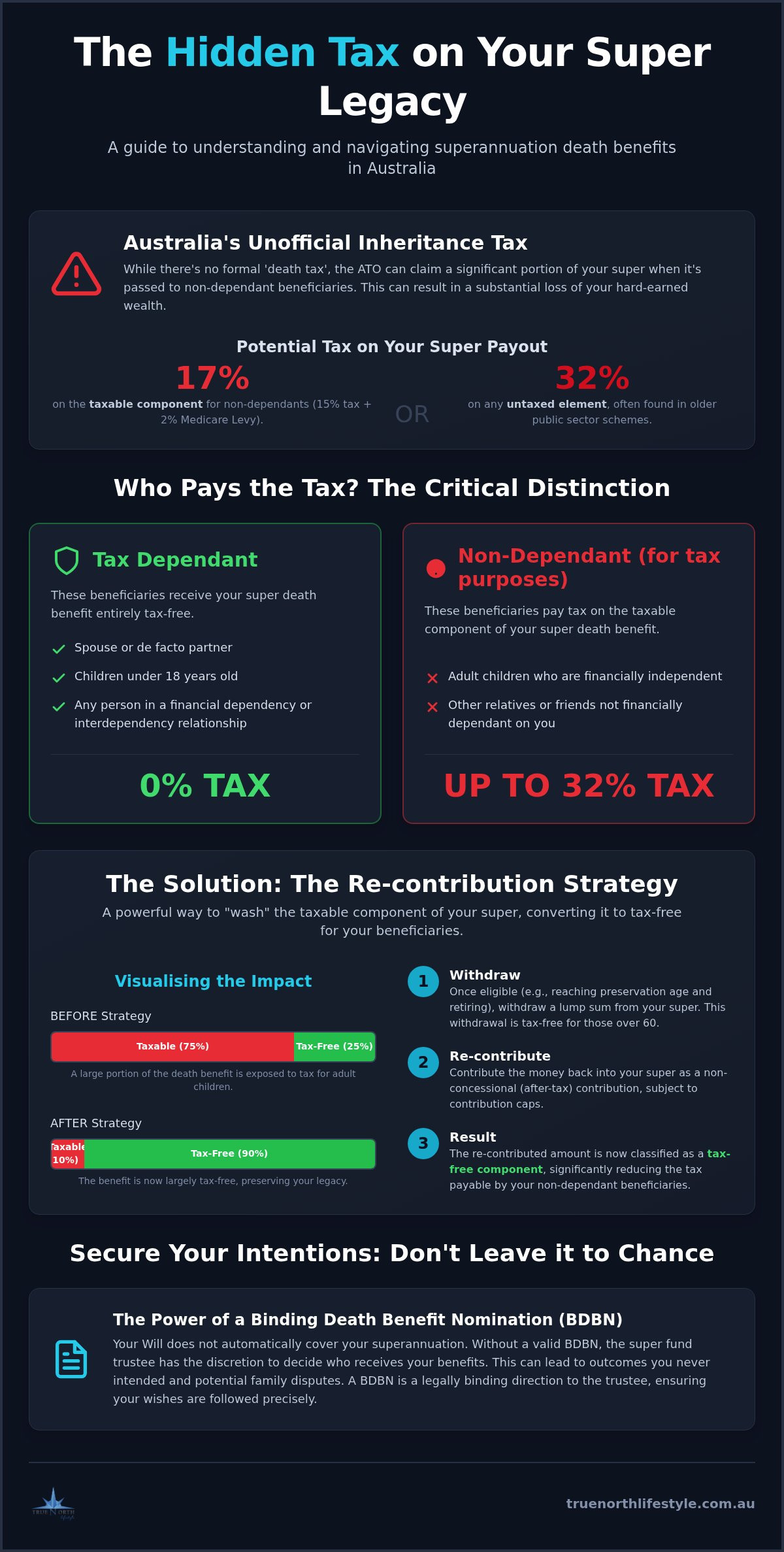
Sydney families with substantial super balances are particularly vulnerable to inheritance leakage. This occurs when the ATO claims a significant portion of your wealth before it reaches your children or grandchildren. It's a transition from financial success to intergenerational significance. This shift requires a structured, logical approach to ensure your hard-earned assets aren't eroded by unnecessary taxes. Without proactive modelling, your family's future security could be diminished by a tax hit of up to 17 percent or even 32 percent on certain components.
The Taxable vs. Tax-Free Components
Your superannuation is comprised of two distinct elements. The tax-free component generally includes your non-concessional contributions, which are funds you've added from your after-tax income. Conversely, the taxable component consists of employer contributions and investment earnings that have only been taxed at the concessional rate of 15 percent. Crucially, the proportioning rule dictates that any payment made from your fund must be drawn proportionately from both components; you cannot simply choose to withdraw the tax-free portion first to minimise the tax burden for your adult children. This mathematical reality makes strategic optimisation essential before the benefit is triggered.
The Role of the Super Fund Trustee
Control is often an illusion. Many people assume their Will automatically covers their super, but Superannuation in Australia operates under a specific regulatory framework that sits outside of standard estate law. In the absence of a valid binding nomination, the super fund trustee holds discretionary power to decide how your benefits are distributed. They are legally required to identify your dependants, but their final decision may not align with your personal intentions. Adopting a "Steady Navigator" approach means ensuring your wishes are legally ironclad through precise estate planning strategies, replacing the anxiety of trustee discretion with the quiet certainty of a bespoke legal structure.
Dependants vs. Non-Dependants: Who Pays the Tax?
Definitions matter deeply. While superannuation law identifies who can legally receive your funds, tax law determines how much of that money actually arrives. This distinction between a "Superannuation Dependant" and a "Tax Dependant" is the primary driver of inheritance leakage when passing on superannuation to beneficiaries. Without a clear understanding of these categories, your family may face an avoidable financial shock during an already difficult time.
Adult children are frequently the ATO’s largest source of superannuation tax revenue. Because they are typically financially independent, they are classified as non-dependants for tax purposes. This means any taxable component they inherit is subject to a 15 percent tax plus the 2 percent Medicare Levy, creating a total hit of 17 percent. If your fund includes an "untaxed element", often found in certain older public sector schemes or life insurance components, this rate can climb to a staggering 32 percent. A structured superannuation review and optimisation can help identify these vulnerabilities before they impact your estate.
Defining the Tax Dependant
Spouses and de facto partners are the primary tax-free beneficiaries. They are viewed as dependants by both super and tax law, ensuring they receive death benefits without a tax deduction. Children under 18 also enjoy this tax-free status, but this protection vanishes the moment they reach adulthood and financial independence. For others to qualify as tax dependants, you must prove a relationship of financial dependency or an interdependency relationship. This requires evidence of shared living arrangements, ongoing financial support, and a commitment to long-term care, which can provide a vital path to tax-free status for non-traditional households.
The Impact on Adult Children
Consider the real-world cost. If an adult, financially independent child inherits a $500,000 taxable component, the 17 percent tax hit results in $85,000 being redirected to the ATO. This is not a hypothetical scenario; it's a standard outcome for many Sydney families who haven't adjusted their strategies as their children have grown. Families in the Sutherland Shire should review their children’s dependant status annually, particularly as they transition through university or enter the workforce. Proactive foresight allows you to implement strategies that "wash" these taxable components, transforming a potential tax liability into a protected family legacy.
Binding Death Benefit Nominations: Securing Your Intentions
Intentions require protection. When passing on superannuation to beneficiaries, many Sydney residents rely on non-binding nominations, believing their wishes are final. In reality, a non-binding nomination is merely a suggestion to the super fund trustee. This leaves the ultimate distribution of your wealth subject to their discretion, which can lead to prolonged family disputes and outcomes that contradict your actual goals. To achieve certainty, a binding nomination is the essential tool for directing your legacy with precision.
The lapsing trap is a common oversight for many. Most standard binding nominations expire every three years, yet many retirees in Miranda and the wider Sydney area unknowingly let these documents lapse. When a nomination expires, it reverts to being non-binding, stripping away your control. Non-lapsing binding nominations represent the gold standard for long-term estate certainty. These provide a permanent instruction to the trustee that remains valid until you proactively choose to update it, offering a stabilizing foundation for your financial future.
Common Pitfalls in Super Nominations
Precision is paramount. A single error in witnessing, such as having a nominated beneficiary sign as a witness, can render the entire document void. For families in the Sutherland Shire with blended dynamics, these technicalities are even more critical. You must ensure your superannuation instructions align perfectly with your broader estate planning strategy Australia. Without this alignment, you risk creating a scenario where your super and your Will work at cross-purposes, leading to legal complexity and emotional strain for those left behind.
Directing Super to the Estate
Control sometimes requires a different structure. By nominating a Legal Personal Representative (LPR), you direct your superannuation death benefits into your estate rather than paying them directly to individuals. This approach allows you to utilise Testamentary Trusts, which offer superior protection for your beneficiaries. These trusts can shield an inheritance from a beneficiary’s potential divorce or bankruptcy proceedings. While this path requires careful consideration of the tax implications for non-dependants, it provides a robust mechanism for protecting your family’s wealth across multiple generations. Balancing tax efficiency with this level of asset protection is a hallmark of a sophisticated, bespoke retirement model.
The Re-contribution Strategy: A Masterclass in Tax Minimisation
Tax is not inevitable. For those focused on passing on superannuation to beneficiaries, the re-contribution strategy serves as a powerful tool to transform a potential tax liability into a tax-free legacy. The core objective is simple yet profound. You withdraw funds from the taxable component of your super and immediately re-contribute them as non-concessional, tax-free amounts. This process effectively "washes" the balance, ensuring that when your adult children eventually inherit the funds, the ATO's 17 percent claim is eliminated.
Timing remains critical. The "golden window" for this manoeuvre typically opens at age 60, when you can access your super tax-free, and closes at age 75. While the work test has been abolished for most non-concessional contributions, navigating the complex web of contribution caps requires discipline. For the 2026/27 financial year, the non-concessional cap sits at A$130,000. Exceeding these limits or mismanaging the "bring-forward" rule can trigger significant ATO penalties, which is why a Steady Navigator approach is essential to maintain order.
Step-by-Step: Executing a Re-contribution
Success depends on precision. You must first ensure you have "unrestricted non-preserved" access to your funds, typically achieved by reaching age 65 or meeting a condition of release after age 60. Once access is confirmed, you calculate your available non-concessional cap, often utilising the bring-forward rule to contribute up to three years' worth of caps in a single year. By effectively converting a A$300,000 taxable component into a tax-free one, this strategy can save a family over A$51,000 in tax on a typical Sydney super balance.
Strategic Considerations for Couples
Collaboration enhances outcomes. Couples can use this strategy to equalise their balances, ensuring neither partner inadvertently breaches the A$2.1 million General Transfer Balance Cap. If one partner is younger, their contribution caps can be utilised to maximise the total volume of funds being "washed" of tax. This level of coordination requires a deep understanding of how individual caps interact. Seeking bespoke superannuation advice Sutherland Shire is vital before moving large sums of capital to ensure every move is mathematically sound and legally compliant.
You can protect your family's future today. Schedule a superannuation review and optimisation session to see if a re-contribution strategy fits your bespoke retirement model.
Integrating Legacy into Your Bespoke Retirement Model
Structure provides peace. A truly bespoke retirement model doesn't treat estate planning as a final chapter; it's a foundational pillar of retirement planning Sydney. When passing on superannuation to beneficiaries, the decisions you make today regarding your pension drawdowns and asset allocation directly influence the legacy you leave tomorrow. By integrating legacy planning into your daily financial structure, you move beyond the anxiety of "what if" and step into a role of confident oversight. It's about ensuring your wealth serves its ultimate purpose without being diminished by lack of foresight.
Numbers tell a story. We use sophisticated long-term projections to determine the probable residual balance of your superannuation across various life stages, accounting for market volatility and inflation. This creates a natural synergy between your current wealth preservation strategies and the eventual intergenerational transfer of assets. It's the transition from mere financial success to a legacy of enduring significance, ensuring your hard work continues to support your children and grandchildren long after your own retirement needs are met. You've done the heavy lifting; now it's time to ensure the rewards reach the right destination.
Modelling the Impact of CGT and Death Benefits Tax
Logic replaces fear. Our modelling factors in the 2026 tax environment, including the A$2.1 million general transfer balance cap and the 12 percent Superannuation Guarantee rate, to ensure your portfolio remains optimised. We stress-test your estate plan against multiple longevity scenarios, ensuring that even if you live well into your nineties, the tax-minimisation structures for your beneficiaries remain robust. This bespoke construction ensures the right assets are in the right hands at the right time, preventing unnecessary inheritance leakage. We look at the real-world probability of your plan, not just best-case scenarios.
The True North Approach to Estate Clarity
You aren't alone. Our Miranda-based team acts as your steady navigator, coordinating directly with your legal advisers to ensure your financial modelling and legal estate structures are perfectly aligned. This research-driven approach provides the deep emotional reassurance that your hard work will benefit your family rather than the tax office. We understand the unique needs of families across the Sutherland Shire and Sydney CBD, offering a polished service that values proven outcomes over flashy innovation. It's about quiet certainty in a fluctuating environment, allowing you to enjoy your retirement with a clear mind.
Secure your legacy today. Organise a consultation with our team to ensure your family’s financial future is protected by a structured, research-driven plan that leaves nothing to chance.
Securing Your Family's Future with Confidence
Legacy is built through a lifetime of discipline. It shouldn't be dismantled by avoidable tax liabilities. By distinguishing between tax and legal dependants, ensuring your binding nominations are current, and employing re-contribution strategies, you can transform a complex financial burden into a seamless transition of wealth. Proactive planning replaces the anxiety of the unknown with the quiet certainty of a well-structured plan. This is the essence of a calm retirement.
We provide the stabilizing, research-driven advice needed to navigate these complexities. Our team specialises in bespoke retirement modelling for Sydney families, ensuring every strategy is grounded in evidence and tailored to your personal journey. We've already done the heavy lifting and rigorous testing so that you can focus on what matters most. When passing on superannuation to beneficiaries, our expertise in tax-minimisation strategies ensures your hard-earned wealth stays exactly where it belongs: with your loved ones.
Secure your family legacy with a bespoke superannuation review. You've worked hard to build your wealth, and you deserve the peace of mind that comes with knowing it is protected for the next generation.
Frequently Asked Questions
What is the "Super Death Tax" and who actually pays it?
The "Super Death Tax" is a colloquial term for the tax applied to the taxable component of a superannuation death benefit when it is paid to a non-tax dependant. Adult, financially independent children are the primary group who pay this tax, which typically sits at 17 percent including the Medicare levy. This tax is deducted by the super fund before the final proceeds are distributed to your loved ones.
Can I leave my superannuation to anyone I want?
Legally, you can only nominate "dependants" under superannuation law or your Legal Personal Representative (your estate). Dependants include your spouse, children of any age, and individuals with whom you share an interdependency relationship. If you wish to leave your super to someone outside these categories, such as a friend or a charity, you must nominate your estate and outline those wishes in your Will.
What is the difference between a binding and non-binding death benefit nomination?
A binding nomination is a formal legal instruction that the fund trustee is required to follow, provided it is validly executed and remains in force. A non-binding nomination is merely a suggestion, leaving the trustee with the discretionary power to decide who receives your balance. For most families, a binding nomination provides the quiet certainty needed when passing on superannuation to beneficiaries.
How does the re-contribution strategy work to reduce tax for my kids?
This strategy involves withdrawing a portion of your super and re-contributing it as a non-concessional, tax-free contribution. By doing this, you effectively "wash" the taxable component of your balance, converting it into a tax-free component. When your adult children eventually inherit these funds, they receive them without the 17 percent tax hit that would otherwise apply to the taxable portion.
Is superannuation part of my Will in Australia?
Superannuation is not automatically part of your Will because it is an asset held in trust by your super fund. It only enters your estate if you specifically nominate your Legal Personal Representative (LPR) as your beneficiary. This is why it's vital to coordinate your super nominations with your broader estate planning strategy to ensure all your assets are distributed according to your bespoke plan.
What happens to my super if I die without a nomination?
The super fund trustee will determine how to distribute your funds based on superannuation law and the fund’s specific trust deed. They will generally look for your dependants, but this discretionary process can lead to significant delays and potential family disputes. Dying without a nomination means you relinquish control over your legacy and leave your family to navigate a complex administrative process during a time of grief.
How long does it take for a super fund to pay out a death benefit?
Most superannuation death benefits are paid out within three to six months, though this timeline can vary based on the complexity of the situation. If there is no valid nomination or if the distribution is contested by a family member, the process can be delayed for a year or more. Ensuring you have a valid, non-lapsing binding nomination is the most effective way to facilitate a prompt and orderly payout.
Are there any tax-free ways to pass super to an adult child?
Yes, you can use a re-contribution strategy to convert the taxable portion of your super into a tax-free component while you are still alive. Another option is to withdraw your superannuation once you are over 60 and have met a condition of release, then gift those funds to your children. Both methods require careful modelling to ensure you maintain enough capital for your own longevity and lifestyle needs in retirement.


