

If you reached your 67th birthday tomorrow, would your superannuation balance be a source of quiet confidence or a cause for immediate concern? The question of how much do i need to retire in australia is no longer answered by a single, static figure. You likely feel the weight of a shifting economic landscape, where rising inflation and evolving tax laws in 2026 can make even a substantial nest egg feel vulnerable. It's a common anxiety, yet it is one that can be managed through disciplined logic and professional foresight.
Clarity. Order. Certainty. This guide provides the precise financial benchmarks and strategic modelling required to secure a comfortable, lasting retirement in the current environment. We will examine the latest ASFA standards, such as the $730,000 lump sum recommended for couples, while exploring how to optimise your position within the 2026 Transfer Balance Cap of $2.1 million. You will discover a personalised roadmap designed to minimise tax, maximise Centrelink entitlements, and replace uncertainty with a structured path forward. By the end of this guide, you'll have the data required to ensure your lifestyle remains sustainable for the long term.
Key Takeaways
- Define the 2026 ASFA benchmarks and understand why high-net-worth families require more than a "one-size-fits-all" figure for a truly comfortable lifestyle.
- Discover exactly how much do i need to retire in australia by strategically mapping your income across superannuation, the Age Pension, and private wealth.
- Protect your capital against the "silent risks" of inflation and longevity through research-driven risk management and bespoke portfolio sustainability modelling.
- Move beyond generic online calculators toward sophisticated cash flow modelling that accounts for the complex "sequence of returns risk" in a fluctuating market.
- Learn the essential first steps for a successful transition, including lifestyle spending audits and the optimisation of your underlying superannuation investment allocations.
Decoding the ASFA Retirement Standard: What is 'Comfortable' in 2026?
The question of how much do i need to retire in australia often leads people directly to the Association of Superannuation Funds of Australia (ASFA). Their data provides a baseline; it's a common language for a nation trying to quantify the future. However, there is a distinct difference between a lump sum target and a sustainable annual income stream that adapts to your life. While a lump sum looks like a finish line, an income stream is the fuel that keeps you moving. Understanding this distinction is the first step toward replacing retirement anxiety with structured logic.
The ASFA Benchmarks: Couples vs Singles
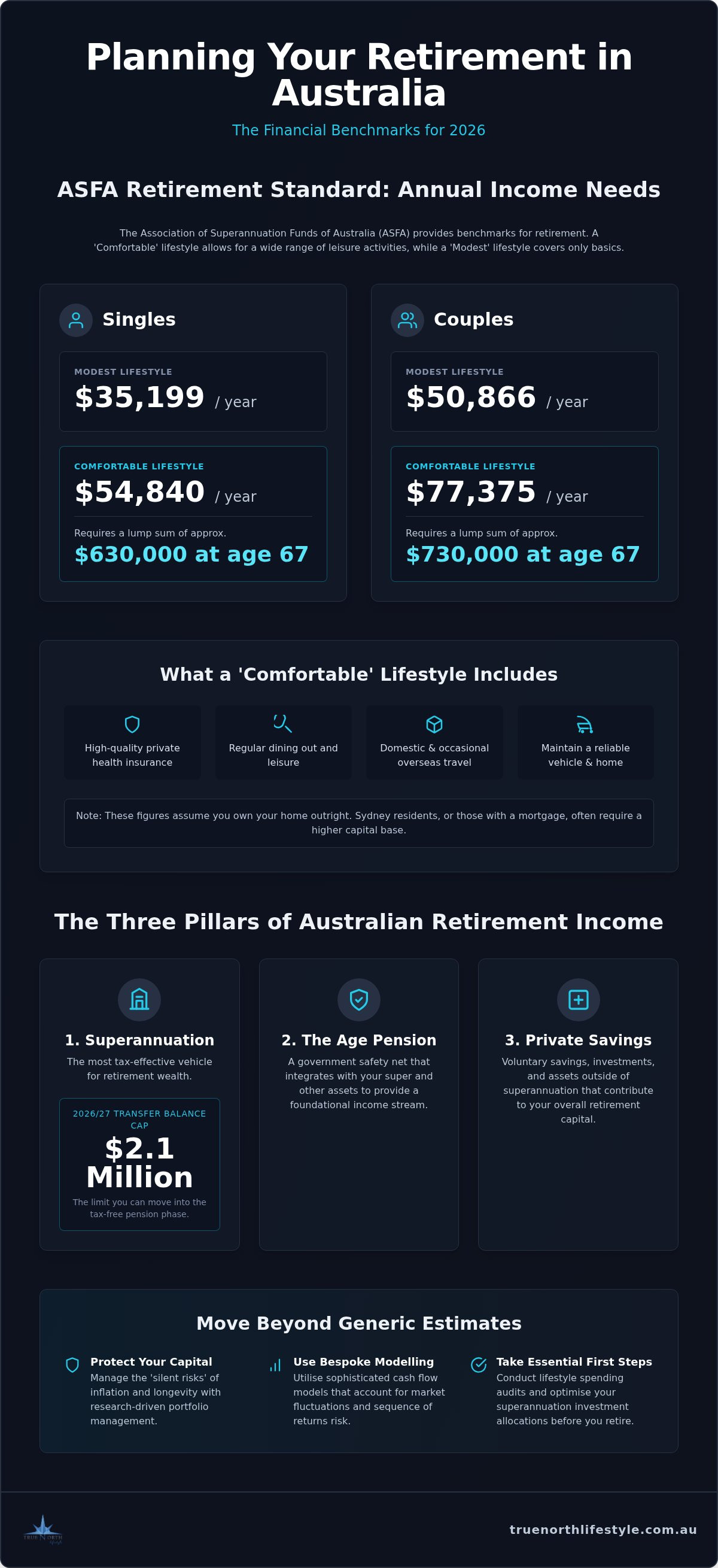
Benchmarks provide clarity. For the 2026 financial year, the ASFA Comfortable Standard requires an annual income of $54,840 for singles and $77,375 for couples. To achieve this, the estimated lump sum needed at age 67 is $630,000 for individuals and $730,000 for couples. By contrast, the Modest Standard, which covers only basic activities, sits at an annual income of $35,199 for singles and $50,866 for couples. We define the Comfortable Standard as the ability to involve yourself in a broad range of leisure and recreational activities. This lifestyle typically allows for:
- High-quality private health insurance and top-tier medical care.
- Regular dining out at local restaurants and cafes.
- Domestic holidays and occasional international travel.
- The capacity to replace household goods and maintain a reliable vehicle.
These figures are a useful starting point, yet they are rarely the final destination for those seeking a truly bespoke lifestyle. They represent a median experience that may not align with your specific expectations or family legacy goals.
Why Sydney Residents Often Need a Higher 'Comfortable' Bar
Geography dictates cost. For residents in the Sutherland Shire or the Sydney CBD, the national average often falls short of reality. Localised pressures, such as higher council rates, premium insurance costs, and the expense of maintaining a home in a high-value area, necessitate a more robust capital base. The system of Superannuation in Australia is designed to support these needs, but the ASFA data assumes you own your home outright. If you are still managing a mortgage or face high strata fees, the "comfortable" figure can feel surprisingly lean. Engaging with retirement planning Sydney provides the essential local context that national data simply cannot capture. It's about moving from a generic estimate to a precise, research-driven model that reflects the life you actually lead in Miranda or the city.
The Three Pillars: Mapping Your Retirement Income Sources
The Australian retirement system rests on three distinct pillars: compulsory superannuation, the Age Pension, and voluntary private savings. Navigating these requires more than just a savings target; it demands a strategic "bucket" approach to manage tax and cash flow. When determining how much do i need to retire in australia, you must look at how these pillars intersect to create a sustainable lifestyle. Stability is found not in a single source, but in the intelligent coordination of all three to replace the uncertainty of market fluctuations with a sense of order.
Optimising Superannuation and the 2026 Transfer Balance Cap
Superannuation remains the most tax-effective vehicle for your wealth, yet it is subject to rigorous legislative boundaries. For the 2026/27 financial year, the General Transfer Balance Cap has reached $2.1 million. This cap limits the total amount you can move into the tax-free pension phase, making it a critical benchmark for high-net-worth individuals. For couples, balancing these accounts is essential to ensure neither partner exceeds the cap while the other remains underutilised. A re-contribution strategy can also be employed to reduce the future tax burden on non-dependant beneficiaries, effectively preserving more of your family legacy. Seeking superannuation advice Sutherland Shire allows you to tailor these technical strategies to your specific goals before you transition away from the workforce.
Integrating the Centrelink Age Pension
The Age Pension isn't just for those with minimal savings; it acts as a vital hedge against longevity risk. Even if you don't qualify for a full pension, structuring assets to receive a part-pension can provide valuable indexation and access to the Commonwealth Seniors Health Card. For 2026, the income thresholds for this card are $101,105 for singles and $161,768 for couples. These benefits significantly reduce out-of-pocket medical costs, which is a key component of robust wealth preservation strategies. Understanding the ASFA Retirement Standard benchmarks helps you see where the pension fits into your broader cash flow modelling. When calculating how much do i need to retire in australia, remember that the Age Pension age is now 67 for anyone born on or after 1 January 1957. You might find that bespoke portfolio construction provides the stability needed to bridge the gap between your private wealth and these government entitlements.
Managing the 'Silent Risks' to Your Retirement Capital
Identifying a target figure is only the beginning. When you ask how much do i need to retire in australia, you are really asking how to protect your capital from forces beyond your control. Inflation, longevity, and market volatility are the silent risks that can erode even the most disciplined savings plan. Static calculators often fail because they assume a "straight line" of growth, ignoring the reality of economic cycles. A research-driven, income-focused portfolio acts as a stabilising anchor, replacing the anxiety of market noise with a sense of methodical order. By focusing on low-volatility strategies, you ensure that your lifestyle remains consistent regardless of broader market fluctuations.
Sequence of Returns Risk: The Retirement 'Red Zone'
Timing is everything. The years immediately surrounding your retirement date represent a critical "red zone" where market fluctuations have a disproportionate impact on your long-term success. If the market dips significantly just as you begin drawing down on your capital, your portfolio may never fully recover. This is the sequence of returns risk. While generic funds might focus purely on long-term averages, those entering this phase require bespoke investment advice Sydney to construct defensive cash buckets and diversified allocations. It's about protecting the principal while ensuring your income remains uninterrupted. This disciplined approach allows you to weather short-term storms without being forced to sell assets at a loss.
Longevity Risk: What if You Live to 100?
We are living longer. Data from SuperCalc Pro in April 2026 suggests that an increasing number of Australians will reach their 100th birthday. This longevity is a triumph of modern medicine, but it poses a significant challenge to your financial modelling. You must choose between a strategy of capital depletion, where you spend your principal over time, or capital preservation, where the principal remains intact to fund your later years or a family legacy. A sustainable plan must account for the rising costs of healthcare and residential aged care in the final decades of life. When calculating how much do i need to retire in australia, you aren't just planning for a decade of travel; you are structuring a financial engine that must remain reliable for thirty years or more. A truly robust model ensures that you do not outlive your savings, providing the quiet certainty that your needs will always be met.
Bespoke Retirement Modelling vs Generic Calculators
Generic online tools offer a seductive simplicity. They promise an instant answer to the question of how much do i need to retire in australia by asking for little more than your age and current super balance. However, these tools are built on "straight-line" projections. They assume that markets grow by a fixed percentage every single year and that your spending will remain perfectly static for three decades. Life is not linear. A basic calculator cannot account for the nuanced reality of the Australian tax system, nor can it capture the specific lifestyle costs associated with living in the Sutherland Shire or Sydney CBD.
Cash flow modelling is the gold standard for retirement clarity. Unlike a calculator, a bespoke model looks at the timing of every dollar. It aligns your financial capital with your "lifestyle capital," ensuring that your money serves your life rather than the other way around. This methodical approach replaces the inherent anxiety of guesswork with a structured, evidence-based plan. It allows you to move beyond a single "magic number" toward a dynamic strategy that adapts as your circumstances evolve.
Factoring in 'Lumpy' Expenses
Retirement spending typically moves through three distinct phases: the "Go-Go" years of active travel and adventure, the "Slow-Go" years of local leisure, and the "No-Go" years where health and aged care become the focus. Each phase requires a different level of funding. You may also have "lumpy" expenses on the horizon, such as a major home renovation, the purchase of a new caravan, or a desire to help your children with a house deposit. Using sophisticated tax planning for retirement Australia ensures these significant withdrawals are made with maximum efficiency, protecting your core capital from unnecessary erosion.
The Value of Strategic Stress-Testing
True security is found in the "what if." We use research-driven stress-testing to simulate "worst-case" economic scenarios before they happen. What if inflation remains at 4% for a decade? What if the equity market experiences a prolonged bear market in your first three years of retirement? By simulating these environments, we move from "hope" to "mathematical probability." This provides the quiet certainty that your plan is robust enough to withstand a crisis without compromising your standard of living. You can secure this level of clarity by engaging with our retirement modelling and long-term projections service, allowing you to step into your future with absolute confidence.
Starting Your Journey: Steps to Take Before You Retire
Preparation brings peace. Moving from a career to a self-funded lifestyle is a significant transition that requires more than just a healthy bank balance. It requires a sequence of deliberate, logical actions to ensure your capital is aligned with your future. While the question of how much do i need to retire in australia is complex, the path to the answer is found in these five essential steps:
- Step 1: Audit your lifestyle spending. Understand your current outgoings with precision. This data is the foundation of any reliable projection.
- Step 2: Consolidate and review. Ensure your superannuation isn't fragmented across multiple funds. Review your underlying investment allocations to match your nearing retirement date.
- Step 3: Determine your withdrawal rate. Use professional modelling to identify a sustainable percentage you can draw from your portfolio without risking capital depletion.
- Step 4: Organise your legacy. Implement robust wealth transfer strategies Australia to protect your family's future and minimise potential death benefits tax.
- Step 5: Consult a Steady Navigator. Schedule a face-to-face meeting in our Miranda or Sydney CBD offices to formalise your strategy.
The Role of Professional Advice
Complexity demands expertise. The 2026 regulatory landscape, featuring a 12% Superannuation Guarantee and a $2.1 million Transfer Balance Cap, is difficult to navigate alone. A "DIY" approach often overlooks tax-minimisation opportunities or fails to account for the interplay between private wealth and the Age Pension. An Authoritative Guide does the heavy lifting for you. They test your plan against real-world probabilities, allowing you to step into a role of oversight rather than one of constant management. To prepare for your first meeting, gather your latest super statements and a clear summary of your estimated annual expenses.
Achieving Clarity and Confidence
Calmness is the goal. The ultimate outcome of bespoke modelling isn't just a set of numbers; it's the emotional freedom that comes from knowing your lifestyle is sustainable. You replace the persistent anxiety of "what if" with a sense of order. When you finally understand how much do i need to retire in australia for your specific circumstances, the future stops being a source of stress. The best time to begin this process was five years ago; the second best time is today. We invite you to secure a bespoke retirement projection that provides the quiet certainty you deserve.
Securing Your Financial Horizon
Clarity is the ultimate antidote to retirement anxiety. While national benchmarks provide a useful starting point, they rarely account for the specific lifestyle goals of high-net-worth Sydney residents. Determining how much do i need to retire in australia is a deeply personal calculation that requires more than a generic online tool. It demands a research-driven methodology that accounts for inflation, longevity, and the critical sequence of returns risk. By moving away from static projections toward dynamic cash flow modelling, you replace uncertainty with a sense of methodical order.
Our Sydney-based experts in Miranda and the CBD are dedicated to providing the stabilising advice required for complex financial futures. We've done the heavy lifting and rigorous testing so you can step into your future with confidence. Secure your retirement future; book a bespoke modelling session with True North Lifestyle today. You've worked hard to build your wealth. Now, let us help you protect it and ensure your lifestyle remains sustainable for decades to come.
Frequently Asked Questions
How much super does a couple need for a comfortable retirement in Australia in 2026?
A couple needs a lump sum of approximately $730,000 to achieve the ASFA comfortable retirement standard in 2026. This figure is designed to support an annual expenditure of $77,375, assuming the couple owns their home outright and is in good health. While this serves as a national benchmark, many residents in high-value areas like Sydney find they require a more significant capital base to maintain their desired lifestyle.
Can I retire at 60 with $500,000 in super?
Retiring at 60 with $500,000 is possible, but it requires disciplined cash flow modelling to bridge the seven-year gap before Age Pension eligibility at 67. Because $500,000 is below the ASFA comfortable benchmark of $630,000 for individuals, your lifestyle may be more modest unless you have other private assets. Success in this scenario depends heavily on your debt levels and your ability to manage market volatility during the initial years.
What is the 'bucket strategy' for retirement income?
The bucket strategy involves segmenting your total savings into three distinct pools to manage liquidity and market risk. You typically hold two years of spending in a cash bucket, several years of income in a defensive bucket, and the remainder in a growth bucket for long-term wealth preservation. This structure provides a sense of order, as it ensures you aren't forced to sell growth assets during a temporary market downturn.
How does the Centrelink assets test work for the Age Pension in 2026?
The assets test calculates your pension eligibility based on the market value of your assets, excluding your principal home. For a homeowner couple in 2026, the threshold for a full pension is $499,000. If your assets exceed this amount, your pension reduces by $3 per fortnight for every $1,000 over the limit. Understanding these thresholds is essential when determining how much do i need to retire in australia with confidence.
Do I need to pay tax on my superannuation withdrawals after age 60?
Most Australians do not pay tax on superannuation withdrawals or income streams after age 60, provided the money comes from a taxed super fund. This tax-free status is a core pillar of the Australian system and significantly simplifies your retirement income planning. It's a vital consideration when calculating how much do i need to retire in australia, as it allows your drawn income to be far more efficient than taxable salary.
What is the 'Transfer Balance Cap' and how does it affect my retirement?
The Transfer Balance Cap is a lifetime limit on the amount of super you can transfer into the tax-free retirement pension phase. For the 2026/27 financial year, this cap is $2.1 million. Balances above this limit must stay in an accumulation account, where earnings are taxed at 15%, or be withdrawn from super. This cap is a critical benchmark for high-net-worth individuals seeking to optimise their tax position.
How much can I give away to my children without affecting my Age Pension?
You can gift up to $10,000 in a single financial year, with a maximum of $30,000 over a rolling five-year period, without triggering Centrelink's deprivation rules. If you exceed these limits, the excess amount is still counted as an asset for five years and is subject to deeming. This rule ensures that your Age Pension entitlements are based on a fair assessment of your true financial capacity.
Is it better to take my super as a lump sum or an account-based pension?
An account-based pension is often more strategic because it keeps your capital within the tax-free retirement environment while providing a regular income. While a lump sum offers immediate flexibility, taking your entire balance out of super can expose your future earnings to higher tax rates. A professional navigator can help you determine the right balance, ensuring your capital remains protected while meeting your immediate cash flow needs.


