
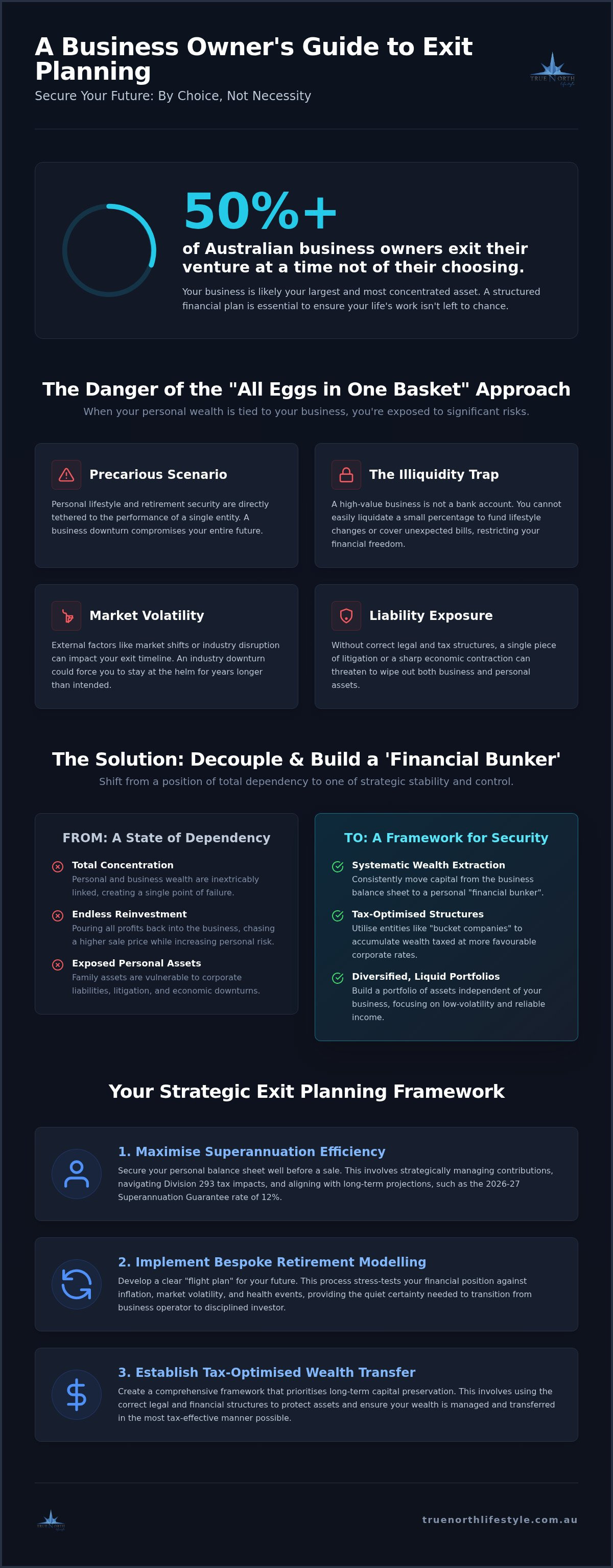
More than 50% of Australian business owners will eventually exit their venture at a time not of their choosing. The risk is real. Whether triggered by health, family changes, or shifting market conditions, your business is likely your largest and most concentrated asset. A structured business exit strategy financial planning process is essential to ensure your life's work isn't left to chance. You have spent years building an engine of growth, but relying solely on its eventual sale for your retirement is a high-stakes gamble.
You deserve a future that is defined by choice rather than necessity. We believe in decoupling your personal security from the inherent volatility of your company. We will show you how bespoke retirement modelling and tax-optimised investment structures can provide the quiet certainty you need. This guide outlines the path toward a diversified portfolio that protects your family and ensures your lifestyle remains secure, regardless of what happens within the business walls.
Key Takeaways
- Understand the mechanics of concentration risk and how to build a 'financial bunker' of assets entirely independent of your business operations.
- Establish a comprehensive business exit strategy financial planning framework that prioritises tax-optimised wealth transfer and long-term capital preservation.
- Learn to maximise superannuation efficiency and manage Division 293 tax impacts to secure your personal balance sheet well before a sale.
- Discover how bespoke retirement modelling provides a clear flight plan, stress-testing your future against inflation, market volatility, and health events.
The Concentration Risk: Why Your Business Shouldn’t Be Your Only Retirement Plan
Risk is concentrated. For the majority of Australian private business owners, their company represents more than just a career; it's their primary financial engine and their largest asset. This creates a precarious scenario where personal lifestyle and retirement security are tethered to the performance of a single entity. If the business faces a downturn, the owner’s entire future is compromised. Effective business exit strategy financial planning requires a deliberate move away from this 'all-in' mentality toward a more diversified, stable foundation.
A high-value business is often an illiquid one. You cannot easily liquidate a small percentage of your company to fund a lifestyle change or cover an unexpected medical bill. This illiquidity trap means that while you might be wealthy on paper, your day-to-day financial freedom remains restricted. External factors, such as shifting market volatility or sudden industry disruption, can also impact your timeline. If your industry faces a downturn just as you plan to depart, you may be forced to stay at the helm for years longer than intended. Comprehensive exit planning provides the foresight to manage these variables before they become crises.
Transitioning from a business operator to a disciplined investor involves a significant psychological shift. It requires moving from a position of total control to one of strategic oversight. You've spent decades trusting your own ability to drive growth. Now, you must learn to trust a research-driven methodology that preserves what you've built.
The Danger of the All Eggs in One Basket Approach
Asset protection is paramount. When your personal wealth is inextricably linked to your business, a single piece of litigation or a sharp economic contraction can wipe out decades of effort. Correct legal and tax structures are essential to wall off your family’s future from corporate liabilities. We advocate for wealth decoupling, a process where we systematically move capital from the business balance sheet to a personal "financial bunker." This safety net ensures that even if the business environment becomes hostile, your family remains protected and your retirement stays on track.
Balancing Reinvestment with Personal Wealth Extraction
Knowing when to stop is a skill. Many owners fall into the trap of constant reinvestment, pouring every cent of profit back into the business in hopes of a higher eventual sale price. However, there is always a tipping point where the risks of reinvestment outweigh the potential rewards. We help you identify this threshold by analysing your long-term projections and the 2026-27 Superannuation Guarantee rate of 12% to ensure your personal contributions are optimised. Wealth management for business owners is the strategic alignment of personal goals with corporate success. By extracting profits consistently and directing them into bespoke investment portfolios, you build a reliable income stream that doesn't depend on your daily presence at the office.
Decoupling Personal Wealth: Strategies for Building Stability
Decoupling is about safety. Your business is the engine, but you need a separate fuel tank. A "financial bunker" consists of assets that don't care if your business has a bad quarter. For many Sydney business owners, the default choice is residential property. While property has been a staple, it often replicates the illiquidity of the business itself. True stability comes from assets you can access when you need them most, rather than waiting months for a settlement. Building a robust business exit strategy financial planning framework ensures that your personal wealth is not a hostage to your company's performance.
Moving away from lumpy assets toward diversified portfolios is a core component of this shift. By utilising corporate structures, such as a separate investment company or "bucket company," you can house these assets tax-effectively. This allows for the accumulation of wealth taxed at corporate rates rather than the top marginal personal rate. It is a vital step to take well before you eventually trigger a sale. Effective business exit strategy financial planning relies on this early structural discipline to maximise your long-term position.
Bespoke Portfolio Construction with Resonant Asset Management
Stability is the goal. We collaborate with Resonant Asset Management to provide a research-driven, Investment Committee approach. This isn't about chasing the latest speculative trend. Instead, we focus on bespoke investment advice Sydney that targets low-volatility, income-producing assets. These assets act as a counterweight to the high-risk, high-growth nature of your business. It's about creating a predictable stream of capital that supports your lifestyle without requiring you to sell shares in your company at an inopportune time.
Asset Protection and Risk Management
Protection precedes growth. You must keep your personal "bunker" out of the reach of the trading entity’s creditors or potential litigants. Beyond structural separation, we review personal insurances such as Buy/Sell and Key Person cover. These ensure that if a partner or key employee is suddenly absent, the business continuity remains intact. A comprehensive Business Owner's Guide to Exit Strategies often highlights that the most successful transitions are those where the owner is financially independent long before the keys are handed over. We focus on wealth preservation and longevity planning to ensure your capital lasts through a 30-year retirement.
If you're unsure if your current structures are sufficiently protected, a portfolio sustainability modelling session can provide the clarity you need to move forward with confidence.
Optimising Superannuation and Tax for the Entrepreneur
Precision meets tax efficiency. While the previous sections focused on building a "financial bunker" outside your company, superannuation remains the most tax-effective environment for Australian wealth accumulation. For a business owner, the transition toward retirement allows for a significant acceleration of these contributions. Navigating the 2026-27 financial year requires a firm grasp of the updated caps; concessional contributions are now capped at $32,500, while non-concessional (after-tax) contributions sit at $130,000. Integrating these limits into your business exit strategy financial planning ensures you are moving capital from a high-tax environment into one where earnings are taxed at a maximum of 15%.
High-earning owners must remain mindful of the Division 293 tax threshold. If your combined income and concessional contributions exceed $250,000, you will face an additional 15% tax on those contributions. While this increases the cost of entry, the long-term benefits of the superannuation environment often outweigh the immediate tax hit. Strategic planning is about Overcoming emotional and financial roadblocks that often prevent owners from extracting profits early. Unlike employees, you have the unique ability to control the timing and character of your income, allowing for a more sophisticated approach to wealth preservation.
Self-Managed Super Funds (SMSF) vs. Professional Management
Control brings complexity. Many entrepreneurs prefer an SMSF because it allows the fund to hold business real property, creating a scenario where your business pays rent to your retirement fund. This can be a powerful tool for asset growth, yet it requires rigorous compliance. The Australian Taxation Office (ATO) maintains strict oversight on "sole purpose" tests and related-party transactions. Professional oversight is not just a luxury; it is a necessity to avoid heavy penalties and compliance breaches. If you are seeking local expertise, our team provides tailored superannuation advice Sutherland Shire to ensure your fund remains a stable vehicle for your future.
Strategic Tax Planning for Retirement
The Small Business CGT Concessions are a primary lever for Australian owners. If your business meets the $2 million aggregated turnover test or the $6 million net asset value test, you may be able to significantly reduce or even eliminate capital gains tax upon sale. These concessions allow for substantial amounts to be rolled into superannuation above the standard caps. Implementing tax planning for retirement Australia can save six figures during a business exit by aligning the sale with your specific retirement phase. We also utilise the Superannuation Re-contribution strategy as a legacy tool, converting taxable components of your fund into tax-free components to benefit your beneficiaries in the future.
Succession Planning and the Family Legacy
Legacy is deliberate. It requires a methodical transition from the operational day-to-day to a role of strategic oversight. For most Australian entrepreneurs, the business is a member of the family, and deciding its future is as much an emotional challenge as a financial one. A comprehensive business exit strategy financial planning framework acts as the bridge between your current success and your family's multi-generational security. Without a structured plan, the value you have spent decades building can quickly erode through poor timing or lack of leadership depth.
To secure a smooth transition, we follow a disciplined five-step process:
- Step 1: Identify the ideal exit. Determine if your path leads to a third-party sale, a merger, or a family transition. Each route carries distinct tax and legal implications.
- Step 2: Conduct a formal valuation. This valuation must be stress-tested against your retirement modelling to ensure the net proceeds, after all liabilities and taxes, will support your desired lifestyle.
- Step 3: Implement a multi-year transition. Rushing a sale often leaves significant capital on the table. A three-to-five-year lead time allows you to optimise profitability and remove balance sheet clutter.
- Step 4: Review estate planning. Your post-exit wealth will require new structures. Ensure your Wills and Power of Attorney documents reflect your liquid asset position.
- Step 5: Communicate the plan. Transparency with the next generation prevents the 'sudden wealth' syndrome and reduces the risk of future conflict.
Protecting the Family Estate
Protection is foundational. Testamentary Trusts are an essential tool for the Australian business owner, shielding an inheritance from external threats such as creditors or marital breakdowns. By utilising these structures, you ensure that the capital remains within the family bloodline and is managed according to your specific wishes. Our approach to wealth transfer strategies Australia focuses on minimising tax leakage while providing a clear, evidence-based roadmap for your heirs.
The Human Element of Succession
Identity matters deeply. Many owners face a profound identity crisis after selling what they often describe as their 'baby.' To ensure the business is truly sale-ready, you must systematically remove yourself as the sole key-person. A business that cannot function without its founder is a business with a compromised valuation. We help you plan for a lifestyle that provides purpose beyond the boardroom, ensuring your retirement is as fulfilling as your career. If you are ready to document your intentions and protect your loved ones, our estate planning strategy services provide the structured path you need to move forward with quiet certainty.
The True North Approach: Retirement Modelling for Sydney Business Owners
Clarity replaces anxiety. For many business owners, the future is a series of "what-ifs" that lead to sleepless nights. We believe that your business exit strategy financial planning should be grounded in evidence, not guesswork. Our Steady Navigator philosophy is designed to provide a stabilising influence in a fluctuating economy, moving you from a state of uncertainty toward a structured, well-defined path. By acting as your authoritative guide, we do the heavy lifting of technical analysis so you can step into a role of confident oversight.
Local expertise is vital. Based in Miranda and the Sydney CBD, we understand the specific pressures facing Australian private business owners. We don't just provide generic advice; we build bespoke models that reflect the nuances of the 2026-27 tax environment and the unique liquidity challenges of local industries. Our collaboration with Resonant Asset Management ensures that your portfolio is constructed to withstand the real-world probability of market shifts. We focus on the human outcome of these strategies, ensuring you feel protected and empowered to make informed choices.
Achieving Clarity through Long-Term Projections
Projections provide a flight plan. We use sophisticated modelling to visualise your "Lifestyle Runway," showing exactly how long your capital will last under various conditions. This allows us to stress-test your wealth against high inflation, market crashes, or unexpected health events. By comparing different exit scenarios side-by-side, you can see the immediate impact of a specific sale price or a staggered transition on your future income. This level of detail is a core part of our retirement planning Sydney pillar, ensuring that your lifestyle is never left to chance.
Your Next Steps to Financial Confidence
Strategy requires independence. We operate on a fee-for-service model to ensure our strategic advice remains unbiased and focused solely on your outcomes. This transparency is the foundation of the trust we build with our clients. If you're ready to secure your future beyond the business, we invite you to book a discovery session at our Miranda or Sydney CBD offices. We will review your current position and begin the process of risk management and portfolio sustainability modelling. You've spent years building the business; it's now time to build the life it was always meant to provide. Take the first step toward quiet certainty by visiting True North Lifestyle today.
Charting Your Path Toward Financial Autonomy
Securing your future is a deliberate act of transition. We've explored how decoupling your personal assets from your company's performance creates a necessary safety net. By moving beyond the concentration risk of your business, you establish a foundation of stability that isn't dependent on the next market shift or industry disruption. A structured business exit strategy financial planning process ensures that your life’s work translates into a lasting family legacy. Our Steady Navigator approach focuses on wealth preservation through bespoke portfolio construction in collaboration with Resonant Asset Management, providing you with the quiet certainty you deserve.
Clarity is the ultimate goal. As specialists in Sutherland Shire retirement modelling, we help you stress-test your wealth against real-world variables, ensuring your lifestyle runway remains secure for decades to come. You've already done the heavy lifting of building a successful enterprise; now it's time to build the life that success was meant to provide. Secure your lifestyle beyond the business-book a discovery session with our Sydney advisers today. Your future is too important to be left to chance, and we are here to guide you toward a well-defined and prosperous horizon.
Frequently Asked Questions
How is wealth management for business owners different from personal financial planning?
Wealth management for business owners focuses on decoupling personal security from business volatility. Unlike standard personal planning, it addresses the concentration risk of having most wealth tied to a single, illiquid asset. It requires a sophisticated alignment of corporate structures with personal lifestyle goals to ensure that your family remains protected regardless of the company's performance.
When should I start planning for my business exit?
You should ideally begin the process three to five years before your intended departure. This timeframe is necessary to implement a multi-year business exit strategy financial planning framework that optimises business value and allows for strategic tax positioning. Rushing the process often leads to missed opportunities with superannuation caps or Capital Gains Tax concessions.
Can I use my business as my primary superannuation fund?
Relying solely on your business as a retirement fund is a high-stakes gamble. While a successful sale can provide substantial capital, external factors like industry shifts or health events can compromise your exit timing. Diversifying into independent assets or superannuation ensures your retirement isn't hostage to the fluctuating value of a single trading entity.
What are the Small Business CGT concessions and how do they work in 2026?
For the 2026-27 financial year, these concessions remain a powerful tool for reducing tax on business sale proceeds. To be eligible, your business must have an aggregated turnover of less than $2 million or a total net asset value of no more than $6 million. These rules allow you to potentially eliminate or significantly reduce capital gains by directing funds into superannuation.
How can I protect my personal assets from business-related risks?
Structural separation is the most effective defence. By housing investment assets in a separate entity, such as a discretionary trust or a "bucket company," you keep them out of the reach of the trading entity's creditors. Maintaining robust Buy/Sell and Key Person insurance further ensures that business-related shocks don't spill over into your personal balance sheet.
Is an SMSF better than a retail super fund for a business owner?
An SMSF offers unparalleled control, such as the ability for the fund to own your business premises and lease them back to the company. However, this control comes with significant compliance responsibilities and ATO oversight. Retail funds offer simplicity and lower administrative burdens but lack the bespoke flexibility many entrepreneurs require for their specific asset types.
What is retirement modelling and why do I need it?
Retirement modelling is a data-driven "flight plan" that projects your financial future across various scenarios. It allows us to stress-test your capital against inflation, market volatility, and longevity. This process provides the quiet certainty that your lifestyle runway is sufficient to support you for 30 years or more after you hand over the keys.
How do I manage irregular income when building an investment portfolio?
Managing irregular cash flow requires a disciplined structural approach. By utilising a corporate structure to receive business dividends, you can smooth out your personal drawings and maintain a consistent investment schedule. This "bucket company" strategy prevents you from being pushed into the highest personal tax brackets during high-profit years while ensuring your portfolio continues to grow.


