
What if the greatest risk to your family's legacy isn't a tax that technically exists, but a series of "stealth" liabilities triggered the moment your assets change hands? While it's a relief that Australia has no formal death duties, many families are blindsided by the complexities of minimizing inheritance tax Australia through strategic foresight. It's natural to feel concerned that your adult children might face a 17% tax bill on your superannuation or lose a significant portion of the family home's value to Capital Gains Tax due to a simple timing error.
We believe that wealth transfer should be a transition of calm and order, not a source of financial anxiety. This 2026 guide provides the professional clarity you need to protect your hard-earned assets, offering a methodical look at bespoke estate planning strategies. You'll discover how the "re-contribution strategy" can help neutralise superannuation taxes and learn to navigate the ATO's latest rulings on inherited property. We've done the heavy lifting and rigorous testing of these models to ensure you can step into a role of confident oversight for your family's future.
Key Takeaways
- Clarify the distinction between abolished federal death duties and the modern "stealth" taxes that can still impact contemporary Australian estates.
- Identify the specific triggers that lead to a 17% tax liability on superannuation death benefits for adult beneficiaries and how to restructure your balance in advance.
- Learn the critical requirements of the CGT "two-year rule" to ensure an inherited family home remains a tax-free asset for your loved ones.
- Discover how tactical estate planning strategies, such as the re-contribution method, are essential for minimizing inheritance tax Australia by protecting the taxable components of your wealth.
- Understand how bespoke retirement modelling provides the necessary structure to visualise a seamless, tax-efficient transfer of assets to the next generation.
Understanding the Landscape: Does Australia Have Inheritance Tax?
Australia formally abolished inheritance tax and estate duties at the federal level in 1979. By the early 1980s, every state had followed suit, removing the direct levy on the value of a deceased person's estate. While this sounds like a total reprieve, the term remains part of the national conversation in 2026 because of the financial "sting" that often accompanies a transfer of wealth. The broader framework of Taxation in Australia has evolved to capture revenue through other mechanisms, making the process of minimizing inheritance tax Australia a matter of navigating complex, overlapping rules rather than a single, flat levy.
Three primary "hidden" taxes often act as de facto death duties. Capital Gains Tax (CGT) can apply when assets are sold by beneficiaries; superannuation death benefits may be taxed at 17% for non-dependants; and the estate itself must account for any outstanding income tax. For families in Sydney and the Sutherland Shire, early planning isn't just about the numbers. It's about replacing the inherent anxiety of wealth transfer with a sense of calm and order. Strategic foresight ensures that a lifetime of work isn't diluted by avoidable liabilities.
The Distinction Between Estate and Inheritance Taxes
Australian law differs significantly from the UK or US systems, where estates are often taxed directly before distribution. Here, the tax burden is usually deferred or triggered by specific events, such as a non-dependant child receiving a superannuation payout. Your residency status in NSW matters, particularly regarding land tax and the precise wording required in wills to maintain exemptions for certain assets. Legacy leakage is the erosion of estate value through unmanaged tax obligations. By identifying these leakages early, we can construct a more resilient wealth transfer plan.
The Role of the Legal Personal Representative
The tax responsibilities of an executor, or Legal Personal Representative (LPR), are substantial. They're responsible for lodging the deceased's final "date of death" tax return and managing the estate's own tax filings until all assets are distributed. This process is often where technical errors occur, leading to delays and unexpected costs for the beneficiaries. Professional tax planning for retirement Australia simplifies the executor’s burden by ensuring the financial structure is transparent and optimized long before the transition occurs.
The Superannuation Death Benefit Trap: Protecting Adult Beneficiaries
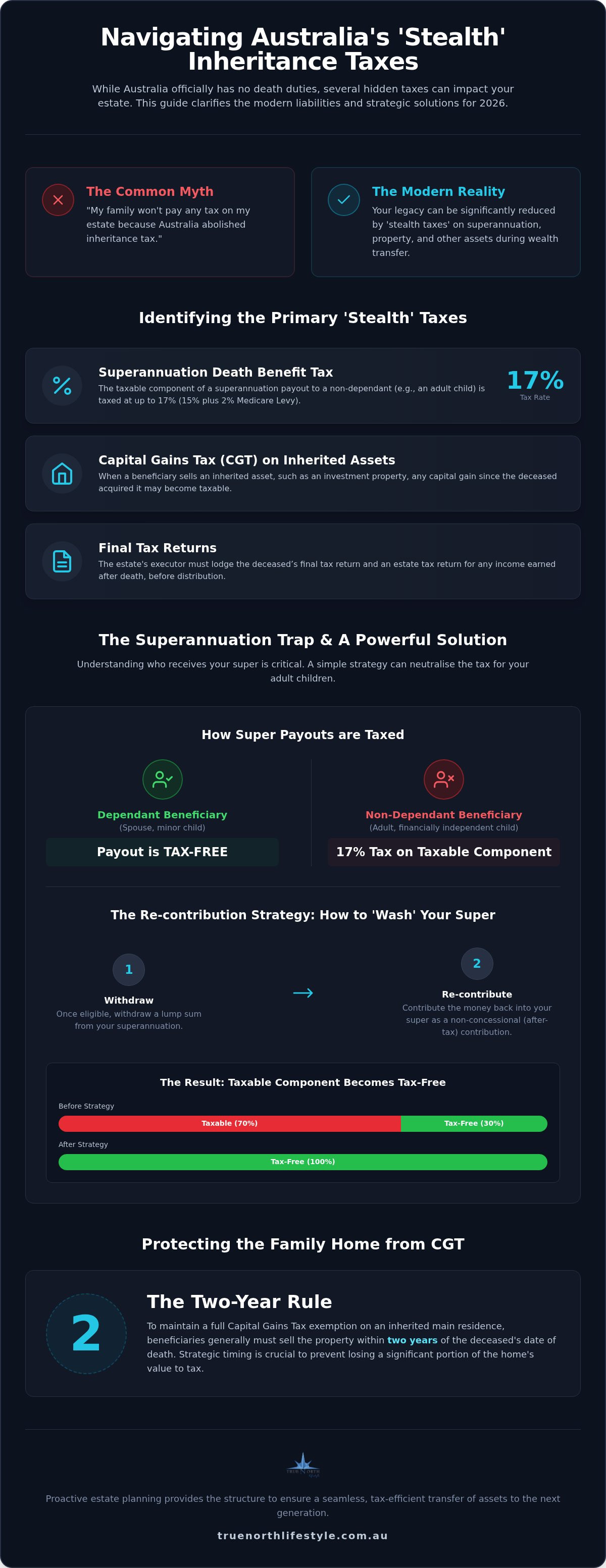
Superannuation remains a cornerstone of Australian wealth. However, it harbours a significant tax liability that many only discover during a time of grief. Under tax law, there is a sharp distinction between a "death benefit dependant", usually a spouse or minor child, and a "non-dependant", typically an adult, financially independent child. While spouses receive super tax-free, adult children are often hit with a 17% tax sting on the taxable component of the fund. This is essentially a hidden levy on your legacy. Understanding the nuances of these components is the first step in minimizing inheritance tax Australia and ensuring your wealth reaches the next generation intact.
Most super statements split balances into tax-free and taxable components. The taxable portion is further divided into taxed and untaxed elements. According to the Australian Taxation Office guide for beneficiaries, the taxed element is subject to a 15% tax plus the 2% Medicare levy when paid to non-dependants. To identify your exposure, look for the component breakdown on your latest member statement; this figure represents the portion of your life's work currently vulnerable to the ATO. Minimizing inheritance tax Australia requires a methodical review of these numbers to prevent avoidable leakage.
The Superannuation Re-contribution Strategy
Control your outcome. This strategy involves withdrawing a portion of your super, once you reach preservation age and meet a condition of release, and re-contributing it as a non-concessional contribution. By doing so, you effectively "wash" the taxable component, converting it into a tax-free component. For the 2026-27 financial year, the low rate cap for superannuation lump sums is $260,000, which provides a structured window for this transition. This strategy can save a beneficiary $17,000 for every $100,000 inherited. It is a precise, evidence-based method to protect your children from unnecessary tax erosion.
Binding Death Benefit Nominations (BDBN)
Clarity provides security. A Binding Death Benefit Nomination (BDBN) directs your super fund trustee exactly where to pay your balance, bypassing the uncertainty of trustee discretion. Many standard nominations are lapsing, meaning they expire every three years; a non-lapsing nomination offers a more permanent, stabilising anchor for your estate plan. You must decide whether to direct funds to the estate, where they are governed by your will, or directly to beneficiaries. Our specialists at True North Lifestyle provide the estate planning strategy needed to align these nominations with your broader retirement modelling, ensuring your legacy is legally and financially protected.
Capital Gains Tax (CGT) and Inherited Assets: Managing the "Two-Year Rule"
Inheriting an asset is not a taxable event in Australia; however, the subsequent sale of that asset often is. When you receive property or shares from an estate, you generally "step into the shoes" of the deceased regarding the asset's cost base. This means if they purchased a block of shares in 1995 for $10,000 and they are now worth $100,000, your potential CGT liability is calculated from that original 1995 price. Minimizing inheritance tax Australia in this context requires a precise understanding of when the cost base was established and whether any exemptions apply to shield the growth.
The most significant shield is the Main Residence Exemption. If you inherit a property that was the deceased's primary home, you can typically sell it tax-free if the sale settles within two years of their death. This "Two-Year Rule" is a critical window for beneficiaries. It applies even if you rent the property out during that period. However, the ATO has recently tightened the rules through Taxation Determination TD 2026/D1, which narrows the "right to occupy" exemptions. Ensuring your legal and financial strategies align with these 2026 updates is vital for preserving the full value of a family home.
A different rule applies to "Pre-CGT" assets, which are those acquired before 20 September 1985. For these legacy holdings, the cost base "resets" to the market value on the date of the owner's death. This reset is a powerful tool for wealth preservation, as it effectively wipes out decades of capital gains for the beneficiary. Identifying these assets early allows for a more structured approach to the eventual distribution of the estate.
Inheriting Shares and Investment Portfolios
Complexity often arises with liquid assets. While inheriting cash is straightforward, receiving an "in-specie" transfer of a share portfolio means you inherit the original tax foundations of every individual holding. Selling these shares immediately to diversify could trigger a massive, avoidable tax bill. When rebalancing inherited wealth, utilizing bespoke investment advice Sydney ensures that your portfolio remains aligned with your personal risk profile while accounting for these complex tax foundations. We focus on modelling the long-term impact of these transfers to prevent unnecessary "legacy leakage."
Sydney Property Nuances and CGT
The stakes are high in the Sydney market. In areas like Miranda or the CBD, where property valuations have seen exponential growth, missing the two-year exemption window by even a few weeks can result in a six-figure tax liability. Beneficiaries must maintain meticulous records, including the original purchase contract, stamp duty receipts, and costs of any capital improvements made by the deceased. If the two-year limit is exceeded, you may only be eligible for a partial exemption, making the initial valuation at the date of death a cornerstone of your tax-minimisation strategy.
Strategic Solutions for Minimising Tax on Your Estate
Legacy is intentional. Moving from a state of concern to one of quiet certainty requires a structured methodology. While the previous sections highlighted the risks associated with superannuation and property, this section focuses on the tactical construction of a plan for minimizing inheritance tax Australia. By implementing sophisticated structures early, you can ensure that your legacy remains a source of stability for your heirs, rather than a tax burden. Effective wealth preservation is rarely about a single action; it is the result of multiple, integrated strategies working in unison.
The Role of Testamentary Trusts
Protection meets flexibility. A testamentary trust is a trust established within your will that only comes into effect upon your passing. It is one of the most robust wealth transfer strategies Australia offers for families seeking long-term security. These trusts provide a high degree of asset protection, shielding your children's inheritance from potential divorce proceedings or bankruptcy. Beyond protection, they offer immense tax flexibility. Income generated by the trust can be distributed to minor grandchildren, who are taxed at adult rates rather than the usual penalty rates for minors. This allows for the splitting of income across multiple family members, significantly reducing the overall tax paid by the group.
Withdrawal Strategies Prior to Passing
Timing remains critical. If you have "unrestricted non-preserved" benefits in your super, you have the legal right to withdraw them at any time. Withdrawing these funds shortly before death can effectively bypass the 17% superannuation death benefits tax entirely, as the money is no longer inside the super system at the time of passing. To execute a tactical withdrawal and re-contribution, you generally follow a structured process:
- Identify the taxable component on your latest super statement.
- Confirm you have met a condition of release to access funds legally.
- Withdraw the taxable portion into a personal bank account.
- Re-contribute the funds as a tax-free non-concessional amount.
This "Deathbed Withdrawal" is a high-risk, high-reward strategy. If you withdraw too early, you lose the tax-free earnings status of the pension phase. Professional oversight is essential to model these scenarios and identify the optimal window for action. We focus on ensuring the executor has the necessary clarity to act when the time comes, preserving the value you've built over decades.
Balance the risk. Other strategies include gifting assets during your lifetime. Under Centrelink rules, you must be aware of the five-year gifting window; assets given away within five years of applying for the Age Pension are still counted under the assets test. Additionally, some families use life insurance policies specifically designed to provide a tax-free lump sum to heirs. This cash can then be used to pay any CGT or super tax liabilities, ensuring the core assets, like the family home, don't need to be sold. At True North Lifestyle, we specialise in bespoke portfolio construction that integrates these tactics for minimizing inheritance tax Australia into a seamless, long-term projection.
Securing Your Legacy with Professional Estate Planning in Sydney
Legacy is more than a final balance on a ledger. It represents the culmination of a lifetime's effort and the values you wish to pass forward. At True North Lifestyle, we act as your Steady Navigator, ensuring that the technical complexity of minimizing inheritance tax Australia doesn't overshadow the human significance of your wealth transfer. While standard financial advice often stops at the point of retirement, our methodology extends further. We integrate estate strategy directly into our retirement modelling to ensure your assets are protected for the next generation.
Visualising the "Legacy Outcome" is a cornerstone of our process. We utilise sophisticated long-term cash flow projections to model not just your spending, but the eventual tax position of your heirs. This allows Sydney families to see the tangible impact of strategies like superannuation re-contributions or the establishment of testamentary trusts. For residents in Miranda and the Sutherland Shire, or professionals in the Sydney CBD, this level of detail replaces uncertainty with quiet certainty. You gain the confidence that your wealth transfer plan is both tax-efficient and legally robust.
The True North Approach to Estate Strategy
Success requires collaboration. While we don't draft legal documents, we work closely with your legal professionals to ensure your Will and Power of Attorney align perfectly with your financial structures. A plan created in isolation is a risk; a plan built through integrated expertise is a shield. This is particularly vital in the 2026 environment, where legislative shifts require constant vigilance. Achieving a "Calm Retirement" is only possible when you know your wealth preservation strategies are adaptable to future changes in tax law.
Next Steps for Sydney Families
Clarity begins with a conversation. We invite you to organise a discovery session at our Miranda or Sydney offices to review your current position. This is a no-nonsense look at your "legacy leakage" and the steps required to plug it. To make the most of this estate review, we recommend gathering a specific checklist of documents:
- Latest superannuation member statements showing tax-free and taxable components.
- Copies of current Wills and Binding Death Benefit Nominations.
- Trust deeds for any existing family or testamentary trusts.
- Recent valuations for high-value Sydney property or share portfolios.
Taking these steps now ensures your family is protected from the "stealth" taxes discussed throughout this guide. We have already done the heavy lifting of testing these models; now, we invite you to step into a role of confident oversight. Organise a consultation with a True North Lifestyle adviser today.
Empowering Your Family's Financial Future
Protecting your legacy is a deliberate act of care. We have explored how the 17% tax on superannuation death benefits for adult children can be managed through re-contribution strategies, and why the two-year window for property sales remains a critical deadline for Sydney beneficiaries. By focusing on the technical precision of minimizing inheritance tax Australia, you move from a place of uncertainty to a position of confident oversight. Your assets represent a lifetime of discipline, and they deserve a transition that reflects that commitment.
Our specialists provide the stabilising anchor you need, offering specialist retirement modelling and deep expertise in superannuation tax-minimisation. With local offices in Miranda and the Sydney CBD, we are committed to helping you visualise a seamless, intergenerational transition of wealth. Secure your family’s future with a bespoke estate planning strategy from True North Lifestyle. Your hard work deserves a protected outcome, and we are here to ensure your family steps into a future characterised by order, clarity, and enduring financial stability.
Frequently Asked Questions
Does Australia have a formal inheritance tax or death duty in 2026?
Australia does not have a formal inheritance tax or death duties in 2026. This federal tax was abolished in 1979, and all states followed suit soon after. However, significant tax liabilities still arise through other channels. Capital Gains Tax and superannuation death benefits tax are the primary mechanisms that impact an estate's value. Understanding these "hidden" costs is the first step toward minimizing inheritance tax Australia and ensuring your wealth reaches your heirs intact.
How much tax do adult children pay on inherited superannuation?
Adult children who are financially independent are considered non-dependants for tax purposes. They must pay tax on the taxable component of an inherited superannuation death benefit. For the 2026-27 financial year, the taxed element is subject to a 15% tax rate plus the 2% Medicare levy, totalling 17%. If there is an untaxed element, the rate rises to 32%. Spouses and minor children generally receive these benefits tax-free, creating a sharp distinction in estate outcomes.
What is the "two-year rule" for inherited property and CGT?
The "two-year rule" allows you to sell an inherited main residence without paying Capital Gains Tax if the sale settles within 24 months of the date of death. This exemption applies even if the property was rented out during that timeframe. Under the ATO's 2026 determination TD 2026/D1, you must ensure the deceased's will grants an express right to occupy the dwelling to maintain certain exemptions. Missing this deadline can lead to substantial CGT liabilities.
Can I avoid tax by gifting my assets before I die?
Gifting assets can reduce your estate's taxable value, but you must navigate the Centrelink "deprivation" rules. You can generally gift up to $10,000 per financial year, or $30,000 over a rolling five-year period, without impacting your Age Pension assets test. Any amount gifted above these limits within five years of applying for a pension is still counted as your asset. Strategic gifting requires balancing immediate tax benefits with your own long-term financial longevity and lifestyle needs.
Is the re-contribution strategy still effective for minimising super tax?
The re-contribution strategy remains one of the most effective methods for minimizing inheritance tax Australia in 2026. By withdrawing taxable super components and re-contributing them as non-concessional amounts, you "wash" the tax liability for future beneficiaries. For the 2026-27 income year, the low rate cap is $260,000. This tactical shift can save your adult children $17,000 in tax for every $100,000 they eventually inherit, making it a cornerstone of modern retirement modelling.
Do I need a Testamentary Trust if I only have a modest estate?
Testamentary Trusts offer value even for modest estates by providing robust asset protection and tax-effective income splitting. These trusts allow you to distribute income to minor grandchildren at adult tax rates rather than the penalty rates usually applied to children's income. This structure also shields assets from potential divorce or bankruptcy proceedings involving your beneficiaries. While there are setup costs, the long-term wealth preservation benefits often outweigh the initial investment for families seeking stability.
What happens to my super if I die without a valid nomination?
If you die without a valid Binding Death Benefit Nomination, the super fund trustee decides who receives your balance. They generally follow the law to pay it to your dependants or your estate, but this process often leads to significant delays and potential family disputes. Without a non-lapsing nomination, your super might not end up where you intended. This lack of direction can also trigger higher tax liabilities if the funds are paid to non-tax dependants.
How does an inherited investment portfolio affect my own tax return?
Inheriting a share portfolio doesn't trigger immediate tax, but it affects your future filings. You generally inherit the deceased's original cost base for assets acquired after 20 September 1985. If you sell the shares, you'll be liable for CGT on the growth since their original purchase date. For assets acquired before that 1985 date, the cost base resets to the market value at the time of death. This reset provides a clean slate for your personal tax return.


