

You don’t always need to pay for help with super. Free guidance, online tools and calculators can answer basic questions, while more complex retirement planning in Australia often calls for professional advice. Industry super fund advice in Sutherland Shire can help you understand which approach suits your circumstances.
It’s understandable to focus on fees when protecting your retirement savings. The value of advice depends on what you need: comparing fund fees, insurance and investment options is a different task from coordinating super with tax, estate planning and broader retirement goals.
This guide explains what to compare across super funds, when paid advice may be useful, and how adviser credentials, risk and tax considerations fit into a considered plan. You’ll have a clearer basis for deciding whether general guidance is enough or a broader, tailored strategy could help bring your next steps into focus.
Key Takeaways
- Compare fees alongside insurance, investment choices and long-term performance to assess how a fund fits your needs.
- Consider how super tax planning and beneficiary nominations connect with your wider estate plans.
- Match your investment mix to your time horizon, goals and comfort with market fluctuations.
- Before engaging an adviser, check their licence and understand how they’re paid; consider modelling and super review when you need a coordinated retirement strategy.
Comparing super fund fees, insurance, benefits, performance and investment options
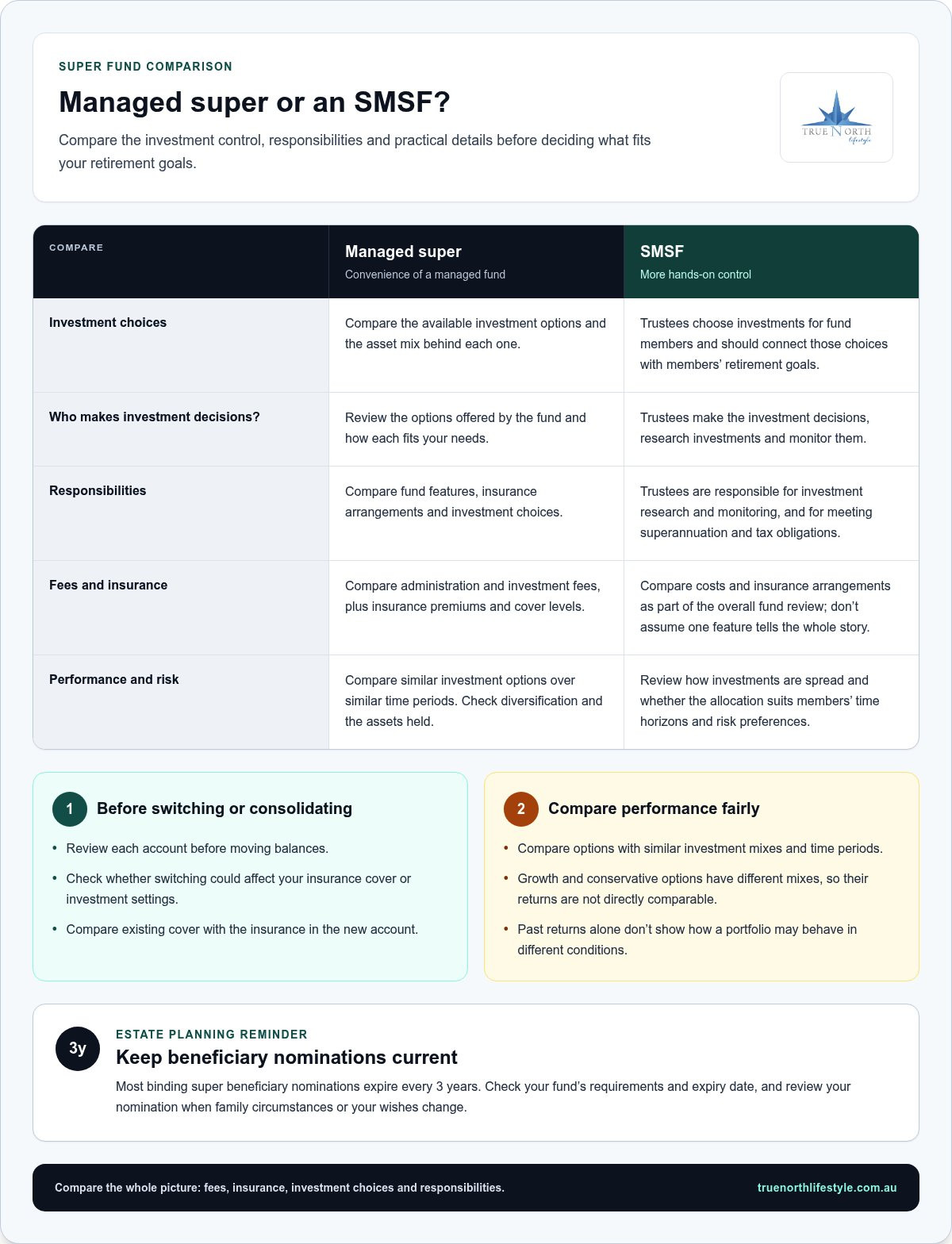
Compare total fees, insurance cover and investment choices against your retirement goals. Switching or consolidating accounts can affect your insurance cover or investment settings, so review each account before moving balances. Industry super fund advice sought by Sutherland Shire residents can help organise these comparisons around their circumstances.
Fees and insurance comparisons
Compare administration and investment fees, then include insurance premiums and cover levels. A lower-fee managed super account may provide different insurance from another fund. Before switching, compare your existing cover with the insurance in the new account.
Benefits and investment flexibility
Compare each fund’s features, insurance arrangements and investment options rather than treating one benefit as decisive. An SMSF can give trustees flexibility over investment choices, but that control brings responsibility: trustees make investment decisions, research and monitor investments, and meet superannuation and tax obligations. Consider whether this hands-on role suits you, compared with the convenience of managed super.
Performance and diversification
Compare performance across similar investment options and time periods. A growth option and a conservative option have different investment mixes, so their returns are not directly comparable. Past returns alone do not show how a portfolio may behave in different conditions. Review the assets in an option and whether its investments are diversified or concentrated in one area. Diversification can help manage portfolio risk, but it does not remove market fluctuations.
Investment strategy and asset allocation
An SMSF investment strategy should connect investment choices with members’ retirement goals, time horizons and risk preferences. Asset allocation describes how a portfolio is spread across investments such as shares, property and cash. Before choosing an allocation, consider how much fluctuation you can tolerate and whether the fund can meet its intended purpose. Trustees remain responsible for researching and monitoring their investments. This gives Sutherland Shire residents a practical basis for comparing fund structures through industry super fund advice.
Tax planning and estate planning
Tax and estate decisions can affect how your Australian retirement savings support you and your family. A useful first step is to bring your expected retirement income, super accounts and beneficiary intentions together in one strategy.
Complying Australian superannuation funds that meet the Superannuation Industry (Supervision) Act 1993 standards qualify for concessional tax rates. For retirement planning, consider how contributions, investment choices and withdrawals fit your circumstances over time. A retired person can withdraw superannuation tax-free from age 60. The timing and structure of withdrawals matter, so consider them alongside other income and the lifestyle you want to fund.
Estate planning also needs attention. Most binding super beneficiary nominations expire every 3 years, so check the expiry date and keep the nomination aligned with your current wishes. Check your fund’s requirements for completing a beneficiary nomination. Marriage, separation, a new child or a change in family circumstances can prompt a review of your nomination and wider estate arrangements.
Keep the process practical. Review the fund’s nomination requirements, confirm who you intend to benefit, and note when the nomination may need attention again. Then consider how your super instructions fit with your broader estate plans. A nomination is one part of the picture; a coordinated strategy considers retirement income, wealth preservation and the people you want to provide for.
If you’re bringing these decisions together, estate planning strategy can help connect super intentions with longer-term wealth preservation.
Asset allocation and risk preferences
Asset allocation determines how retirement savings are spread across investments such as shares, bonds, property and cash. Start by identifying your goal, time horizon and income needs. Someone planning to draw on super soon may need different access to funds from someone still building retirement savings. Financial advice should take your needs and lifestyle into account, so your strategy reflects your circumstances rather than a generic risk label.
Risk preference is about more than comfort with market movements. Consider how a fall in investment value could affect your plans and whether you could stay invested through a downturn. For example, compare a portfolio weighted towards shares with one holding more defensive assets. Ask what each mix could mean for fluctuations, access to income and planned expenses. Your answers help define a level of risk you can live with.
For managed super, examine the asset mix behind each investment option rather than relying on labels such as “balanced” or “growth”. Options with similar names can hold different proportions of shares, property and cash. Check how each mix aligns with your time horizon and risk comfort. With an SMSF, investment decisions are made for its members, so the strategy should connect those choices with their retirement objectives.
Use a structured review. Record your income needs, planned withdrawals, investment horizon and response to possible losses. Then compare those details against the current allocation and consider whether a change would affect your broader retirement plan. Include insurance needs and estate intentions in the discussion, as these can shape the purpose of your assets. Independent financial advice can help assess the trade-offs and make the reasoning behind an allocation clear.
Checking adviser licensing and qualifications
Start by confirming that the adviser is licensed to give financial advice in Australia. If the advice involves setting up an SMSF, the person or company advising you must hold an Australian financial services licence. Check that the authorisation covers the advice you’re seeking rather than relying on a job title or general experience.
Qualifications matter alongside licensing. An adviser should understand Australian tax, investment and superannuation law, as well as available investment markets. Ask how these areas apply to your situation, such as balancing retirement savings with insurance needs. Advice should be in your best interests and reflect your circumstances, rather than simply directing you towards a managed super fund or product.
Understand how the adviser is paid before agreeing to a recommendation. Ask whether they receive commissions or other benefits from selling financial products, including insurance. Some advisers earn insurance commissions, but you must explicitly agree to them. Super funds may also provide advice on a fee-for-service basis, so clarify what the advice covers and how payment works.
For SMSF advice, distinguish personal financial advice from the ongoing responsibilities of being a trustee. An adviser may help with a decision, but SMSF trustees remain responsible for investment decisions, monitoring and compliance. Ask what falls within the adviser’s role and what remains your responsibility. Clear answers help you understand the work involved before establishing or changing a fund.
Before proceeding, write down your priorities, such as comparing insurance, reviewing managed super funds or assessing an SMSF. Then ask the adviser to explain the reasoning behind each recommendation, its risks and any commission or other benefit involved. A clear discussion helps you judge whether the advice fits your needs and supports your savings goals. For decisions connecting advice with your wider plans, discuss your estate planning strategy.
True North Lifestyle: Retirement modelling & long-term projections
True North Lifestyle can help when comparing funds is only one part of your retirement decision. Retirement modelling and long-term projections bring super, expected income and planned spending into one view, helping you assess how different choices may affect your plans.
A superannuation review can examine your current arrangements, while tax-minimisation strategies and bespoke portfolio construction can support a broader approach. This may be useful when weighing a fund change, planning for retirement or coordinating investment choices with your goals.
For a considered view of how these pieces fit together, contact True North Lifestyle to discuss your retirement planning needs.
Give your retirement decisions a clear next step
Your next move doesn’t have to be a major change. It can be a clearer set of priorities: what you want retirement to provide, which decisions need attention first, and how your financial choices support those aims. This gives future conversations a useful starting point, grounded in your circumstances rather than a generic checklist.
For industry super fund advice in Sutherland Shire, True North Lifestyle brings retirement modelling and long-term projections together with superannuation review and optimisation, alongside tax-minimisation strategies. This can help you consider how a decision fits into your broader financial direction instead of treating each account or choice in isolation.
If you’re ready to clarify your next steps, contact True North Lifestyle to discuss the retirement questions you’d like to work through. A thoughtful plan starts with knowing what matters most to you.
Frequently Asked Questions
Do I really need to pay for a financial adviser to help me plan my retirement?
Not necessarily. Free guidance may suit straightforward questions, while substantial retirement planning usually calls for paid professional advice. If you need to understand a fund option, start with the fund’s information and online calculators. If you want to connect retirement income with tax choices, other assets or family priorities, paid advice can bring those decisions into one strategy.
How can understanding my super fund benefit me?
Understanding your super helps you see how the account fits your plans. Review its investment option, insurance settings, fees and nominated beneficiaries, then note any details that need attention. For example, moving to part-time work may change your expected employment income, making it useful to reconsider how your super fits alongside it.
How can you help improve my fund’s performance?
A performance review can separate market movements from decisions about your investment strategy. It can assess whether your current option suits your goals, compare alternative portfolio structures and model how changes may affect your long-term plan. True North Lifestyle offers superannuation review and optimisation, retirement projections and bespoke portfolio construction, helping you make considered decisions rather than chase recent returns.
How do you minimise taxes and fees associated with superannuation?
Start by identifying the fees charged within each account, including administration and investment costs, then consider their effect on your long-term balance. Tax outcomes depend on your circumstances and super structure, so advice can assess strategies across contributions, investments and retirement withdrawals. Tax-minimisation planning is different from preparing a tax return, so be clear about the support you need.
Super financial advice: Paid vs free, which one do you need?
Free guidance can help with general super questions and basic research, including fund resources and online calculators. Paid advice is more relevant when you need a tailored plan linking super with retirement income, tax choices or wider financial priorities. Before agreeing to advice, understand what it covers, how the adviser is paid and whether an insurance commission applies.


