

An inaccurate Centrelink assessment can leave aged-care families paying too much or receiving too little. Centrelink structuring advice in the Sutherland Shire can help you understand how a person’s financial details affect aged-care fees and entitlements, and identify information that may need updating. In some cases, missed benefits can amount to thousands of dollars.
It’s understandable to feel uncertain when Centrelink assessments, aged-care costs and family finances intersect. A careful review can clarify the figures and help you see what may be affecting the assessment.
This article explains what a review can examine, how updated details may support a more accurate assessment, and when specialist guidance can help. You’ll also learn how to approach the next steps with a clearer picture of your family’s aged-care finances.
Key Takeaways
- Review the information behind an aged-care assessment and identify which details may need updating.
- Learn how to assess an adviser’s qualifications and experience in Centrelink and aged-care financial matters.
- Consider how gifts, trusts, superannuation and asset transfers may interact when planning for Centrelink entitlements.
- Explore how True North Lifestyle’s retirement modelling and long-term projections can help bring aged-care financial decisions into a clearer plan.
Reviewing Centrelink assessments
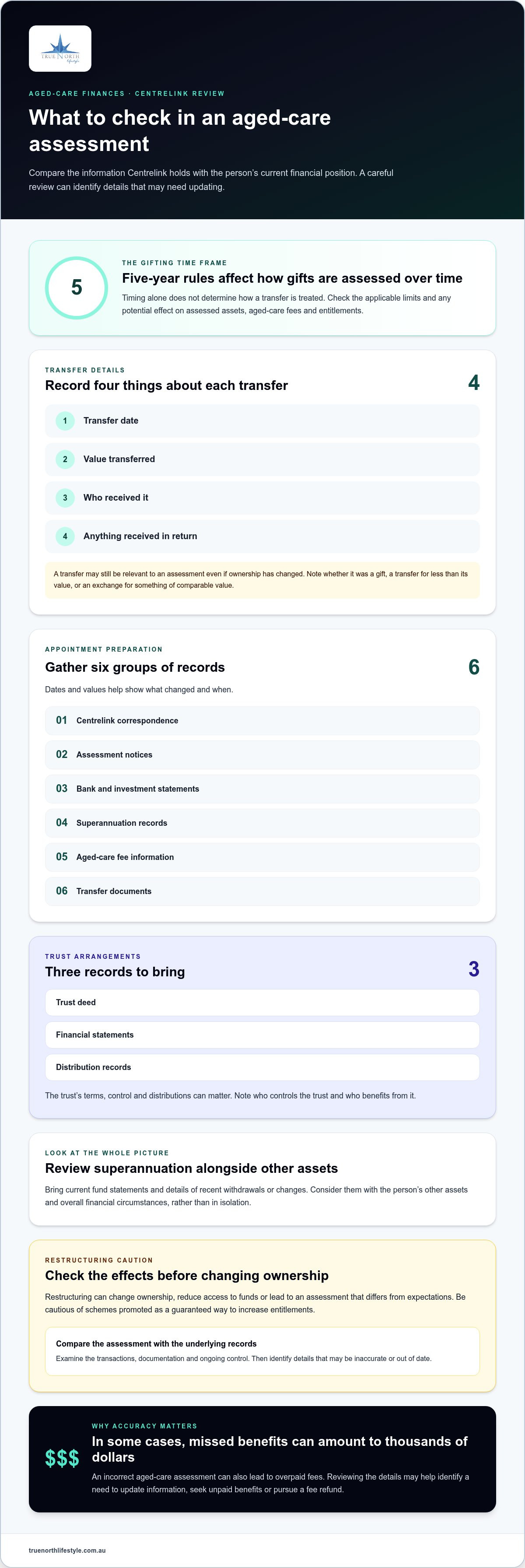
Centrelink assessments can affect aged-care fees and entitlements. Compare the details on record with the person’s current financial position.
Gifting limits and transfer penalties
Centrelink applies gifting rules when assessing transfers, and excess gifts may be treated as deprived assets. Relevant details include the transfer date, value, recipient and anything received in return. The five-year rules affect how gifts are assessed over time, but timing alone does not determine how a transfer is treated. Before acting, review the applicable limits and any potential effect on assessed assets, fees and entitlements.
Effects of gifting and asset transfers
A gift or transfer can change who owns an asset without removing its possible relevance to an assessment. Record whether money was given away, transferred for less than its value, or exchanged for something of comparable value. For an advice appointment, gather Centrelink correspondence, assessment notices, bank and investment statements, superannuation records, aged-care fee information and transfer documents. Dates and values help show what changed and when.
Trusts and superannuation effects
A trust’s terms, control and distributions can matter when Centrelink assesses someone’s financial circumstances. Gather the trust deed, financial statements and distribution records, and note who controls the trust and benefits from it. Review superannuation alongside other assets, rather than in isolation. Bring current fund statements and details of recent withdrawals or changes so the assessment can be considered against the person’s overall finances.
Risks of asset restructuring
Restructuring without first understanding Centrelink’s treatment can leave a family with changed ownership, reduced access to funds or an assessment that differs from expectations. Be cautious of schemes promoted as a guaranteed way to increase entitlements. Instead, examine the actual transactions, documentation and ongoing control. Compare the assessment with the underlying records, then identify any inaccurate or outdated details. An incorrect aged-care assessment can lead to overpaid fees and, in some cases, thousands of dollars in missed benefits.
Simon assesses aged-care fees and entitlements and can help clients update their details with Centrelink to seek an accurate outcome, including recovering unpaid benefits or obtaining a refund of fees.
Which Centrelink-approved financial advisers serve the Sutherland Shire and nearby suburbs?
For local support, the Sutherland Service Centre is at 36 Eton Street, Sutherland NSW 2232. An Aged Care Specialist Officer service is available there, alongside My Aged Care services. This identifies a local government service point, not a directory of private financial advisers.
Separate Centrelink support from financial advice
Centrelink staff and specialist officers can help with government service enquiries. A private financial adviser can advise on personal finances and aged-care planning. These roles differ, so clarify the help you need before arranging an appointment.
For example, decide whether you need help understanding an assessment, updating financial details or planning how assets and income fit together. A Centrelink service appointment may suit questions about government processes. For broader financial decisions and their likely implications, a financial advice appointment may be more appropriate.
How to assess an adviser’s fit
Look for experience with Centrelink assessments and aged-care finances, not only general retirement planning. Ask how the adviser reviews income, assets, superannuation, gifts and relevant trust arrangements. A useful discussion should address your specific question, not promise a particular payment or fee outcome.
Ask what information the adviser will review and how recommendations will be explained. Clear reasoning helps you understand the options and trade-offs before making a change. For example, consider a proposed asset transfer alongside its effect on access to funds and Centrelink reporting.
Plan your local enquiry
Write down the person’s main concern, such as an aged-care fee assessment or a change in financial circumstances. Gather relevant Centrelink letters and financial records, then list specific questions for the appointment. This helps distinguish an administrative query from a request for personal financial advice.
Families in Sutherland, Kirrawee, Miranda and nearby suburbs can follow the same preparation steps. Start with the service that matches the task, then bring the relevant assessment details and questions to keep the discussion clear.
What qualifications should a Centrelink or aged-care financial adviser have in Australia?
Ask what “Centrelink-approved” means in the adviser’s case. The label alone does not explain their qualifications, advice scope or aged-care experience. Ask them to describe their training and the financial matters they advise on, then consider whether their experience fits your needs, such as reviewing an aged-care assessment or considering superannuation alongside other assets.
Check qualifications and advice scope
Ask the adviser to explain their relevant financial qualifications in plain language. Find out how their training relates to retirement income, Centrelink assessments and aged-care finances. For example, an adviser discussing a superannuation decision should explain how it fits the broader financial picture.
Clarify what the appointment covers before sharing documents. Ask whether the adviser will review a Centrelink assessment, discuss possible financial strategies or do both. These are distinct tasks. A clear explanation helps you understand the advice and which decisions remain yours.
Test their aged-care experience
Ask for examples of issues they regularly assess, without requesting another person’s private details. Relevant topics include aged-care fees, financial information supplied to Centrelink, superannuation and asset ownership. For instance, ask how an adviser might examine a recent income change alongside an existing assessment.
Listen for a structured explanation. The adviser should identify relevant records, explain how different details could affect the review and show how they reach their recommendations. If they use unfamiliar terms, ask for a practical example based on your circumstances.
Prepare questions for an appointment
Before meeting, write down your main concern and questions about the adviser’s qualifications, experience and process. Ask how recommendations will be documented and explained, and what information they need to consider your situation. Bring relevant Centrelink correspondence and aged-care details to keep the discussion focused.
Choose an adviser whose experience fits the decision you face. A clear discussion of qualifications, advice scope and aged-care knowledge gives you a practical basis for deciding whether their advice suits your needs.
Simon can meet with aged-care residents and their families in person, by phone, or by Skype or Zoom to discuss their circumstances.
How do gifting, trusts, superannuation, and asset transfers affect Centrelink entitlements?
Centrelink considers financial circumstances when assessing entitlements, so a transaction’s form and timing matter. A gift, trust arrangement, superannuation decision or asset transfer can change what someone owns, controls or receives. Before making changes, review each decision alongside the person’s income, assets and aged-care costs.
Gifting and asset transfers
A gift may affect an assessment even after the money or property leaves the person’s hands. The amount, date, recipient and value received in return help explain the transaction. For example, giving funds to an adult child differs from selling an asset at an agreed price. Keep records of the transfer and its purpose.
Asset transfers also change access and ownership. A transfer between family members may affect who can use the asset, while Centrelink may assess it under applicable gifting and deprivation rules. Record the former and new owner, transfer date, and any payment or agreement. These details help clarify how the change could affect an entitlement.
Trusts and control
A trust’s deed, control arrangements and distributions can shape how its assets relate to a person’s financial position. For example, a family member named as trustee may have different responsibilities from someone receiving trust distributions. Review the deed alongside distribution records, and identify who makes decisions and who benefits.
Superannuation decisions
Consider superannuation alongside the person’s age, access to funds, other assets and Centrelink assessment. A withdrawal may change available cash and the overall mix of assets. Changing an investment or moving funds can also affect the financial picture. Compare the proposed decision with current statements and the person’s income needs.
Plan before changing arrangements
Write down the intended outcome, then map each proposed transaction and its effect on ownership, control and accessible funds. Keep deeds, statements, transfer records and Centrelink correspondence together. A tailored Centrelink structuring review can help assess how these decisions fit the wider financial position.
True North Lifestyle: Retirement modelling & long-term projections
True North Lifestyle helps families connect aged-care decisions with retirement modelling and long-term projections. This can be useful when Centrelink assessments, superannuation and ongoing income needs must be considered together. Modelling can compare how different assumptions about income, assets and care costs may shape a person’s longer-term financial position.
If the review identifies broader planning needs, tax-minimisation strategies, superannuation review and optimisation, or bespoke portfolio construction may also form part of the discussion. The aim is to clarify the financial trade-offs so families can consider their choices within their wider retirement plans.
For a structured discussion of your circumstances, contact True North Lifestyle or visit truenorthlifestyle.com.au.
Choose your next step with confidence
Aged-care financial decisions can affect several people in a family. Before making a change, agree on the question to address first, who will coordinate the information and which decisions can wait. This preparation can focus the next discussion and connect immediate concerns with longer-term priorities.
If you’re considering Centrelink structuring advice in the Sutherland Shire, consider how any recommendation fits the person’s care arrangements, financial priorities and need for access to funds. Set out the decision you face and the outcome that matters most to your family. This gives the discussion a clear starting point without rushing into changes.
Start a conversation with True North Lifestyle about the financial decisions ahead, and move forward with a clearer sense of direction.
Frequently Asked Questions
What Centrelink financial structuring advice is available in the Sutherland Shire?
Centrelink structuring advice in the Sutherland Shire can help you understand how financial arrangements relate to Centrelink assessments and aged-care decisions. For families in Miranda, a discussion can focus on a specific issue, such as how a change in income or asset ownership may affect the wider retirement plan. Bring the decision you’re considering and the outcome you want to explore.
What are the current Centrelink income and assets test rules for Age Pension eligibility?
The Age Pension is assessed using income and assets tests, which consider different aspects of a person’s financial circumstances. For Sutherland Shire families seeking Centrelink structuring advice, relevant details may include income sources, asset ownership and household situation. Keep current records and consider how each test applies to your circumstances. Eligibility is not determined by one figure alone.


