

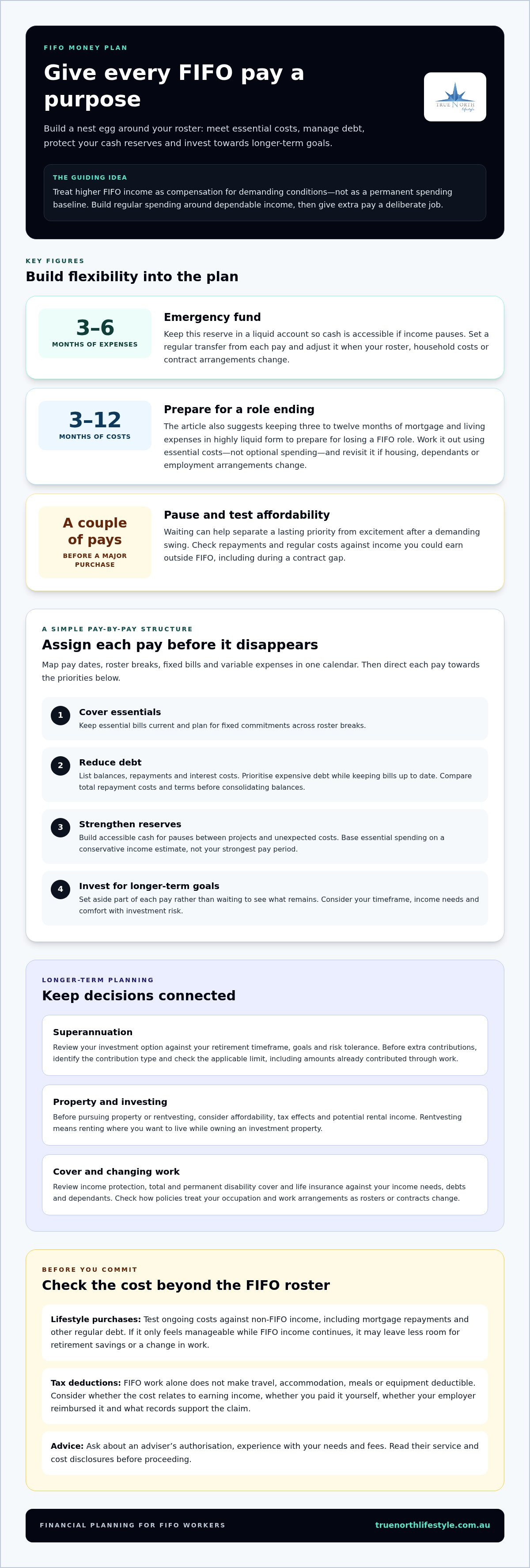
A FIFO income can build a nest egg when each pay has a clear purpose: cover regular costs, direct a portion towards savings or investment, and keep three to six months of expenses in a liquid emergency fund. Financial planning for FIFO workers in Sydney can organise these priorities around your roster, income and longer-term goals. Review your strategy regularly and adjust it as your circumstances change.
Higher pay can make it tempting to increase spending, but a plan helps turn income into lasting progress instead of relying on what remains at the end of the month. Practical cash-flow management can help you build savings and make considered decisions about investing, superannuation and life after FIFO.
Set a steady savings approach, keep lifestyle spending manageable and review your financial strategy as your goals evolve. A considered plan should fit your circumstances and help you make decisions with greater clarity.
Key Takeaways
- Build savings deliberately by setting aside part of each pay and keeping three to six months of expenses accessible for emergencies.
- Plan around the uncertainty of FIFO work, including roster changes, contract gaps and the financial impact of losing a role.
- Before a major lifestyle purchase, consider how repayments and regular costs would fit within a non-FIFO income.
- Review your strategy every six to twelve months and begin shaping your post-FIFO plans well before you’re ready to make a change.
How do I build a nest egg?
Give each FIFO pay a purpose: cover essential costs, reduce debt, build reserves and invest towards longer-term goals. Financial planning for FIFO workers in Sydney can organise these priorities around your roster and changing income.
Long-term wealth and financial security
Choose a clear goal and timeframe, then track progress against savings, debt and investment contributions. For example, set a target to clear a major debt by a chosen age, and review it when your work pattern changes. Financial planning for FIFO workers in Sydney may include retirement projections, tax strategies, superannuation reviews and portfolio advice. Ask an adviser about their authorisation, experience with your needs and fees, and read their service and cost disclosures before proceeding.
Debt management and emergency reserves
List each debt, its repayments and interest costs. Prioritise expensive balances while keeping essential bills current. Build an emergency fund of three to six months of expenses in a liquid account, so cash is accessible if income pauses. Schedule a regular transfer from each pay and adjust it when your roster, household costs or contract arrangements change.
Investment income and wealth building
Set aside part of each pay for investment instead of waiting to see what remains at month’s end. Consider your timeframe, income needs and comfort with investment risk when planning for life beyond FIFO work. Rentvesting means renting where you want to live while owning an investment property. Before pursuing property, consider affordability, tax effects and potential rental income.
Superannuation strategies and contributions
Review your super investment option against your retirement timeframe, goals and tolerance for investment risk. Before making extra contributions, identify the contribution type and check the applicable limit, including amounts already contributed through work. Limits depend on contribution type and current rules, so account for them when deciding what to contribute. A superannuation review can help align contributions and investment choices with your wider financial plan.
Treating extra FIFO income as a hardship allowance
Treat the higher income from FIFO work as compensation for demanding conditions, not as a permanent spending baseline. Rosters can change, contracts can end, and project-based work can leave gaps. Build your regular budget around dependable income, then give additional pay a deliberate purpose: reduce debt, strengthen reserves or invest for future wealth.
Keep your lifestyle sustainable if FIFO work stops. List fixed costs, including housing, debt repayments and household bills, then compare them with income you could earn outside FIFO. If a new vehicle or upgrade adds ongoing costs, consider whether those payments remain manageable during a contract gap. Waiting a couple of pays before committing can help distinguish a lasting priority from a temporary opportunity.
Tax deductions aren’t automatic for travel, accommodation, meals or equipment simply because you work FIFO. Consider whether each expense relates to earning income, whether you paid it yourself, whether your employer reimbursed it, and what records support the claim. If your employer provides flights or accommodation, those costs aren’t your out-of-pocket expenses. Consider only eligible costs you personally incurred.
Income protection, total and permanent disability cover, and life insurance are relevant considerations when work involves remote locations, unusual hours or limited access to traditional services. Review existing cover against your income needs, debts and dependants, and check how a policy treats your occupation and work arrangements. A changing roster or contract may alter the risks your plan needs to address.
For irregular income, base essential spending on a conservative estimate rather than your strongest pay period. Direct additional pay towards planned goals, and keep enough accessible cash to manage a pause between projects. Review interest costs on debts before directing surplus money elsewhere, and don’t assume a high-earning roster will last indefinitely.
Use a written plan to coordinate income protection, life cover, debt and investments. A risk management and portfolio sustainability approach can help assess how these parts fit together as FIFO work changes.
Managing FIFO cash flow and lifestyle spending
Make cash flow fit your roster. Map pay dates, roster breaks, fixed bills and variable expenses in one calendar, then assign each pay to those commitments. This shows what remains for discretionary spending before a break begins. A plan can also reveal upcoming obligations before you commit to lifestyle assets, rather than relying on a strong earning period to cover future costs.
Pause before a major purchase. Waiting a couple of pays can help distinguish a lasting priority from excitement after a demanding swing. Test the cost against income you could earn in a non-FIFO job, including mortgage repayments and other regular debt. If the purchase only feels manageable while FIFO income continues, it may leave less room for retirement savings or a change in work.
Some FIFO workers aim to buy a home or pay off debt within a couple of years. Set a target, then compare repayments with essential expenses and expected income across roster changes. If credit card debt is accumulating interest, consider consolidating it and paying it off as soon as possible. Compare the total repayment cost and terms before replacing several balances with one loan.
Keep three to twelve months of mortgage and living expenses in a highly liquid form, such as cash, to prepare for losing a FIFO role. Calculate the amount using essential costs, not optional spending. Review it when housing costs, dependants or employment arrangements change. This reserve can help cover bills while you assess your next step.
Salary packaging and novated leases can make ongoing commitments harder to manage if employment or income changes. Before agreeing, understand the payment structure, ongoing costs and what happens if your role ends or your roster changes. Treat any vehicle commitment as a debt obligation, and test whether it fits a non-FIFO budget.
When planning around FIFO life, separate today’s spending from longer-term goals. A clear cash-flow view makes it easier to balance home ownership, debt reduction and retirement plans without assuming higher FIFO earnings will last indefinitely.
Reviewing a financial strategy
A financial plan needs to keep pace with your situation, not just your original goals. Reassess it every six to twelve months, and after major changes such as a new contract, altered roster, home purchase or change in dependants. Compare actual savings, debts and investments with your plan. This review can show whether your current approach still supports your priorities and financial security.
Look beyond your current FIFO income. Physically demanding work may not suit every stage of life, and moving away from FIFO can reduce income. Test different work and lifestyle scenarios, including essential costs, savings goals and expected earnings. Financial planning for FIFO workers in Sydney can help you consider these choices together, rather than assuming today’s roster and income will continue unchanged.
A FIFO worker in the example paid off their home by age thirty-five, ahead of their goal to be debt-free by age forty. That progress raises a useful question: should extra repayments now go towards another goal? As your circumstances evolve, review the assumptions behind your plan and adjust your priorities.
Discuss your goals for five and 10 years’ time with a financial adviser. Start considering your post-FIFO career or lifestyle five to ten years ahead, leaving time to prepare for a possible change in earnings. Review how insurance, investments and superannuation connect with tax, accounting, lending, wills and estate planning. Financial planning for FIFO workers in Sydney should take account of how a change in one area affects the broader strategy.
At each review, record what has changed, which goals still matter and what action follows. Check progress against debt reduction, savings and retirement plans, then set a date to revisit the strategy. This keeps your financial plan active as your work and life change. Arrange a review of your financial strategy to consider how your goals and circumstances fit together.
True North Lifestyle: Retirement modelling & long-term projections
True North Lifestyle helps FIFO workers coordinate savings, superannuation and investment decisions into a long-term strategy. Retirement modelling and long-term projections can show how different income, spending and retirement choices may affect your financial direction. Consider this support when your roster, earnings or goals change, or when planning a transition away from FIFO work.
The strategy can also include superannuation review and optimisation, tax-minimisation strategies and bespoke portfolio construction. These help assess how your investments and super fit your timeframe, priorities and capacity for risk. The focus is a considered plan, not a one-size-fits-all assumption about FIFO income or retirement timing.
To explore how a tailored financial strategy could fit your circumstances, contact True North Lifestyle in Miranda, Sydney.
Shape the next chapter with a clear plan
Your next step is to turn a broad ambition into decisions you can revisit as work and life change. For FIFO workers in Sydney, financial planning can connect today’s choices with the future you want, whether that means more flexibility, a career transition or greater confidence about retirement.
True North Lifestyle offers retirement modelling and long-term projections, tax-minimisation strategies, and superannuation review and optimisation. These services can help you assess how your priorities fit together and where a considered adjustment may support your plans. Seek guidance when your goals or circumstances shift, or when you want a clearer view of the choices ahead.
Contact True North Lifestyle to discuss a financial strategy shaped around your circumstances. A thoughtful next step can make the path ahead feel more manageable.
Frequently Asked Questions
Paying More Tax Than Feels Fair?
A tax bill can feel unexpected when variable FIFO income, allowances or bonuses lift your annual earnings. Compare payslips with your year-to-date income and check whether withholding kept pace with changes in your roster. Keep records for work-related expenses you paid yourself, noting any employer reimbursements. A tax-focused financial review can help you understand how income, investments and superannuation affect your broader financial position.
What’s the best way to make my money work for me?
Match each dollar to a purpose and timeframe before choosing where it goes. Money needed soon for a planned expense should remain accessible, while longer-term funds can be considered against your investment horizon and comfort with fluctuations. For example, keep a home deposit goal separate from retirement investing. This makes it easier to see whether a decision supports your priorities or competes with them.
Your best financial tip?
Make important money decisions using a written plan, not the feeling of a high-pay swing. Choose a priority, such as reducing a loan balance or building a deposit, and define the next action you’ll take after payday. Record the decision and review it when your circumstances change. A simple written rule can help you stay consistent when roster patterns or earnings shift.
How should FIFO workers manage irregular income, allowances, bonuses and roster changes?
Separate dependable base pay from variable amounts, and avoid committing uncertain allowances or bonuses to ongoing bills. Check each payslip against your roster and employment terms, then update your cash-flow forecast when a shift pattern or contract changes. If a bonus arrives, decide its purpose before spending it, such as funding a one-off goal or strengthening your longer-term investment plan.
How can FIFO workers plan for a home deposit or mortgage in Sydney?
Set a deposit target based on the property and purchase costs you’re considering, then keep those savings separate from everyday spending. Before taking on a mortgage, test repayments against your household budget during a lower-income period, not only during a full FIFO roster. Include other loan commitments and property maintenance costs, so the purchase fits your wider plans.
How can FIFO workers budget for time off between swings and build an emergency fund?
Use your roster calendar to map pay dates against bills due during breaks, including travel, groceries and direct debits. Keep money for planned time off separate from unexpected costs, so a holiday or home project doesn’t use up your safety buffer. Review upcoming commitments before each swing ends, and adjust discretionary spending early if the next pay date or roster has changed.


