

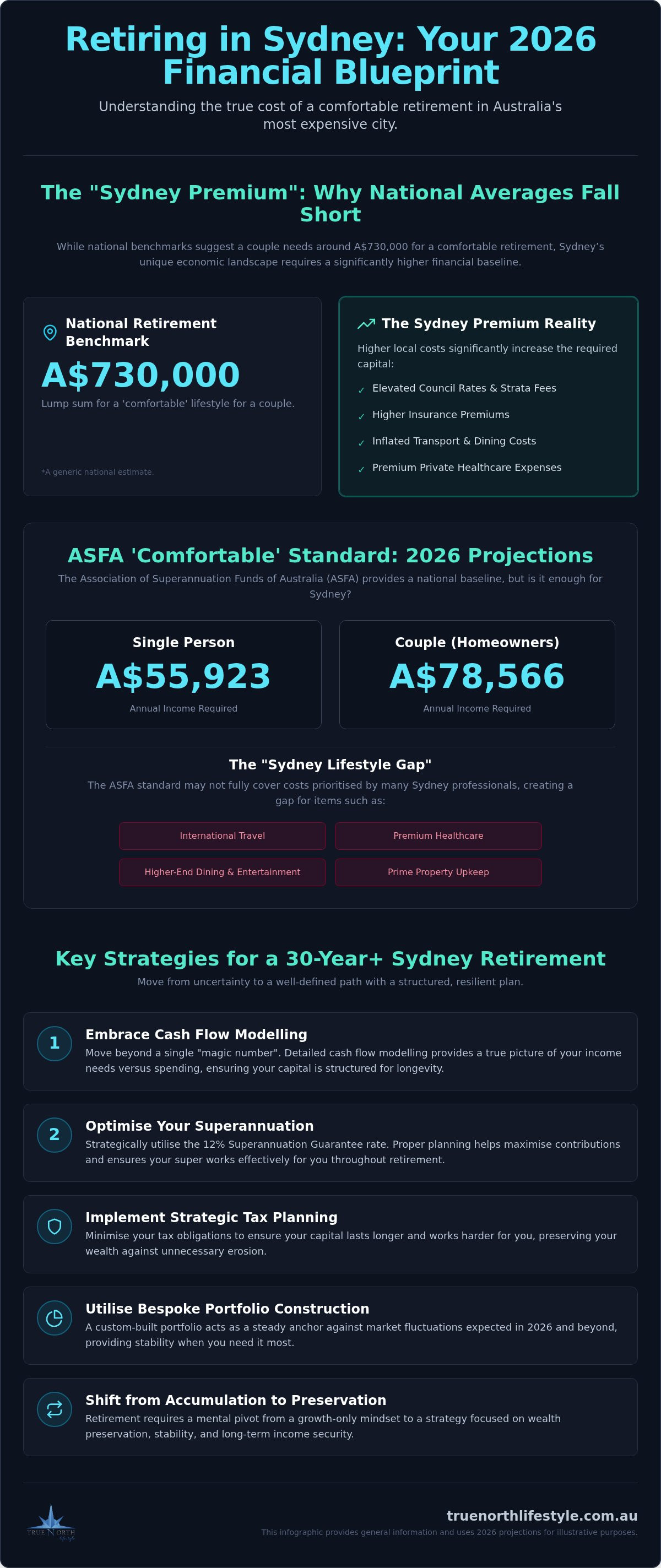
The Sydney premium is real. While national benchmarks suggest a couple needs approximately A$730,000 for a comfortable lifestyle, these figures often fail to account for the unique economic gravity of Australia’s most expensive city. It’s natural to feel a sense of trepidation when faced with conflicting data or watching market volatility impact your super balance as we head into 2026. You deserve more than a generic estimate; you require a clear, personalised understanding of exactly how much do I need to retire in Sydney without compromising your lifestyle.
We understand that true financial security isn't found in a single "magic number" but in a structured, resilient plan. This strategic guide provides the realistic benchmarks and bespoke strategies required to ensure your capital lasts thirty years or more. We will examine the latest 2026 ASFA standards, model the true cost of Sydney living, and outline precise methods to minimise tax while optimising your superannuation for long-term longevity. By moving from uncertainty toward a well-defined path, you can step into your next chapter with quiet certainty.
Key Takeaways
- Understand why the "Sydney Premium" requires a higher financial baseline than national averages to cover the city's elevated rates, insurance, and lifestyle costs.
- Discover why answering "how much do I need to retire in Sydney" requires moving beyond a single lump sum target toward comprehensive cash flow modelling.
- Learn how to utilise the 12% Superannuation Guarantee rate and strategic tax planning to help your retirement capital last 30 years or more.
- Recognise the value of bespoke portfolio construction in providing a steady anchor against the market fluctuations expected throughout 2026.
- Transition from the confusion of conflicting retirement figures to a personalised strategy that prioritises your unique lifestyle outcomes and wealth preservation.
The Sydney Retirement Premium: Why National Averages Often Fall Short
The Sydney premium is real. While national benchmarks provide a useful starting point, they frequently fail to capture the specific economic pressures of living in Australia’s global city. This premium represents the significantly higher baseline for council rates, strata fees, insurance premiums, and general lifestyle costs unique to New South Wales. For those asking how much do I need to retire in Sydney, the answer isn't a static number found in a generic report. It's a moving target influenced by the city's specific inflation rate and cost of living.
Many people fixate on the A$1 million "magic number." This figure can create unnecessary anxiety for some or a false sense of security for others. In the 2026 economic landscape, persistent inflation has shifted the goalposts for retirees. A million dollars today doesn't buy what it did a decade ago, particularly when you're competing with Sydney’s local cost pressures. We move beyond these generic national data points to focus on lifestyle-adjusted benchmarks that reflect your actual spending patterns.
The Reality of Sydney Living Costs in 2026
Sydney’s property market significantly impacts retirement liquidity. High home values often mean a substantial portion of your wealth is locked in your primary residence, leaving less available for immediate cash flow. Whether you're living in the Sydney CBD or the Sutherland Shire, costs for transport, dining, and private healthcare consistently outpace national norms. A comfortable Sydney retirement is one that preserves purchasing power against local inflation while allowing you to enjoy the city’s unique amenities. This requires a deeper level of modelling than a simple online calculator can provide.
Psychological Shift: From Accumulation to Preservation
Transitioning to retirement requires a mental pivot. Sydney investors, often accustomed to the aggressive growth of the local property market, can find it difficult to switch from a growth-only mindset to one of stability. This is where a structured wealth preservation strategy becomes essential. It replaces the stress of market timing with the quiet certainty of a managed outcome. Understanding the nuances of Superannuation in Australia is part of this journey, but it must be tailored to the Sydney context.
We validate your need for clarity. In a high-pressure environment like ours, knowing how much do I need to retire in Sydney isn't just about your super balance. It's about the confidence that your lifestyle won't be eroded by the very city you call home. By focusing on preservation and longevity, you can enjoy the fruits of your career without the constant fear of market volatility impacting your long-term security.
Benchmarking Your Future: ASFA Standards vs. the Sydney Reality
Benchmarks provide clarity. The Association of Superannuation Funds of Australia (ASFA) Retirement Standard serves as the national yardstick for measuring what a "modest" or "comfortable" lifestyle requires. In the June 2026 landscape, a comfortable retirement for a couple who owns their home is defined by an annual income of A$78,566, while a single person requires A$55,923. These figures are designed to cover basic health insurance, a mid-range car, and occasional local holidays. However, for many professionals asking how much do I need to retire in Sydney, these national averages often feel like a conservative floor rather than a realistic ceiling.
The Sydney reality is more complex. While the Age Pension remains an essential component of the Australian social fabric, its role has shifted. Understanding your Age Pension eligibility is crucial for long-term security; however, for those accustomed to a Sydney lifestyle, the pension typically serves as a supplementary safety net. It rarely covers the true cost of maintaining a home in the Sutherland Shire or the Eastern Suburbs while preserving the freedom to travel and dine at the level you've worked hard to achieve.
The ASFA 'Comfortable' Standard Adjusted for 2026
Projecting into 2026 requires accounting for cumulative CPI increases that have specifically impacted local services. The national "comfortable" basket misses the mark for Sydney professionals who prioritise international travel, premium healthcare, and regular home maintenance. A comfortable lifestyle in Miranda or Cronulla involves higher council rates and strata fees than a similar lifestyle in regional centres like Dubbo. We find that Sydney retirees often need to buffer these national benchmarks by 20% to 30% to maintain their standard of living without compromise.
Factoring in the 'Hidden' Sydney Costs
Maintaining a family home in Sydney's premium suburbs carries significant "hidden" costs. Beyond simple repairs, you must account for rising insurance premiums and the higher cost of trades in the metropolitan area. Additionally, out-of-pocket medical expenses in 2026 continue to rise, making robust private health cover a non-negotiable expense. Moving from generic figures to a personalised plan starts with bespoke retirement modelling that reflects your specific postcode and lifestyle goals.
| Requirement | ASFA National (2026) | Sydney Adjusted Est. |
|---|---|---|
| Annual Income (Couple) | A$78,566 | A$110,000+ |
| Annual Income (Single) | A$55,923 | A$80,000+ |
| Lump Sum (Couple) | A$730,000 | A$1,200,000+ |
Beyond the Lump Sum: Why Cash Flow Modelling Beats the 'Magic Number'
Strategy replaces guesswork. While most Australians fixate on a single "magic number" to fund their post-work years, this static approach often fails to account for the dynamic nature of life in an expensive city. Retirement planning in Sydney is a sophisticated process of continuous adjustment rather than a fixed destination. Relying on a lump sum target can be misleading because it doesn't reflect how your capital will actually behave when faced with fluctuating withdrawal rates and the specific inflation pressures of the New South Wales economy.
Understanding how much do I need to retire in Sydney requires a shift from accumulation to sustainability. A balance that seems substantial on paper can be quickly eroded if the sequence of investment returns is unfavourable in the early years of your retirement. We use research-driven projections to move beyond the foundational figures provided by the ASFA Retirement Standard. By modelling your income needs over a thirty year horizon, we replace the inherent anxiety of the unknown with a structured, logical path forward.
The Power of Longevity and Sustainability Modelling
Longevity risk is a significant concern for Sydney families. The fear of outliving your money is amplified when basic living costs sit well above the national average. Our modelling simulates various market scenarios to ensure your capital remains resilient until age 95 and beyond. We test the probability of your portfolio’s success against historical data and future projections, providing a level of transparency that a simple calculator cannot offer. Cash flow modelling is the Steady Navigator's primary tool for certainty, ensuring your lifestyle remains protected regardless of broader economic shifts.
Bespoke Portfolios vs. One-Size-Fits-All Super
Generic superannuation funds are designed for the "average" Australian, but your goals are rarely average. Off-the-shelf products often lack the tactical flexibility required to manage a sophisticated retirement income stream in a high-cost environment. Seeking bespoke investment advice in Sydney allows for the construction of a portfolio tailored to your specific liquidity needs and risk tolerance. This disciplined approach, supported by rigorous Investment Committee oversight, focuses on wealth preservation and income stability. It ensures that your superannuation works as a precise instrument for your lifestyle, rather than a blunt tool for the masses.
Strategic Levers: Superannuation, Tax, and the Age Pension in 2026
Control creates confidence. While the broader economy remains outside your influence, the strategic levers of your financial structure are within your grasp. In the 2026 financial year, the Superannuation Guarantee rate has reached its scheduled 12%. This increase provides a steady tailwind for those still in the workforce, but for those nearing the finish line, the focus must shift to contribution caps and tax efficiency. When asking how much do I need to retire in Sydney, many overlook how significantly tax planning for retirement Australia can lower your required capital baseline. By reducing the tax leakage from your annual income, you effectively increase the longevity of your nest egg without needing to save an extra dollar.
The Transfer Balance Cap remains a critical boundary. It limits the amount you can move into a tax-free pension account; any excess remains in an accumulation environment typically taxed at 15%. Navigating these limits requires precision. Even for self-funded retirees in Sydney’s premium suburbs, Centrelink optimisation shouldn't be ignored. Strategic structuring can often reveal eligibility for the Commonwealth Seniors Health Card or even a part-pension, providing valuable offsets to the city's high cost of living. These benefits act as a buffer, ensuring your private capital isn't the only pillar supporting your lifestyle.
Optimising Your Superannuation Structure
The right structure acts as a foundation. For couples, a re-contribution strategy can be used to equalise super balances, which helps both partners stay under individual Transfer Balance Caps and reduces potential tax for beneficiaries. Whether an SMSF or a high-performing Industry fund better supports your Sydney lifestyle depends on your need for control and the complexity of your assets. Accessing superannuation advice in the Sutherland Shire ensures that these high-level strategies are grounded in local, face-to-face expertise. We help you choose the vehicle that best aligns with your long-term liquidity requirements.
Reducing the 'Tax Leakage' in Your Portfolio
Efficiency drives outcomes. Utilising franking credits and tax-effective income streams can significantly boost your net returns, providing more spendable cash flow from the same amount of capital. For many Sydney homeowners, downsizing a large family home is a key part of the retirement transition. Managing the Capital Gains Tax (CGT) implications of such a move requires careful timing and modelling to ensure you maximise the proceeds available for your new lifestyle. To see how these levers can be applied to your specific situation, explore our bespoke retirement modelling services today.
Securing Your Horizon: How Professional Modelling Provides Certainty
Confidence requires a plan. The question of how much do I need to retire in Sydney is ultimately a personal one that only you and your trusted adviser can accurately answer. While national benchmarks provide a useful baseline, they cannot account for your specific aspirations or the unique lifestyle pressures of Australia’s global city. We move beyond generic estimates to provide strategic clarity. By utilising a fee-for-service model, we ensure our advice remains unbiased and focused solely on your outcomes. This structure replaces the inherent stress of "not knowing" with the quiet certainty of a documented, resilient plan.
Retirement in Sydney can be spectacular. It offers world-class amenities, vibrant communities, and a lifestyle that few other cities can match; however, enjoying these benefits requires a map that is as sophisticated as the environment itself. Transitioning from a state of uncertainty to one of confidence is the primary goal of professional modelling. It allows you to step into your next chapter knowing that the heavy lifting of testing and validation has already been done. With the right strategy, you can enjoy the fruits of your career without the constant shadow of financial doubt.
The Human Element: Clarity and Confidence
Numbers are just the beginning. True security comes from moving beyond the spreadsheet to focus on human outcomes: your travel plans, your time with family, and the legacy you wish to leave behind. During the fragile early years of retirement, managing "Sequence of Returns" risk is paramount. We provide the professional oversight needed to protect your capital from market volatility while ensuring your wealth transfer strategies are secure for the next generation. This holistic view ensures that your financial structure serves your life, rather than the other way around.
Next Steps for Sydney Pre-Retirees
Timing is everything. We recommend starting the modelling process at least five years before your target retirement date. This lead time allows for the implementation of tax-minimisation strategies and the optimisation of your superannuation balance before you transition to an income stream. When you visit our offices in Miranda or the Sydney CBD for a consultation, bring your current super statements, a summary of your assets, and a clear vision of your ideal lifestyle. We will work together to build a bespoke path forward. To begin your journey toward financial longevity, organise a retirement modelling session with True North Lifestyle and secure the horizon you’ve worked so hard to reach.
Navigating Your Path to Financial Longevity
Security is a process. We've explored why national averages often fall short of the Sydney reality and how cash flow modelling replaces the anxiety of the unknown. Determining how much do I need to retire in Sydney isn't about finding a single magic number; it's about building a resilient structure that preserves your purchasing power for thirty years or more. Our disciplined approach provides the logical grounding you need to make informed choices with quiet certainty.
We focus on specialised retirement modelling and bespoke portfolio construction to ensure your wealth remains protected against market volatility and local inflation. If you're ready to move beyond generic estimates, book a bespoke retirement modelling consultation with our Sydney experts today. With local offices in Miranda and the Sydney CBD, we're here to act as your steady navigator in a fluctuating environment. You've done the hard work of accumulation. Now, let us help you secure a spectacular future in the city you call home.
Frequently Asked Questions
What is the ASFA 'Comfortable' retirement standard for 2026?
For the 2026 financial year, the ASFA Comfortable Retirement Standard requires an annual income of A$78,566 for couples and A$55,923 for single individuals. These figures assume you own your home outright and enjoy relatively good health. While these national benchmarks provide a useful starting point, they don't account for the higher cost of living in Sydney, which often necessitates a larger buffer to maintain a truly comfortable lifestyle.
Is $1 million enough to retire in Sydney as a couple?
While a A$1 million lump sum exceeds the national ASFA benchmark of A$730,000, its sufficiency depends entirely on your specific lifestyle and spending habits. In Sydney’s high-cost environment, expenses such as council rates, insurance, and dining are significantly elevated. For many asking how much do I need to retire in Sydney, a million dollars may provide a solid foundation, but bespoke modelling is required to ensure this capital sustains your desired lifestyle.
How does the 2026 Superannuation Guarantee rate affect my retirement planning?
The Superannuation Guarantee rate reached 12% on 1 July 2026, providing a consistent boost to the accumulation phase of your retirement journey. This higher contribution rate helps build a more resilient nest egg, particularly for those still several years from retirement. However, relying solely on mandated contributions is rarely enough for a premium Sydney lifestyle. It's essential to pair this growth with voluntary contributions and strategic tax planning to maximise your final balance.
What is retirement cash flow modelling and why is it better than a calculator?
Retirement cash flow modelling is a sophisticated simulation that projects how your capital behaves across various market scenarios, rather than providing a simple, linear estimate. Unlike basic online calculators, professional modelling accounts for inflation, tax structures, and the timing of your withdrawals. This research-driven approach replaces guesswork with logic. It allows you to visualise your financial longevity and adjust your strategy before you reach the point of no return.
Can I still get the Age Pension if I own a home in Sydney?
Yes, you can still qualify for the Age Pension while owning a home in Sydney, as your primary residence is generally exempt from the Centrelink assets test. However, the value of your other assets and your total income will determine your eligibility and payment rate. Given high Sydney property values, many retirees find themselves "asset rich but cash poor," making strategic Centrelink structuring vital to maximise available benefits and supplement your private superannuation income.
How much does a financial adviser in Sydney charge for retirement modelling?
Financial advice fees for retirement modelling in Australia typically follow a fee-for-service structure, which ensures the advice remains unbiased and focused on your strategic goals. The cost varies based on the complexity of your financial situation, the number of entities involved, and the depth of the projections required. We recommend a consultation to discuss your specific needs, as this allows for a tailored quote that reflects the bespoke nature of professional modelling.
What is 'Sequence of Returns' risk and why should Sydney retirees worry about it?
Sequence of returns risk refers to the danger of experiencing poor investment returns during the early years of your retirement when you are also withdrawing capital. For Sydney retirees with high annual expenses, a significant market downturn at this stage can disproportionately deplete your nest egg. Managing this risk requires a disciplined portfolio construction strategy that prioritises wealth preservation and maintains sufficient liquidity to avoid selling assets during a market low.
How can I reduce the tax I pay on my superannuation income?
Minimising tax involves several strategic levers, such as transitioning your superannuation into a tax-free account-based pension once you reach preservation age and meet a condition of release. Strategies like re-contribution can help equalise balances between couples to stay under individual Transfer Balance Caps. Additionally, utilising investments with franking credits can provide tax-effective income. These methods help answer the question of how much do I need to retire in Sydney by making your existing capital more efficient.


