

The payment that preserves the most cash today may cost more over time. When weighing a Refundable Accommodation Deposit (RAD), Daily Accommodation Payment (DAP) or a combination, the right choice depends on more than the room price. If you’re looking for aged care RAD and DAP explained Sutherland Shire, start by considering how each option could affect accessible savings, household cash flow and longer-term retirement plans.
It’s understandable to feel unsure. A lump sum can tie up funds you may want to keep available, while ongoing payments can put pressure on regular income. Room prices also vary between Sutherland Shire aged care homes, so comparing offers means looking beyond the headline amount.
This guide explains how RADs, DAPs and combination payments work, and what to consider when comparing their impact on your finances. It also covers how assets, superannuation and Centrelink circumstances can inform the decision, and what to prepare for a financial advice discussion. Retirement modelling can bring these moving parts into one view, helping you assess the options in the context of your wider plans.
Key Takeaways
- Understand how RADs and DAPs differ, and why accommodation payments should be considered separately from day-to-day care fees.
- Learn how the room price, unpaid RAD amount and current MPIR affect DAP calculations.
- Compare lump-sum, daily and combination payments by considering cash flow, accessible savings and longer-term plans.
- Use a Sutherland Shire room-offer checklist to organise the details needed for a meaningful comparison.
- See how aged care RAD and DAP explained Sutherland Shire can fit into broader retirement modelling, including superannuation and Centrelink considerations.
Aged care RAD and DAP explained: what each payment covers
A room offer can arrive with several figures and unfamiliar terms, while a family is also weighing care needs, location and timing. Start by separating the accommodation cost from other aged-care fees. In the broader aged care in Australia system, the room payment relates to accommodation. It is not a general account for personal care, meals or other daily services.
A RAD is a lump-sum accommodation payment; a DAP is an ongoing daily payment towards accommodation. A resident’s means assessment helps determine whether they pay an accommodation price themselves or may qualify for government assistance with accommodation. The applicable rules can also depend on when the person entered care, so current information matters.
Keep the categories distinct. Accommodation payments are separate from day-to-day care fees and contributions, which may include charges for care and services. A RAD or DAP does not, by itself, cover every cost associated with living in residential aged care. Identifying which figure belongs to each category makes a room offer easier to assess.
What does a Refundable Accommodation Deposit cover?
A Refundable Accommodation Deposit (RAD) is a lump sum paid towards the accommodation price of a room. It is not a general care-fee account, and paying a RAD does not mean other fees disappear. The amount relates to the room’s accommodation price, while care-related fees are assessed separately.
“Refundable” describes the general nature of the deposit, not an instant or unconditional return of the exact amount paid. Refunds are subject to the rules that apply to the resident and the provider’s processes. Authorised deductions or other applicable requirements may affect the amount and timing. Review the written terms and current requirements before relying on a particular refund outcome.
A Refundable Accommodation Contribution (RAC) is a related term used in the accommodation-assistance system. Broadly, it refers to a contribution towards accommodation for a person whose means assessment places them in a government-supported arrangement, rather than a RAD paid as the accommodation price. The terms are not interchangeable: eligibility and the relevant payment type depend on the individual assessment and applicable rules.
What is a Daily Accommodation Payment?
A Daily Accommodation Payment (DAP) is paid over time rather than as one large lump sum. The Maximum Permissible Interest Rate (MPIR) is an input used to convert an unpaid accommodation amount into a daily payment. In general, a larger unpaid amount or a higher applicable rate means a higher DAP. Check the rate and calculation rules against current official guidance when reviewing an offer.
For families seeking aged care RAD and DAP explained Sutherland Shire, the distinction is practical: a RAD commits more money upfront, while a DAP creates an ongoing cash-flow commitment. The payment choice is one part of the picture. Understanding it clearly is the first step towards comparing options against savings, income and other aged-care costs.
How RAD and DAP calculations work under current aged-care rules
A room’s quoted accommodation price is the starting point, not necessarily the amount a resident pays upfront. A resident may pay it as a RAD, pay an equivalent amount over time as a DAP, or combine the two. With a combination, the unpaid portion of the accommodation amount is used to calculate the DAP. Compare both the room price and the effect each payment option could have on available funds and regular cash flow.
How is a DAP worked out from an accommodation amount?
The DAP calculation uses the unpaid RAD amount and the applicable Maximum Permissible Interest Rate (MPIR): multiply the unpaid RAD amount by the MPIR, then divide by 365. In plain English, the MPIR is the rate used to convert the outstanding accommodation amount into a daily payment. A higher unpaid amount or applicable rate generally produces a higher DAP.
For example, choosing a partial RAD leaves a smaller unpaid amount for the DAP calculation than choosing no lump sum. The MPIR can change, so a figure from an earlier quote may no longer reflect the current calculation. As at 1 October 2026, the MPIR is 8.51%; verify the applicable rate and calculation details against current My Aged Care guidance before relying on a figure.
Why can entry dates change the rules?
The aged-care funding changes that commenced on 1 November 2025 mean residents may be subject to different arrangements depending on when they entered care. My Aged Care distinguishes people who entered before that date from those entering on or after it. A friend’s experience or an older guide may not describe the rules that apply to your family member.
For residents entering from 1 November 2025, current guidance provides for RAD retention of 2% of the balance per year, for a maximum of five years. DAP indexation also applies twice a year for this group. The treatment of deductions, retention and refunds depends on the rules and the resident’s circumstances. Check current requirements and written payment information rather than assuming the whole balance will be returned unchanged.
For a clear starting point, compare the room price with the proposed RAD, any unpaid amount used to calculate the DAP, and the stated payment and refund terms. The Ageing Australia peak body offers broader aged-care industry context, while government sources provide payment rules and current figures.
For current accommodation-payment figures, use My Aged Care and Services Australia as the official reference points. This is especially useful when reading older material that predates the November 2025 changes. A considered retirement cash-flow projection can also show how different payment assumptions sit alongside household income and assets, rather than treating the accommodation choice in isolation.
RAD vs DAP vs a combination: compare the trade-offs
Each payment option shifts the balance between money paid upfront and payments made over time. A RAD may reduce ongoing accommodation payments but ties up a larger amount of capital. A DAP avoids a lump-sum payment, while a combination sits between the two. None is automatically best for every resident. The preferred option depends on personal circumstances and current rules.
| Option | Payment form | Cash-flow effect | Liquidity to consider | Questions to model |
|---|---|---|---|---|
| RAD | Lump sum towards accommodation | Generally reduces or removes the DAP for the amount paid | More savings are committed upfront; consider what remains accessible | Will funds still be available for planned spending and unexpected needs? |
| DAP | Daily accommodation payments | Creates an ongoing payment from available income or other funds | More capital may remain available initially, but regular outgoings continue | Can income support the payments over time, including if circumstances change? |
| Combination | Part RAD and part DAP | Balances an upfront payment with ongoing daily payments | Uses some capital while retaining more than a full RAD approach may leave | Does the reduced DAP justify using that portion of accessible funds? |
This comparison is a starting point, not a recommendation. Payment choices and their treatment are subject to applicable rules, including the resident’s circumstances and entry date.
When might a RAD, DAP or combination suit different priorities?
Consider two hypothetical households. One has sufficient accessible assets but wants to preserve regular income for ongoing expenses. Modelling a larger RAD alongside a partial payment could show the trade-off between capital used and the DAP remaining. Another has limited spare cash but a reliable income stream. Comparing DAP payments with expected income may clarify whether retaining more capital is worth the ongoing commitment. These are scenarios to test, not rules of thumb.
Individual outcomes depend on the room price, assets, income and applicable rules. A combination can balance lump-sum use with daily payments, where permitted, but it does not remove the need to assess liquidity and future cash-flow needs.
How can accommodation payments affect the wider retirement plan?
Look beyond the first payment. Consider accessible savings after any lump sum, the income available for regular expenses, planned purchases or travel, and family objectives such as preserving assets for a partner or beneficiaries. The time horizon matters too: a daily commitment can accumulate, while using capital upfront changes what remains available for other goals.
Superannuation and Centrelink circumstances can add important context, but the effect depends on individual details and current assessment rules. Compare how each payment scenario sits alongside income sources, assets and longer-term plans rather than assuming one choice produces a particular outcome. Reviewing superannuation advice in the Sutherland Shire may also help place the accommodation decision within the household’s broader retirement strategy.
For families researching aged care RAD and DAP explained Sutherland Shire, compare the same room offer under all available payment structures. A side-by-side view makes the trade-offs clearer and gives a financial advice discussion a practical starting point.
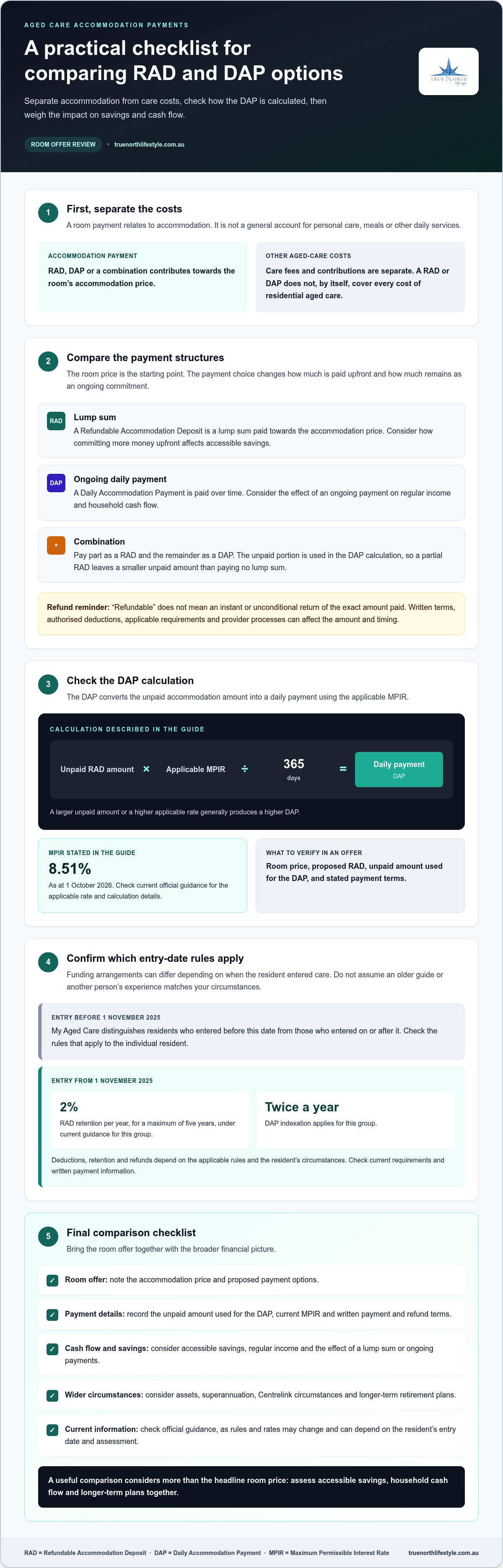
A Sutherland Shire checklist for comparing aged-care room offers
Room offers can look similar at first glance, but prices, payment terms and available options may differ between aged-care homes across the Sutherland Shire. A consistent checklist helps families compare like with like instead of focusing on one headline figure. Keep accommodation payments separate from care fees and other charges so each part of the decision remains clear.
What should families collect before comparing local room offers?
Build a file for each room under consideration. Use written information and My Aged Care’s provider information to support a local comparison, then note the proposed entry date and the resident’s assessment information. These details help establish which payment arrangements and rules are relevant. Keep copies together so family members can refer to the same material.
- Record the room price. Note the accommodation price for the specific room and any written explanation of the available payment options. Do not assume that a price or term at one home applies to another.
- Set out each payment scenario. Record the RAD option, the DAP option and any combination offered. For a combination, note the proposed lump sum and the daily payment calculated on the unpaid amount.
- Capture the terms. Keep the written information on payment timing, applicable rate assumptions, deductions, retentions and refund processes. Mark any figures that need checking against current official guidance.
- Separate other charges. Create a different line for care fees, contributions and other charges. This prevents accommodation costs from being mistaken for the full cost of residential care.
- Note the personal context. Record the proposed entry date, assessment details and relevant circumstances that may affect the resident’s applicable arrangements.
This organised view is particularly useful when comparing aged care RAD and DAP explained Sutherland Shire options. The local room price may vary, but the comparison method can stay consistent.
How can a family make the comparison more manageable?
Next, add the household’s financial picture. List accessible savings, regular income needs and near-term commitments such as home expenses or planned spending. Compare each payment scenario over a suitable planning period, noting how much capital remains accessible and how ongoing payments could fit the household budget. Avoid relying on a single month’s cash flow if the decision has longer-term effects.
Retirement planning in Sydney can help frame accommodation choices alongside future income and spending needs. A focus on wealth preservation strategies can also help families consider liquidity and longer-term priorities without assuming one payment structure suits everyone.
Bring the room information, assessment details and household figures together for a considered financial advice discussion. Explore retirement modelling for your aged-care payment decision to see how RAD and DAP scenarios can be compared alongside wider retirement plans.
Model RAD and DAP decisions with a broader retirement strategy
A RAD or DAP decision can affect more than the next payment. It may change how much capital remains accessible, how income is used and what funds are available for other priorities. Retirement modelling helps organise these moving parts by comparing payment scenarios alongside household income, assets and planned expenses. It can bring structure to a complex decision without suggesting there is one right answer for every family.
What can retirement modelling bring to the RAD or DAP decision?
Modelling can set out different possibilities side by side: paying a larger lump sum, meeting daily payments from income, or combining the two. Scenarios can include the room offer, available assets, income sources, household spending and relevant Centrelink circumstances. This helps show how each option may affect cash flow and accessible funds over a chosen planning period.
Projections depend on the information and assumptions used. They can inform a decision, but they cannot guarantee a particular financial result or Centrelink outcome. Centrelink rules and personal circumstances matter, so consider the assessment as part of the broader financial picture rather than inferring it from the payment choice alone.
Tax can also be relevant to how retirement income and assets are organised. Where it forms part of the discussion, retirement tax planning in Australia provides context for considering tax alongside the accommodation decision. True North Lifestyle’s retirement modelling, superannuation review and optimisation, and Centrelink structuring can bring these elements into a considered strategy.
For families seeking aged care RAD and DAP explained Sutherland Shire, the benefit of modelling is a clearer view of the trade-offs, not a promise of a particular outcome. The focus stays on what the household needs its money to do over time.
What to bring to a financial strategy discussion
A useful discussion starts with clear information. Gather the room offer, proposed entry date and available aged-care assessment information, then prepare a current overview of income, assets and superannuation. Include regular household commitments and planned expenses. These details help make comparisons more relevant to the resident’s circumstances and retirement priorities.
- The written room offer and payment options
- The proposed entry date and available assessment information
- A summary of income, assets and superannuation
- Regular expenses, upcoming commitments and family priorities
True North Lifestyle is based in Miranda and works with clients across the Sutherland Shire. If you’re ready to consider how an accommodation payment fits into the wider retirement picture, discuss your retirement strategy with True North Lifestyle.
Take your next step with a clearer retirement plan
An aged-care move can reshape more than the household budget. It can prompt important conversations about security, independence and the priorities a person wants their retirement savings to support. Rather than trying to settle every question at once, use the room offer and your family’s priorities to begin a considered discussion.
For anyone seeking aged care RAD and DAP explained Sutherland Shire, view the accommodation decision within the wider retirement picture. Retirement modelling can help explore how assumptions about income and assets sit alongside future plans. Superannuation review and Centrelink structuring can add relevant context, while recognising that projections inform decisions, not guarantee financial or government outcomes.
True North Lifestyle’s Miranda-based team can help you consider the decision as part of a broader retirement strategy, with attention to your circumstances and longer-term priorities. Discuss your retirement strategy with True North Lifestyle and take a measured step towards greater clarity and confidence.
Frequently Asked Questions
What is the difference between a RAD and a DAP?
A Refundable Accommodation Deposit (RAD) is paid as a lump sum, while a Daily Accommodation Payment (DAP) is paid daily. Both relate to accommodation, not day-to-day care fees. Depending on the resident’s circumstances and applicable rules, a combination may also be available. For a practical comparison, note the payment terms and quote date beside each option, then keep accommodation amounts separate from care charges in your records.
Can you pay part RAD and part DAP?
A combination payment may let a resident pay part of the accommodation amount upfront and meet the remaining amount through daily payments. The arrangement and calculation depend on the resident’s circumstances and current rules. Review the home’s written payment information and record the proposed lump sum and daily amount. Then consider whether accessible savings would still cover upcoming household expenses while income meets regular payments.
Is a RAD refundable when someone leaves aged care?
A RAD is described as refundable, but the amount and timing can depend on the applicable rules, any permitted deductions, the resident’s circumstances and the provider’s refund process. Do not plan on having the full amount available immediately. Review the accommodation agreement and current My Aged Care guidance. If the expected refund forms part of estate or household cash-flow planning, include different timing assumptions in that plan.
Can a RAD affect Age Pension eligibility?
A RAD may be relevant to a person’s wider financial assessment, but its effect on Age Pension eligibility depends on individual details and current assessment rules. Paying one does not automatically mean an entitlement will rise or fall. Families looking for aged care RAD and DAP explained Sutherland Shire should include the proposed payment in a broader financial projection and check the person’s circumstances directly with Services Australia.
Can you change from DAP payments to a RAD later?
A change may be possible, but it depends on the resident’s circumstances, provider arrangements and the rules that apply to their entry date. Before relying on a future switch, review the accommodation agreement and the written information about how a change would be handled. If flexibility matters, include a later RAD payment as a separate scenario in financial planning rather than assuming the terms or daily amount will stay unchanged.
Do RAD and DAP rules differ for people entering aged care before 1 November 2025?
Yes, My Aged Care provides separate information for some people who entered residential aged care before 1 November 2025. The entry date can affect which arrangements apply, including transitional details, so a general explanation may not fit every resident. Check the person’s entry date and circumstances against current official guidance before comparing payment terms. This is particularly important if relying on an older agreement or information prepared before the changes.


